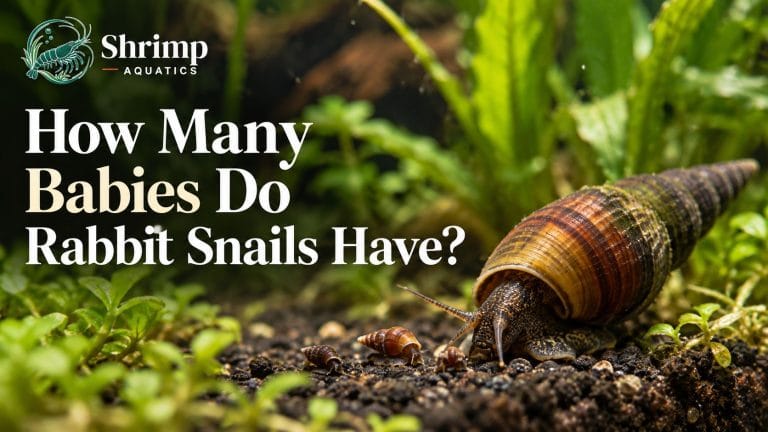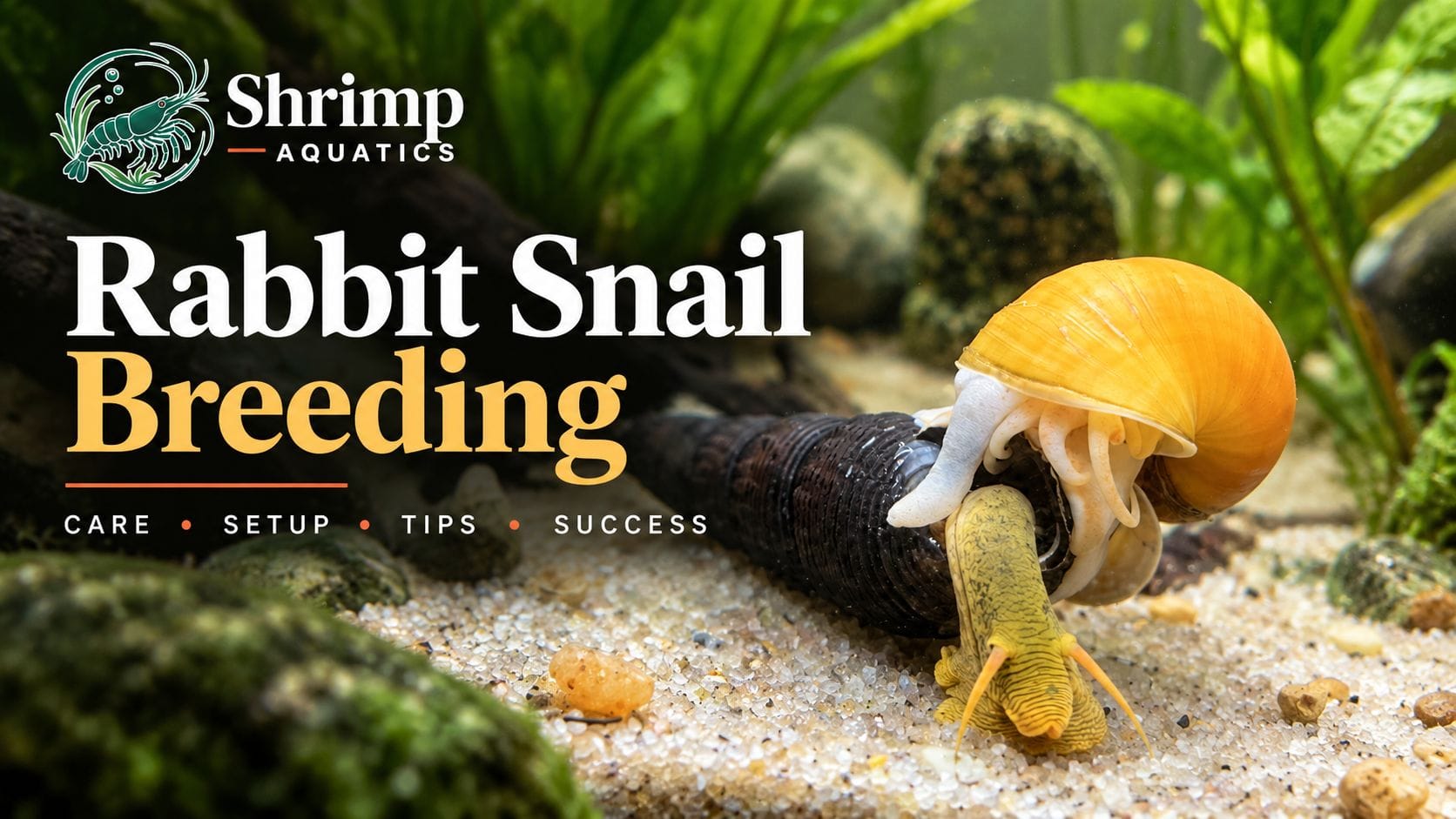
Yes, rabbit snails breed in a home aquarium, and you don’t have to do much to make it happen. Keep a small group in steady, warm, hard water with plenty to graze, and young turn up on their own. What you won’t get is a boom. These snails give birth to large, fully shelled babies, one at a time, about once a month per female. Births can keep arriving long after a male was last in the tank, which raises how long a rabbit snail stores sperm.
What you need to do to get rabbit snail babies
Very little beyond keeping them well. No conditioning period, no separate breeding tank, nothing to trigger. Rabbit snails carry their young inside the mother and release them as small, shelled snails.1 If your water is steady and the snails are grazing and growing, you’ve already done the work.
Start with a small group rather than one snail. Nobody has published whether a single rabbit snail can reproduce alone, and keepers work on the assumption that you need more than one. The mechanics behind it, a brood pouch and no visible eggs, are how rabbit snails reproduce. So if babies are part of why you’re buying, a group is the safe choice.
Then be patient. A group that is alive, grazing and slowly putting on shell a year in is a group doing well, whether or not you’ve spotted young yet. When young do appear, caring for baby rabbit snails asks for nothing new: the same water, covered intakes and no snail-eaters.
How many babies to expect, and how often
Expect slow: a female releases one young about every four weeks. First young from snails around a year old is a keeper estimate, and when rabbit snails start breeding shows how little is confirmed. Treat that age as a rough expectation, not a schedule. The same caution covers how long a female keeps producing young.
What is on record is what a female carries. A study that opened the brood pouch of two wild species found very different numbers:2
| Species | Embryos carried | Largest embryo |
|---|---|---|
| Tylomelania sinabartfeldi | 11-67 | 5.0 mm |
| Tylomelania hannelorae | 1-2 | 3.1 mm |
Those counts come from preserved museum specimens of two wild species, one from the Larona River and one from Lake Mahalona. They show what a female was carrying, not how many young leave at once, and they aren’t figures for any snail in the trade. Still, “one baby at a time” is true for some rabbit snails and far off for others. The snails sold in the hobby have no confirmed species, so you can’t know which end of that range yours sit at. That’s why we don’t promise a number. Why those counts differ so much between species is the whole of what’s known about how many babies rabbit snails have so far.
Is that tiny snail in your gravel a baby rabbit snail?
Almost certainly not. Rabbit snail babies are big from the start, already shelled and close to 2 cm in the species where they’ve been measured.1 Adults run from about 16 mm to about 82 mm depending on species.3 A swarm of 2 mm cones appearing in your substrate overnight is a different snail. Keepers usually point to the Malaysian trumpet snail, MTS.
If a baby’s color doesn’t match its parents, don’t read that as proof of crossbreeding. Our guide to the types of rabbit snails explains what the trade names can and can’t tell you.
Water and feeding that help rabbit snails breed
There’s no special breeding water. The water that keeps them healthy is the water they breed in: 79-86°F (26-30°C), pH 7.5-8.5, GH 4-8 dGH, KH 3-6 dKH, TDS 150-250 ppm and nitrate under 10 ppm. The full setup is in our Sulawesi rabbit snail care guide.
Three things help, and one common habit hurts:
- Keep GH and KH from sagging. A snail growing its own shell and carrying shelled young is spending minerals. In other snails, more calcium meant better shell growth and more eggs.45
- Keep a grazing surface growing. Rock and glass with a film on them are the food supply between feedings, and how little to add on top of that is covered under what rabbit snails eat.
- Keep the water steady. Hold the numbers above between water changes instead of letting them drift.
- Don’t turn up the heat or feed harder. No study links warmer water to more babies in these snails. Warm, alkaline water already makes ammonia more toxic, about tenfold per pH unit and roughly double for every 10 degrees Celsius.6 Extra food that isn’t eaten becomes that ammonia.
Choosing rabbit snails if you want young
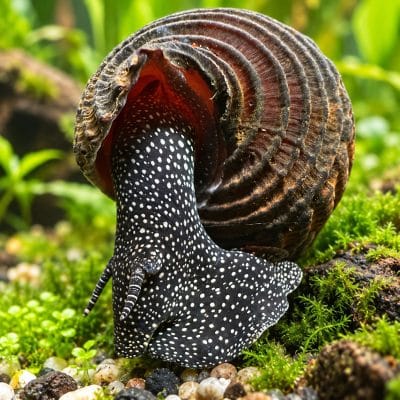
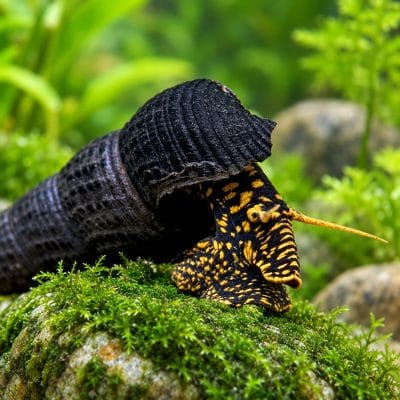
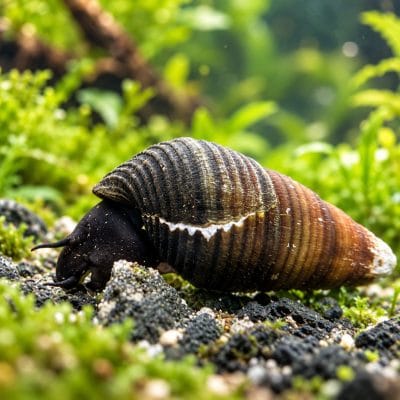
Every snail we sell is bred in our own tanks rather than collected from the wild. We keep four lines, all listed as Tylomelania sp..
All four want the same water, so pick on looks. If you plan to breed a line, keep it in its own tank so you know what you’re getting. The snail itself is moderate to keep. The tank is the demanding part: it should be mature, warm and alkaline, with grazing already growing before the snails arrive.
Shipping is a flat USD 120 per order to every country, and Shrimp Aquatics pays the duties and taxes the courier bills against the shipment. Once the courier collects the box, transit is normally 2-3 days. If snails arrive dead and you report it within 2 hours of delivery, we replace them under our live arrival policy; you cover shipping on the replacement box. Confirming your own import rules is part of ordering. We do not promise breeding, sex or the number of young from any order. You can see all four lines together in our Sulawesi snail range.
References
6 Sources
- Anatomy of an adaptive radiation: a unique reproductive strategy in the endemic freshwater gastropod Tylomelania (Cerithioidea: Pachychilidae) on Sulawesi, Indonesia, and its biogeographical implications, Biological Journal of the Linnean Society 85(4), 2005.
- Three new species of the freshwater snail genus Tylomelania (Caenogastropoda: Pachychilidae) from the Malili lake system, Sulawesi, Indonesia, Zootaxa 1852, 2008.
- Ueber die Molluskenfauna der grossen Suesswasser-Seen von Central-Celebes, Zoologischer Anzeiger 20, 1897.
- The effect of calcium and pH on Florida apple snail, Pomacea paludosa (Gastropoda: Ampullariidae), shell growth and crush weight, Aquatic Ecology 43, 2009.
- Effects of dietary calcium on growth and oviposition of the African land snail Limicolaria flammea (Pulmonata: Achatinidae), Revista de Biologia Tropical 56(1), 2008.
- Aquatic Life Ambient Water Quality Criteria for Ammonia, Freshwater (2013), U.S. Environmental Protection Agency, Office of Water, April 2013.
Ready to get started?
Shop our Sulawesi Snail collection
12 products available · Live Arrival Guarantee