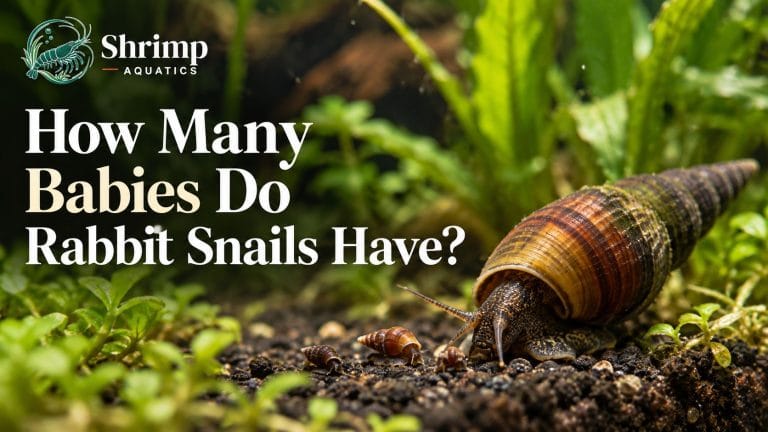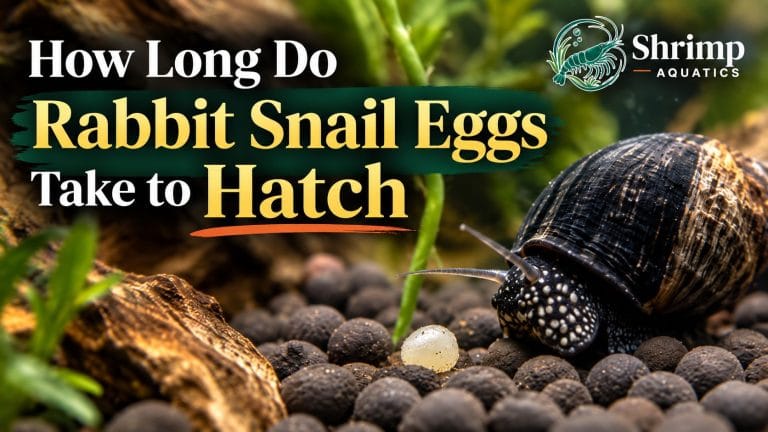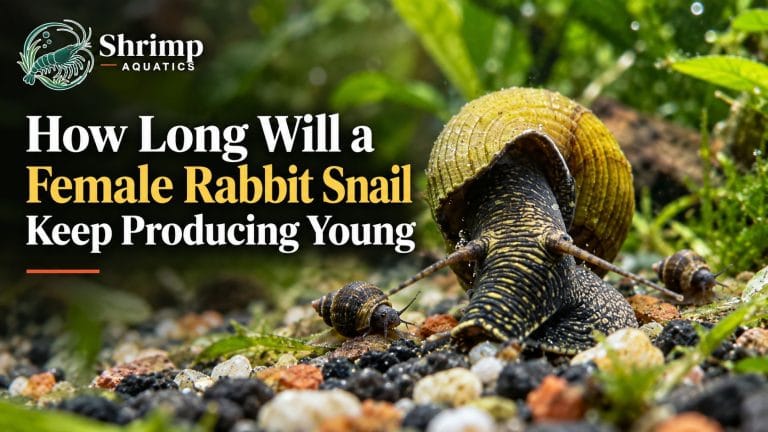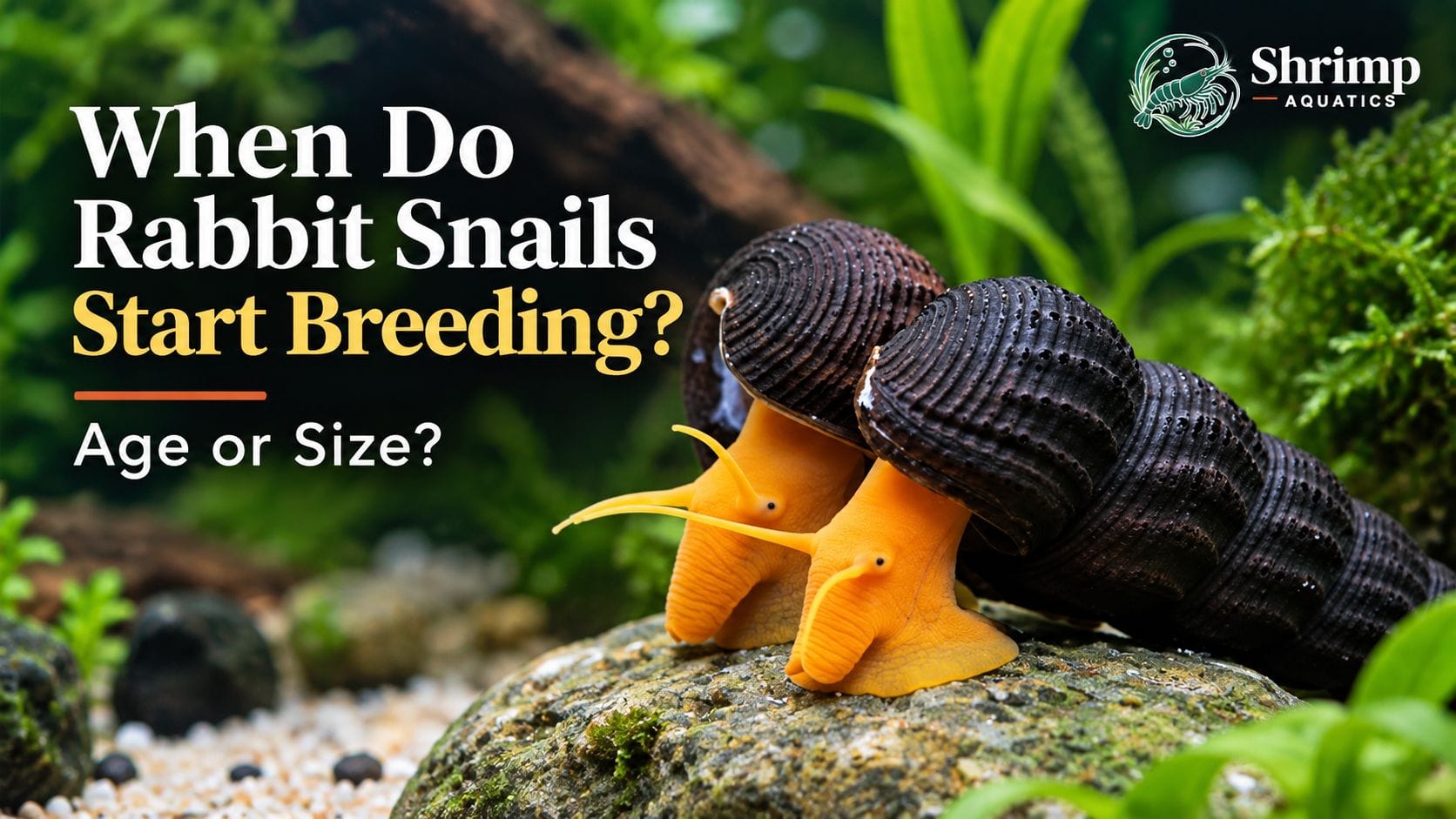
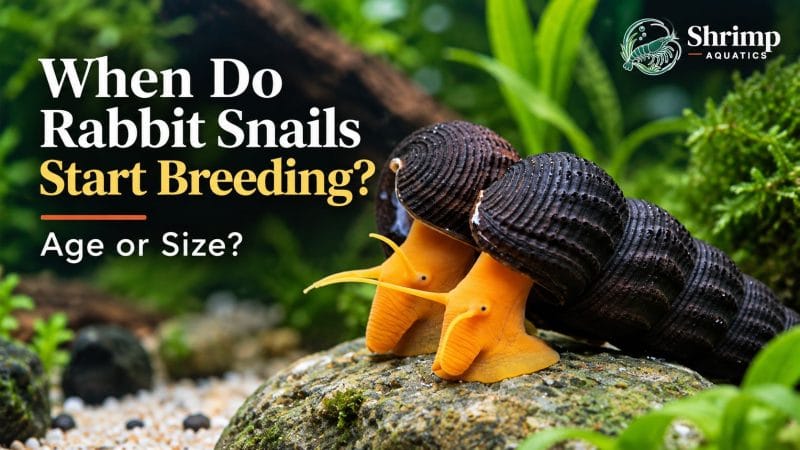
Keepers say at about 1.5 inches (3.8 cm) and close to a year old. That pairing comes from keepers watching their own tanks: no published study gives an age or a size at first breeding for any rabbit snail, including the Tylomelania sp. lines the hobby actually sells.
Where the rabbit snail breeding numbers you have read come from
Ask the question anywhere and you get the same two numbers back: they start breeding at about 1.5 inches (3.8 cm), and it takes close to a year to get there. That pairing turns up on care guide after care guide, and none of them cite anything. Keepers commonly report it.
That doesn’t make it wrong, and we’re not going to pretend it’s useless. It’s an estimate built from people watching snails in their own tanks, which is how a lot of hobby knowledge starts. But an estimate like that moves with temperature, with how much film is on the rock, and above all with which species is in the tank. What a small group needs to produce any young at all is rabbit snail breeding, once you stop chasing one age number. The genus is large and its members differ a great deal in adult size, and the animals in the trade are often not identified to species at all. That’s why ours are sold as Tylomelania sp. A number borrowed from someone else’s unidentified snail is a guess wearing a decimal point.
How close published research gets to a rabbit snail breeding age
Closer than you’d think, without ever landing on it.
Start with what breeding looks like in this genus, because it changes what you’re even looking for. Tylomelania holds its eggs and embryos inside a uterine brood pouch, produces embryos continuously, and releases young that are already shelled. In some species those juveniles are almost 2 cm long when they leave the mother, the largest known in any live-bearing snail.1 So there’s no clutch to find and no hatch date to count from. The first event you can actually put a date on is a juvenile appearing. The brood pouch behind that is explained in how rabbit snails reproduce.
Then there’s one real bound, and it belongs to one species. T. gemmifera, a rabbit snail that reaches the aquarium trade, is assessed by the IUCN Red List as Endangered, and its assessment lists a generation length of 2 years.2 Generation length isn’t a lifespan and isn’t an age at maturity. IUCN defines it as the average age of the parents of the current crop of newborns, and states plainly that it’s greater than the age at first breeding.3 Put those two together and you get a ceiling: in T. gemmifera, first breeding happens before two years of age. It’s a ceiling, not an answer, and it was never measured in an aquarium.
What two related snails suggest about maturing quickly
Brotia hainanensis sits in the same family as Tylomelania. In a Hong Kong forest stream, growth to sexual maturity took roughly 8.5 months.4 Melanoides tuberculata, a cousin one step further out, was already carrying eggs and developing larvae in its brood pouch at over 3.0 mm shell width, at 90 to 120 days old.5 Both are small stream snails, both were measured in the wild, and neither is a rabbit snail. Read them as a reason to think in months rather than in years, and don’t read them as numbers for your tank.
Can you tell when a rabbit snail is old enough to breed?
Not by looking at it. No published method exists for separating a mature rabbit snail from an immature one by eye, and no measured size threshold exists to check it against. A snail you cannot sex or age can still be carrying stored sperm, which is how long a rabbit snail stores sperm.
Biologists working on related snails hit the same wall and fall back on shell length. A 2024 field study of Tarebia granifera sorted every snail it collected into newborn, juvenile, adult and mature adult purely by shell length, with the boundaries taken from maturity sizes already published for that species, not from any measured age.6 It’s a workable stand-in when somebody has done the underlying work. For Tylomelania, there are no boundaries to borrow.
Which leaves the one unambiguous sign: a small, fully shelled snail turns up on the glass or in the rockwork.1 Because there’s no visible clutch beforehand, it usually arrives with no warning at all, and it’s often the first evidence a keeper has that anything in the tank has been breeding.
Don’t try to speed it up with heat
Running the tank at the top of the temperature range to push growth won’t buy you a date, and it leaves you less room when something slips. Steady is worth more here than fast. Steady water matters just as much on the way to full size, which is how long rabbit snails take to reach full size.
What decides how fast a rabbit snail reaches adult size
Growth, not the calendar. A rabbit snail matures when it’s big enough, and how long that takes is mostly down to water and food. So the question worth asking isn’t a number of months. Ask whether your tank is actually growing the animal. The targets for that water and that grazing layer are in Sulawesi rabbit snail care, which matters more to growth than any age chart.
Hold the range we keep to, and hold it steady: 79-86°F (26-30°C), pH 7.5-8.5, GH 4-8 dGH, KH 3-6 dKH and TDS 150-250 ppm. Drift is the part that matters. A tank that sits at 84°F and pH 8.0 all year is doing more for a growing snail than one that swings across the whole range every week.
Minerals deserve more attention than they usually get, because most of what’s growing is shell. The closest evidence comes from a different family: in a 12 week trial, apple snails reared at 500 mg/L calcium ended up significantly larger and with significantly harder shells than snails held at lower calcium concentrations.7 That’s an aquaculture study on a different animal, so don’t read a target off it. Read the direction. If your GH is sitting at the bottom of the range and your KH is drifting down between water changes, that’s the first thing to fix.
Then there’s the grazing layer. These snails feed by rasping mature biofilm, aufwuchs and algae off hard surfaces, and a clean new tank has none of that to offer an animal this size. If you added a young rabbit snail to a tank that’s still bare, building the film is the work, and supplemental food doesn’t substitute for it.
Should you buy rabbit snails expecting young?
Buy them because you want the animal. If you buy them on a breeding timetable, we can’t give you one, and neither can anyone else selling them. Every one of our Sulawesi rabbit snails is bred in our own tanks and not collected from the wild, and we still won’t promise breeding, sex, or the number of young from any order.
What we’d tell a friend is smaller than a plan. Get the tank mature and the water steady before the snails arrive. Feed the film, not the snail. Then leave them alone and stop counting months, because the only honest schedule anyone can offer you is the one where you notice a juvenile on the glass one morning and work backward from there.
References
7 Sources
- Anatomy of an adaptive radiation: a unique reproductive strategy in the endemic freshwater gastropod Tylomelania (Cerithioidea: Pachychilidae) on Sulawesi, Indonesia, and its biogeographical implications, Biological Journal of the Linnean Society, 2005.
- Tylomelania gemmifera, IUCN Red List assessment, IUCN Red List of Threatened Species, assessed 2018, published 2019.
- IUCN Red List Categories and Criteria, Version 3.1, Second Edition, IUCN Species Survival Commission, 2012.
- The life history of Brotia hainanensis (Brot, 1872) in a tropical forest stream, Zoological Journal of the Linnean Society, 1982.
- The life cycle, population dynamics and productivity of Melanoides tuberculata (Muller, 1774) in Hong Kong, Journal of Zoology, 1986.
- Distribution, abundance, population structures, and potential impacts of the invasive snail, Tarebia granifera in aquatic ecosystems of north-eastern South Africa, Ecology and Evolution, 2024.
- Growth and shell hardness of the apple snail Pomacea flagellata Say, 1829, reared at three calcium concentrations, PeerJ, 2023.
Ready to get started?
Shop our Sulawesi Snail collection
12 products available · Live Arrival Guarantee