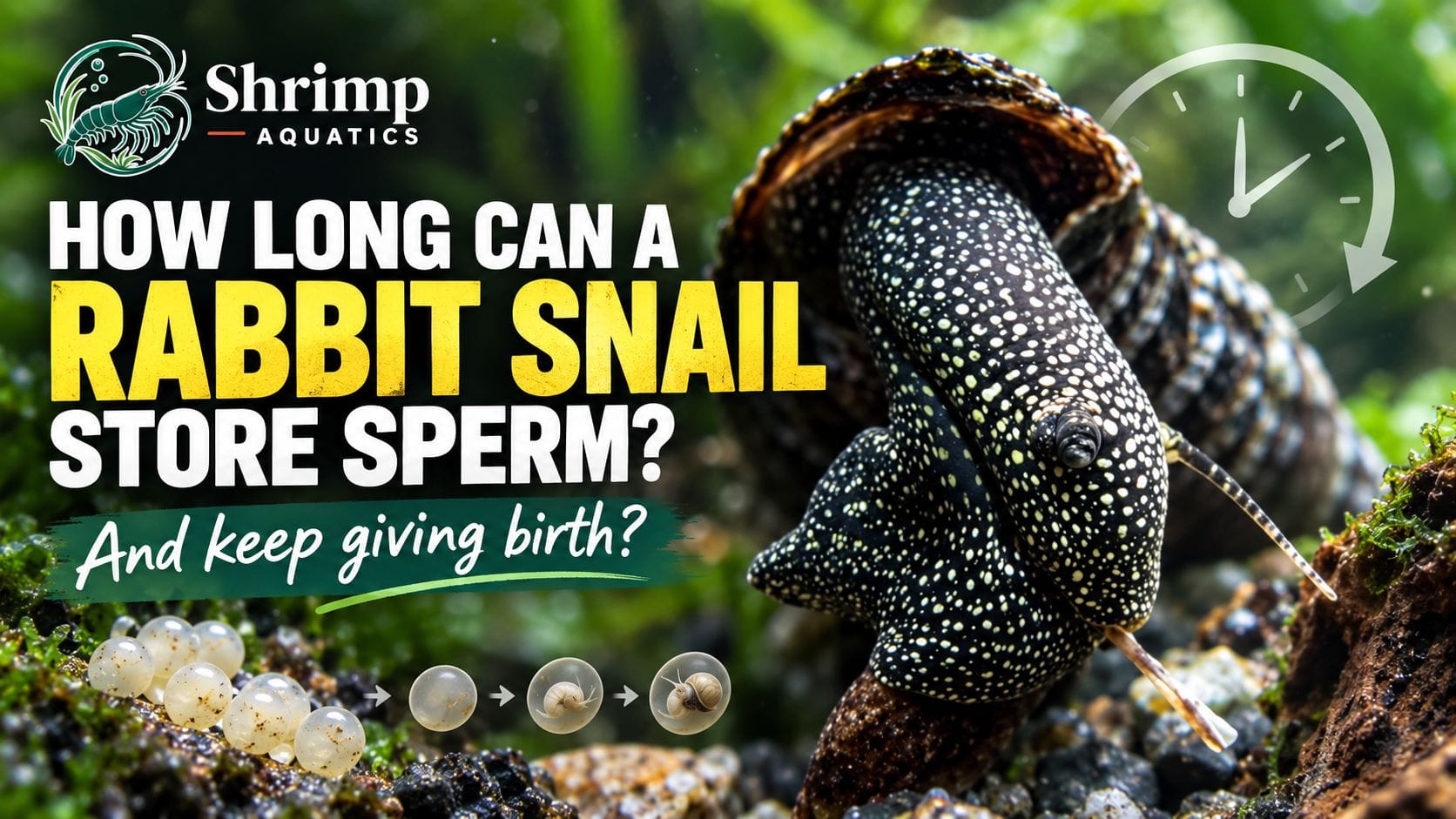
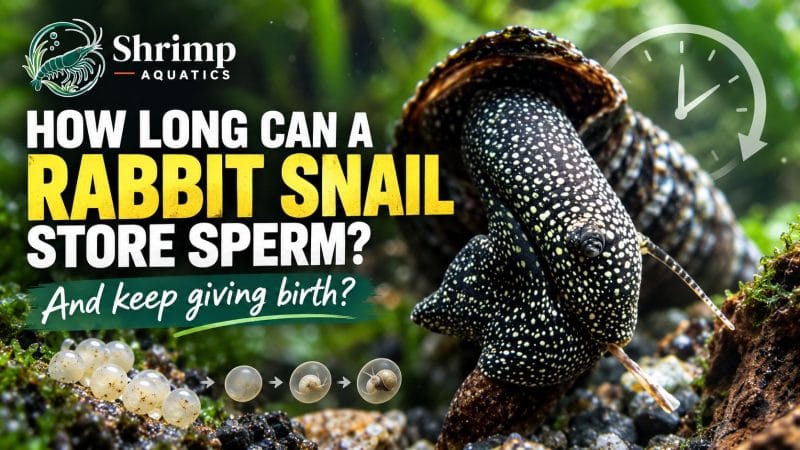
Keepers and care sheets usually say four to six months. Nobody has measured it in a rabbit snail (Tylomelania sp.), so treat that as a hobby figure rather than a number to plan around. What is published is that she holds developing young in a brood pouch, and that embryos are produced continuously.1 So a birth weeks after the last male left tells you very little about stored sperm.
Why a rabbit snail can give birth months after the male is gone
Two different things can produce that birth, and you can’t tell them apart from the outside.
The first is simply that she was already carrying young. Tylomelania keeps its eggs and embryos inside the pallial oviduct, which is modified into a uterine brood pouch. Embryos are produced continuously there, not in one synchronized clutch.1 In a Philippine relative in the same family, females were found carrying egg capsules, embryos and advanced juvenile stages together in the mantle cavity.2 Think of the pouch as a queue with animals at different stages in it. Emptying that queue takes time, and it takes no male at all. What gets that queue started, a small mixed group rather than one snail, is rabbit snail breeding. How long a female keeps it running with no new mating is how long a female keeps producing young.
The second is stored sperm, and the hardware for it is real. Published anatomy of this family describes a spermatophore bursa where a partner’s sperm package arrives, a sperm gutter, and a ridge working as a seminal receptacle.2 Across caenogastropods generally, those two structures do different jobs. The bursa holds a mass of unoriented sperm. The receptacle is muscular and lobed, with rounded chambers full of sperm lined up and ready.3 So yes, a female rabbit snail has somewhere to keep sperm.
The practical consequence is small and clear. Neither route gives you a countdown, and once the pouch is empty, more young need a mating.
What the four to six month sperm storage figure is based on
Keeper reports, and nothing else. Every care sheet and answer page in circulation puts the storage window at four to six months, with one juvenile every 4-6 weeks. Not one of them cites a study. They’re repeating each other. That doesn’t make the numbers wrong, but it does mean you shouldn’t plan a breeding project around them.
The closest real measurement sits in a different family. In the apple snail Pomacea canaliculata, females store sperm in a seminal receptacle. Stored sperm stayed able to fertilize for up to 140 days after mating, a figure that paper credits to earlier work.4 That’s about four and a half months, which is uncomfortably close to the hobby number for rabbit snails.
Read that carefully, though. Pomacea is an egg-laying snail from a different family, and the same study counted stored sperm fertilizing thousands of eggs.4 Our animal is a live-bearer from an ancient Sulawesi lake. The apple snail result shows that months of sperm storage is an ordinary thing for a snail to do. It says nothing about how long this snail does it.
Are the baby snails in your tank actually rabbit snails?
Check the size before you conclude anything about breeding. Rabbit snail juveniles leave the mother already shelled, and in some species they’re the largest juveniles known from any live-bearing gastropod, close to 2 cm long.1 A newborn looks like a small copy of the adult, and you’ll see it without looking for it. If what you have is a spreading population of pinhead snails, that’s a different animal that came in on a plant or some rock. The same size check decides whether a snail is even old enough, which is when rabbit snails start breeding.
Brood size is worth a second look too. One species described from the Malili lakes was recorded with 11-67 embryos in the pouch, reaching 5.0 mm across.5 So the tidy hobby picture of one baby at a time isn’t a rule for the genus. A female who produces two or three in a row hasn’t done anything strange.
When to add another rabbit snail instead of waiting for young
If your water is where it should be and she’s stopped producing, waiting longer is just a guess with no end date. A second snail is the only thing that actually changes the odds. There’s no published way to sex one of these, so a small group is how keepers end up with a pair. We don’t promise breeding, sex or the number of young from any order.
Before that, get the water right. These are the numbers we’d hold a rabbit snail tank to, and they’re the same warm, alkaline numbers the Sulawesi shrimp need.
| Difficulty | Moderate |
|---|---|
| Temperature | 79-86°F (26-30°C) |
| pH | 7.5-8.5 |
| GH | 4-8 dGH |
| KH | 3-6 dKH |
| Nitrate | We’d keep it under 10 ppm |
| TDS | 150-250 ppm |
| Substrate | Inert sand and hardscape, no pH lowering soil |
| Tank | Mature, with visible algae and biofilm on rock and glass |
That moderate rating is about the animal, not the tank. The snail is hardier than the Sulawesi shrimp it shares water with. The system is still the demanding part, and this is not a soft way into Sulawesi keeping or a snail for a young tank. If the tank is drifting on KH, steady that first. And don’t put a snail this size into a tank with no visible biofilm on the rock and glass, whatever you plan to feed it.
When you do add one, stock already living in this water is one less variable to manage. Everything the water needs to already be right is in Sulawesi rabbit snail care, so a new snail is not also fighting the tank. Every one of our Sulawesi rabbit snails is bred in our own tanks rather than collected from the lakes. Import rules for freshwater snails differ by country, so check what your own country requires before you order.
More questions about rabbit snails breeding alone
Can a single rabbit snail reproduce on its own?
No. It isn’t a hermaphrodite and it doesn’t clone itself. Most freshwater snails of this kind are separately sexed, with the male fertilizing the female by copulation.6 The published anatomy of this family shows females with a bursa that takes in a partner’s sperm package, and a receptacle that stores sperm.2 A lone female producing young is working through her brood pouch, stored sperm, or both.
Can you tell a male rabbit snail from a female?
Not by looking at the shell. There’s no published method for sexing Tylomelania from the outside, and the hobby sites that discuss it say the two sexes look identical. That’s the honest reason we’d suggest a group of three or four if young are the goal, instead of buying a pair and hoping.
References
6 Sources
- Anatomy of an adaptive radiation: a unique reproductive strategy in the endemic freshwater gastropod Tylomelania (Cerithioidea: Pachychilidae) on Sulawesi, Indonesia, and its biogeographical implications (abstract), Biological Journal of the Linnean Society 85(4): 513-542, 2005.
- Morphology, reproductive biology and molecular genetics of ovoviviparous freshwater gastropods (Cerithioidea, Pachychilidae) from the Philippines, with description of the new genus Jagora (publication record and abstract), Zoologica Scripta 32: 35-59, 2003.
- Refining molluscan characters: morphology, character coding and a phylogeny of the Caenogastropoda, Zoological Journal of the Linnean Society 137(4): 447-554, 2003.
- Microsatellite evidence for multiple paternity in non-native populations of Pomacea canaliculata (Caenogastropoda: Ampullariidae) in China, Aquatic Invasions 14(4): 656-666, 2019.
- Tylomelania sinabartfeldi Rintelen & Glaubrecht, 2008, sp. nov. (species treatment), Zootaxa 1852: 37-49, 2008.
- Freshwater Snails, Freshwater Mollusk Conservation Society.
Ready to get started?
Shop our Sulawesi Snail collection
12 products available · Live Arrival Guarantee