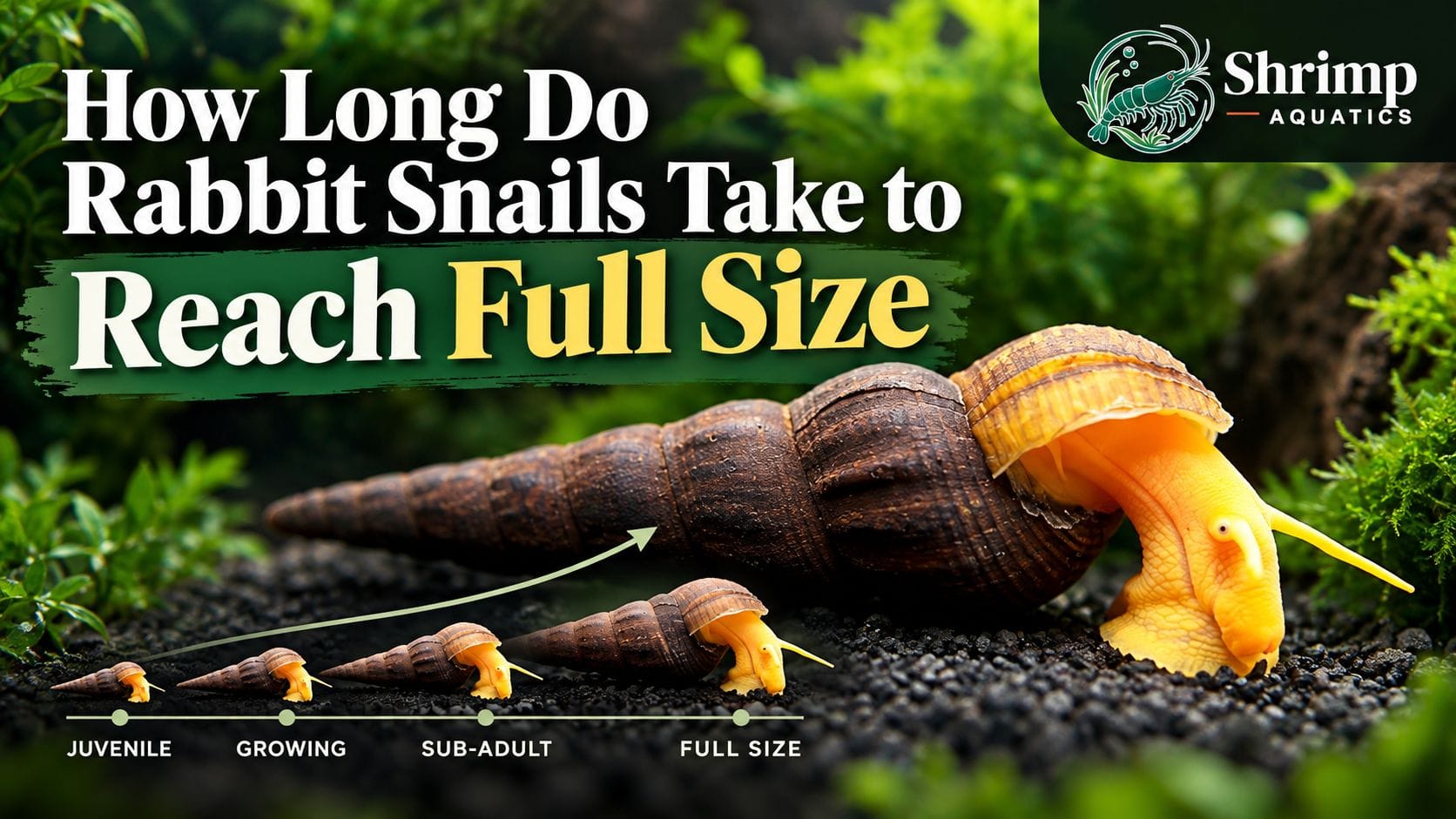

Plan on a year or more. Keepers report rabbit snails reaching breeding size at around a year old, and full size in the larger species comes after that. No published study has timed how long any rabbit snail (Tylomelania) takes to reach full size. What is on record is where growth starts and where it can end. Some species give birth to young almost 2 cm long,1 and the largest wild shells of the biggest lake species reach about 82 mm (3.2 in).2 How long your snail takes to cover that distance depends on its species and on the water you keep it in.
How big does a full-grown rabbit snail get?
It depends on which species you have, and the spread is wide. When Paul and Fritz Sarasin described the lake snails of Sulawesi in the 1890s, they measured the biggest shells they collected.2 Treat them as a ceiling for those species, not a size every snail reaches. What a trade name does and does not tell you about which species you have is in types of rabbit snails.
| Species | Longest shell measured |
|---|---|
| Tylomelania patriarchalis | 82 mm (3.2 in) |
| T. patriarchalis, Lake Towuti form | 62 mm (2.4 in) |
| Tylomelania gemmifera | 46.5 mm (1.8 in) |
You’ll see bigger adult sizes quoted in hobby guides. None of these measured shells comes close to them, so we wouldn’t plan around those figures.
Which row applies to your snail? Often you can’t know. Many rabbit snails reach the hobby under a trade name with no confirmed species behind it, and specialists count another 10-15 lake species that were still waiting for a formal description when they wrote.3 The lines we sell are listed as Tylomelania sp. for exactly that reason, and we don’t have a measured adult size for any of them yet.
How big is a baby rabbit snail at birth?
Bigger than most people expect. Rabbit snails don’t lay eggs. The female keeps her developing young in a brood pouch and feeds them there, so each one comes out with its shell already formed, and in some species it’s almost 2 cm long at birth.1 The Sarasins found an unborn young 15 mm long with eight whorls inside a Lake Towuti snail, and one of 6 mm with six whorls inside T. gemmifera.2 Telling a newborn from a pest snail by its size and head is baby rabbit snail identification.
So a newborn of a large species can start life at roughly a quarter of the longest adult shell of its kind. It also means a small snail in your tank could be a young one of a big species or an adult of a small one. Size alone won’t tell you which.
Is there any measured growth data from rabbit snail relatives?
Only a little, and none of it comes from a rabbit snail. The nearest is Brotia hainanensis, a snail in the same family, studied wild in a Hong Kong forest stream, where growth to sexual maturity took about 8.5 months.4 That’s a different genus in a stream with seasonal floods. It shows how fast one relative can grow up, not how fast yours will in a glass tank. The keeper estimates for breeding size get the same treatment in when rabbit snails start breeding.
Keeper guides often give a neat timeline, down to the month, for breeding size and full size. We haven’t found one that rests on measured snails. We’d read any of them as one keeper’s tank, not a schedule for yours. A female giving birth tells you she’s mature. It doesn’t tell you how old she is or whether she’s done growing.
How can you tell whether your rabbit snail is still growing?
Watch the lip of the shell opening, not the tip. New shell is added at that edge, so if the lip keeps extending over the months, your snail is still growing. Unlike a shrimp, it never sheds that shell: rabbit snail shells grow with the snail for life.
Don’t read much into a worn tip. In the original descriptions, the upper whorls of wild adults were mostly eroded from the third whorl on, and some snails collected alive had the ribs on their upper whorls worn away completely.2 A scarred apex on an adult is expected. On its own, it isn’t a sign your water is wrong. Fresh erosion at the opening edge, where the snail is actively growing, is different: that’s your cue to test pH, GH and KH.
Can you work out your snail’s age from its size? Not reliably. Researchers who study a related freshwater snail sort animals into newborn, juvenile, adult and mature adult by shell length, which places a snail in a life stage without giving its age in months.5 Try it with yours. You’ll get a stage, not a birthday.
What in your tank can hold back a rabbit snail’s shell growth?
Unstable or soft, acidic water, and a tank without enough to graze. Keep your rabbit snail in the same water as Sulawesi shrimp: 79-86°F (26-30°C), pH 7.5-8.5, GH 4-8 dGH, KH 3-6 dKH and TDS 150-250 ppm. Keeping KH from drifting matters most, because it’s what stops pH sliding down. Holding those numbers steady is the day to day work in Sulawesi rabbit snail care.
Why does the chemistry matter for growth? The evidence comes from apple snails, a different family. Florida apple snails held in water very low in calcium with pH below 6.5 grew the least, and their shells eroded and lost strength.6 In another apple snail, water with more dissolved calcium produced faster shell growth and harder shells, and the authors note that these snails draw most of their shell calcium straight from the water.7 That gives no rabbit snail threshold. The direction is clear enough, though: steady, mineralized water first, and supplements only as a top-up.
Food is the other half. These snails graze the film of algae and biofilm on rock and glass, so add one only once that film is visible. Prepared food won’t make up for a tank that hasn’t matured. A snail this size also counts toward the grazing load, so a tank that feeds a colony of shrimp may not feed a growing snail as well.
You may wonder whether a warmer tank grows a bigger snail faster. Don’t push the heater past 86°F (30°C) chasing size.
What size rabbit snail should you expect when you order one?
Expect a snail that may still have growing to do, and plan the tank for an adult. Every snail in our Sulawesi snail range is tank-bred by Shrimp Aquatics, not collected from the wild. We don’t promise the size a snail will reach, how fast it gets there, or whether it will breed. A snail bought today will be with you for years, which is why how long rabbit snails live matters when you plan the tank.
Read the names the same way. The “Mini” in Mini Tylo Poso rabbit snail is a trade name, not a promise of a small adult, and “Poso” isn’t a confirmed lake of origin.
References
7 Sources
- Anatomy of an adaptive radiation: a unique reproductive strategy in the endemic freshwater gastropod Tylomelania (Cerithioidea: Pachychilidae) on Sulawesi, Indonesia, and its biogeographical implications (abstract), Biological Journal of the Linnean Society 85(4): 513-542, 2005.
- Materialien zur Naturgeschichte der Insel Celebes, Band 1: Die Süsswasser-Mollusken von Celebes, P. Sarasin and F. Sarasin, C. W. Kreidel’s Verlag, Wiesbaden, scanned by the Internet Archive.
- Freshwater snails of Sulawesi: a brief overview, T. von Rintelen, Sulawesi Keepers, undated.
- The life history of Brotia hainanensis (Brot, 1872) (Gastropoda: Prosobranchia: Thiaridae) in a tropical forest stream (abstract), D. Dudgeon, Zoological Journal of the Linnean Society 76(2): 141-154, 1982.
- Distribution, abundance, population structures, and potential impacts of the invasive snail, Tarebia granifera in aquatic ecosystems of north-eastern South Africa, R. Gerber and others, Ecology and Evolution, 2024.
- The effect of calcium and pH on Florida apple snail, Pomacea paludosa (Gastropoda: Ampullariidae), shell growth and crush weight (abstract), Aquatic Ecology 43: 1085-1093, 2009.
- Growth and shell hardness of the apple snail Pomacea flagellata Say, 1829, reared at three calcium concentrations, PeerJ, 2023.
Ready to get started?
Shop our Sulawesi Snail collection
12 products available · Live Arrival Guarantee