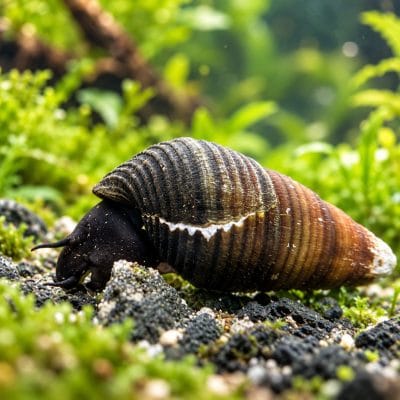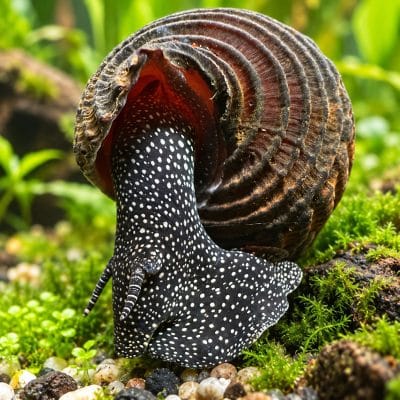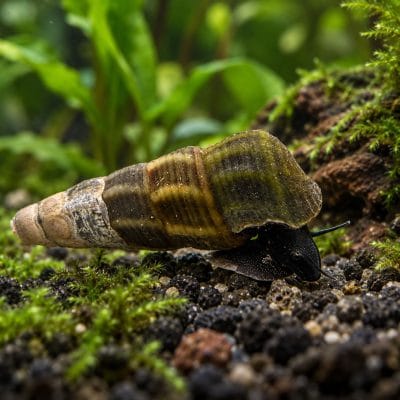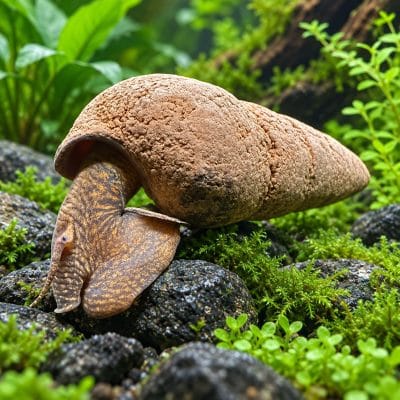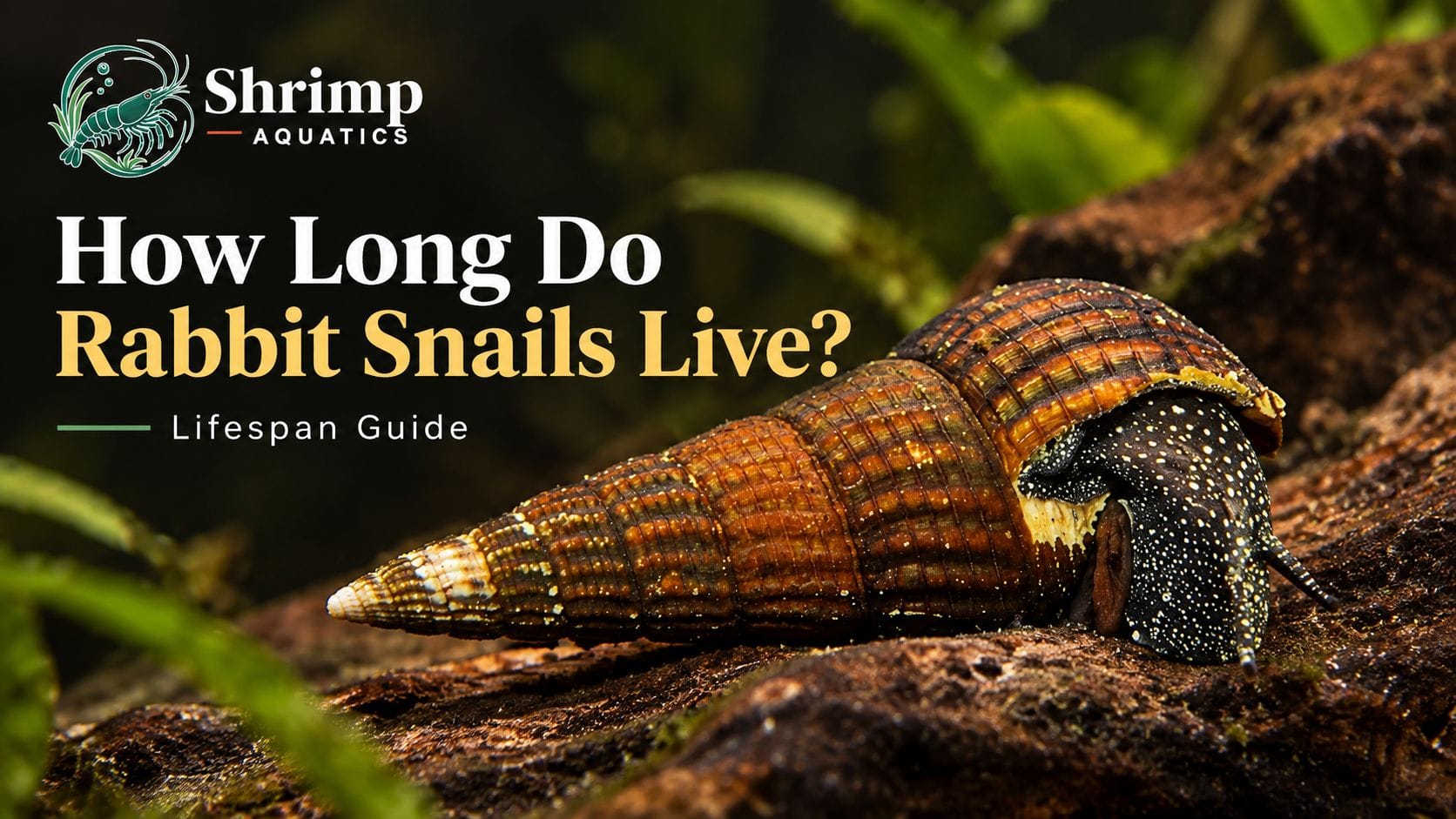
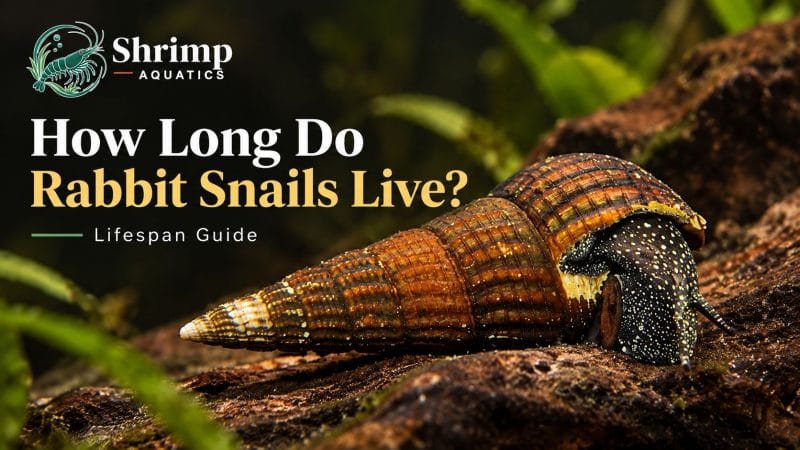
Plan on several years. Care sites and keepers mostly put a rabbit snail’s lifespan at about 1 to 5 years, and the highest figure in circulation is ten. No study has measured it, so every one of those numbers is keeper experience rather than a fact about your snail.
The most specific one comes from Sulawesi Keepers, a conservation group, which says these snails can live up to ten years in an aquarium.1 Other keepers and care sites put it far lower. So what’s in circulation runs from a few years up to about ten, with no study behind any of it. Our advice is to plan for years, not months. In keeper experience this is a long-term animal, and the tank you build for one should still be running steadily three years from now. If you are weighing that commitment against another snail, rabbit snail vs mystery snail sets the two side by side.
Why the lifespan numbers for rabbit snails disagree
Because there is no accepted way to read a rabbit snail’s age from its shell or its body. The field work on its relatives doesn’t try: a 2024 study of Tarebia granifera, a related freshwater snail, sorted wild populations into four life stages by shell length alone.2 No growth line, ring or other age marker was counted. Size classes stand in for age; they don’t measure it.
So the years you see quoted are experience, honestly meant and unmeasured. One rabbit snail number does carry an official stamp, and it still isn’t a lifespan. The IUCN assessment of Tylomelania gemmifera, a wild Sulawesi species, lists a generation length of 2 years.3 IUCN defines that as the average age of the parents of the current cohort, longer than the age at first breeding and shorter than the age of the oldest breeder.4 It tells you roughly when snails in that wild population are producing young. It says nothing about how long one lives, and nothing about the snails we sell. Whether your snail belongs to a listed species at all is a separate question, worked through in are rabbit snails endangered.
What shortens a rabbit snail’s life in your tank
You can’t set a lifespan, but you can take away the things that end one early. They come down to the shell, the water, and what you let into the tank with the animal. If your system isn’t built for these numbers yet, sort that out through Sulawesi rabbit snail care before you order anything.
| Temperature | 79-86°F (26-30°C) |
|---|---|
| pH | 7.5-8.5 |
| GH | 4-8 dGH |
| KH | 3-6 dKH |
| TDS | 150-250 ppm |
| Nitrate | under 10 ppm |
Hold the minerals that keep the shell hard
The shell is what soft, acidic, mineral-poor water takes away first. In the Florida apple snail, a different snail family, the smallest shell growth and the visible erosion came from low calcium combined with low pH.5 In another apple snail, reared at three calcium levels, more dissolved calcium gave faster shell growth and harder shells.6 That species draws most of its shell calcium straight from the water. Neither animal is a rabbit snail, and neither study hands you a threshold for one.
So the answer is the water, not a supplement. Hold GH 4-8 dGH and KH 3-6 dKH. Test before a water change as well as after, because that is where most tanks let hardness sag unnoticed. Plenty of keepers drop cuttlebone or crushed coral in as insurance; we’d fix the water first and treat the rest as habit.
Ammonia bites harder in warm, alkaline water
Ammonia has to read zero, and here it matters more than in most tanks. Why? Only part of the ammonia in water is the toxic un-ionized form. That share rises about tenfold for each pH unit, and roughly doubles for each ten degrees Celsius of warming, in fresh water generally.7 Rabbit snail water is warm and alkaline. The same reading on your test kit carries more of the dangerous form here than it would in a cool, soft tank. A snail does not belong in a tank that is still cycling.
Keep copper out of the tank
No copper, in any amount you were thinking of. In one laboratory study of a related freshwater snail, copper was the most toxic of eight metals tested.8 That’s a different family from Tylomelania, and it gives no safe level, which is why we won’t offer you one. Read the ingredients on fish medications, algaecides and plant fertilizers before any of them goes near the water. Treat a sick fish somewhere else.
Hold the temperature steady inside the range
Keep the tank at 79-86°F (26-30°C) and leave it there. You will read that warm water burns a snail out faster. We haven’t read a study that shows that for rabbit snails, so we’re not going to tell you it. What we’d avoid is the lurch: a failed heater, a big cold top-up, a summer spike in a room with no air conditioning. Match replacement water to the tank before it goes in.
An injured or frightened snail can stop eating
Keepers report that a rabbit snail which has been dropped, knocked about or badly startled can shut its trapdoor and stay in for days. It stops feeding and dies of that instead of anything in the water. That’s a keeper report and not a study, but it is the one risk here your own hands control. If yours has been closed up for a while, work through rabbit snail not moving before you assume it is dying of old age.
How old is your rabbit snail, and can its size tell you?
You can’t tell, and size won’t help. Nothing on the outside of a rabbit snail gives you a year count, and the two features keepers reach for both fail.
Size is the first. Described Tylomelania species differ enormously as adults, from roughly 16 mm of shell to roughly 82 mm by species in the original scientific descriptions. A big snail may only mean you bought a big kind. Ours are Tylomelania sp. with no measured adult size of their own. Which named form you have is worth settling before you guess at its age, and types of rabbit snails is where those trade names get sorted out.
Keepers also say the shell keeps growing for the whole of the animal’s life, which would make the biggest snail in your tank the oldest. How fast that growth runs in the early years is covered in how long rabbit snails take to reach full size.
The worn tip is no better as a clock. The 1897 Sarasin monograph on Sulawesi describes wild adults of these snails with the upper whorls mostly eroded away, including three taken alive whose ribs had worn off completely.9 A blunt, scarred apex on an adult is ordinary, and not by itself a sign that something is wrong with your water. Fresh erosion at the growing edge of the shell is the one worth acting on. That sends you back to hardness and pH.
When rabbit snails reach breeding age, and why that isn’t a lifespan
Keepers commonly report first young from snails somewhere around six months to a year old. That’s a keeper report.
The nearest published figures belong to relatives. Brotia hainanensis, the same family as rabbit snails but a different genus, reached sexual maturity in about 8.5 months in one Hong Kong forest stream.10 Mortality after maturity ran high there because of seasonal floods. In a second wild Hong Kong population, this time a related ditch-dwelling snail, few individuals survived to a second breeding season.11 Wild snails are taken by floods and predators, so that turnover says little about a heated tank with a lid on it. Neither study puts a number on how long an animal can live.
Breeding age tells you a snail is mature and nothing else. If young are what you’re after, the brood figures quoted around the hobby deserve the same skepticism as the lifespan ones, and rabbit snail breeding walks through them.
Buying rabbit snails for a tank that lasts years
Everything in our catalog is bred or propagated in our own tanks rather than collected from the wild, and that goes for the Sulawesi snails as much as the shrimp. What we can’t tell you is how old one is. We don’t know the age of a snail we ship, and we won’t promise you a number of years out of it.
So judge the tank instead of the animal. A snail you hope to keep for years needs water that is still steady in year three. That is the demanding half here: the snail is moderate to keep, the warm alkaline Sulawesi system around it is not, and it is no shortcut into Sulawesi keeping without that system. Shipping is a flat USD 120 per order to every country, so it’s worth having the tank ready before the box arrives.
References
11 Sources
- Do you know Sulawesi snails?, Sulawesi Keepers, undated, read 2026-09-19.
- Distribution, abundance, population structures, and potential impacts of the invasive snail, Tarebia granifera in aquatic ecosystems of north-eastern South Africa, Ecology and Evolution, 2024.
- Tylomelania gemmifera, The IUCN Red List of Threatened Species 2019, assessed 2018.
- IUCN Red List Categories and Criteria, Version 3.1, Second Edition, IUCN Species Survival Commission, 2012.
- The effect of calcium and pH on Florida apple snail, Pomacea paludosa, shell growth and crush weight, Aquatic Ecology, 2009.
- Growth and shell hardness of the apple snail Pomacea flagellata Say, 1829, reared at three calcium concentrations, PeerJ, 2023.
- Aquatic Life Ambient Water Quality Criteria for Ammonia, Freshwater, U.S. Environmental Protection Agency, Office of Water, April 2013.
- Toxicity of Metals to a Freshwater Snail, Melanoides tuberculata, The Scientific World Journal, 2012.
- Materialien zur Naturgeschichte der Insel Celebes, volume 1, Paul and Fritz Sarasin, 1897, scanned by the Internet Archive.
- The life history of Brotia hainanensis (Brot, 1872) in a tropical forest stream, Zoological Journal of the Linnean Society, 1982.
- The life cycle, population dynamics and productivity of Melanoides tuberculata (Muller, 1774) in Hong Kong, Journal of Zoology, 1986.
Ready to get started?
Shop our Sulawesi Snail collection
12 products available · Live Arrival Guarantee