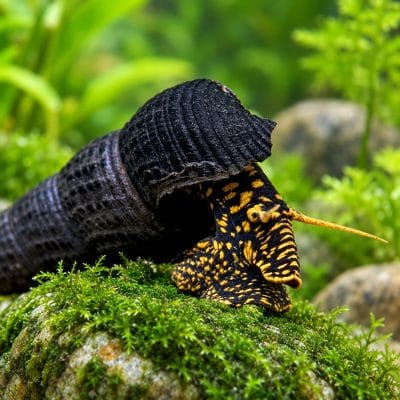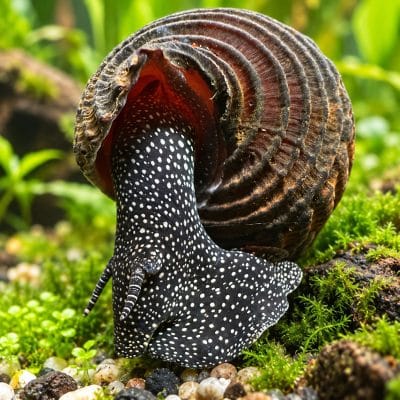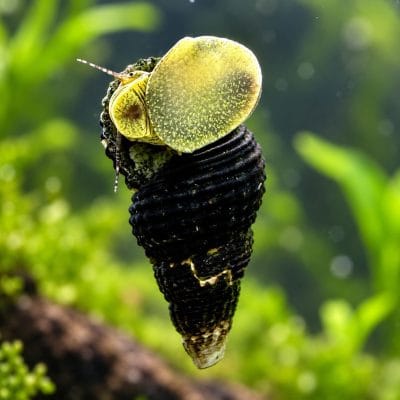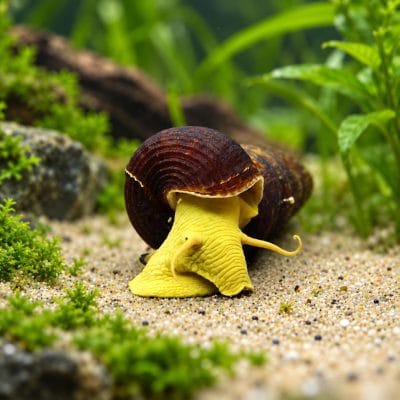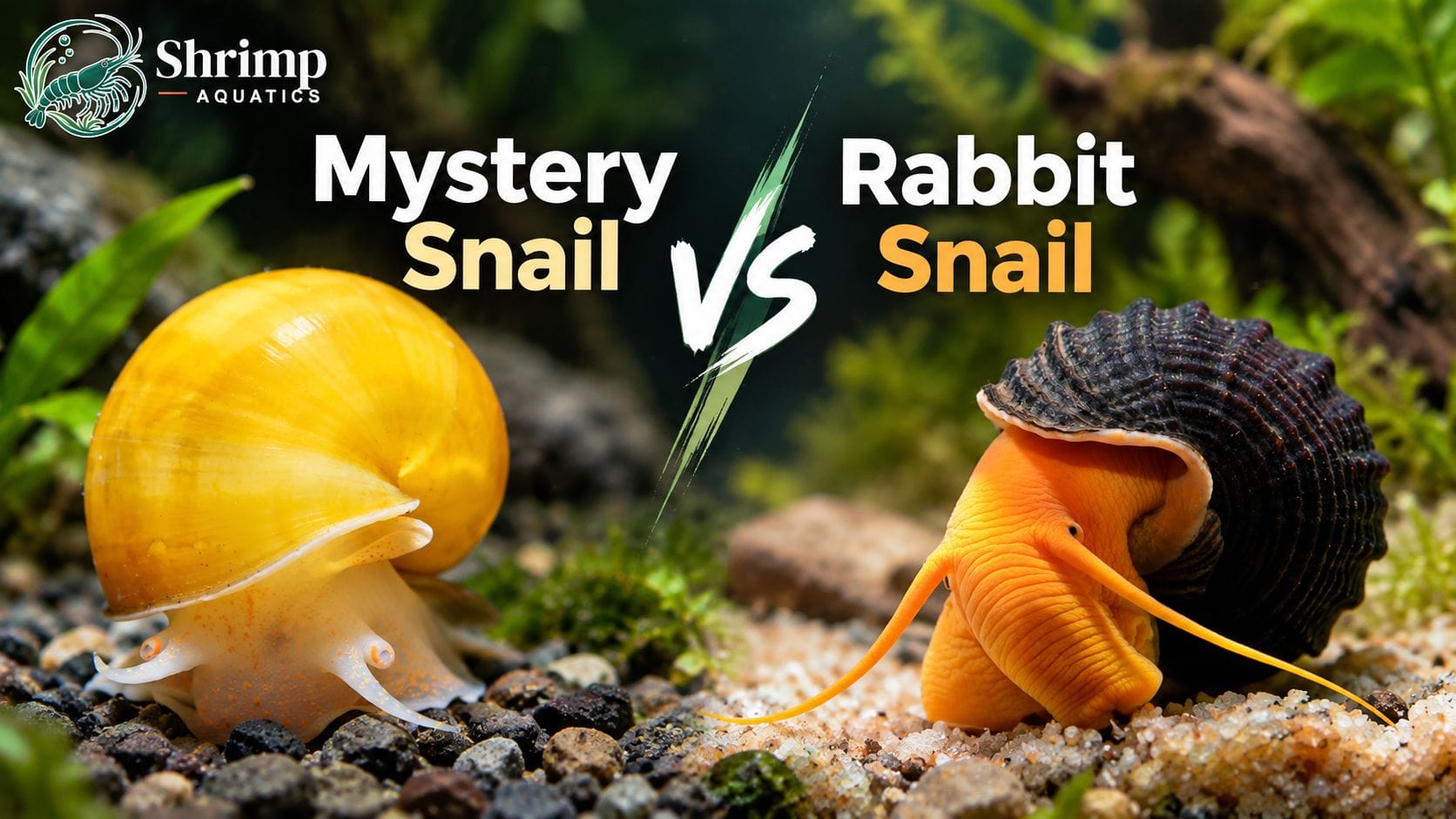
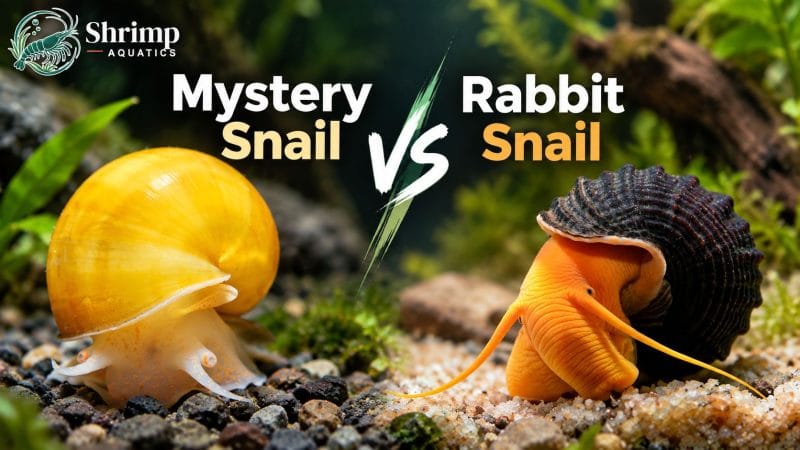
They’re both big snails, and that’s about where the resemblance ends. A rabbit snail is a live-bearing Sulawesi snail, Tylomelania sp. It drops one already shelled young at a time into the tank, about once a month, and grazes the thin film on your rock and glass. A mystery snail is an apple snail, Pomacea diffusa, that climbs out of the water and glues a clutch of pink eggs above the waterline. Different animals, different jobs. We’d keep them in separate tanks. If you’re set on one tank, it has to be big, mature, and carrying far more grazing surface than either snail needs alone. The same grazing math applies when shrimp share the tank instead of a second snail, which is Sulawesi shrimp living with rabbit snails.
How a rabbit snail and a mystery snail differ, line by line
Here’s the whole comparison in one place. Two rows are worth reading twice. The water row, because there’s nothing honest to put beside ours for the mystery snail. And the plants row, because neither animal gets a clean answer.
| What you’re comparing | Rabbit snail (Tylomelania sp.) | Mystery snail (Pomacea diffusa) |
|---|---|---|
| What it is, and how it breathes | A Sulawesi freshwater snail in the family Pachychilidae, endemic to the island, and fully aquatic. | An apple snail, family Ampullariidae. Every Pomacea carries both a lung and a gill, so it can take air at the surface.1 |
| Size | No traded line has a measured size, ours included. The original descriptions of named wild species run from about 16 mm to about 82 mm of shell. | Adult shell 40-50 mm wide and 45-65 mm high.2 |
| How it breeds | Live-bearing. Young leave the mother already shelled, a few at a time. Published brood-pouch counts run from one or two embryos in one named species to 11 to 67 in another. | Pale pink to reddish clutches of 200-600 eggs, stuck to a vertical surface above the waterline, as often as every 15 days, hatching in about three weeks.2 |
| Food | Grazes biofilm and aufwuchs, the living film on rock and glass. Filamentous green algae are not its natural food.3 | Described by USDA APHIS as primarily an algae feeder, which is why the species is handled differently from its pest relatives.4 |
| Plants | Unrecorded either way. No published work shows one eating living plant tissue, and none shows one leaving plants alone. | Unresolved. One older report has it feeding mainly on aufwuchs and not on plants; another has it eating plants readily.5 |
| Water | 79-86°F (26-30°C), pH 7.5-8.5, GH 4-8 dGH, KH 3-6 dKH, TDS 150-250 ppm, nitrate under 10 ppm. | No aquarium keeping range has been published for this species. |
| Legal status | No Tylomelania appears on Indonesia’s protected species list, and its CITES position could not be confirmed. | Differs by country and by species within the genus. See the section below before you order. |
| Sold by us | Yes. Four lines, bred in our own tanks. | No. Shrimp Aquatics does not stock Pomacea. |
Can a rabbit snail and a mystery snail share one tank?
Our answer is no, unless the tank is unusually large and unusually mature. What follows is us weighing what’s known about each one separately. We’d rather say that out loud than dress a judgment up as a finding.
Two things point in favor. The first is water. A rabbit snail tank is warm, alkaline and mineral rich, and that’s good water for an apple snail’s shell. In the Florida apple snail, a relative, low calcium together with acidic water slowed shell growth and left the shells eroded.6 In another apple snail, more calcium in the water produced measurably harder shells.7 The second is heat. Snails from a wild Pomacea population in Queensland, identified only to genus, stayed active in laboratory testing well above the top of the range we keep rabbit snails in.8 So the usual keeper worry, that a Sulawesi tank cooks a mystery snail, isn’t where the trouble is.
Two things point against, and we think they weigh more.
Food is the first. Both animals work the same thin film on rock and glass, and that film is what a rabbit snail lives on. Grazing snails measurably thin it: in a laboratory stream study of Juga, a different snail entirely, grazing held the standing algal layer at roughly half of what ungrazed streams grew.9 Your rabbit snail can’t graze what the mystery snail got to first.
Waste is the second. A mystery snail can lay 200-600 eggs as often as every 15 days.2 Most clutches dry out or get scraped off. The ones that don’t become a lot of small snails, all of them eating and excreting in water that is already warm and alkaline. That’s exactly where ammonia sits in its most toxic form.10
So keep them apart. If you’re determined to mix them, use a large, mature tank with far more grazing surface than either snail needs on its own, and watch the hardscape instead of the snails. When your rock starts looking clean, you’re already overstocked. And getting the water right and letting the tank mature comes first either way, which is the whole job in Sulawesi rabbit snail care.
Which breeds faster, the rabbit snail or the mystery snail?
The mystery snail, and it isn’t close. It climbs above the waterline, glues down a pale pink to reddish clutch of 200-600 eggs, can do it again about every 15 days, and those eggs hatch in roughly three weeks.2 A rabbit snail does none of that. It’s live-bearing: the young develop inside the female and leave her already shelled, one at a time, about every four weeks.
How few? In a home tank, one young about every four weeks per female. What she carries inside depends on the species, and most traded rabbit snails don’t have a confirmed one. Preserved females of one named species carried 11 to 67 embryos; females of another carried one or two. If what you want is young from your own tank, the part you can control is set out in rabbit snail breeding.
The practical difference is simple. A mystery snail can turn one tank into a snail problem in a season. A rabbit snail won’t. Keepers sometimes report a male mystery snail trying to mate with a rabbit snail; nothing published speaks to it, and the two belong to different families. We don’t promise breeding, sex or the number of young from any order.
Mystery snails do more of your algae work than rabbit snails do
If algae is the reason you’re shopping, the mystery snail is the better fit of the two. USDA APHIS describes Pomacea diffusa as primarily an algae feeder.4 That classification is the reason the species is handled separately from its pest relatives. A US federal risk screening says much the same: it largely feeds on decaying organic matter and algae.1
A rabbit snail is not a cleanup crew, and we won’t sell it as one. It grazes biofilm and aufwuchs, the thin living film on hard surfaces. Green filamentous algae are not its natural food, in the words of the specialist group Sulawesi Keepers.3 That’s usually the exact stuff a keeper wants gone. Put one in a tank full of hair algae and you’ll have hair algae and a hungry snail. For glass algae in an ordinary tropical tank, the rabbit snail vs nerite snail choice goes to the nerite.
Will either snail eat your plants?
For the rabbit snail, play it safe. We treat soft leaved plants as at risk in these tanks and stick to hardy epiphytes tied to rock.
For the mystery snail the record disagrees with itself. One report has it feeding mainly on aufwuchs and not on plants; another has it eating plants readily.5 The federal screening notes that in laboratory work the snails avoided most plants offered and went for animal tissue instead.1 Our reading: probably light on plants, and we wouldn’t stake a rare Bucephalandra on it.
Not every snail sold as a mystery snail is the same animal
The snail this page compares is Pomacea diffusa, an apple snail also sold as the spiked-top apple snail2 and, in its albino form, as the albino mystery snail.1 It is a separate species from the channeled apple snails of the Pomacea canaliculata complex, the ones that damage rice, and genetic work confirmed that separation.5 That separation is the whole reason its legal position differs from theirs.
There’s a second animal wearing the same name. The Chinese mystery snail, Cipangopaludina chinensis, is not an apple snail and is not a close relative. If a seller or a forum thread says mystery snail, work out which one they mean first. The rules that apply to them aren’t the same either.
Check whether a mystery snail is legal where you live before you order one
We can’t tell you the answer for your address, and neither can anyone else on the internet. Here’s what we were able to confirm in September 2026, which should be enough to show you why the question is worth asking.
In the United States, Pomacea diffusa is the one apple snail that USDA APHIS allows to move between states without a permit, because it isn’t regarded as an agricultural pest.4 Pomacea canaliculata is federally restricted, and restricted by several states as well.
In Australia, exotic snails can’t be imported or bought online, and Pomacea canaliculata is named as a National Priority Plant Pest.11 In Queensland, Pomacea diffusa is not a prohibited or restricted invasive animal, and buying and keeping it in a home aquarium is permitted provided it can’t escape; releasing one is banned.2
In the European Union, no Pomacea appears on the list of invasive alien species of Union concern, which was last updated in July 2025.12 The genus has been under separate emergency plant health measures since 2012, which state that Pomacea shall not be introduced into or spread within the Union,13 and we could not verify the current status of that instrument. Until someone official tells you otherwise, treat the genus as regulated there.
In Great Britain, no Pomacea and no freshwater snail appears on the list of species of special concern.14 The Chinese mystery snail is only on the shortlist being considered for that list. It was added to the EU list in 2025, though.12
None of that is advice for your country. Check your own national and local rules before you order any live snail, ours included.
Choosing a rabbit snail from our four tank-bred lines
We don’t sell mystery snails, so nothing on this page is trying to steer you. What we do sell is rabbit snails, and everything in our catalog is bred or propagated in our own tanks, not collected from the wild.
Four lines are live right now, all Tylomelania sp., all moderate to keep once the tank is already holding the water in the table above. The snail is the manageable part; the system is the demanding part, and a rabbit snail is not a shortcut into Sulawesi keeping without one. That system has to keep running for years, because how long rabbit snails live is measured in years rather than a season.
Our line names are trade names, not species. If you want to know what a label like Poso or Golden Spotted actually tells you about the animal in your tank, that’s the job of types of rabbit snails. All four sit together in our Sulawesi snails category if you’d sooner compare them in one place.
Before you order
Shipping is a flat USD 120 per order to every country. Confirming your own import rules is part of ordering. We cannot tell you that live freshwater invertebrates are legal to import where you live.
References
14 Sources
- Spike-topped Applesnail (Pomacea diffusa) Ecological Risk Screening Summary, U.S. Fish and Wildlife Service, February 2023, web version 2 April 2025.
- Spiked-top apple snail, Business Queensland, Queensland Government.
- Do you know Sulawesi snails?, Sulawesi Keepers.
- Snails and Slugs, USDA Animal and Plant Health Inspection Service.
- The identity, distribution, and impacts of non-native apple snails in the continental United States, Rawlings TA, Hayes KA, Cowie RH, Collins TM, BMC Evolutionary Biology 7:97, 2007.
- The effect of calcium and pH on Florida apple snail, Pomacea paludosa (Gastropoda: Ampullariidae), shell growth and crush weight, Glass NH, Darby PC, Aquatic Ecology 43:1085-1093, 2009.
- Growth and shell hardness of the apple snail Pomacea flagellata Say, 1829, reared at three calcium concentrations, De Jesus-Navarrete A and co-authors, PeerJ 11:e14840, 2023.
- Assassins and apples: the environmental constraints of two snails that threaten Australian aquatic systems, Bodley B, Holmes BJ, Williams SM, Tibbetts IR, Burfeind DD, McDougall C, Marine and Freshwater Research 73(12):1510-1519, 2022.
- Effects of three herbivores on periphyton communities in laboratory streams, Lamberti GA, Ashkenas LR, Gregory SV, Steinman AD, Journal of the North American Benthological Society 6(2):92-104, 1987.
- Aquatic Life Ambient Water Quality Criteria for Ammonia, Freshwater, U.S. Environmental Protection Agency, Office of Water, April 2013.
- Invasive snails (exotic species), Australian Government Department of Agriculture, Fisheries and Forestry.
- Commission Implementing Regulation (EU) 2025/1422 of 17 July 2025 amending Implementing Regulation (EU) 2016/1141 to update the list of invasive alien species of Union concern, Official Journal of the European Union, 17 July 2025.
- Commission Implementing Decision 2012/697/EU of 8 November 2012 as regards measures to prevent the introduction into and the spread within the Union of the genus Pomacea (Perry), Official Journal of the European Union, 8 November 2012.
- Species of Special Concern, GB Non-native Species Secretariat.
Ready to get started?
Shop our Sulawesi Snail collection
12 products available · Live Arrival Guarantee