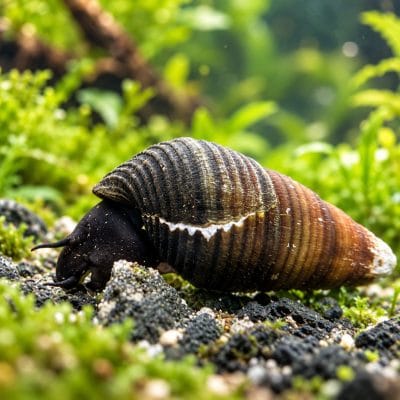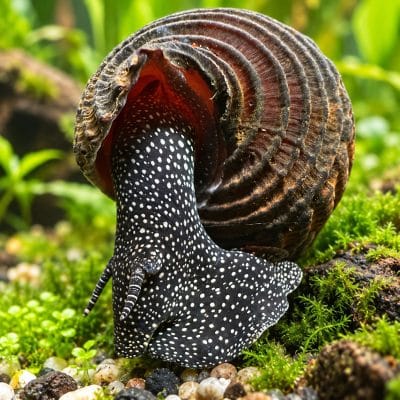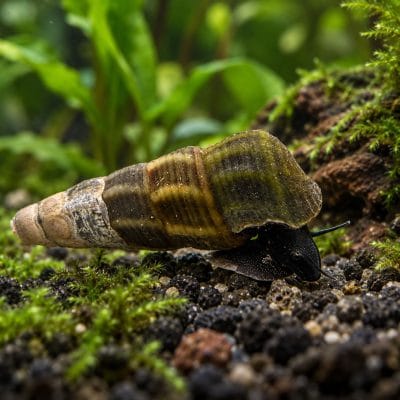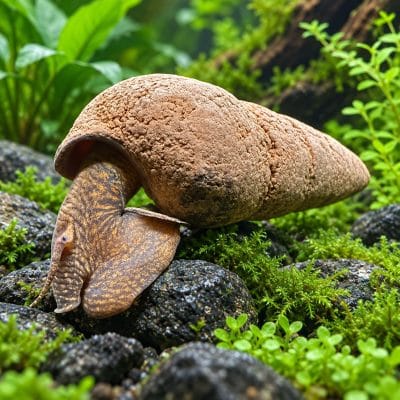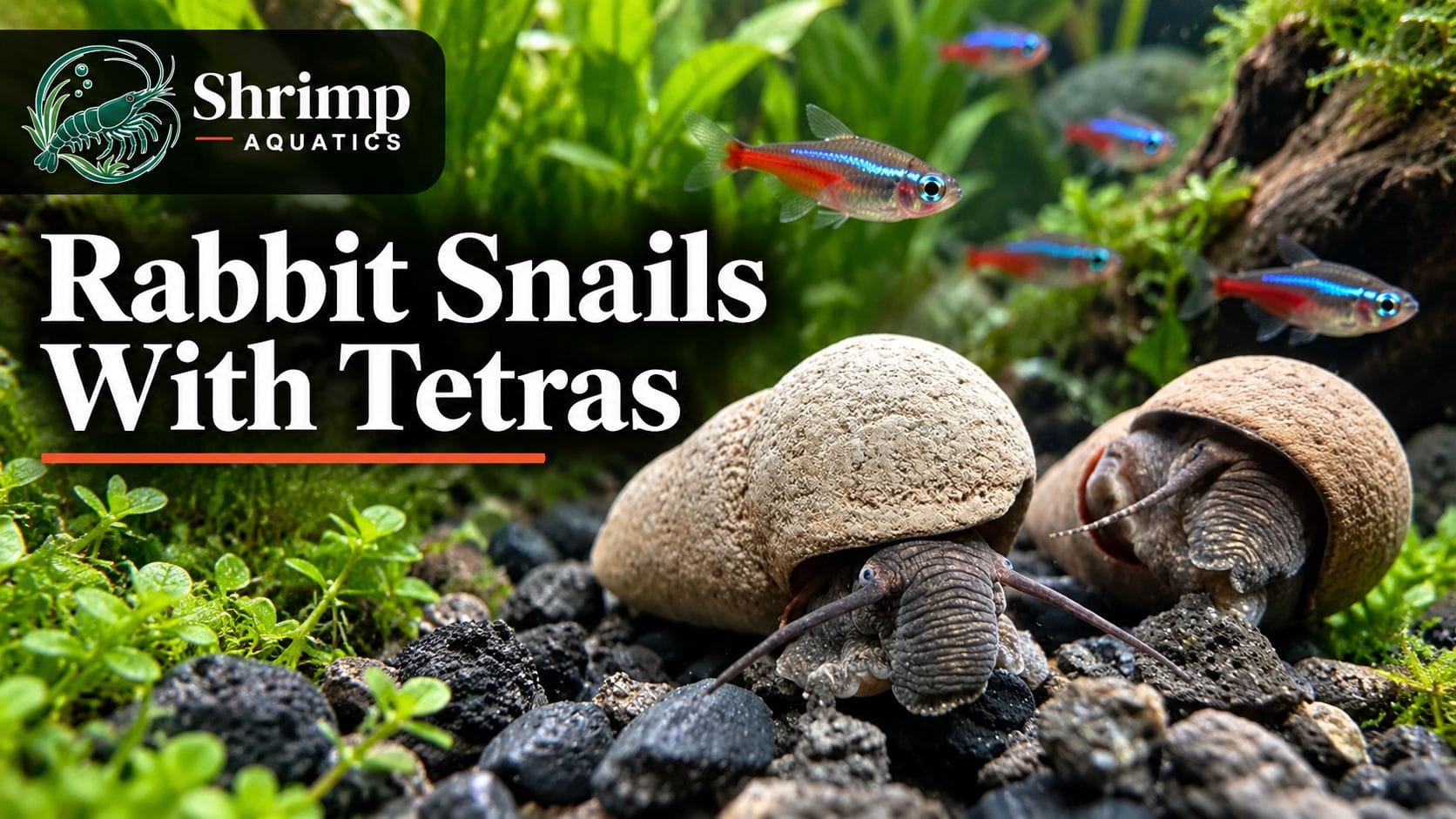
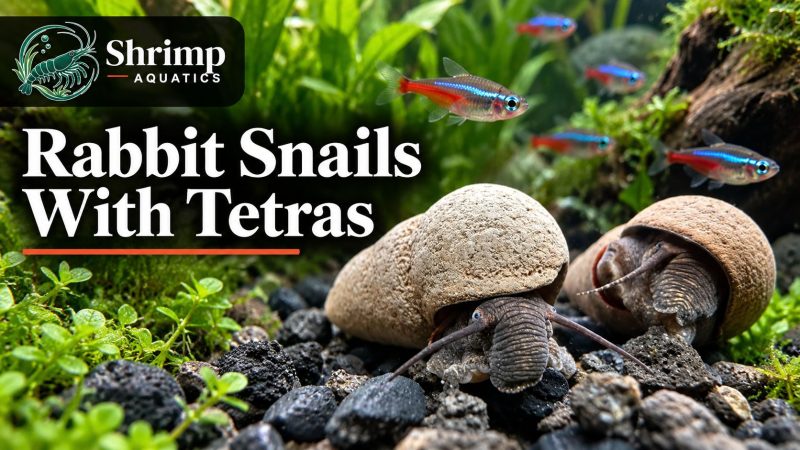
Most tetras aren’t a good match for rabbit snails (Tylomelania sp.). The snail needs warm, hard, alkaline water at 79-86°F (26-30°C) and pH 7.5-8.5, and the tetras usually suggested as tankmates are listed for cooler, softer or more acidic water. This answer comes from each animal’s documented water and from what keepers report.
Which tetras can handle the water a rabbit snail needs?
None of the common community tetras fits the snail’s whole range, and the ember tetra comes closest on temperature. Start with the snail’s numbers, because they don’t bend for tankmates. The snail itself is moderate to keep, but the tank is the demanding part: it has to be warm, alkaline, mineral-rich and mature. Set that tank up the way Sulawesi rabbit snail care lays out before any fish goes in.
| Temperature | 79-86°F (26-30°C) |
|---|---|
| pH | 7.5-8.5 |
| GH | 4-8 dGH |
| KH | 3-6 dKH |
| TDS | 150-250 ppm |
| Nitrate | Keep it under 10 ppm |
| Substrate | Inert sand or gravel, no active soil that lowers pH |
| Tank | Mature, with a visible film of algae and biofilm on rock and glass |
Now hold each tetra up against that. FishBase, the scientific fish database, lists a temperature and water range for the tetras keepers ask about most, and here’s where each one meets the snail’s water.
| Tetra | What FishBase lists | Overlap with the snail tank |
|---|---|---|
| Neon tetra (Paracheirodon innesi) | Very soft, acidic to neutral water; its warm end stops at the snail’s lowest temperature1 | Temperature touches the snail’s floor only; no pH overlap |
| Cardinal tetra (Paracheirodon axelrodi) | Acidic water; its warm end sits a degree or two Fahrenheit above the snail’s floor2 | A narrow temperature overlap; no pH overlap |
| Serpae tetra (Hyphessobrycon eques, filed on FishBase as Megalamphodus eques) | Acidic to slightly alkaline water, harder than the snail’s GH band; its warm end stops at the snail’s floor3 | A thin pH overlap at the snail’s low end; temperature touches the floor only |
| Black skirt tetra (Gymnocorymbus ternetzi) | Slightly acidic to slightly alkaline water; its warm end stops at the snail’s floor4 | pH overlaps the lower half of the snail’s range; temperature touches the floor only |
| Ember tetra (Hyphessobrycon amandae) | Warm water, with no pH or hardness listed5 | Temperature overlaps the snail’s lower end; water chemistry unknown |
So what does that leave? For four of the five, a tank held at the very bottom of the snail’s temperature range with the fish living at the very top of theirs. We wouldn’t build a tank where both animals sit at the edge of what they’re known to handle. The ember tetra overlaps better on temperature, but with no published pH or hardness range there’s nothing to check its chemistry against, so we don’t recommend it either.
Why a middle-ground pH puts the rabbit snail’s shell at risk
Splitting the difference takes the snail out of its range, and the snail pays for it in its shell. Some guides suggest settling near neutral so each animal gets part of what it needs, but that moves the water toward soft and acidic, which is exactly the direction that hurts snail shells.
In a study of the Florida apple snail (Pomacea paludosa), which belongs to another family, animals kept in low-calcium, acidic water grew very little shell, and their shells showed erosion and broke more easily.6 It’s a different animal, but it shows which way the risk runs. Nobody has measured the point where a rabbit snail’s shell starts to suffer, so the safe rule is to hold the range in the table and keep KH from drifting down. If your tap water starts soft, rabbit snails in soft water need that KH added back before anything else.
The same goes for the planted tanks tetras often live in. An active soil that pulls pH down suits soft-water fish and plants, and it’s the wrong base for this snail, which needs inert sand or gravel. If you see fresh erosion at the shell’s opening edge, where the snail is growing, test pH, GH and KH before you change anything else.
Do tetras nip at rabbit snail tentacles?
Some do, going by keeper reports. Rabbit snail owners describe tetras picking at the snail’s long, soft tentacles, and the reports name species already known as fin-nippers, such as Buenos Aires tetras.
Why does it matter if the snail survives the nipping? A rabbit snail feeds by grazing the film on rock and glass, and a snail that keeps pulling back into its shell isn’t out grazing. If you see fish following the snail or shortened tentacles, separate them. Nothing added to the tank will reliably stop fish attacking rabbit snails, so separation is the fix.
If your rabbit snails already live with tetras, check these four things
Test the water first, because that decides everything else. Then work through the rest:
- Water. Compare pH, GH, KH and temperature with the table above. Below pH 7.5 or 79°F (26°C), the snail is outside its range.
- Tentacles. Watch for fish trailing the snail, tentacles that look shorter, or a snail that stays sealed in its shell for long stretches.
- Food. Tetras reach sinking food long before a slow snail does. Drop food right beside the snail and lift what’s left before it sits for hours in warm water.
- Shell edge. Look at the opening of the shell for fresh, chalky wear, which points back to the water.
If the water is out of range, the fix is a separate tank for the fish. Pushing a stocked tank’s chemistry around to suit both animals is the riskier move, because fast shifts in pH and hardness stress everything in it.
What can share a rabbit snail tank instead of tetras?
Sulawesi shrimp are the natural tankmate, because they need the same water. The question with them is grazing space: both graze the same film on rock and glass, so the tank needs enough mature surface for everyone. Start rabbit snails with Sulawesi shrimp small, one snail or a pair, and add more only while the film keeps up.
Neocaridina are usually kept at 65-78°F (18-26°C), below this tank’s 79°F (26°C) start, though a small group lives and breeds in some of our own Sulawesi tanks. Bee and Crystal shrimp want soft, acidic water and don’t fit. Assassin snails never belong in a rabbit snail tank, because they eat other snails. Guppies miss for a different reason: rabbit snails with guppies don’t share a hardness range at all.
If it’s tetras you want, give them their own soft-water tank and let the rabbit snail tank be the warm, hard one. Once that tank is running in the range above, with a visible film of algae and biofilm on the rock, you can choose from our Sulawesi snail lines. Every one is tank-bred by Shrimp Aquatics, and we don’t promise breeding, sex or the number of young from any order.
References
6 Sources
- Paracheirodon innesi, Neon tetra, FishBase species summary, accessed 2026-09-26.
- Paracheirodon axelrodi, Cardinal tetra, FishBase species summary, accessed 2026-09-26.
- Megalamphodus eques, Jewel tetra, FishBase species summary, accessed 2026-09-26.
- Gymnocorymbus ternetzi, Black tetra, FishBase species summary, accessed 2026-09-26.
- Hyphessobrycon amandae, Ember tetra, FishBase species summary, accessed 2026-09-26.
- Glass, N. H. and Darby, P. C., The effect of calcium and pH on Florida apple snail, Pomacea paludosa (Gastropoda: Ampullariidae), shell growth and crush weight, Aquatic Ecology 43, 2009 (abstract).
Ready to get started?
Shop our Sulawesi Snail collection
12 products available · Live Arrival Guarantee