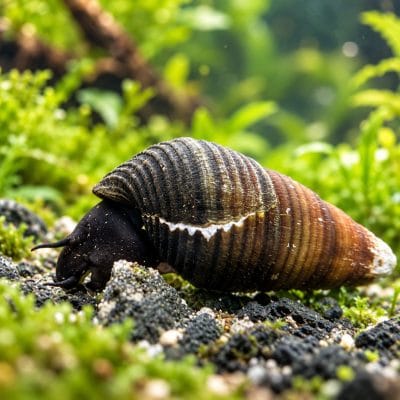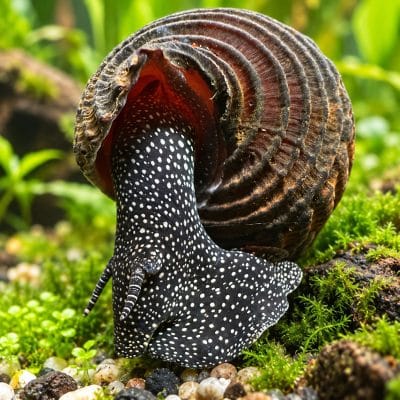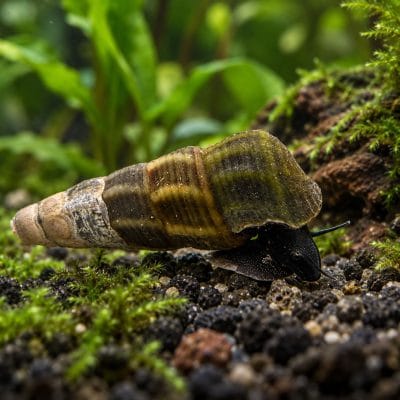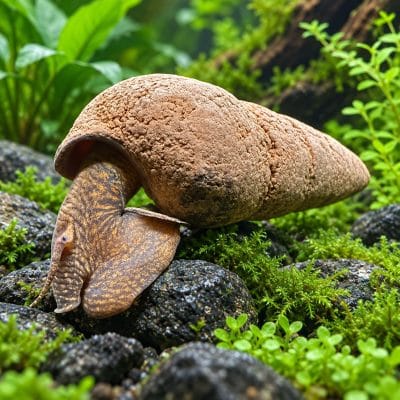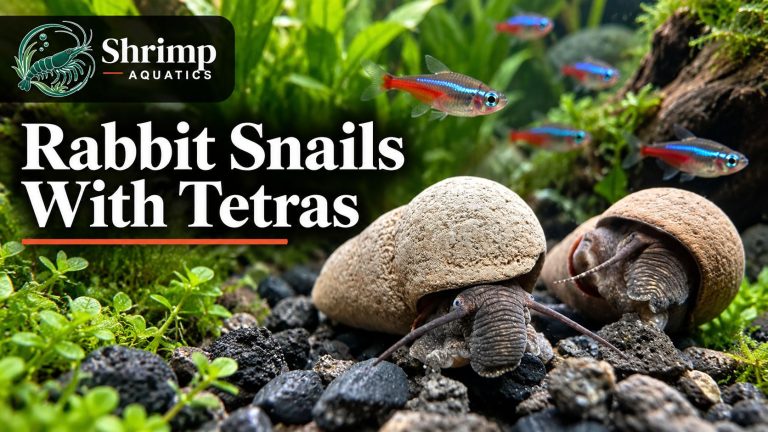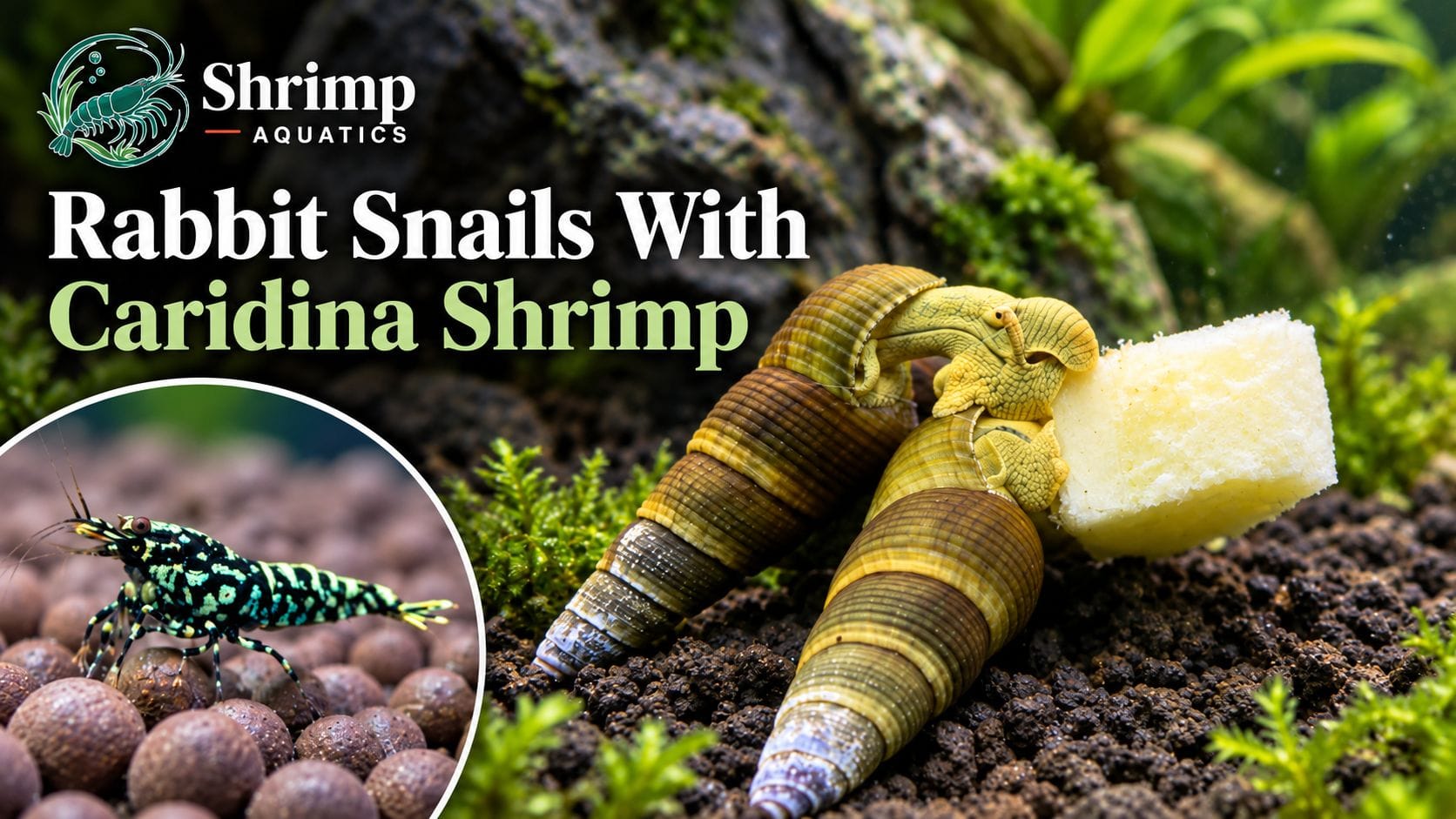
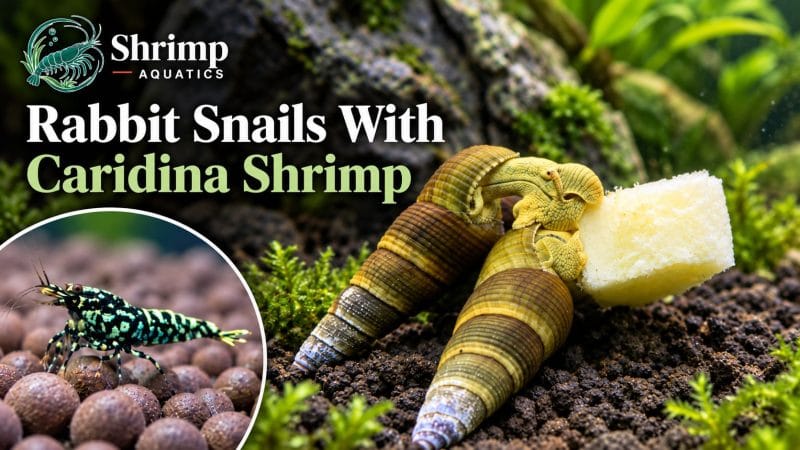
Yes, rabbit snails can live with Caridina shrimp, but only with the Sulawesi lake species such as Cardinal shrimp, because both are kept in the same warm, alkaline water. Crystal Red, Bee and Taiwan Bee shrimp are a different story: their soft, acidic water and the snail’s water don’t meet on temperature, pH or KH, so the answer there is no.
Rabbit snails are the Tylomelania snails from Sulawesi, and “Caridina” covers shrimp that need opposite water. That’s why keepers get conflicting advice on this pairing. The rest of this page shows you where the line falls and what a shared tank has to get right.
Why can’t rabbit snails live with Crystal Red or Bee shrimp?
Rabbit snails can’t live with Crystal Red or Bee shrimp because the two animals are kept in water that never overlaps on temperature, pH or KH. The snail’s water starts where the Bee tank’s water stops, as the table below shows.
| Parameter | Crystal Red and Bee shrimp | Rabbit snails and Sulawesi shrimp |
|---|---|---|
| Temperature | 60-72°F (15.5-22°C) | 79-86°F (26-30°C) |
| pH | 5.8-6.8 | 7.5-8.5 |
| GH | 4-6 dGH | 4-8 dGH |
| KH | 0-2 dKH | 3-6 dKH |
| TDS | 100-150 ppm | 150-250 ppm |
| Nitrate | Under 20 ppm | Under 10 ppm |
Only GH shares any ground, and GH on its own doesn’t keep either animal alive. A Bee tank is also usually built on a buffering soil that pulls the pH down on purpose, which is exactly what a snail with a calcium shell doesn’t want.
What does acidic, low-mineral water do to a snail shell? In a study on the Florida apple snail, a different snail family, animals kept in water with very little calcium and a pH under 6.5 grew the least and showed shell erosion.1 Nobody has measured the same thing in rabbit snails, so treat that as the direction of the risk, not a threshold. It’s also why rabbit snails in soft water need the carbonate put back before pH will hold.
We know the tempting fix: split the difference and run both at neutral pH. It doesn’t work. Neutral sits above the Bee shrimp range and below the rabbit snail range, so you’d be keeping both animals outside the water they’re kept in, and 72°F is still too cool for the snail. If you love both, give them two tanks.
Which Caridina shrimp share the same water as rabbit snails?
The Sulawesi lake Caridina share the rabbit snail’s water: Cardinal shrimp, White Sock, Blue Leg and the other lake species. They come from the same island, which is why their numbers line up. Tylomelania is found only on Sulawesi,2 and Cardinal shrimp (Caridina dennerli) is one of the Caridina species described from the island’s ancient lakes.3
So the range we keep rabbit snails to is simply the Sulawesi shrimp range in the table above. Nothing needs adjusting for the snail, and nothing should: if you keep Sulawesi shrimp well, the snail’s water is already done. What’s left of Sulawesi rabbit snail care after that is grazing space and patience.
The snail is easy, the tank isn’t
We’d rate a rabbit snail as moderate to keep, hardier than the Sulawesi shrimp beside it. That rating is for the animal. The tank still has to be mature, warm, alkaline and mineral-rich, which makes this a poor first tank and no shortcut into Sulawesi keeping.
How many rabbit snails can a Sulawesi shrimp tank feed?
Start small, with one snail or a pair, and add more only while the film on your rock and glass keeps up with everyone grazing it. There’s no published stocking figure for this pairing, so the film itself is your gauge. The same slow start suits rabbit snails with Sulawesi shrimp of every kind, Cardinals included.
Both animals feed mostly by grazing the layer of algae and biofilm that grows on hard surfaces in a mature tank. A rabbit snail is a large animal next to a Cardinal shrimp, and it counts toward that grazing load. When rock that used to look furred starts looking scraped clean, you’ve reached the limit. Because rabbit snails eat biofilm as their main food, prepared food only tops that film up.
Does the kind of surface matter? For these snails, yes. In one Lake Towuti species, snails found on rock and snails found on sunken wood had measurably different feeding organs, and every snail collected on wood was the wood-adapted form.2 The study didn’t look at what they swallowed, so it’s no diet list, but it’s a good reason to give your snails both rock and wood to work over.
Prepared food can top things up, but it can’t stand in for an immature tank. If the film isn’t visible yet, the snail isn’t ready to go in.
Why rabbit snail waste hits harder in warm, alkaline water
A snail’s waste is more dangerous in this tank than the same amount would be in a Bee tank, because warm, alkaline water turns more of the ammonia into its toxic form. The share of ammonia in its un-ionized, toxic form rises about tenfold for each full pH unit and roughly doubles with each 18°F (10°C) rise in temperature.4
That’s why a Sulawesi tank punishes overfeeding. Feed lightly, lift anything the snails and shrimp leave within a few hours, and keep nitrate under 10 ppm, the target in the range we keep to.
Which tankmates and treatments rule out a shared rabbit snail tank?
Copper and assassin snails rule out a shared rabbit snail and Sulawesi shrimp tank, and Neocaridina need care. Each one is on the list for a different reason. The same test applies to every other name on a list of rabbit snail tankmates: water first, then temperament.
- Copper and copper-based medications. Copper can harm both snails and shrimp. Check the label of any fish medication or plant fertilizer before it goes near this tank.
- Assassin snails. They eat other snails, and a rabbit snail is a snail.
- Neocaridina, such as Cherry shrimp. Neocaridina are usually kept at 65-78°F (18-26°C), while this tank starts at 79°F (26°C). In our tanks a small group lives and breeds at the snail’s temperature, but they graze the same film and can outnumber Sulawesi shrimp, so keep the group small, as we do with rabbit snails with Neocaridina shrimp, or leave them out of a Sulawesi breeding tank.
Is your Sulawesi tank ready to add rabbit snails?
Your tank is ready for rabbit snails when every line below is true. If one isn’t, wait until it is.
- Ammonia and nitrite read 0 and the filter has been running long enough to be established.
- Temperature, pH, GH, KH and TDS have held steady inside the range in the table above.
- The substrate and hardscape are inert, with no soil that lowers pH.
- You can see a film of algae and biofilm on the rock and glass.
- Nitrate sits under 10 ppm.
If every box is ticked, our Sulawesi snail lines are tank-bred by Shrimp Aquatics, not collected from the wild. We don’t promise breeding, sex or the number of young from any order. Not sure your water fits? Email contact@shrimpaquatics.com with your pH, GH, KH, TDS, temperature, tank size, cycle status and current livestock, and we’ll tell you honestly.
References
4 Sources
- The effect of calcium and pH on Florida apple snail, Pomacea paludosa (Gastropoda: Ampullariidae), shell growth and crush weight, Glass and Darby, Aquatic Ecology 43: 1085-1093, 2009.
- Evolutionary Divergence and Radula Diversification in Two Ecomorphs from an Adaptive Radiation of Freshwater Snails, Hilgers et al., Genes 13(6): 1029, 2022.
- Radiation of endemic species flocks in ancient lakes: systematic revision of the freshwater shrimp Caridina from the ancient lakes of Sulawesi, Indonesia, with the description of eight new species, von Rintelen and Cai, Raffles Bulletin of Zoology 57(2): 343-452, 2009.
- Aquatic Life Ambient Water Quality Criteria for Ammonia, Freshwater (2013), U.S. Environmental Protection Agency, Office of Water, April 2013.
Ready to get started?
Shop our Sulawesi Snail collection
12 products available · Live Arrival Guarantee