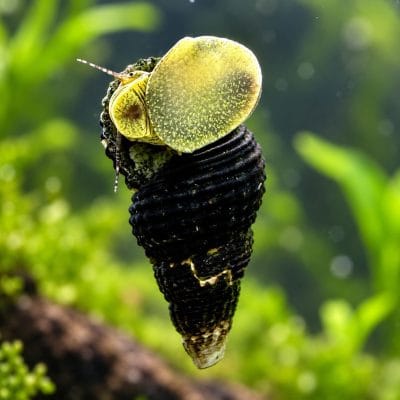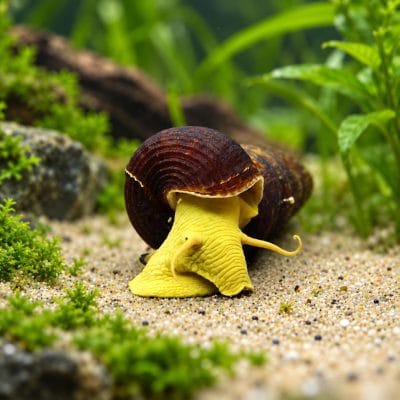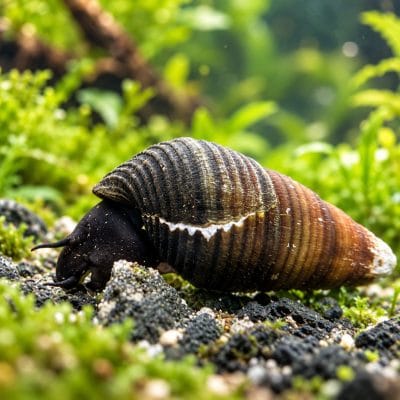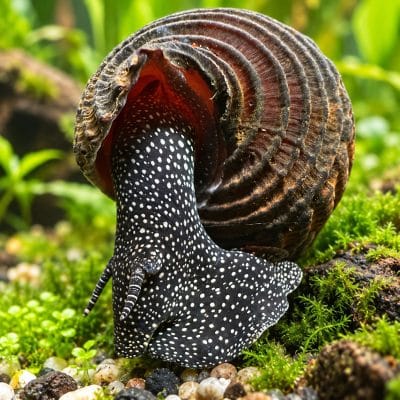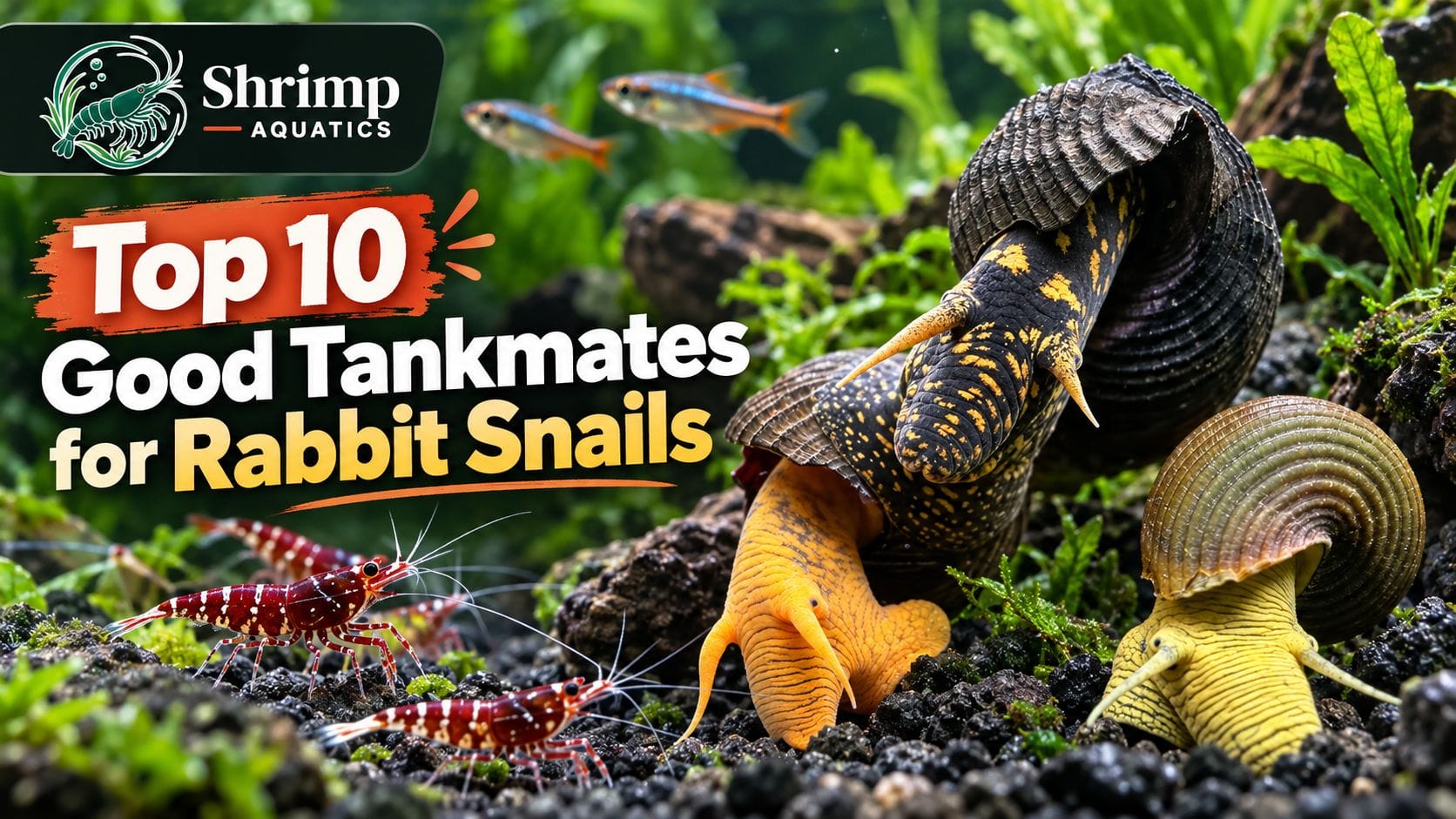
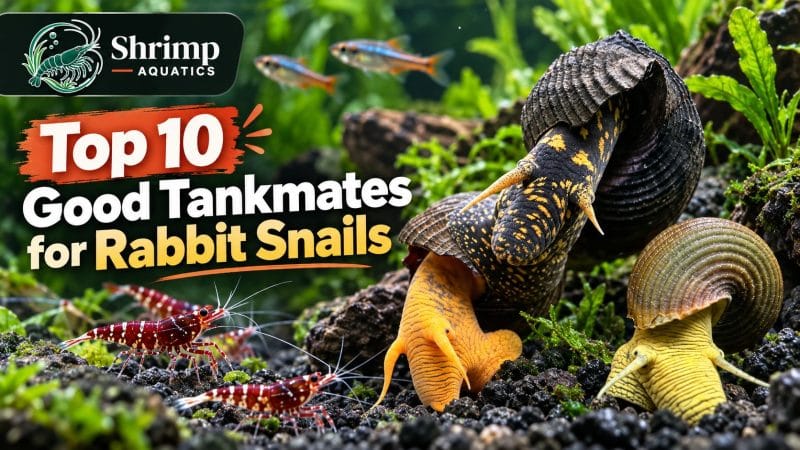
The best tankmates for a rabbit snail are Sulawesi shrimp and other rabbit snails, because both want the same 79-86°F (26-30°C), pH 7.5-8.5 water. The fish that usually fill top ten lists each miss at least one of the snail’s numbers, and the Celebes rainbowfish misses by the least.
That’s a short list for a top ten, and it’s the honest one. Below are ten animals that turn up again and again on rabbit snail tankmate lists, ranked by how well they fit a warm, alkaline Sulawesi tank, followed by the ones that should never go in at all.
What must a rabbit snail tankmate match?
A rabbit snail tankmate has to live in the snail’s water, leave its antennae alone and not strip the film it grazes. Water comes first, because a gentle temperament can’t rescue a fish that’s too cool or too acid for the tank.
| Temperature | 79-86°F (26-30°C) |
|---|---|
| pH | 7.5-8.5 |
| GH | 4-8 dGH |
| KH | 3-6 dKH |
| TDS | 150-250 ppm |
| Nitrate | Aim for under 10 ppm |
| Tank | Mature, with algae and biofilm already visible on rock and glass |
Those are the numbers we keep our Sulawesi shrimp to, and rabbit snails need the same water. Check a candidate against every line, not only temperature. A fish that copes with pH 8 but wants cooler water will still spend its life at the edge of what it can take.
Temperament is the second test. A rabbit snail pulls into its shell when something bothers it, and a snail that stays shut isn’t grazing. The third test is food. This snail eats the film on rock and glass, so any tankmate that grazes the same surfaces is a competitor, however polite it is. The snail itself never starts the trouble: rabbit snails aren’t aggressive toward shrimp, fish or each other.
If your tank doesn’t hold that table yet, build it before you shop for company, starting with the water and maturity checks in Sulawesi rabbit snail care.
The 10 most suggested rabbit snail tankmates, ranked by fit
Only the first two on this list share a rabbit snail’s full range. Everything from third place down misses at least one number, so we ranked them by how close they come, using each fish’s published range against the one we keep the snail to.
-
Sulawesi shrimp want the snail’s exact water
Sulawesi shrimp are the one tankmate built for the same tank. The table above is the range we keep Sulawesi shrimp to as well, so nothing has to give. The limit is food, not chemistry. Both graze the same film, and a big snail eats into the layer a shrimp colony lives on. Add the snail only when the rock already carries a film you can see, then watch that film after it goes in. Grazing space is the only real limit when you keep rabbit snails with Sulawesi shrimp.
-
Other rabbit snails fit if the rock can feed them all
Other rabbit snails need exactly the same water, whatever trade name is on the bag. What limits you is grazing. Each snail you add is another large grazer on the same rock, so add one, watch nitrate and the film for a few weeks, and let those readings decide the next.
-
Celebes rainbowfish come closest, but miss on hardness
The Celebes rainbowfish (Marosatherina ladigesi) is the best fish here, and it still isn’t a clean match. It’s native to south Sulawesi, and FishBase lists it as a peaceful community fish for water up to 82°F (28°C) and pH 8.0.1 The same entry puts its hardness range above our 8 dGH ceiling.1 So the two overlap only at the cool, low-pH end of the snail’s range, and even there the water is softer than the fish is listed for. We wouldn’t call that a match, and we wouldn’t build a tank around it.
-
Mollies overlap on pH and compete for the same film
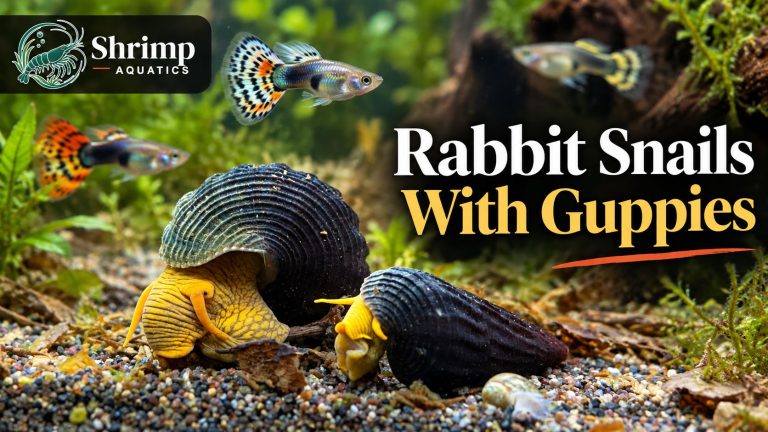
Mollies (Poecilia sphenops) come closer on pH than most fish and further on everything else. FishBase lists them for alkaline water from pH 7.5, which suits, but only up to 82°F (28°C) and at a hardness well above 8 dGH.2 In aquariums they also feed on green algae.2 That puts a group of busy grazers on the film your snail needs, so we’d leave them out. Guppies, their close relatives, miss on hardness as well, which is why we wouldn’t keep rabbit snails with guppies either.
-
Ember tetras overlap only at the cool end
Ember tetras (Hyphessobrycon amandae) are small and peaceful, but the fit is thin. FishBase gives them a temperature range that stops at 82°F (28°C) and lists no pH or hardness at all.3 You’d be guessing on the two numbers that matter most in this tank. If Sulawesi shrimp share it, small tetras often eat shrimplets too, so we’d skip them.
-
Pygmy corydoras stop where the snail’s range starts
Pygmy corydoras (Corydoras pygmaeus, now listed by FishBase as Gastrodermus pygmaeus) get suggested because they’re tiny and gentle, but temperature rules them out. FishBase lists them up to 79°F (26°C), the very bottom of a rabbit snail tank.4 That leaves them no margin on a warm day or a heater that runs a little high. They’re bottom dwellers too, so they’d share the snail’s sand.
-
Otocinclus want water cooler than a rabbit snail tank
Otocinclus top plenty of shrimp tank lists, and in a cooler tank they earn the spot. FishBase lists Otocinclus vittatus, one of the species sold under that name, for water that ends below 79°F (26°C), which is where this tank begins.5 They’re grazers as well, so they’d compete for the snail’s film even if the water suited them.
-
Cardinal tetras need soft, acid water
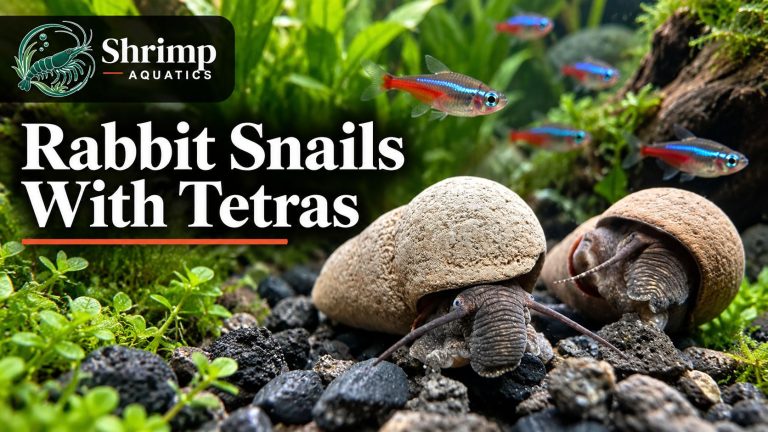
Cardinal tetras (Paracheirodon axelrodi) come from the Rio Negro and upper Orinoco basins, and FishBase lists them for acid water that never reaches pH 7.5.6 Pulling a Sulawesi tank down to suit them would take the snail below its own range. This pairing fails before behavior even comes into it. Most other tetras miss the same way, which is why rabbit snails with tetras rarely work.
-
Sulawesi ricefish come from soft water, despite the name
A Sulawesi name doesn’t mean Sulawesi lake water. Oryzias woworae, a ricefish from Muna Island off southeast Sulawesi, is listed by FishBase for water below pH 7.5.7 It’s also known from a single collection site and assessed as Endangered.7 It doesn’t belong in a rabbit snail tank, whatever the label on the tank at the store says.
-
Cherry shrimp work only as a small group in the snail’s water
Cherry shrimp and other Neocaridina are the surprise on this list. The usual Neocaridina range is 65-78°F (18-26°C), while a rabbit snail tank starts at 79°F (26°C), so on paper the temperatures never meet. The chemistry overlaps, though, and at Shrimp Aquatics a small group of Neocaridina lives and breeds in some of our Sulawesi tanks at the snail’s temperature. Keep the heater in the snail’s range and the group small, the two rules we follow for rabbit snails with Neocaridina shrimp.
If Sulawesi shrimp and more rabbit snails are where you land, the snails are the easy part to source. Every rabbit snail we sell is bred by Shrimp Aquatics, not collected from the wild. Pick the Sulawesi snail line you like the look of, since they all need the water above. We don’t promise breeding, sex or the number of young from any order.
Which animals should never share a rabbit snail tank?
Never add assassin snails, crayfish, large cichlids or any fish sold to control snails. Each of them hunts or crushes snails, and a slow snail has nowhere to go in a glass box.
Assassin snails (Anentome helena, often sold as Clea helena) hunt other freshwater snails and eat them through the shell opening.8 In one lab study they took only prey under about twice their own weight.8 A big adult rabbit snail may be more than one can manage, but young rabbit snails are small, and we wouldn’t gamble them. Whether assassin snails attack a much larger rabbit snail is a risk we wouldn’t take with adults either.
Big cichlids are the clearest warning, because it has already happened in the wild. The introduced flowerhorn cichlid reached Lake Matano, one of the rabbit snail’s home lakes, around 2005, and researchers link it to a decline in the lake’s endemic animals.9 A tank gives a snail far fewer places to get away than a lake does. That’s why we wouldn’t keep rabbit snails with cichlids of any size.
Crayfish are a no as well. In mesocosm trials with two invasive snails, redclaw crayfish killed both the smallest and the largest snails tested, and the authors found no size at which a snail was reliably safe.10 We’d give large freshwater crabs the same answer.
For fish, the usual rule is simple. If it’s sold to control snails, it doesn’t go in a snail tank. That covers pea puffers and the loaches keepers buy for exactly that job. Bettas are a milder case of the same problem, and whether rabbit snails can live with bettas comes down to water and nipped tentacles.
How to add a tankmate without starving your rabbit snail
Add one kind of tankmate at a time, and only once the rock and glass already carry a film you can see. The snail’s food grows on those surfaces, every grazer you add draws on the same supply, and prepared food doesn’t make up for a tank that hasn’t grown one.
- Test against the table above for a few weeks running, with ammonia and nitrite at zero the whole time.
- Add the first group of tankmates, then leave the tank alone for a few weeks apart from your normal water changes.
- Watch the film on the rock. If it’s being grazed bare faster than it grows back, stop adding animals.
- Watch nitrate. If it climbs toward 10 ppm on your usual maintenance, the tank is carrying all it can.
- Watch the snail. If it stays shut whenever a new tankmate is near, move the tankmate, not the snail.
A safe default for feeding a mixed tank is a little prepared food on open sand after the lights go out, when most tankmates have settled, with whatever’s left lifted within a few hours. That keeps the snail from being outcompeted and leaves the rock’s film for the shrimp.
Not sure whether your tank can take one more? Wait a month. A grazing layer that’s been worked flat takes weeks to come back, and everything in the tank shares that wait.
References
10 Sources
- Marosatherina ladigesi, Celebes rainbowfish, FishBase species summary, read September 25, 2026.
- Poecilia sphenops, Molly, FishBase species summary, read September 25, 2026.
- Hyphessobrycon amandae, Ember tetra, FishBase species summary, read September 25, 2026.
- Gastrodermus pygmaeus, Pygmy corydoras, FishBase species summary, read September 25, 2026.
- Otocinclus vittatus, FishBase species summary, read September 25, 2026.
- Paracheirodon axelrodi, Cardinal tetra, FishBase species summary, read September 25, 2026.
- Oryzias woworae, FishBase species summary, read September 25, 2026.
- Assassin snails (Anentome helena) as a biological model for exploring the effects of individual specialisation within generalist predators, Berkhout and Morozov, PLOS ONE 17(3), 2022.
- The complete mitogenome of Tylomelania sp. ‘Poso A’ (Caenogastropoda: Pachychilidae) from Lake Poso assembled from long-read sequencing data, Stelbrink and others, Molecular Biology Reports 53, 2026.
- Multiple invasions and predation: The impact of the crayfish Cherax quadricarinatus on invasive and native snails, Baudry and others, Ecology and Evolution 14(4), 2024.
Ready to get started?
Shop our Sulawesi Snail collection
12 products available · Live Arrival Guarantee