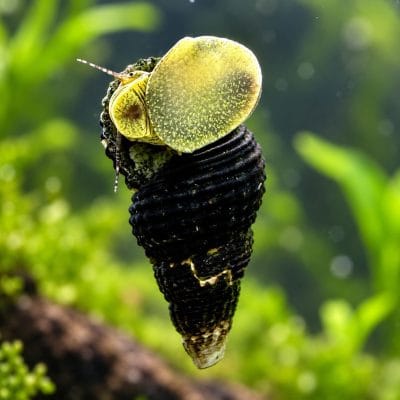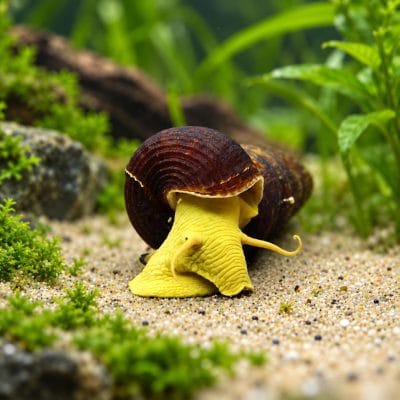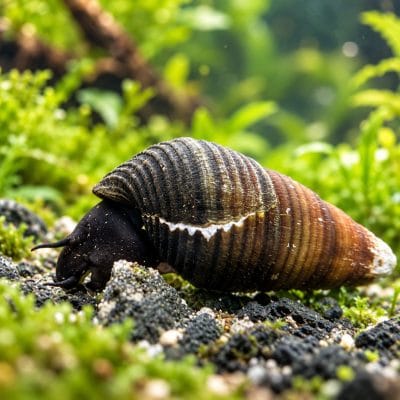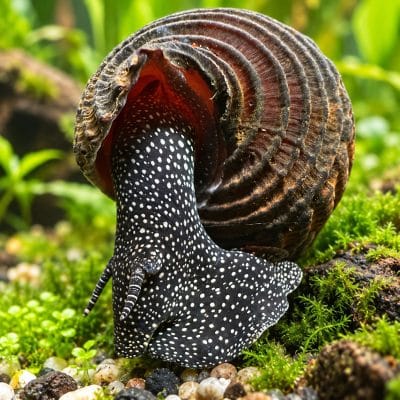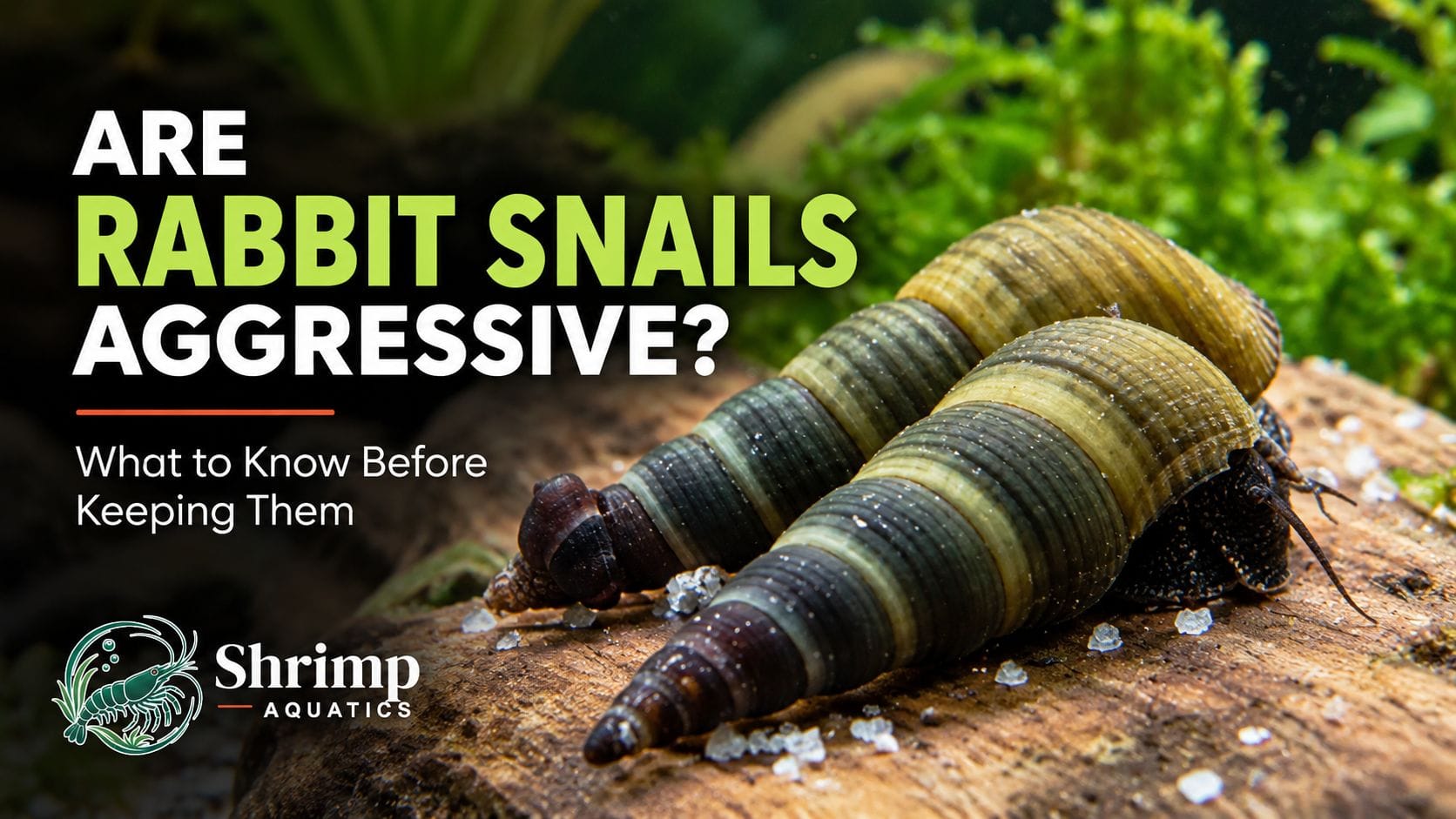
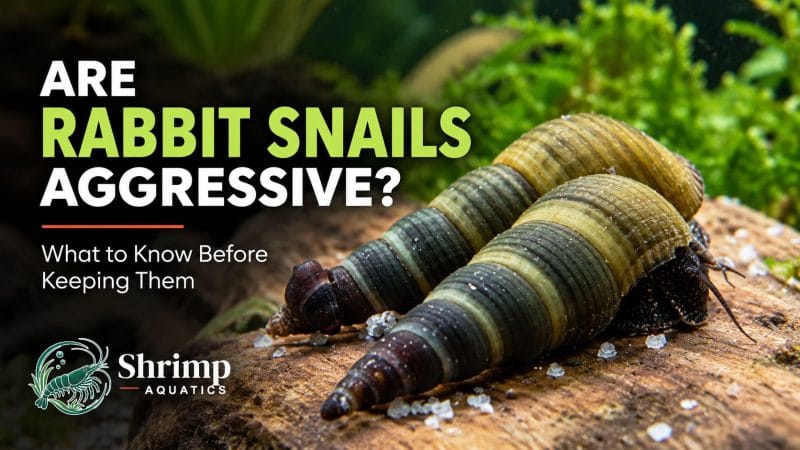
No, rabbit snails aren’t aggressive. Sulawesi rabbit snails (Tylomelania sp.) are slow grazers that spend their time scraping the film of algae and microbes off rock, wood and glass, and they don’t chase, bite or corner fish, shrimp or other snails. If there’s danger in a tank with a rabbit snail in it, it usually runs the other way: certain fish, crabs and snail-eating snails are what the rabbit snail has to worry about.
Will a rabbit snail hurt your shrimp?
No. A rabbit snail and a Sulawesi shrimp live in the same warm, hard water and work the same surfaces, and grazing that surface film is how the snail feeds. Its feeding organ, the radula, is a ribbon of tiny teeth built for scraping. In one Lake Towuti species, snails living on rock and snails living on sunken wood even carry measurably different radulae, apparently shaped by the surface each one grazes.1 That’s a grazer’s toolkit, and we don’t know of any published record of a rabbit snail catching a live shrimp or shrimplet. If shrimp are disappearing from your tank, check the water and your other tankmates before you decide that your rabbit snails eat shrimp.
What a snail does take from your shrimp is food. Sulawesi Keepers, a conservation group that breeds these snails, describes the generalist species as omnivorous and genuinely voracious.2 A large snail working the same rock as your colony eats into the same biofilm, so the thing to plan for is grazing: can the film on your hardscape feed both?
The shrimp that can’t share a tank with a rabbit snail are ruled out by the water, not by the snail. Bee and Crystal Caridina want soft, acidic water. Neocaridina are usually kept below the 79°F where this tank starts, yet a small group lives and breeds in some of our own warm Sulawesi tanks, so they’re a case for care rather than a flat no.
Which tankmates put a rabbit snail at risk?
Snail-eating fish, crabs and assassin snails. The clearest evidence comes from the snails’ own home: as flowerhorn cichlids spread through Lake Matano, the smaller Tylomelania species and the young of the larger ones disappeared, and the same lakes hold two Syntripsa crabs that feed on molluscs.3 A shell is good armor, but it isn’t enough against an animal built to crack or pick it. Leave all three off your list of rabbit snail tankmates, however peaceful they look in the store.
- Assassin snails, which hunt other snails. Never in a rabbit snail tank.
- Cichlids and other large fish, and any fish people buy to control snails.
- Crayfish and large crabs, or anything else with claws strong enough to work at a shell.
- Known fin-nippers, for the reason below.
Why the fin-nippers? Keepers commonly report that nippy fish pick at a rabbit snail’s long tentacles, and that a snail nipped often enough stays shut in its shell and stops feeding. We’d take it seriously and leave nippy species out. Any fish you’re weighing also has to want this tank’s warm, hard water first, which trims the list before temperament even comes into it.
Do rabbit snails fight each other?
No, and in the wild they even carry other snails around. In Lake Poso and the Malili lakes, two species of tiny limpet, Protancylus, are found only on the shells of Tylomelania, riding on them instead of living on the rocks and wood nearby.4 A group of rabbit snails in one tank will graze side by side without squabbling.
What caps the number you keep is the food. Every large snail you add eats into the same film on the rock and glass, so a tank that looks bare between feedings has more snails than it can carry. The same test works for any other snail you’re thinking of adding: does it want this warm, alkaline water, and is there enough film for everyone?
Will a rabbit snail fit your community tank?
It will if your tank is already a mature Sulawesi tank. The snail itself is moderate to keep, and the water is the demanding part: 79-86°F (26-30°C), pH 7.5-8.5, GH 4-8 dGH, KH 3-6 dKH, TDS 150-250 ppm and nitrate kept under 10 ppm. You’ll also want a visible film of algae and biofilm on the rock and glass before the snail goes in. That’s why we wouldn’t call a rabbit snail an easy way into Sulawesi keeping, or a snail for a tank that has only just finished cycling. Hold the tank to the full range for Sulawesi rabbit snail care for a few weeks before the snail arrives.
If you keep soft-leaved plants, plan around them. No published record shows rabbit snails eating living plants, and none shows them leaving plants alone, so hardy epiphytes tied to rock are the safer choice in this tank. A thick grazing film on the rock is the first thing to grow if you want to keep rabbit snails from eating your plants.
Once your tank is there, you can browse our tank-bred Sulawesi rabbit snails. Every one is bred by Shrimp Aquatics, not collected from the wild. We don’t promise breeding, sex or the number of young from any order.
References
4 Sources
- Evolutionary Divergence and Radula Diversification in Two Ecomorphs from an Adaptive Radiation of Freshwater Snails, Hilgers et al., Genes 13(6): 1029, 2022.
- Do you know Sulawesi snails?, Markéta Rejlková, Sulawesi Keepers, 2026.
- Endemic crabs from ancient Sulawesi lakes under double threat, Rejlková and Iqram, Oryx 58(1): 9-14, 2024.
- Freshwater snails of Sulawesi: a brief overview, Thomas von Rintelen, Sulawesi Keepers, 2022.
Ready to get started?
Shop our Sulawesi Snail collection
12 products available · Live Arrival Guarantee