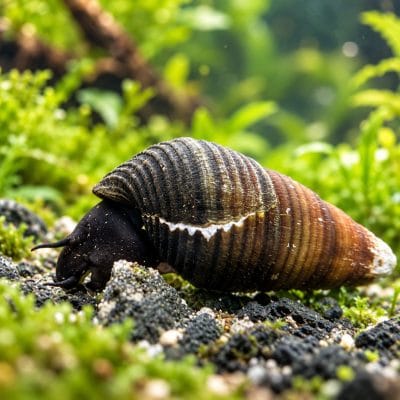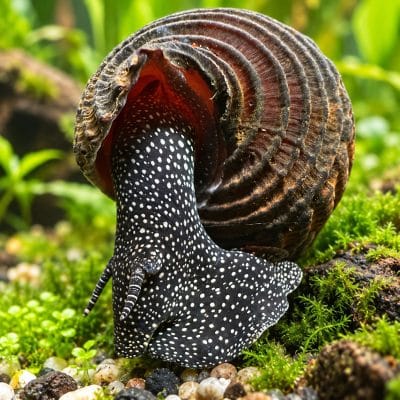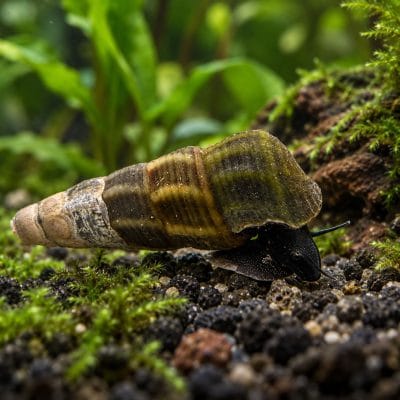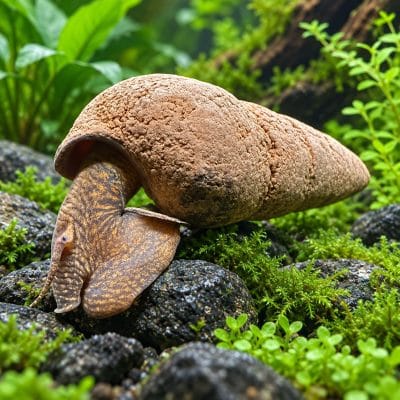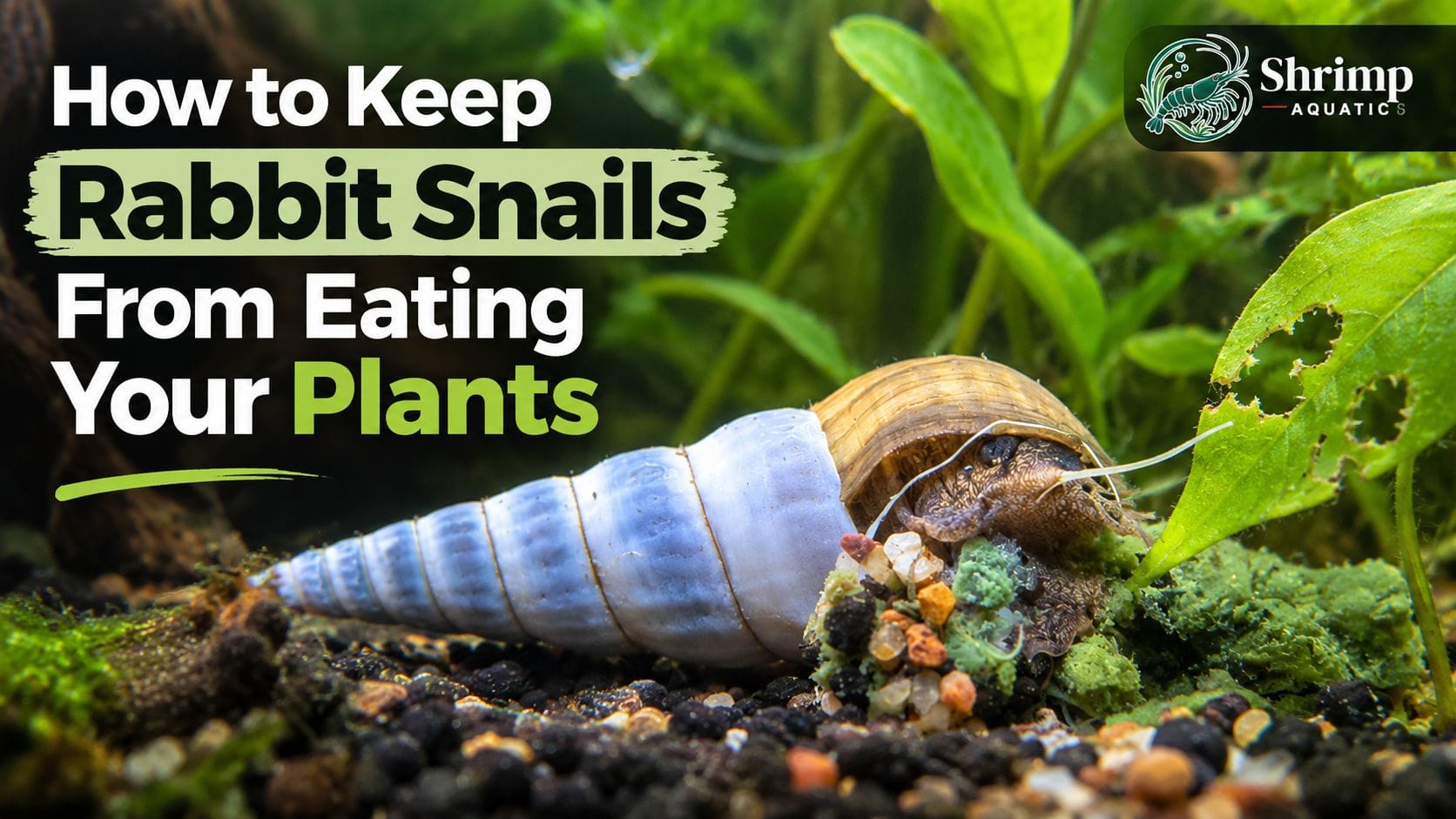
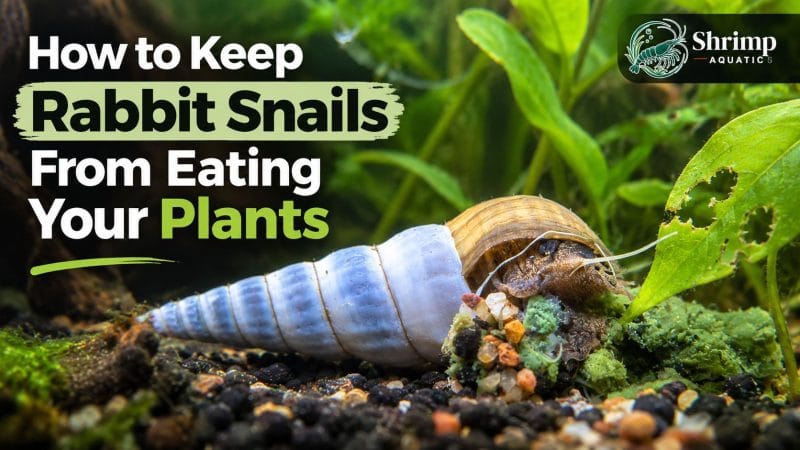
Maybe, and you can make it far less likely. Keepers report both: some rabbit snails (Tylomelania sp.) strip soft leaves, and others share planted tanks for years with nothing chewed. So you protect a planted tank by making the tank do the work: a thick grazing film on rock and glass, plants that can actually live in warm alkaline water, and anything you care about anchored on hardscape.
Will a rabbit snail eat your aquarium plants?
Maybe. We’d rather say that than give you a clean yes or no the evidence doesn’t support. No published study has recorded a Tylomelania either feeding on living plant tissue or ignoring plants. Anyone who tells you they’re guaranteed plant-safe is repeating a care sheet, not a finding.
What is documented is where they feed. In Lake Towuti, Tylomelania sarasinorum exists as two forms that live on different surfaces, one on rock and one on submerged wood, and their feeding organs differ measurably: 79 percent of the snails found on rock were the rock form, and every snail found on wood was the wood form.1 The study measured the radula and the genes expressed in it, so it tells you these animals are built to rasp film off a surface. It doesn’t tell you they swallow the surface, and it doesn’t rule leaves in or out.
Keeper reports are all over the place, and that’s worth knowing before you panic. Plenty of people report a rabbit snail working through Java fern down to the bare rhizome while ignoring softer stem plants next to it. Plenty of others keep the same snails in planted tanks for years with nothing chewed. Read those as reports, not findings. What is on firmer ground is the grazing habit itself, set out in what rabbit snails eat. The same mixed picture shows up with tankmates, and whether rabbit snails eat other snails lands on the same honest answer.
Some of that disagreement probably isn’t about appetite at all. In other freshwater snails, cleaning a leaf and eating a leaf aren’t opposites: in a 90-day outdoor mesocosm experiment, snail grazing removed the algae competing with submerged plants and the plants grew better for it, while the same snails showed feeding preferences among plant species that shifted once competition set in.2 Those are different snails with a different feeding organ, so it isn’t a statement about rabbit snails. It is a good reason why one keeper watching a snail on a leaf sees a cleaner and another sees a pest. Some of it may be the wrong snail altogether: in the rabbit snail vs ramshorn snail comparison, the plant-stripper is usually a giant ramshorn, a different animal sold under the same name.
Our advice is to assume the risk is real for thin, soft leaves and to build the tank so it doesn’t matter much.
Keep the grazing film ahead of your rabbit snail
The first thing to get right is the animal’s own food supply. A tank with a visible film of algae and biofilm on rock, wood and glass gives the snail somewhere to work all day. A clean, young tank with polished glass gives it nothing. If you’re going to have trouble with this animal and your plants, that’s where we’d expect it to start. A grazer with nothing to rasp turns to whatever else is soft, which is why the biofilm a rabbit snail grazes comes first in a planted tank.
Don’t buy one as an algae crew. The conservation group Sulawesi Keepers is blunt about it: green filamentous algae are definitely not their natural food, and while the generalist species are voracious and won’t avoid algae, other species suffer in an aquarium overgrown with algae. The same article separates species that feed on biofilm from stones, glass and smooth surfaces from species that never climb stones at all, for which rockwork takes away living space.3 To cover either group, give the tank both: open sand, and rock and wood to graze.
At Shrimp Aquatics, during the early cycle we normally run the light for 8-10 hours a day so algae and biofilm can establish on the rock and glass. In these systems that natural growth is the main grazing base and prepared food stays supplemental. If you’re setting up for a snail, that’s the work to do before it ships, not after it arrives hungry.
We can’t hand you a feeding menu, and you should be suspicious of the ones that circulate. No published study reports the gut contents of any Tylomelania, so a weekly schedule of blanched vegetables and calcium gels is hobby habit written up as a requirement. The usual rule is a small amount of a sinking food now and then, dropped near where the snail actually grazes, with anything left lifted out before it fouls warm water. Food never makes up for a tank that isn’t mature.
Don’t add the snail to a bare tank
If there’s no visible film on your hardscape and glass yet, wait. A big grazer in a system with nothing to graze is exactly the situation where your plants start looking like the only food in the room.
Choose plants that can live in warm, alkaline water
Pick your plants for the water before you worry about the snail. Rabbit snails need the same water as Sulawesi shrimp, which is warm, alkaline and mineral-rich over inert substrate, and most planted-tank keepers don’t expect that. The soft, acidic, aquasoil-buffered setup that grows delicate stem plants is the wrong tank for this animal, and you don’t get to split the difference. Your plants have to live in it too, and the full range is in Sulawesi rabbit snail care.
| Temperature | 79-86°F (26-30°C) |
|---|---|
| pH | 7.5-8.5 |
| GH | 4-8 dGH |
| KH | 3-6 dKH |
| TDS | 150-250 ppm |
| Nitrate | Hold it under 10 ppm |
| Substrate | Inert sand or gravel with hardscape; no active pH-lowering soil |
| Difficulty | Moderate for the snail, demanding for the system it needs |
That difficulty line matters. The animal itself is hardier than the Sulawesi shrimp we sell, but the tank isn’t a soft one, and a rabbit snail is not a shortcut into Sulawesi keeping or a beginner’s first snail in a three-week-old aquarium.
Plant performance in water like this is species by species, and some plants simply stall. When four submerged species were tested at two bicarbonate levels, three of them photosynthesised harder at the higher level, one didn’t respond at all, and one couldn’t pull enough inorganic carbon out of the water at high alkalinity to keep growing in culture, while Hydrilla verticillata kept growing at an even higher alkalinity.4 Those were lake plants in a laboratory, not an aquarium stocking list. The lesson to take is that hard alkaline water sorts plants into ones that cope and ones that quietly fail, and a failing plant is the one you’ll end up blaming the snail for.
So what’s actually plantable in here? Start with the low-tech species that keepers grow in hard water, and add them a few at a time.
Usually worth trying
Hardy low-tech plants attached to hardscape: Anubias, Java moss, Vallisneria and many Cryptocoryne species. Requirements still vary by species and by your source water, so add a few and watch them for a month before you commit to a layout. Anubias is the safest of these: rabbit snails leave it alone even in tanks where they eat softer plants.
Expect losses
Thin-leaved stem plants, carpeting species and anything planted last weekend. Java fern is the one plant keepers name again and again in damage reports, so if you love yours, we wouldn’t put it in this tank.
Mount plants on hardscape so a heavy grazer can’t pull them loose
Tie or glue epiphytes to rock and wood, and keep the rhizome above the substrate, which is where Anubias and Java fern want it anyway. Plant stems deep enough to hold and leave them alone for a few weeks before you judge them. Skip carpets in this tank; shallow-rooted foreground plants and a snail this size are a losing combination. If you can, leave open sand lanes along the front so the animal has somewhere obvious to travel that isn’t through your planting.
Why bother with all that? Because we think a lot of what gets written up as chewing is a large, heavy snail plowing through a planting that was never held down. A stem that keeps getting knocked loose never roots, and a plant that never roots is the one you lose.
What to do when your rabbit snail is already stripping leaves
Work through it in this order, because the answer is almost never the snail.
- Look at the hardscape. If your rock and glass are spotless, the grazing layer is gone and everything in the tank is now on the menu. Cut back on cleaning, leave the glass alone on the shaded side, and let film rebuild.
- Look at the plant, not the snail. A snail working on a leaf that was already failing looks exactly like a snail killing a healthy plant. Check the new growth before you blame the animal: if the plant is still pushing out good leaves, it isn’t losing.
- Move the plant, not the animal. Lift the species that’s taking damage onto hardscape or out of the tank, and replace it with something from the list above.
- Check the water before you change anything else. Ammonia and nitrite at zero, temperature steady, and the numbers above holding. An unstable tank changes how everything in it behaves.
What we wouldn’t do is starve the snail into leaving plants alone, or reach for a chemical that kills snails. The first is cruel and doesn’t work; the second kills the animal you paid for. And if what you actually want is an untouched competition aquascape with a guarantee attached, be honest with yourself and don’t keep this snail. We’d rather lose the sale than read your email in three weeks.
Before you add a rabbit snail to a planted tank
Run through this first. If any line is a no, the snail can wait.
- The tank is cycled, with ammonia and nitrite at zero and a working biological filter.
- There’s a visible film of algae and biofilm on rock and glass, not just clean decor.
- Your water sits in the range in the table above and holds there between changes.
- The substrate is inert, not an active soil that pulls pH down.
- Your aquascape depends on carpet plants or delicate stems staying perfect.
Our Sulawesi snails are bred by Shrimp Aquatics, not collected from the wild, and they’re kept in the same water as our Sulawesi shrimp, so one set of numbers covers the whole tank. We don’t promise breeding, sex or the number of young from any order, and we won’t promise your plants come through untouched either. What we can tell you is what the animal is built to do, which is graze film off hard surfaces all day, and how to make sure yours has plenty of it.
References
4 Sources
- Evolutionary Divergence and Radula Diversification in Two Ecomorphs from an Adaptive Radiation of Freshwater Snails, Genes (Basel), 2022.
- Snail communities increase submerged macrophyte growth by grazing epiphytic algae and phytoplankton in a mesocosm experiment, Ecology and Evolution, 2022.
- Do you know Sulawesi snails?, Sulawesi Keepers, read 2026-09-19.
- The effect of alkalinity on photosynthesis-light curves and inorganic carbon extraction capacity of freshwater macrophytes, Aquatic Botany 75: 217-227, 2003.
Ready to get started?
Shop our Sulawesi Snail collection
12 products available · Live Arrival Guarantee