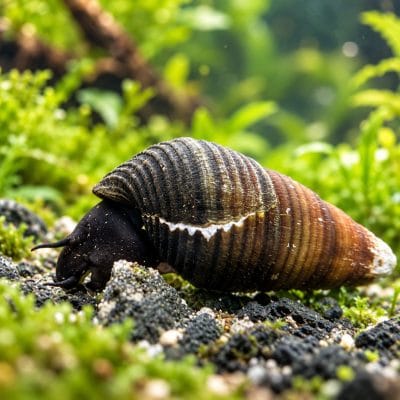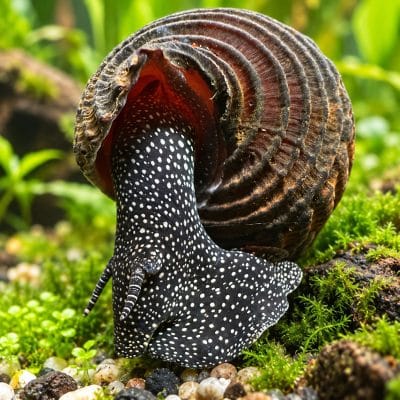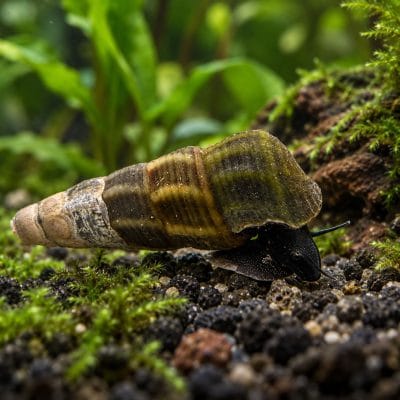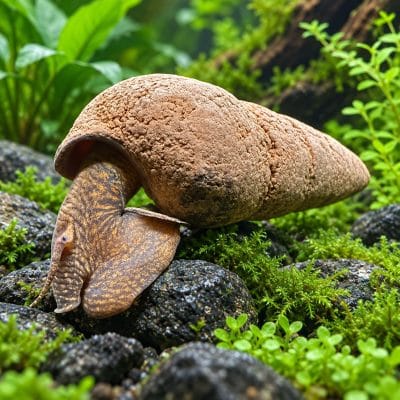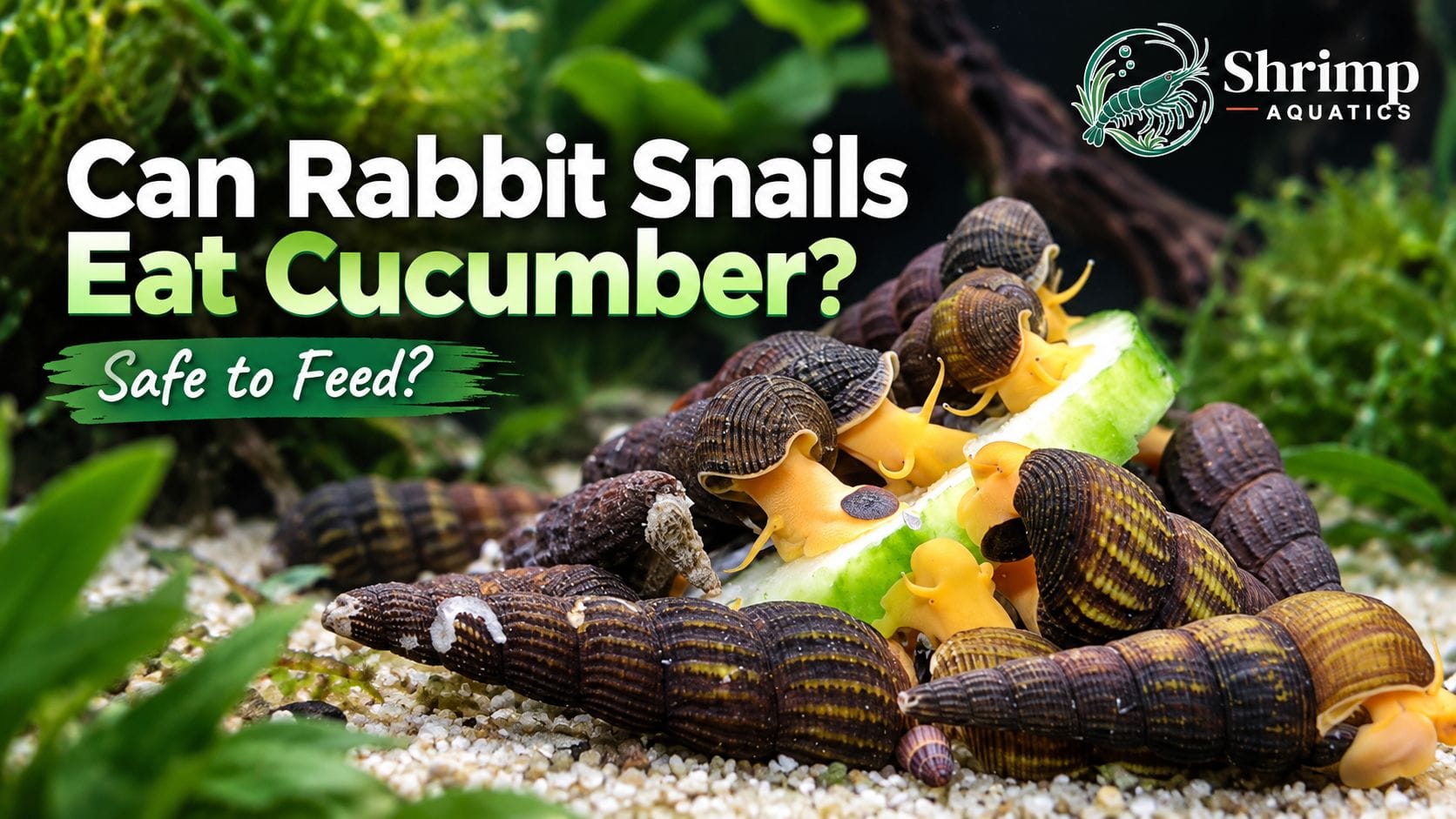
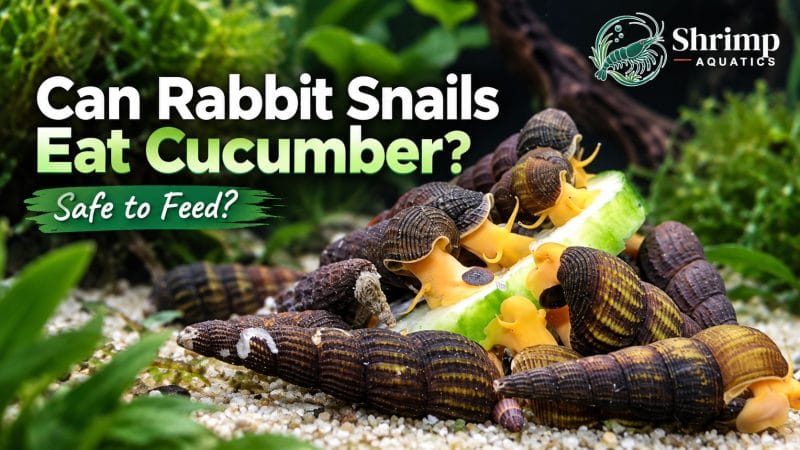
Yes, and most of them will take it. Peel a slice, soften it, sink it where the snail can reach it, and a rabbit snail (Tylomelania sp.) will usually park on top and rasp away. No published study has looked at what any Tylomelania eats, in the wild or in a tank, so every cucumber claim you’ll read, this one included, rests on keeper experience plus what we know about the vegetable itself. And the vegetable is mostly water. The film on your rock and glass is still the meal that counts, which is the short version of what rabbit snails eat.
Cucumber feeds a rabbit snail almost nothing
Offer it because you like watching them feed, not because it’s a meal. The FDA’s chart for raw vegetables puts a 99 gram serving of cucumber, about a third of a medium one, at 10 calories, 1 gram of protein, 1 gram of fiber and 2 percent of the daily value for calcium.1 That’s a vegetable built around water. For an animal hauling a heavy shell around, there isn’t much in there to build with.
| Calories | 10 |
|---|---|
| Protein | 1 gram |
| Dietary fiber | 1 gram |
| Calcium | 2 percent of the daily value |
The calcium line is the one keepers worry about, and it’s the one that matters least. In a trial that reared apple snails at three calcium levels, the authors note that most of a freshwater snail’s shell calcium is taken up straight from the water instead of from its food, and the snails in the richest calcium water grew faster and finished with harder shells.2 Those are apple snails, a different family, so read it as how snail shells work in general. What it means for you is practical. Your GH, your KH and your mineral mix are doing the shell work. A slice of cucumber was never going to. Hold them where Sulawesi rabbit snail care puts them and a cucumber slice changes nothing about the shell.
So is cucumber bad for them? No. It sits close to neutral. The risk is what a lump of wet plant tissue does to a warm tank once you forget about it, and what happens if you let it stand in for the film the snail actually lives on.
If not cucumber, what keeps a rabbit snail fed?
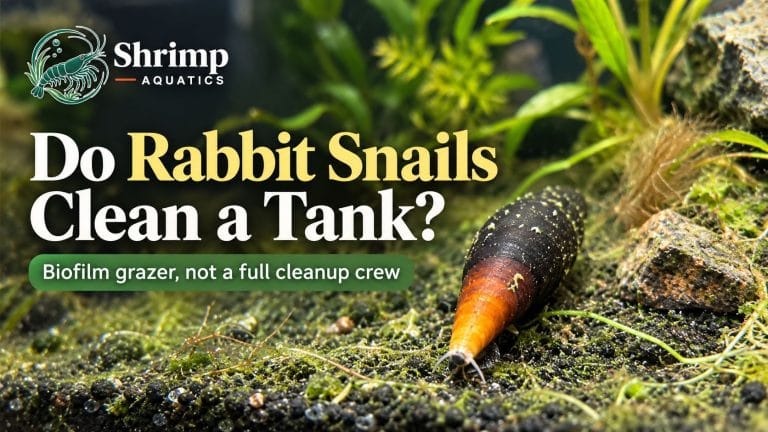
The film on your hardscape does. Grazing on biofilm and aufwuchs is the feeding mode that’s actually documented for this genus, and the tank has to be growing it before the snail arrives. Sulawesi Keepers, the conservation group that works with these animals, is blunt about the rest: green filamentous algae are “definitely not their natural food”, and the species that live on hard surfaces feed on the biofilm they scrape off stones and glass.3 A rabbit snail isn’t a cleanup crew. Buy one to clear hair algae and you’ll both be disappointed.
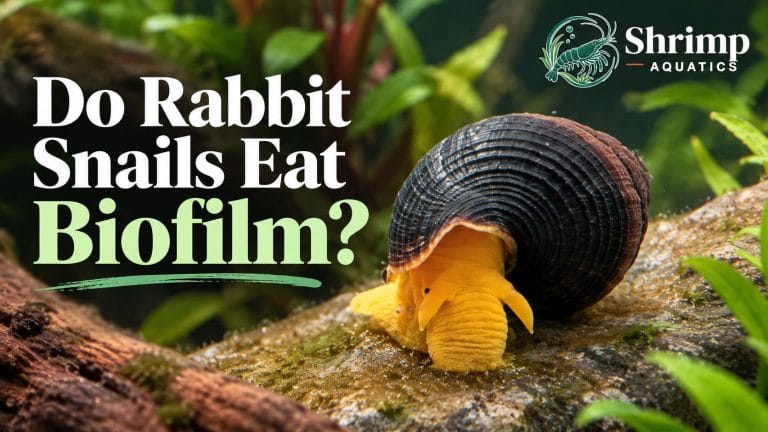
How specialized that grazing is shows up in the animal itself. In Lake Towuti, Tylomelania sarasinorum exists as two forms that sit on different surfaces. Of the snails found on rock, 79 percent were the rock form, and every snail found on wood was the wood form, and the two have measurably different radulas, the ribbon of teeth a snail rasps with.4 That work measured teeth and gene expression, not stomach contents, so it can’t tell us what they swallow. It does tell us the surface matters to this animal in a way a vegetable clip never will. That surface is where the real food grows, and the biofilm rabbit snails graze is what a cucumber slice can only top up.
A bare new setup isn’t ready for a grazer this size, so grow the film first if you’re still deciding whether to add Sulawesi rabbit snails. Ours are tank-bred by Shrimp Aquatics. We’d rather they went to a tank that already carries a visible layer on rock and glass, because in a bright new setup a cucumber slice ends up being the only food in there, and that isn’t enough.
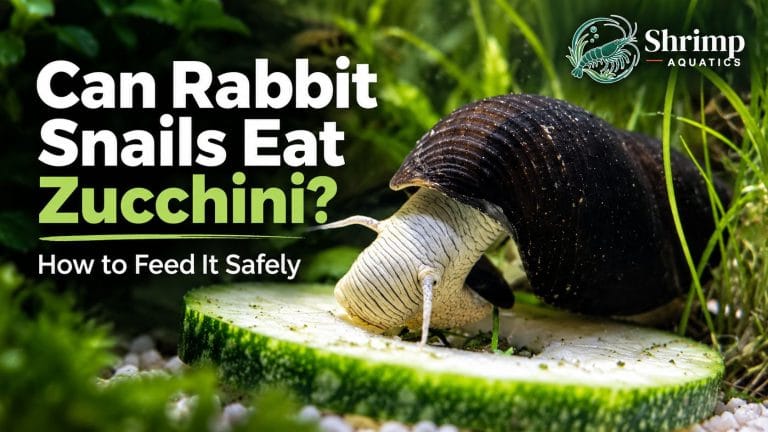
Would zucchini or spinach be better? If you want to offer something, keep the piece small, change it up, and judge it by how much has actually been rasped off before you lift it out. A zucchini slice gets the same test, and whether rabbit snails eat zucchini comes down to the same rasped patch you are looking at.
How to prepare cucumber so a rabbit snail can actually eat it
Peel it, soften it, sink it, and put it on the bottom. A rabbit snail plows along the sand and climbs onto rock. It won’t chase a slice bobbing at the surface, and raw cucumber floats.
- Rinse and peel the whole slice. The skin is where surface residue and any wax coating sit, and it’s the part a snail has the most trouble with. We’d take it off even on an organic cucumber.
- Cut a piece about a centimeter thick and scoop the seedy middle out, so you aren’t picking loose seeds off the sand later.
- Drop it into plain boiling water for a minute or two, or microwave it in water for half a minute. No salt, no oil, nothing else in the pot. You want it soft enough to dent with a fingernail.
- Move it straight into ice water for a minute. That’s the step that pushes the trapped air out, so the slice sinks instead of bobbing.
- If it still floats, pin it down where the snails graze, using a stainless steel skewer, a glass veggie clip or a clean stone.
Never weigh food down with copper or brass
Copper stays out of a tank holding snails or shrimp, and that includes hardware you only drop in for an hour. Stainless steel, glass, ceramic and inert stone are fine. If you can’t tell what an old clip or weight is made of, don’t use it.
How long cucumber can stay in a warm, alkaline tank
A couple of hours, then out. Not overnight. This is where a Sulawesi tank behaves differently from a room-temperature shrimp tank, and the reason is worth knowing.
You’re keeping these snails at 79-86°F (26-30°C) and pH 7.5-8.5. Both of those push the same lever. Ammonia in water sits in two forms, and only one of them, the un-ionized form, is what actually poisons animals. EPA’s freshwater ammonia criteria put the ratio of un-ionized ammonia to ammonium ion rising about tenfold for every single pH unit, and roughly twofold for each ten degree Celsius rise in temperature.5 Read that against your own tank. The same total ammonia reading that would be a shrug in a cool, near-neutral tank is a worse number at pH 8 and 84°F.
Warm water also holds less dissolved oxygen than cold water does.6 So the tank most likely to turn a forgotten slice into a problem is also the one with the smallest oxygen reserve to absorb it.
At Shrimp Aquatics, our Sulawesi systems get prepared food about once a week and the leftovers come out, because food that sits in warm water adds organic waste and can push ammonia, nitrite and nitrate up as it breaks down. That’s the rhythm we’d use for cucumber too: an occasional extra, never a standing dish.
Treat the two-hour, four-hour and twenty-four-hour numbers quoted around the hobby for how long a cucumber slice can safely sit in the tank as guesses. Taking it out while it’s still firm costs you nothing.
Then let the slice tell you what to do next. If it comes out barely touched two or three times running, stop offering it. Either the film is feeding them well, which is the result you want, or something else is off and a vegetable isn’t the fix. If it comes out clean every time and the snails are on it within minutes, offer it a little more often. Watch the tank, not the calendar.
References
6 Sources
- Nutrition Information for Raw Vegetables, U.S. Food and Drug Administration, content current as of December 13, 2017.
- Growth and shell hardness of the apple snail Pomacea flagellata Say, 1829, reared at three calcium concentrations, PeerJ 11:e14840, 2023.
- Do you know Sulawesi snails?, Sulawesi Keepers, undated article by Marketa Rejlkova.
- Evolutionary Divergence and Radula Diversification in Two Ecomorphs from an Adaptive Radiation of Freshwater Snails, Genes 13(6):1029, 2022.
- Aquatic Life Ambient Water Quality Criteria for Ammonia, Freshwater, U.S. Environmental Protection Agency, Office of Water, April 2013.
- Dissolved Oxygen and Water, U.S. Geological Survey, Water Science School, updated August 24, 2026.
Ready to get started?
Shop our Sulawesi Snail collection
12 products available · Live Arrival Guarantee