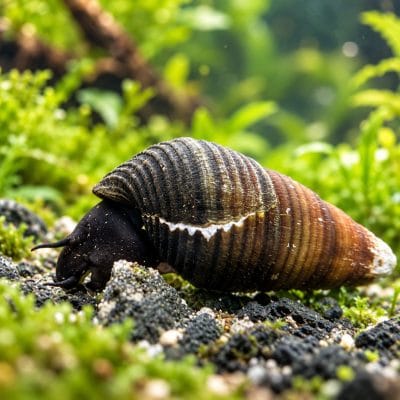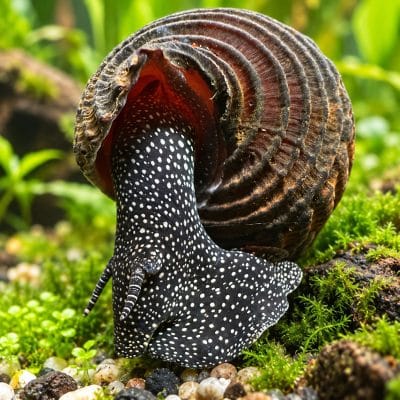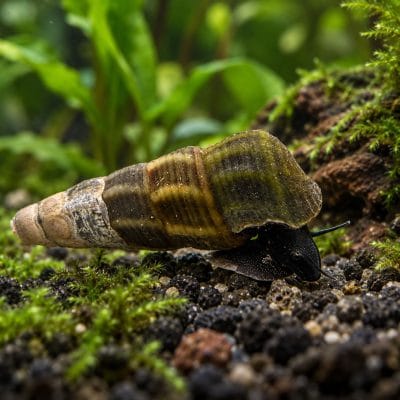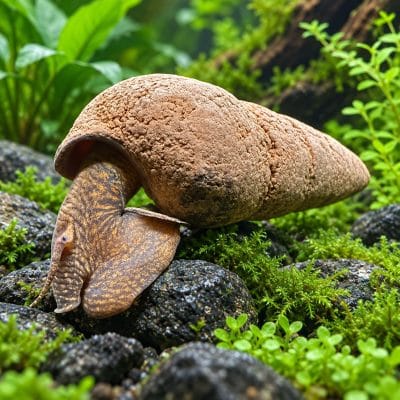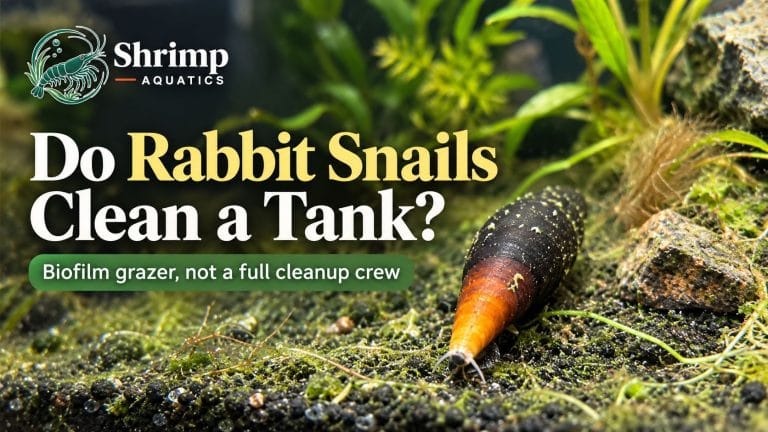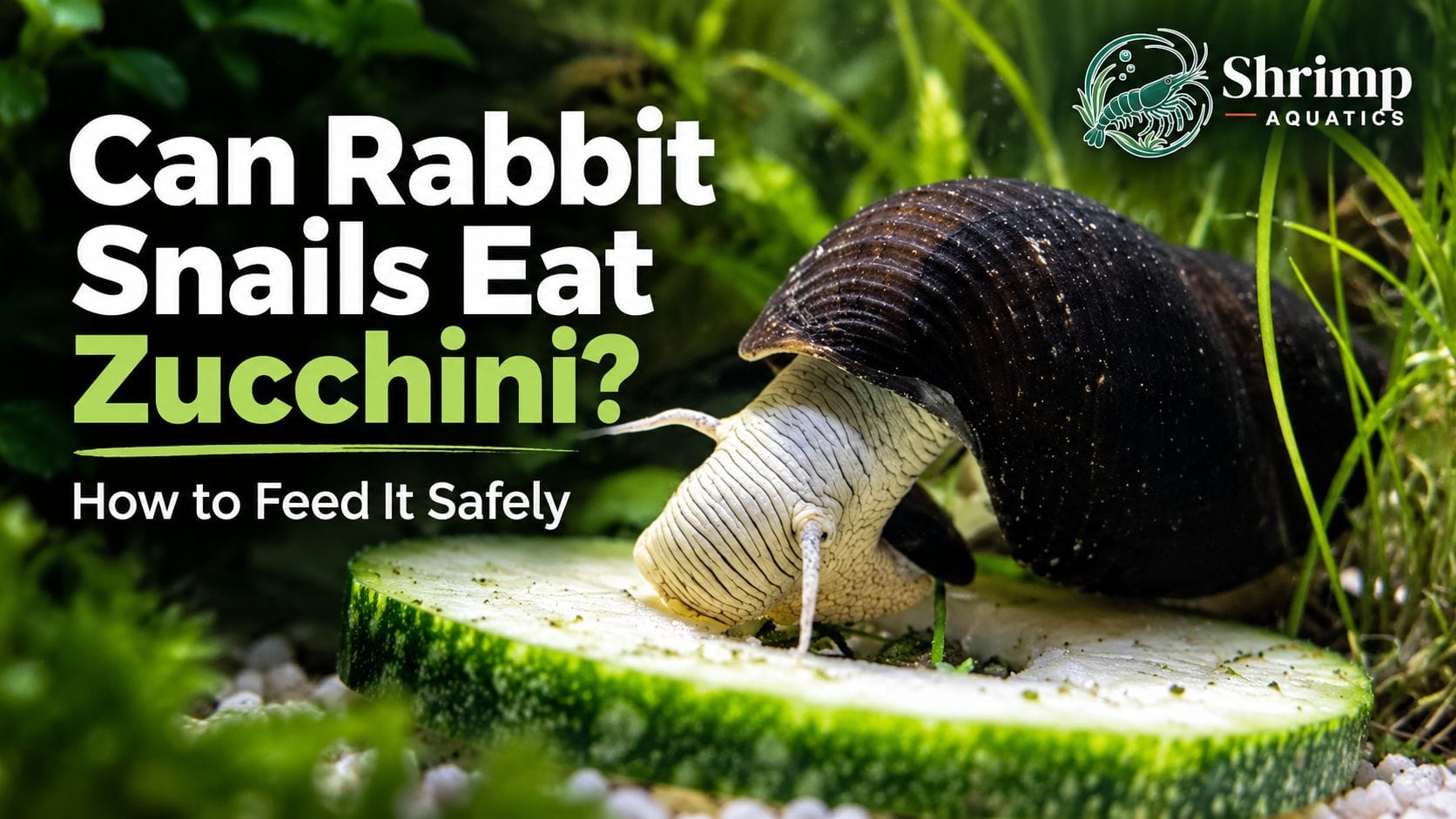
Yes. A rabbit snail (Tylomelania sp.) will usually graze a slice of blanched zucchini, and plain zucchini carries nothing that can harm it. Think of it as an occasional extra sitting on top of the biofilm these snails really live on: small piece, softened first, and out of the tank before it starts breaking down in warm water.
What a rabbit snail actually grazes, and where a zucchini slice fits
These animals are grazers before they’re anything else. Sulawesi Keepers, a conservation group that works with these lake snails, describes them feeding on the biofilm that grows on stones, glass and other hard surfaces, and says green filamentous algae are not their natural food.1 That’s the food your snail is built around, and it’s the reason a mature tank matters more than anything you drop in.
What nobody can tell you is what a wild rabbit snail has in its gut, because no published study has looked. So vegetable feeding is hobby practice, not a documented part of the diet. That doesn’t make zucchini a risk. It makes it optional, and it means the only test that counts is your own snail’s response to one slice. What the animal lives on is the film on your hardscape, which is the whole of what rabbit snails eat.
Expect that response to be slow. A rabbit snail can take most of a night to find food, and some individuals walk past a slice for weeks before touching one. Neither is a sign that anything is wrong.
How to prepare a zucchini slice a rabbit snail can graze
Raw zucchini floats, and the skin is where pesticide residue and supermarket wax sit. Softening it and getting it to the bottom is the whole job.
- Rinse the zucchini under running water, then peel it. The peel goes in the bin, not the tank.
- Cut a round about half an inch thick. Thicker holds together longer; thinner turns to mush.
- Drop it into plain boiling water for one to three minutes, until the white flesh goes translucent and soft enough for a fork to slide in easily.
- Move it straight into cold water for a minute or two. That stops the cooking and helps the slice sink instead of bobbing.
- If it still floats, pin it down with a stainless steel veggie clip or a glass feeding dish. Skip lead weights and anything that rusts.
No seasoning, ever
No salt, no oil, no butter, no leftover cooked zucchini from dinner. Cook it in plain water or don’t cook it at all.
How much zucchini one rabbit snail needs
Very little. A round the size of a bottle cap will keep two or three adults busy, and the usual rule is once or twice a week at most, offered in the evening when the snails start moving. If the slice is gone by morning, the portion was about right. If half of it is still sitting there, cut the next one smaller. Cucumber gets judged exactly the same way, and whether rabbit snails eat cucumber ends with the same small portion.
Your snails still graze all day on rock and glass, so a feed you skip costs them nothing. A feed you overdo costs you water quality. A sinking pellet does the same damage on the same clock, which is why whether rabbit snails eat fish food is really a question about leftovers.
When to lift the slice back out of a warm Sulawesi tank
So how long can a slice stay in? A slice usually comes out after 10 to 48 hours, most often after about a day. We’d lift ours by the next morning: twelve hours or so is generous, and there’s no good reason to leave a softened vegetable in this tank for a second day. The reason is the water these snails need, which is warmer and more alkaline than most freshwater aquariums.
| Temperature | 79-86°F (26-30°C) |
|---|---|
| pH | 7.5-8.5 |
| GH | 4-8 dGH |
| KH | 3-6 dKH |
| TDS | 150-250 ppm |
| Nitrate | under 10 ppm |
Two things change in water like that. Ammonia gets more dangerous per unit: EPA’s freshwater criteria, written for aquatic life in general, describe the share of ammonia present in the toxic un-ionized form rising about tenfold for each single pH unit and roughly twofold for each 10 degree Celsius rise in temperature, and it’s that un-ionized form that drives the toxicity.2 Warm water also holds less dissolved oxygen than cold water does.3 Decaying zucchini pushes on both at once, in a tank that starts near the top of both scales.
So the timing isn’t fussiness. A slice that would sit for a day in a cooler community tank is doing more damage here, and doing it faster.
What to check in the tank the day after a zucchini feed
The first time you feed vegetables, test ammonia and nitrite the following day. You’re looking for zero on both, the same as always, and you’re mainly checking that the portion and the timing you chose are ones your tank can absorb.
- Ammonia and nitrite both at zero.
- Water clear, with no white haze and no sour smell at the surface.
- Snails out and moving on their usual surfaces in the evening.
- Cloudy water, a film on the surface or snails staying shut for days after a feed. Stop offering vegetables, do a small water change with matched water, and sort the water out before you feed again.
Why zucchini will not fix a thinning rabbit snail shell
Plenty of care sheets sell zucchini as a calcium food. We’d treat that as hobby folklore. The better evidence points at the water instead: in a study of the apple snail Pomacea flagellata, most of the calcium in the shell is taken up from the water, not from what the snail eats, and animals reared at the highest calcium level grew faster and ended up with harder shells than those at lower levels.4 That’s a different family from Tylomelania, so read it as how snail shells work in general.
The practical version for your tank: if a shell is looking thin or pitted at the growing edge, test GH and KH before you change the menu. Holding GH 4-8 dGH and KH 3-6 dKH steady does more for that shell than any vegetable will. Where those numbers come from, and how to hold them, is covered in Sulawesi rabbit snail care. Keepers often add a piece of cuttlebone as well, which costs nothing to try, and it still doesn’t replace minerals that were never in the water.
When to skip the zucchini altogether
Some weeks the right answer is no food at all. Skip it when:
- The tank is new and the rock and glass still look clean. A snail this size needs a visible film of algae and biofilm to graze; vegetables don’t make up for a young system.
- The snail arrived in the last few days and is still shut up in its shell. Leave it be and let it come out on its own schedule.
- Ammonia or nitrite is reading anything at all. Fix that first.
- You already fed this week and the last slice came out half eaten.
If you’re still deciding what to put in the tank, our Sulawesi rabbit snails are tank-bred by Shrimp Aquatics, and they expect the same warm, alkaline water shown above, with grazing surfaces already established before they go in. Get that part right and the zucchini question stays what it should be: a small treat you offer now and then, on a tank that was already feeding them.
References
4 Sources
- Do you know Sulawesi snails?, Sulawesi Keepers, undated page, read September 2026.
- Aquatic Life Ambient Water Quality Criteria for Ammonia, Freshwater, U.S. Environmental Protection Agency, Office of Water, April 2013.
- Dissolved Oxygen and Water, U.S. Geological Survey, Water Science School, updated August 24, 2026.
- Growth and shell hardness of the apple snail Pomacea flagellata Say, 1829, reared at three calcium concentrations, PeerJ, 2023.
Ready to get started?
Shop our Sulawesi Snail collection
12 products available · Live Arrival Guarantee