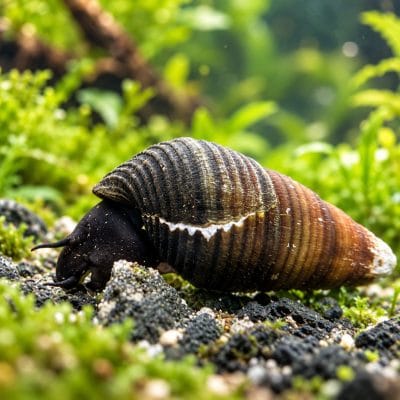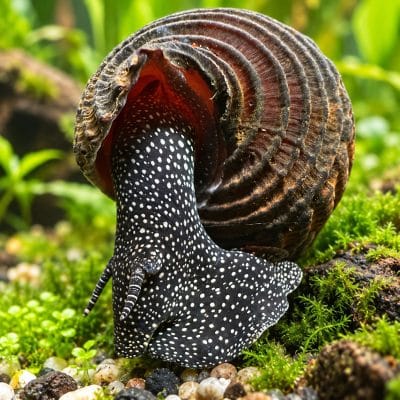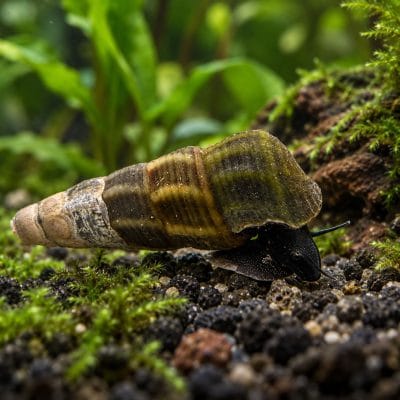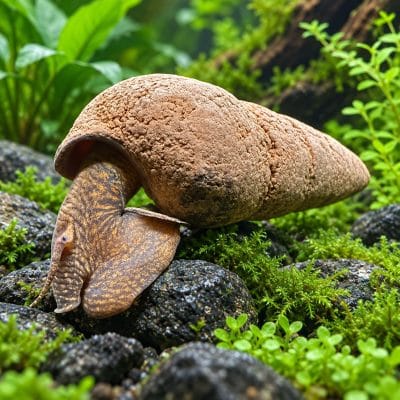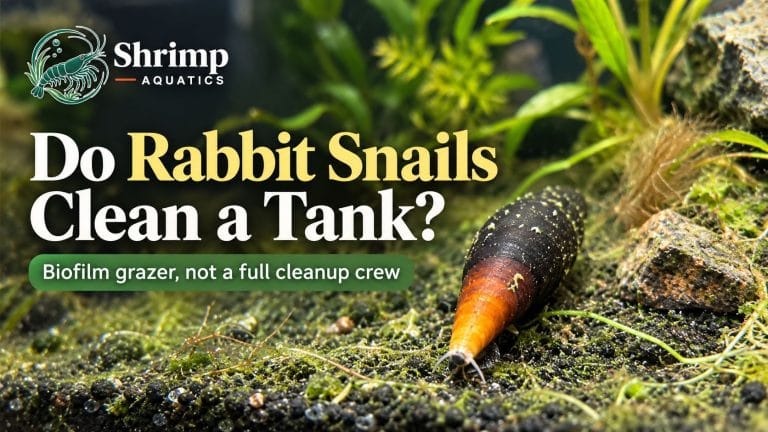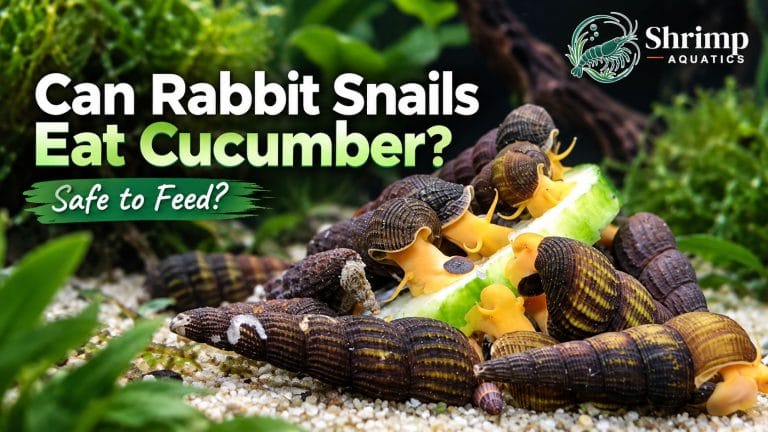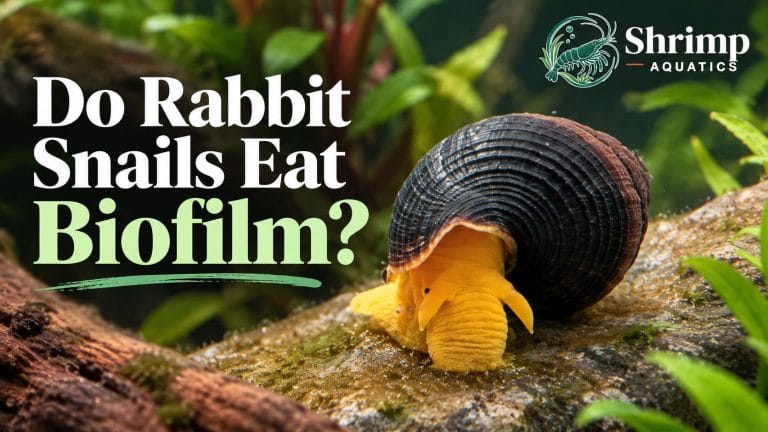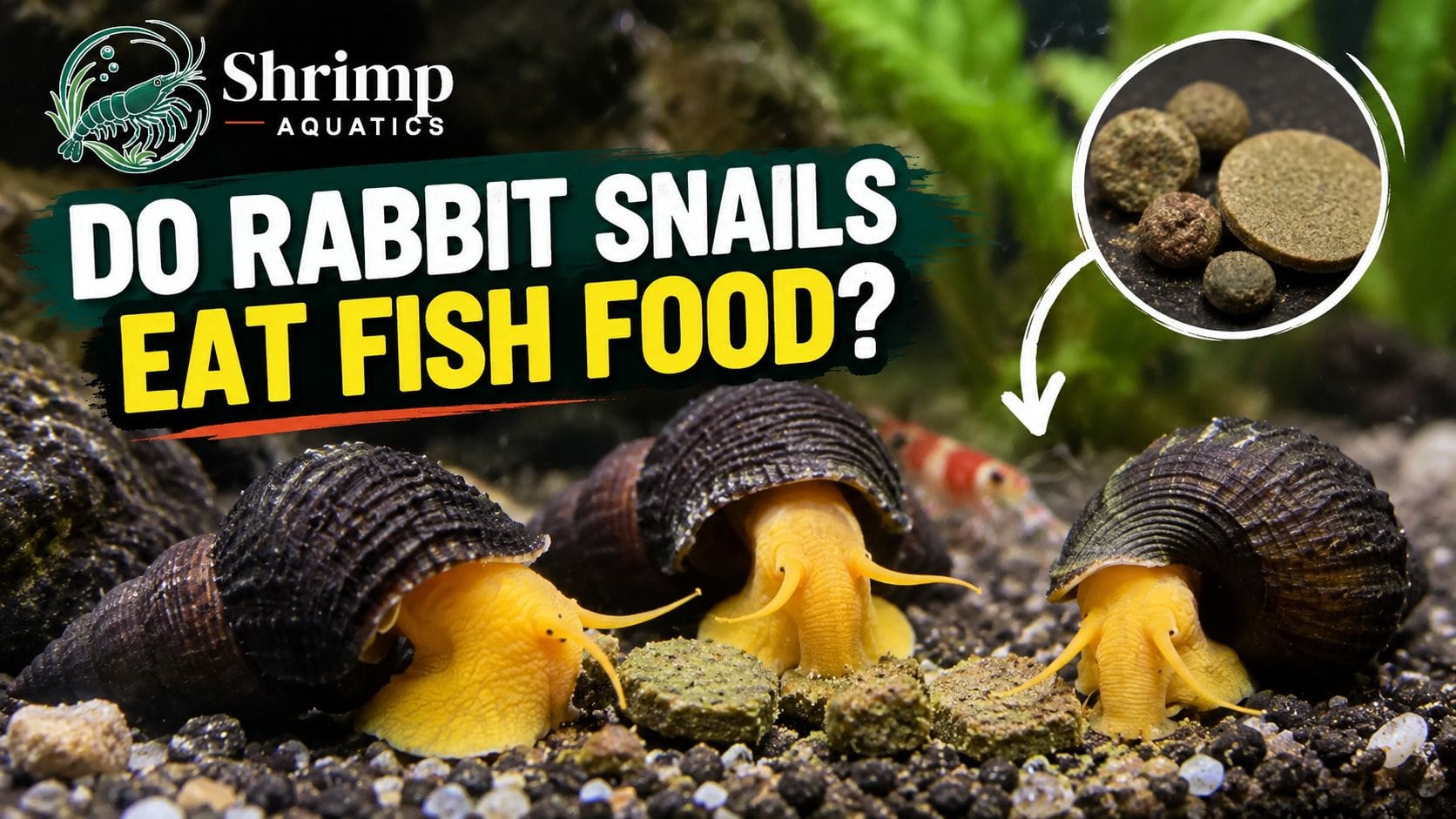
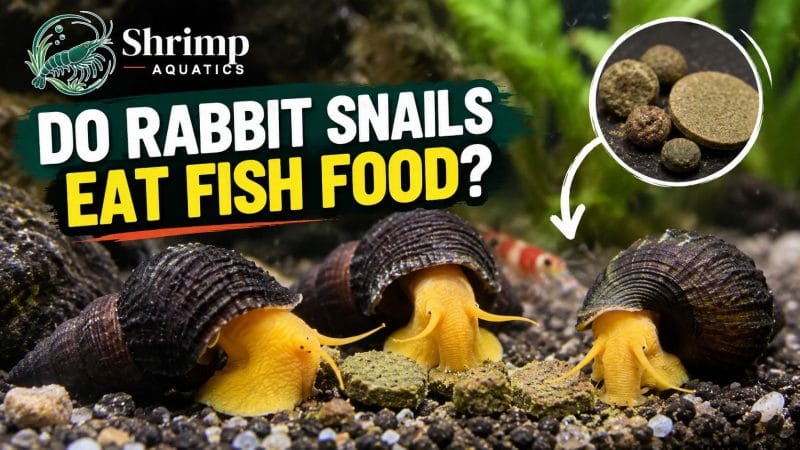
Yes. Put a sinking pellet or an algae wafer on the sand and a rabbit snail (Tylomelania sp.) will usually find it and start rasping. That is not the same as fish food being their food. The grazed film is the meal and a pellet is a top up, which is the picture in what rabbit snails eat.
Which fish foods actually reach a rabbit snail
These are slow, heavy grazers that work the substrate and the hardscape. They can’t chase food and they won’t come up for it, so what matters is whether the food reaches the bottom before something faster clears it.
| Food form | Does it reach the snail | What to watch |
|---|---|---|
| Sinking pellets, wafers and tablets | Yes, they land in the grazing zone | Fish, shrimp and faster snails often strip them first, so watch where the food actually ends up |
| Flakes and floating pellets | Rarely, unless flow pushes them down | Whatever settles uneaten breaks down in the substrate, where the snail lives |
| Frozen foods such as bloodworm or brine shrimp | Yes, they sink | High in protein and easy to overdo; offer a piece you can find again and lift what is left |
The practical routine is simple. Offer a small piece where you can see it, give the tank an hour, and take out whatever is still untouched.
At Shrimp Aquatics, mature algae and biofilm do most of the feeding in our Sulawesi systems. We normally offer prepared food only about once a week and remove leftovers. That cadence is worth copying if your rock and glass already carry a film. If the tank is bare and new, more food isn’t the fix. A snail that ignores that offering is usually still grazing, which is the point of why rabbit snails ignore prepared food.
Why fish food can’t replace the biofilm your rabbit snail grazes
Sulawesi Keepers, a conservation group working with these snails, describes the hard surface species as feeding on the biofilm growing on stones, glass and other smooth surfaces, says green filamentous algae are definitely not their natural food, and describes the generalists, which are not tied to hard or soft ground, as omnivorous and voracious enough that they won’t avoid algae either.1 The traded rabbit snails are sold as Tylomelania sp. with no species name attached, and that preference has never been recorded for a hobby line.
Two things follow for you. Don’t buy one as an algae eater or a cleanup crew, because a hair algae problem is not a job these snails do. And don’t reach for prepared food to make up for a young tank. A rabbit snail belongs in a system that already carries a visible film on the rock and glass, and food dropped in the water can’t stand in for that.
What uneaten fish food does in a warm, alkaline snail tank
We keep these snails in the same water as our Sulawesi shrimp, 79-86°F (26-30°C) at pH 7.5-8.5, and that is exactly the water in which leftovers are least forgiving. Food breaking down releases ammonia, and ammonia sits in two forms. The EPA’s freshwater ammonia criteria describe the un-ionized form as the one that drives toxicity, and put the ratio of un-ionized ammonia to ammonium up tenfold for each rise of a single pH unit, and up roughly twofold for each rise of ten degrees Celsius.2 Those criteria cover freshwater life in general, not this snail, so read them as the reason one crumb behaves differently in a Sulawesi tank than in a cool, neutral community tank.
So keep the portion small, and take leftovers out the same evening. The same evening cutoff applies to a zucchini slice, which softens fast in warm water. We wouldn’t leave prepared food in overnight in water this warm, and a snail that has a grazing film available loses nothing by waiting until tomorrow.
Will fish food keep a rabbit snail’s shell hard?
Mostly not, and this is the part readers usually have backwards. The shell is built largely from minerals the animal takes out of the water. In a controlled trial on an apple snail, a different family of snail, most of the shell calcium was taken up from the water instead of from the diet, and the snails reared in the highest calcium water grew faster and produced harder shells.3 That is a mechanism borrowed from another snail, not a measurement on Tylomelania, and there is no published calcium or hardness figure for rabbit snails at all. Whether your water can supply them is a GH and KH question, answered in Sulawesi rabbit snail care.
What you can act on is the water. Hold the minerals steady in the range we keep to, GH 4-8 dGH and KH 3-6 dKH, and don’t let KH drift down between water changes. If your water sits there, a calcium wafer is not what is holding the shell together, and we’d fix the water before buying one.
Is the copper in fish food a risk to rabbit snails?
This comes up every time somebody reads an ingredient panel and finds copper sulfate in the mineral premix. What is documented is this: the EPA’s background material on copper criteria for aquatic life says elevated copper is toxic in aquatic environments and may affect invertebrates, with mortality among the acute effects and reduced survival, reproduction and growth among the chronic ones, and that pH, alkalinity, dissolved organic carbon and hardness all change how bioavailable copper is.4 That work is about copper dissolved in the water.
We can’t find a study that tests the trace copper bound into a fish food on any freshwater snail, so no one can give you a safe amount from evidence, and we won’t invent one. Our own position: we wouldn’t throw out a food over a trace mineral in the premix, and we are strict about the other source.
Keep copper treatments out
Copper based fish medications, copper algaecides and copper dosed snail treatments don’t go in a tank holding rabbit snails. If a fish in that tank needs treating with one, treat it in a separate hospital tank.
Do baby rabbit snails need the food crushed?
Rabbit snails are live bearers. The young develop inside a uterine brood pouch, are produced continuously, and leave the mother already shelled, and in some species those juveniles are the largest known in any live bearing snail, close to 2 cm long at release.5 A newborn that size is not a speck waiting for dust to settle.
So crushing or soaking pellets for the young is a keeper habit, not something anyone has tested. We’d put the effort into grazing surfaces instead, because a mature tank with film on the rock feeds the young the same way it feeds the adults. Brood size, how often a female gives birth and how fast the young grow are all unpublished for the lines in the trade, so we don’t promise young from any order and we can’t tell you how many to expect.
Feeding rabbit snails in a tank that already feeds fish
If your snails share a tank with fish that get sinking food, they are already being fed, and doubling up on top of that is the mistake we see most. Watch them for a week before you change anything. If they are out and working the rock and glass, the tank is feeding them. Which fish belong in that tank at all is a water question first, and most rabbit snail tankmates people suggest fail it.
Before you add one at all, the tank has to be ready: warm, alkaline, stable, and carrying visible algae and biofilm on the hardscape. The snail itself is moderate to keep. The system is the demanding part, and a rabbit snail is not a shortcut into Sulawesi keeping or a first snail for a young tank. If your tank is already running at those numbers with a grazing film in place, it can feed a rabbit snail from day one, and that is the condition we’d want met before any of our tank-bred Sulawesi snails go into it.
References
5 Sources
- Do you know Sulawesi snails?, Sulawesi Keepers, undated.
- Aquatic Life Ambient Water Quality Criteria for Ammonia, Freshwater, U.S. Environmental Protection Agency, Office of Water, April 2013.
- Growth and shell hardness of the apple snail Pomacea flagellata Say, 1829, reared at three calcium concentrations, PeerJ, 2023.
- Supplementary Training Materials for Aquatic Life Criteria, Copper, Background, U.S. Environmental Protection Agency, Office of Water, last updated May 2026.
- Anatomy of an adaptive radiation: a unique reproductive strategy in the endemic freshwater gastropod Tylomelania (Cerithioidea: Pachychilidae) on Sulawesi, Indonesia, and its biogeographical implications, Biological Journal of the Linnean Society, 2005.
Ready to get started?
Shop our Sulawesi Snail collection
12 products available · Live Arrival Guarantee