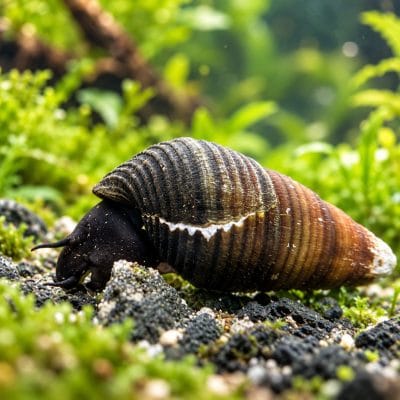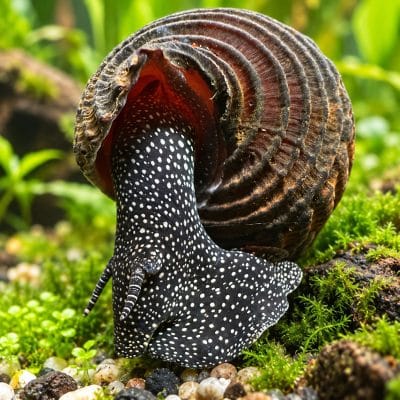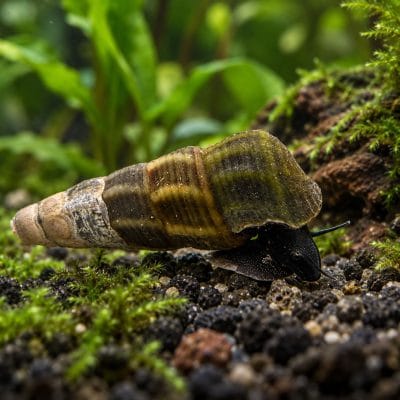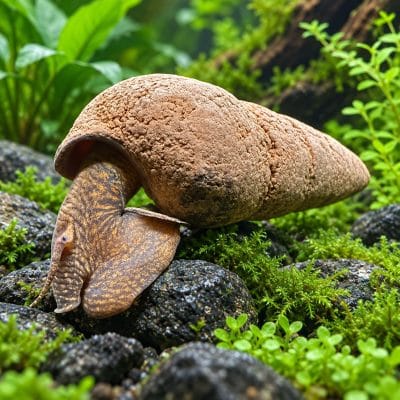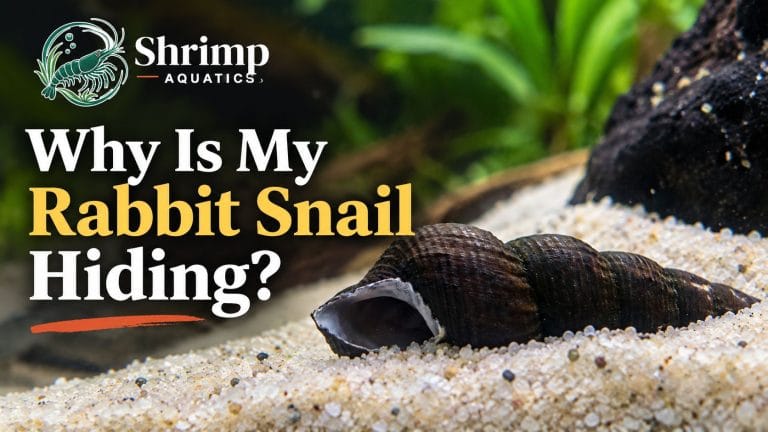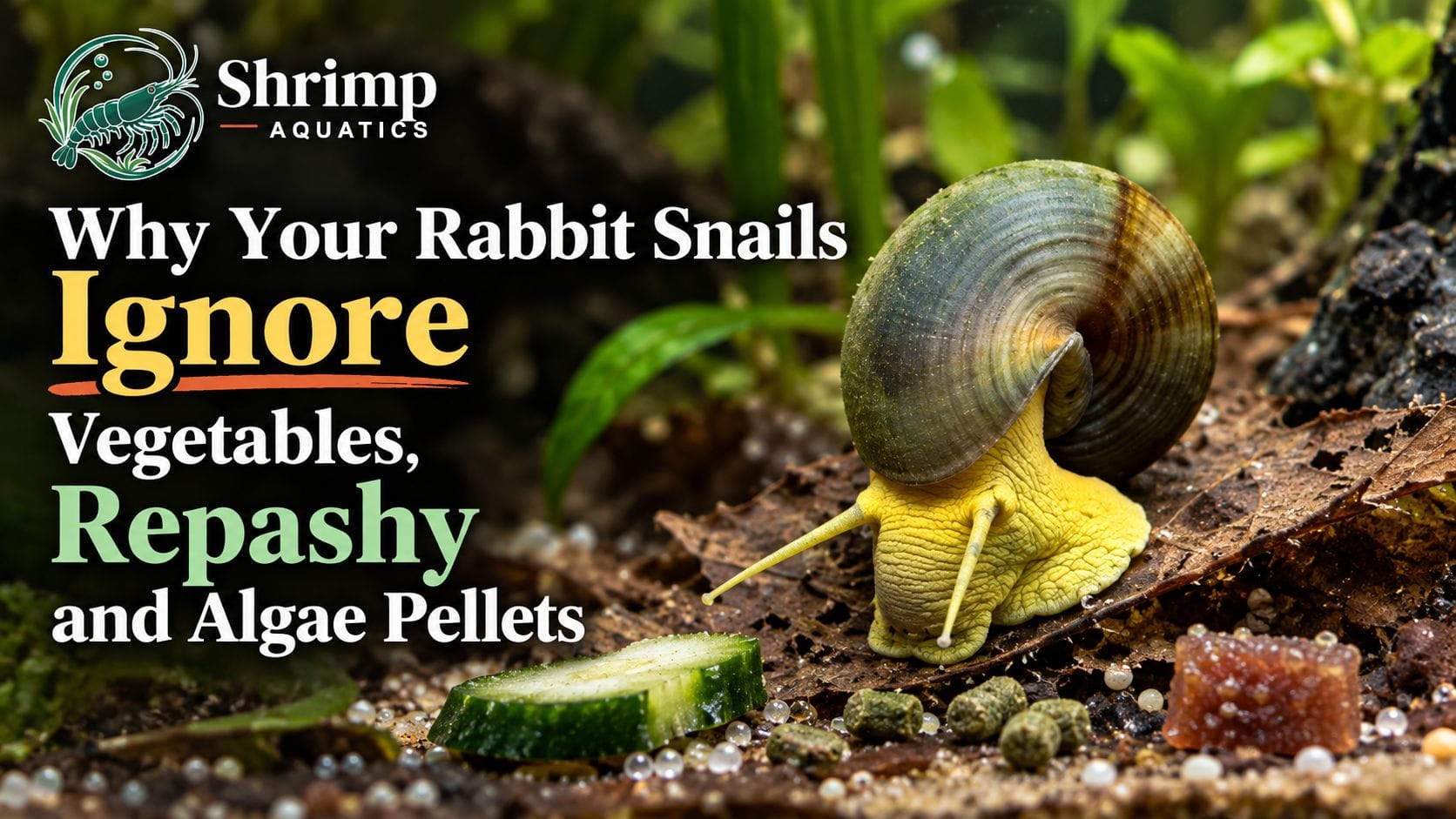
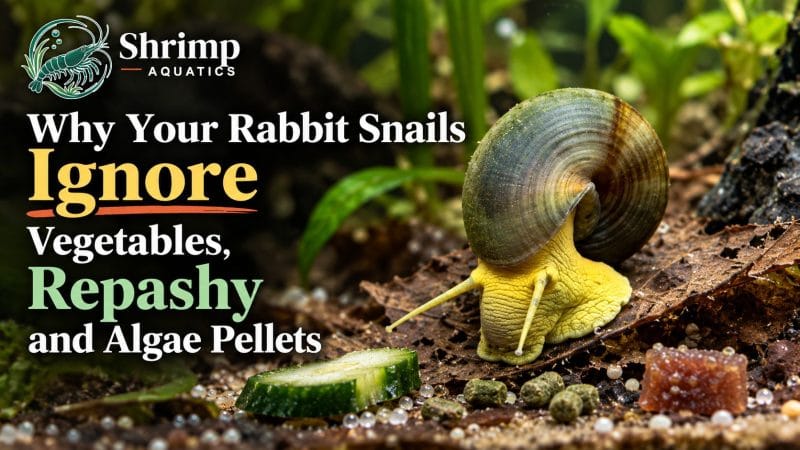
If your rabbit snails walk straight past blanched zucchini, a cube of Repashy and an algae pellet, the most likely answer is that they’re already fed. Rabbit snails (Tylomelania sp.) are grazers. They rasp the thin film of algae and biofilm off rock, wood and glass. In a mature warm tank, that film is the meal. Prepared food is a top-up, and a snail with a well grazed tank under it has no reason to hurry over to a pellet. That habit is the reason a refused pellet says so little, and it is laid out in what rabbit snails eat.
How to tell your rabbit snail is grazing when you never see it eat
Start here. Most “won’t eat” reports turn out to be “won’t eat the thing I put in”. A feeding rabbit snail looks like almost nothing is happening. The long snout sweeps the surface in front of it and the shell creeps along. None of it looks like the dash a shrimp makes for a pellet. Sulawesi Keepers, the conservation group that works with these snails, describes the hard surface species as feeding on the biofilm they take off stones, glass and other smooth surfaces. That’s keeper guidance from a specialist group, not a study.1
So how do you tell? Look for the meal, not the mouth. Two checks give you most of the answer.
- Note where the snail sits at lights out and look again in the morning. If it has moved, it has been working.
- Shine a torch along the glass and the rock at a low angle. Clean, winding paths through the film are grazing tracks.
- Don’t judge it by whether the food disappeared overnight. Shrimp, other snails and the filter account for most of that.
Why a newly arrived rabbit snail may ignore food for weeks
A rabbit snail that has just been shipped may stay withdrawn in its shell for a while before it starts moving around the tank. That is the commonest reason a new one eats nothing you offer. Treat an exact number of days from anyone as a guess. Keep the tank boring instead: steady temperature, no chasing the numbers up and down, modest light, and no pile of food waiting on the sand.
We know you want to tempt it with something. We’d wait. Food left in a tank this warm breaks down quickly, and a shut snail is a much smaller problem than the water you get from overfeeding one that isn’t eating.
Check your Sulawesi tank’s water before you blame the food
Rabbit snails need the same warm, alkaline, mineral rich water as Sulawesi shrimp. The numbers for that water, and how to hold them, are in Sulawesi rabbit snail care. A tank that has drifted out of it explains a shut snail far better than fussiness does. Test first, then move one value at a time. These are the numbers we keep to.
| Temperature | 79-86°F (26-30°C) |
|---|---|
| pH | 7.5-8.5 |
| GH | 4-8 dGH |
| KH | 3-6 dKH |
| TDS | 150-250 ppm |
| Nitrate | Under 10 ppm as a working target, not a tolerance limit |
| Ammonia and nitrite | Zero, in a cycled and mature tank |
Then ask a harder question: has anything copper bearing gone into this tank? Elevated copper is toxic in fresh water and can harm invertebrates. The US Environmental Protection Agency describes acute exposure as killing animals outright, and longer exposure as cutting survival, reproduction and growth.2 That covers a lot of ordinary bottles: fish medications, some plant fertilizers, algaecides and snail treatments. Read the label of everything you have dosed in the past month. No one has published a safe copper level for these snails, so the honest answer is none at all.
Before you add anything
Don’t treat a snail that won’t eat with a medication. There’s no diagnosis here yet, and invertebrate safe dosing for this animal isn’t documented. Fix the water, wait, and ask a qualified aquatic vet if the animal is clearly declining.
Grow enough film on the rock and glass to feed a rabbit snail
This is the real fix, and it’s slower than buying another food. Your job is to run a tank that grows a grazing layer faster than the snail strips it. That means plenty of hard surface, inert rock and sand with no pH lowering soil, and enough light hours for a soft film to build. A young tank with clean glass and bare stone has nothing in it for a grazer. No amount of zucchini makes up for that. The same goes for whether rabbit snails eat fish food, which can round out a meal but never grows the film your snail lives on.
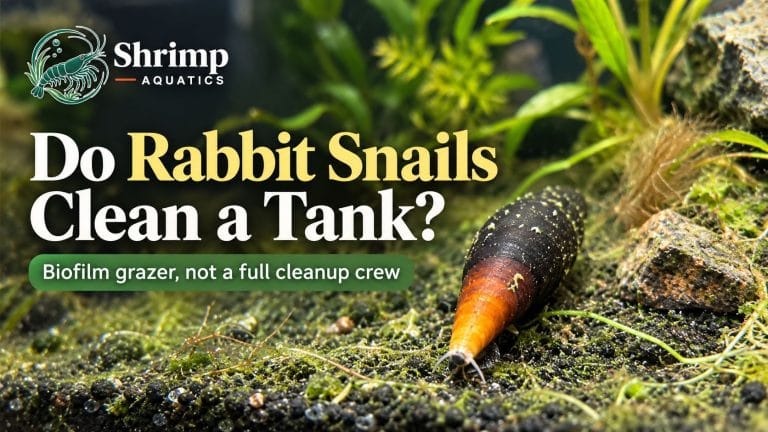
It helps to say plainly what these snails don’t do. Sulawesi Keepers states that green filamentous algae are definitely not their natural food. It also says heavy algae growth is a nuisance, because it blocks access to the surfaces the snails want.1 So a rabbit snail isn’t a cleanup crew. If you bought one to clear hair algae, that’s the disappointment talking, not a sick animal.
Stocking matters here too. An adult rabbit snail is a large grazer, and it counts against the same film your shrimp are working on. A tank that supported a colony fine may go thin when two or three snails join it. Snails sharing one film also raises the question of whether rabbit snails eat other snails, and the answer there is about scavenging, not hunting. If you’re still deciding what to add, our Sulawesi rabbit snails are bred in our own tanks, and we’d put one into a system that already carries a visible film.
Put Repashy, vegetables and pellets where a rabbit snail can rasp them
If you still want prepared food taken, change the presentation before you change the brand. A radula works by scraping against something that holds still. Where these snails graze turns out to be part of what they are. In one Lake Towuti species, snails living on rock and snails living on submerged wood have measurably different feeding organs: 79 percent of the snails found on rock were the rock form, and every snail found on wood was the wood form.3 That study measured the feeding organ and the genes behind it, not stomach contents. Read it as evidence that surface matters to this animal, not as a menu.
- Mix gel food thick and press it onto a stone, a piece of slate or a branch of wood before it sets, then put that piece back in the tank. A cube sitting loose on sand rolls away from a snail trying to rasp it.
- Give vegetables a day in the water before you write them off. A slice that’s still firm on the first evening is often taken once it has softened.
- Feed after the lights go out. Put the food near where the snail already sits, not in the open middle of the tank.
- Take out whatever is left the next morning, every time.
At Shrimp Aquatics, mature algae and biofilm do most of the feeding in our Sulawesi systems. We normally offer prepared food only about once a week and remove the leftovers. Part of the reason is that many of the animals in these systems show limited interest in it. The rest is that food sitting in warm water adds organic waste, and it can raise ammonia, nitrite and nitrate as it breaks down. If you’re feeding a rabbit snail daily and it keeps refusing, once a week is a better starting point than a new product.
One honest caveat. Treat every recommended food list you read, ours included, as something to try. It isn’t a requirement your snail is failing to meet.
When a rabbit snail that stops eating is worth worrying about
Refusing prepared food on its own isn’t a symptom. So when is it actually a problem? When it arrives with company. Work through these, in this order.
- The snail hasn’t moved at all over several days and doesn’t pull in when you touch the shell edge.
- Your test kit shows any ammonia or nitrite, or the temperature, pH, GH, KH or TDS has drifted off the values above.
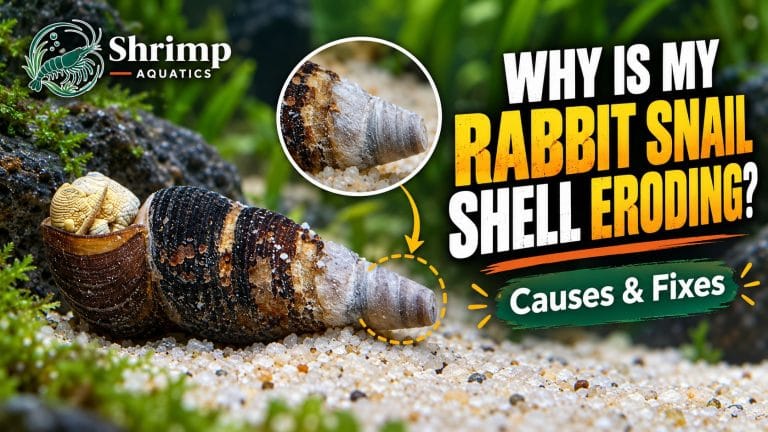
- The newest shell growth at the opening looks pitted or chalky. A worn, scarred tip on an old shell is a different thing, and common in adults.
- Something copper bearing has gone into the tank, or the snail came from a tank that was treated.
If any of those is true, deal with the water first. Test, then do a small water change with water matched to the tank for temperature and chemistry, and hold everything steady for a week. If the animal is clearly declining, a qualified aquatic vet or a local specialist is the right call, and a care article isn’t. You can also email us at contact@shrimpaquatics.com with your pH, GH, KH, TDS, temperature, tank size, cycle status and current livestock, and we’ll tell you what we’d check next.
References
3 Sources
- Do you know Sulawesi snails?, Sulawesi Keepers, undated, read September 2026.
- Supplementary Training Materials for Aquatic Life Criteria, Copper, Background, U.S. Environmental Protection Agency, updated May 6, 2026.
- Evolutionary Divergence and Radula Diversification in Two Ecomorphs from an Adaptive Radiation of Freshwater Snails, Genes 13(6):1029, 2022.

Ready to get started?
Shop our Aquarium Snail collection
1 products available · Live Arrival Guarantee