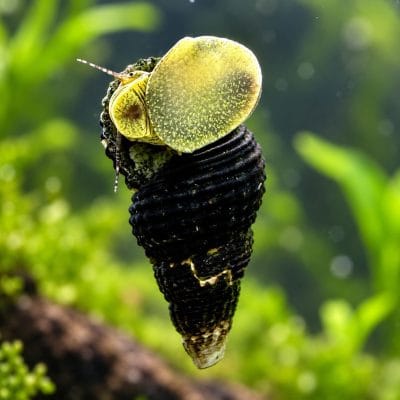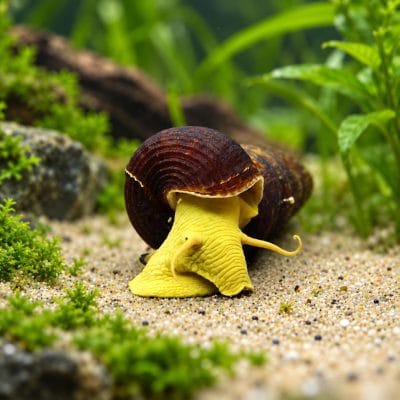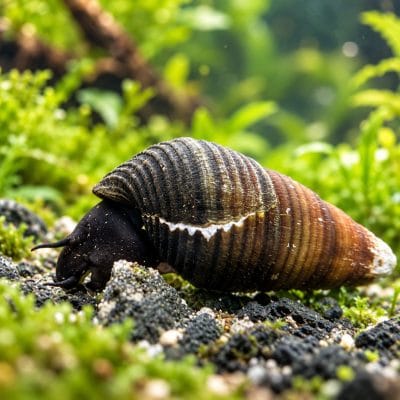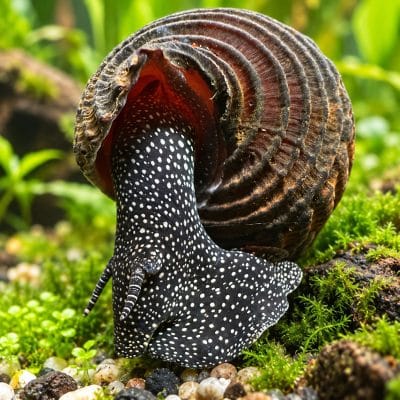
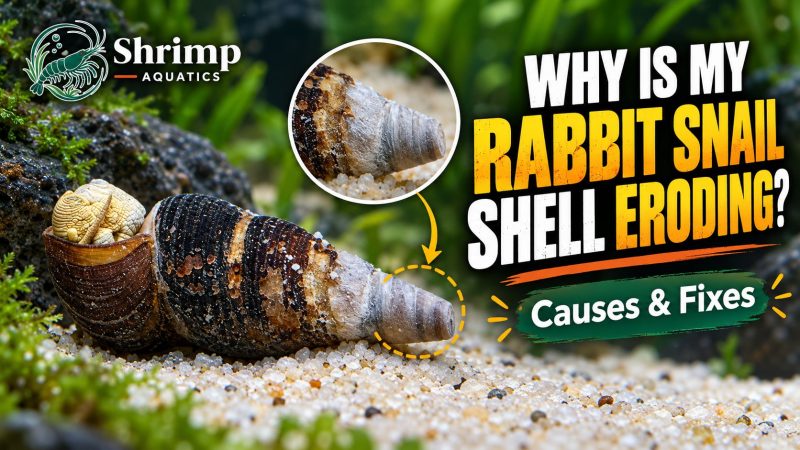
A worn, chalky tip on an adult rabbit snail is usually old wear that wild snails carry too. Fresh pitting or whitening near the opening is different: it points to water that’s too soft or drifting acidic, which is the cause keepers and care sites blame most often. For rabbit snails (Tylomelania sp.), the fix below rests on water chemistry and one lab study from outside the genus.
Is a Worn Tip on an Adult Rabbit Snail Normal?
Usually, yes. The pointed tip is the oldest shell the snail has, and the naturalists who first described the Sulawesi lake snails found the same thing on wild adults. They recorded several lake species as always missing part of the tip, and three snails of one Lake Poso species, collected alive, had the ribs on their upper whorls worn away completely.1 Those were wild snails, and the authors suspected a sponge growing on those three shells, so tip wear has more than one cause.
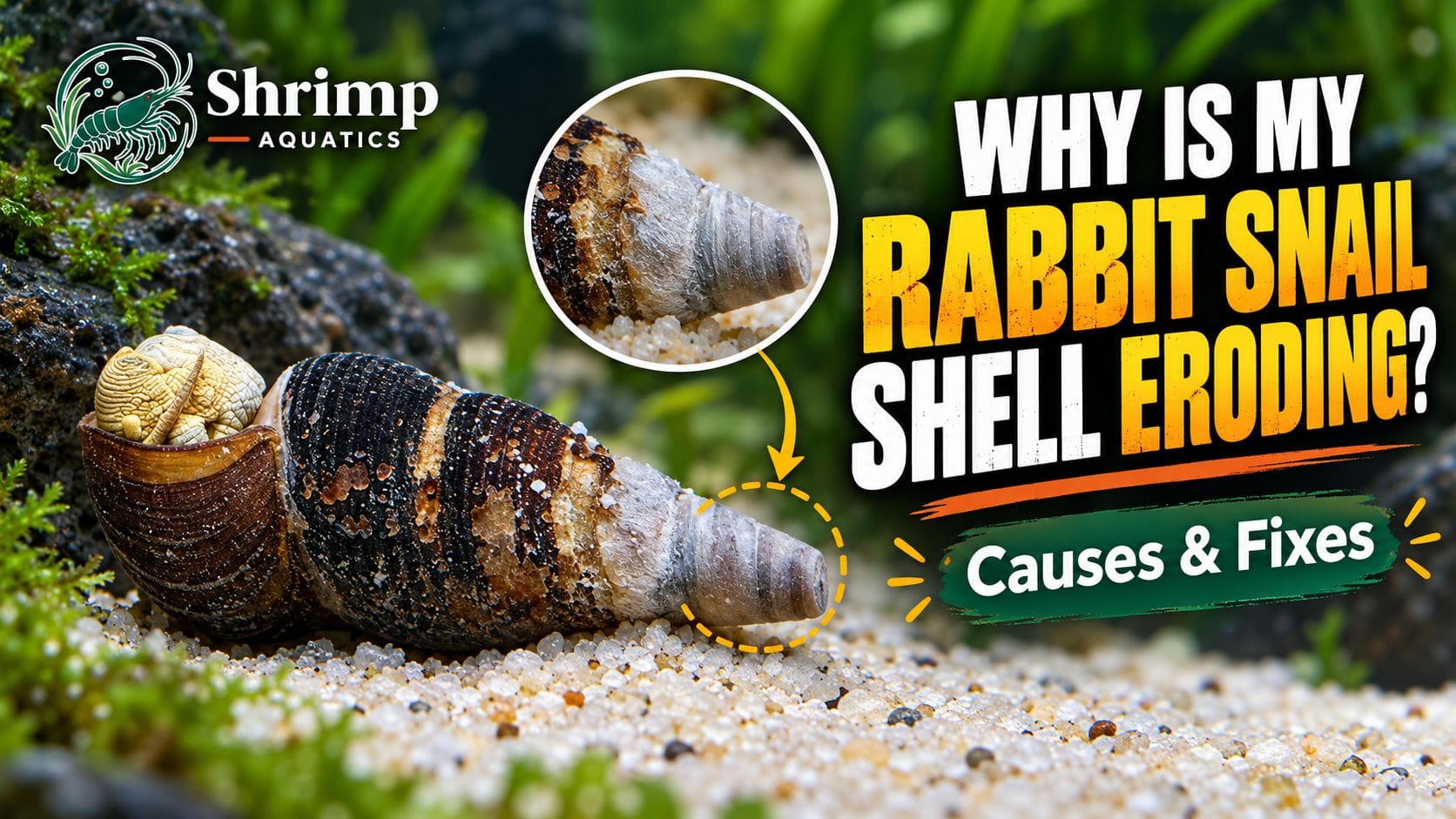
What matters is where the damage is and whether it’s moving. Use these two pictures to sort your snail.
Likely old wear
- The damage sits on the first few whorls at the tip.
- The edge of the opening is smooth and evenly colored.
- It looks the same as it did when the snail arrived.
Treat it as active erosion
- White, chalky or pitted patches show up near the opening.
- New shell at the lip looks thin, rough or pale.
- The marks spread over a few weeks.
If you’re choosing a snail and not worrying about one, the same rule helps. Our Sulawesi rabbit snails are tank-bred by Shrimp Aquatics, and an adult with a scarred tip isn’t a defect by itself. Look at the lip.
Which Readings Explain Fresh Rabbit Snail Shell Erosion?
Start with pH, KH and GH, in that order, and compare them with the range we keep every Sulawesi lake species in. If pH has slipped below the bottom of that range or KH has dropped under 3 dKH, that’s the first thing to fix. Holding that range steady, not correcting it in bursts, is the heart of Sulawesi rabbit snail care.
| pH | 7.5-8.5 |
|---|---|
| GH | 4-8 dGH |
| KH | 3-6 dKH |
| TDS | 150-250 ppm |
Why does soft, acidic water matter so much? A snail’s shell is built with calcium carbonate,2 and calcium carbonate gives way to acid. In a lab study on Florida apple snails, the group kept in the lowest-calcium water at a pH under 6.5 grew the least, showed shell erosion and had the weakest shells.3 That’s a different snail family, so it tells you the direction of the problem, not a safe number for rabbit snails. If your source water is soft to begin with, rabbit snails in soft water need KH raised before pH will stay put.
Why KH Matters More Than Calcium for a Rabbit Snail Shell
KH is your buffer. It comes from the carbonate and bicarbonate in the water, and well-buffered water can neutralize acids and hold its pH fairly steady.4 GH is different: it reads the calcium and magnesium dissolved in the water.5 So a calcium supplement can lift GH and give the snail material for new shell, but unless it brings carbonate with it, it adds no buffer. A tank can test fine on GH and still let pH slide.
If you mix your own water, test KH on the finished water as well as GH and TDS. The label on your mineral salt decides how much KH it adds, and a salt made for soft-water shrimp may add almost none.
Check the Substrate for an Active Soil Pulling pH Down
Look under the snail, too. An active, pH-lowering soil doesn’t belong in a Sulawesi tank, because it keeps working against every correction you make. Inert sand or gravel and hard rock are what this water needs. Fine, inert sand with rock on top is the best substrate for rabbit snails for exactly that reason.
Raise pH and KH Slowly in a Rabbit Snail Tank
Bring the water back up over several ordinary water changes, using new water that’s already mixed to the range above. We know you want to pour something in and be done tonight. Don’t: a sudden shift in pH is hard on aquatic animals in its own right,4 and a snail with a damaged shell doesn’t need a second shock.
- Mix the replacement water to the target first, then test its pH, GH, KH and TDS before it goes near the tank.
- Change the amount you normally would. Skip the giant emergency change.
- Retest the tank the next day and again before the next change, and keep going until KH holds between changes.
- If KH still falls every week, find the source: an active soil, a heavy stocking load, or a salt that carries little KH.
What about crushed coral in the filter? It’s the shortcut most care sheets give. Calcium carbonate does add alkalinity as it dissolves, the same way limestone raises it in a lake,4 but you can’t set how much it adds. If you try it, start with a small bag and test weekly so hardness doesn’t climb out of range. Crushed coral is one of the rabbit snail shell supplements keepers use, and like the rest it sits on top of water that’s already in range.
How Do You Know Rabbit Snail Shell Erosion Has Stopped?
Look at the lip, not the tip. A snail adds new shell along the edge of its opening and lays extra layers on the inside,2 so the eroded outside of the old whorls won’t turn smooth again. What you want to see is a band of new shell at the opening that comes in smooth and evenly colored while the old scars stay where they are. New shell only ever goes on at that edge, which is how rabbit snail shells grow all through the snail’s life.
How long should that take? Let the shell tell you. Take a clear photo of the lip now and another every few weeks, and compare. If new growth still looks rough while your readings sit in range, check your test kit against a second one and look at the substrate again.
When a Rabbit Snail Shell Hole Needs Outside Help
Get advice from an aquatic vet or an experienced invertebrate keeper as soon as erosion goes right through the shell and you can see soft tissue. Keep the water stable and inside the range while you wait, and don’t try to rescue the snail with big chemistry changes.
Before you reach for glue
Keepers describe patching holes with superglue and eggshell membrane. That hasn’t been tested on rabbit snails, and glue near an exposed body is a risk we won’t walk you through without a vet’s input.
References
5 Sources
- Die Süsswasser-Mollusken von Celebes (Materialien zur Naturgeschichte der Insel Celebes, vol. 1), P. Sarasin and F. Sarasin, C. W. Kreidel’s Verlag, Wiesbaden, 1898 (scan at Internet Archive).
- Gastropod: The shell, G. Alan Solem, Encyclopaedia Britannica.
- The effect of calcium and pH on Florida apple snail, Pomacea paludosa (Gastropoda: Ampullariidae), shell growth and crush weight, N. H. Glass and P. C. Darby, Aquatic Ecology 43: 1085-1093, 2009 (abstract).
- Alkalinity and Water, U.S. Geological Survey Water Science School, updated August 24, 2026.
- Hardness of Water, U.S. Geological Survey Water Science School, updated August 24, 2026.
Ready to get started?
Shop our Sulawesi Snail collection
12 products available · Live Arrival Guarantee