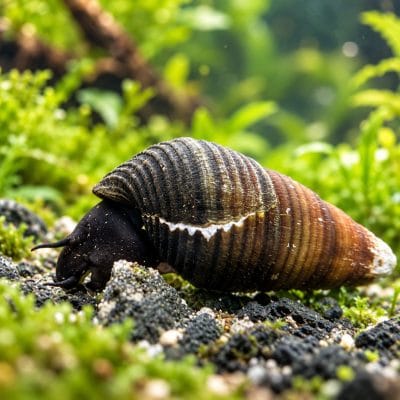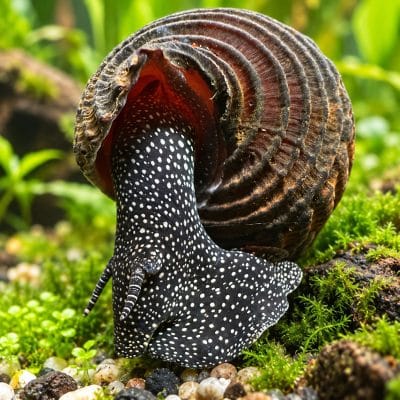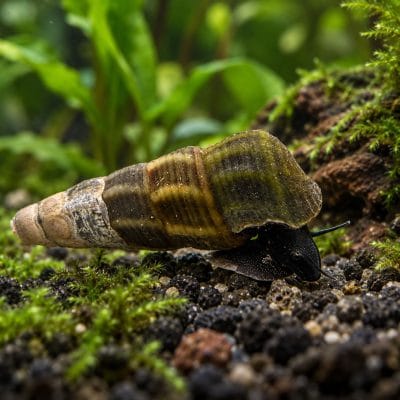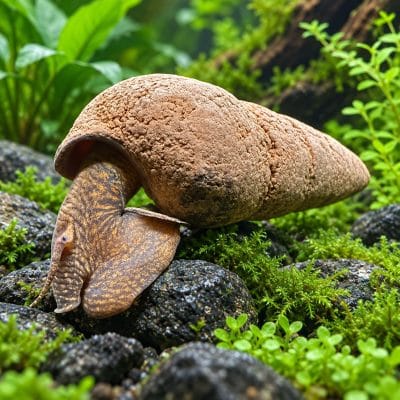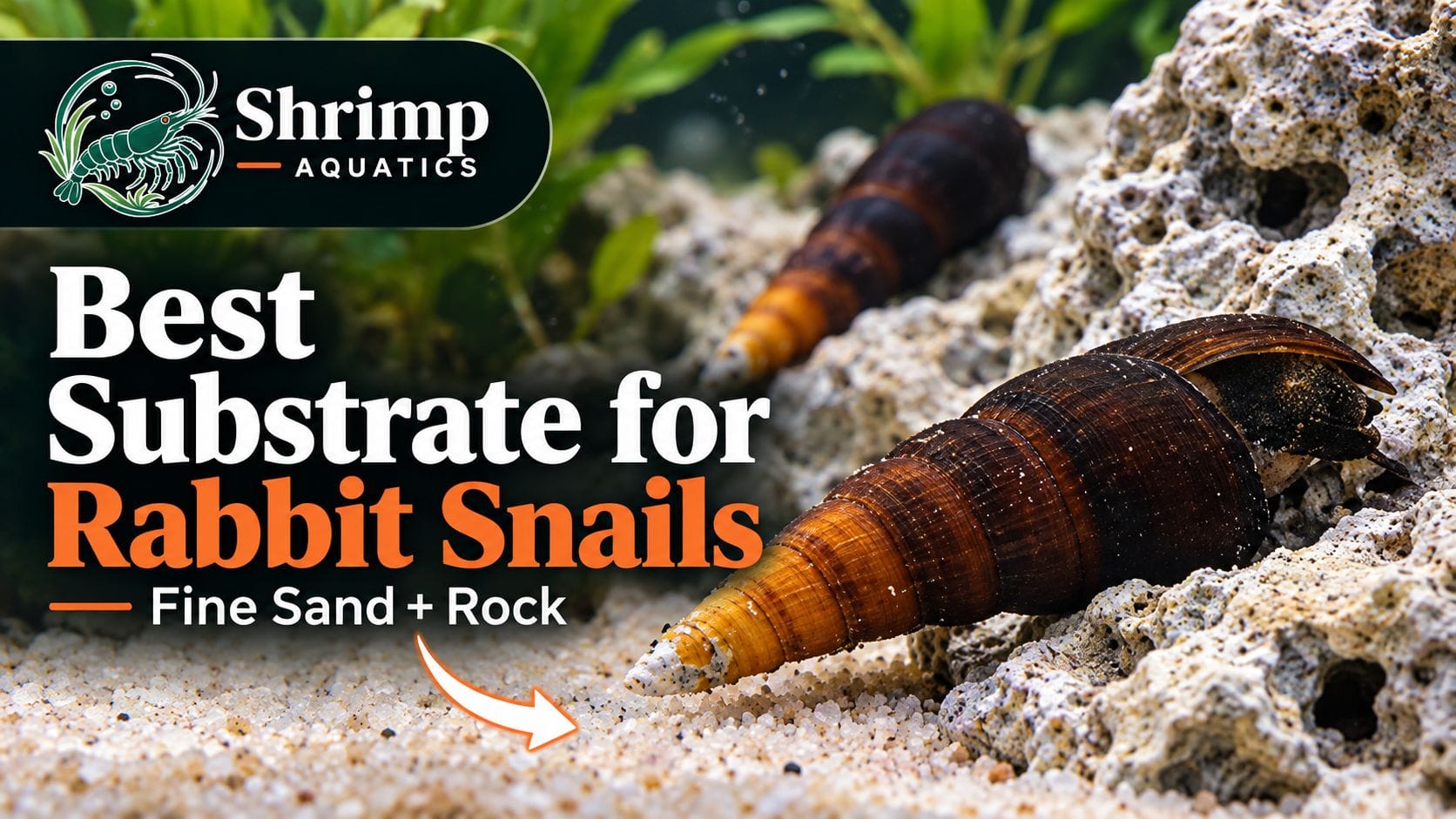
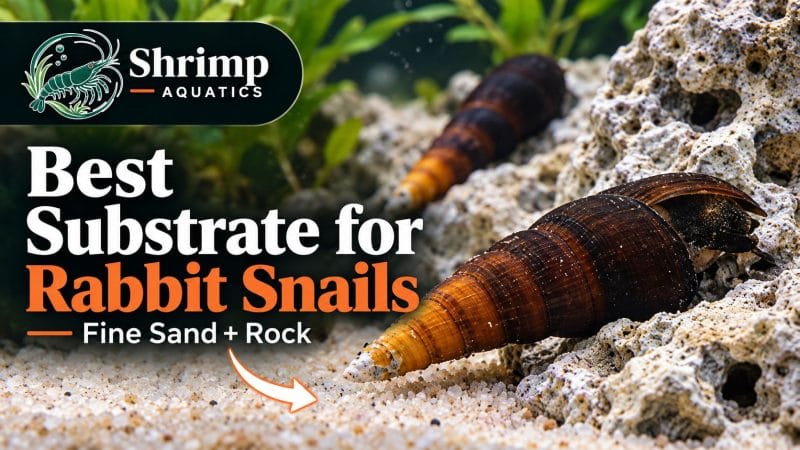
The best substrate for rabbit snails (Tylomelania sp.) is a fine, smooth, inert sand, with rock on top for them to graze. Treat it as the choice that suits every kind of rabbit snail.
What matters more than the grain is that the substrate leaves your water alone. These are the numbers we keep our Sulawesi rabbit snails in, the same water as our Sulawesi shrimp, and the bottom of the tank shouldn’t be pulling them anywhere.
| pH | pH 7.5-8.5 |
|---|---|
| GH | 4-8 dGH |
| KH | 3-6 dKH |
Is your rabbit snail a sand species or a rock species?
You probably can’t tell, and that’s exactly why sand with rock on top is the safe pick. In the Malili lakes, researchers sorted rabbit snail species into hard-ground dwellers on rock and wood and soft-ground dwellers on mud or sand. Their feeding teeth matched the surface they live on.1 The snails in the hobby are sold as Tylomelania sp. without a confirmed species name, and no one has recorded which kind the popular lines are.
So give them both. The sand floor is there for a soft-ground grazer, and the rock gives a hard-ground grazer its surface. Keepers often describe rabbit snails pushing their snouts through sand as they feed. We wouldn’t build a deep sand bed on that alone. A snail that vanishes under the sand for a while is doing the same thing, and why your rabbit snail is burrowing usually comes down to its species, not its health.
Pick smooth, rounded grains fine enough for a snail to push through. Sharp gravel is the one keepers steer clear of, and we agree: there’s no reason to make a heavy snail drag its foot across edges.
| Substrate | What it does to your water | Our view |
|---|---|---|
| Fine, smooth inert sand | Nothing, once rinsed | Our first choice |
| Small, rounded inert gravel | Nothing, once rinsed | Works, but it’s harder to push through than sand |
| Bare bottom with rock | Nothing | Works if the rock carries the grazing film; you lose the soft floor |
| Active aquasoil | Aimed at neutral to slightly acidic water | Don’t use |
| Crushed coral or aragonite as the whole bed | Keeps adding hardness as it dissolves | Don’t use as the main floor |
Why active aquasoil is the wrong floor for a rabbit snail tank
Leave active aquasoil out, because it pushes the water the wrong way for a rabbit snail. These soils are made for planted tanks and soft-water shrimp, and Fluval, for one, describes its Stratum as helping support a neutral to slightly acidic pH.2 That sits below the pH 7.5 floor of the range we keep to, and the shell is what pays for acid water. In the Florida apple snail, a different family, low calcium together with pH under 6.5 cut shell growth and left the shells eroded.3
Already have aquasoil down? Take it out before rabbit snails go in. Propping pH up over a soil that’s built to pull it down means fighting the bottom of your tank every week.
If the soil was for plants, you don’t need it. Epiphytes such as Anubias and Java fern grow tied to rock with no soil at all, which suits a sand and rock tank. Treat soft-leaved plants as at risk. Check that anything you buy copes with warm, alkaline water first. A thick grazing film on the rock is the other thing to grow if you want to keep rabbit snails from eating your plants.
Should you use crushed coral or aragonite sand to protect the shell?
No, not as the main floor: protect the shell with your water and keep the substrate out of it. Crushed coral and aragonite are calcium carbonate. Water dissolves minerals from the rock it moves through, and hardness is simply the calcium and magnesium dissolved in it,4 so a carbonate bed keeps adding hardness at its own pace, and you can’t turn it down. That’s why the water itself is the main rabbit snail shell supplement, and anything you add to the tank comes second.
The range we keep to is modest, KH 3-6 dKH and GH 4-8 dGH, and the whole job is holding it steady. We know it’s tempting to pour in coral and stop worrying about the shell. The catch is that you end up correcting a substrate you can’t adjust. If your KH keeps sliding low, fix the water you prepare and top off with, and test after every change you make.
Which rock gives rabbit snails something to graze?
Give them several pieces of smooth, stable rock with open faces, because the film that grows on rock is what they eat. The surface a rabbit snail grazes is part of what it is: in Lake Towuti one species comes in a rock form and a wood form. Of the snails on rock, 79 percent were the rock form, and every snail on wood was the wood form.5 That study measured their feeding teeth, not what they swallowed, so take it as a reason to offer real grazing surfaces, and not as a menu.
Set rock straight on the glass or pressed firmly into the sand, so a snail working underneath can’t tip it. Leave gaps wide enough for a big shell; keepers report snails wedging themselves between stones that sit too close together. Plan rabbit snail tank size and hardscape together, so the rock you add still leaves the snails open floor to move across.
Inert stone is the easy choice. Any rock that dissolves adds hardness the same way coral does, so after new stone goes in, test GH, KH and pH for the next week or two before you trust it.
Wait for the film
A rabbit snail goes in only once the tank is cycled, reading 0 ammonia and 0 nitrite, and the rock and glass carry a visible layer of algae and biofilm. Prepared food doesn’t make up for a bare, young tank.
How to lay a rabbit snail substrate before the snail goes in
Lay the sand, place the rock, then let the tank grow its film before you order. The order below keeps rock stable and the water honest. It’s the same order Sulawesi rabbit snail care follows: water and film first, snail last.
- Rinse the sand until the water runs clear, so fine dust doesn’t cloud the tank for days.
- Stand the rock on the glass first, then pour sand around it.
- Spread an even layer that covers the glass and stays shallow enough to vacuum easily.
- Fill with water prepared to the numbers above, and test pH, GH and KH again after the tank has run for a few days.
- Let the tank cycle and grow its film on rock and glass before any snail goes in.
At Shrimp Aquatics, we commonly use Sula Sand Volcanic Rock in our Sulawesi systems because it is inert and has worked well in tanks where we need pH to remain steady.
When the rock has its film and your readings hold for a couple of weeks, you’re ready to look at our Sulawesi snail lines. Every one is tank-bred by Shrimp Aquatics, not collected from the wild, and we don’t promise breeding, sex or the number of young from any order.
References
5 Sources
- Escalation and trophic specialization drive adaptive radiation of freshwater gastropods in ancient lakes on Sulawesi, Indonesia, von Rintelen T, Wilson AB, Meyer A, Glaubrecht M, Proceedings of the Royal Society B 271: 2541-2549, 2004 (University of Konstanz repository copy).
- Stratum product information, Fluval USA, accessed September 2026.
- The effect of calcium and pH on Florida apple snail, Pomacea paludosa (Gastropoda: Ampullariidae), shell growth and crush weight, Glass NH, Darby PC, Aquatic Ecology 43: 1085-1093, 2009 (abstract).
- Hardness of Water, U.S. Geological Survey Water Science School, updated August 24, 2026.
- Evolutionary Divergence and Radula Diversification in Two Ecomorphs from an Adaptive Radiation of Freshwater Snails, Hilgers L et al., Genes 13(6): 1029, 2022.
Ready to get started?
Shop our Sulawesi Snail collection
12 products available · Live Arrival Guarantee