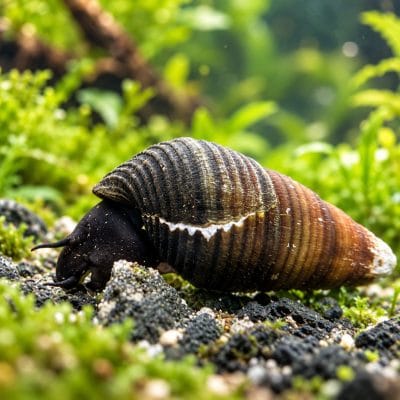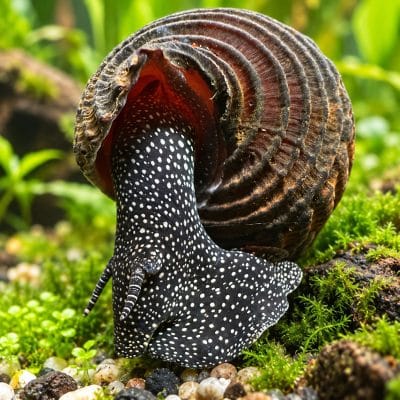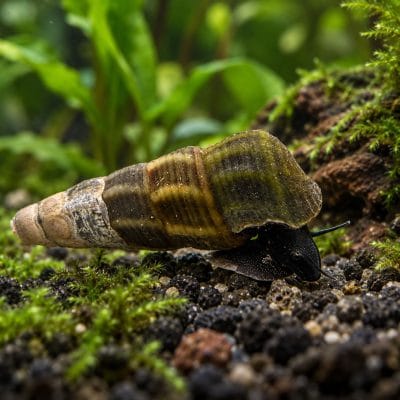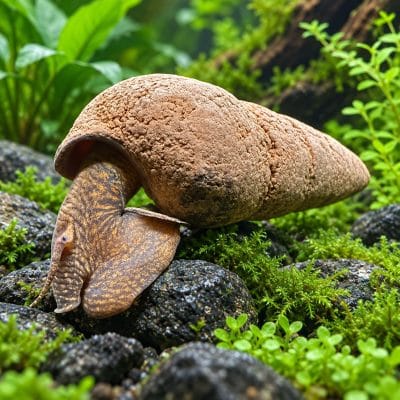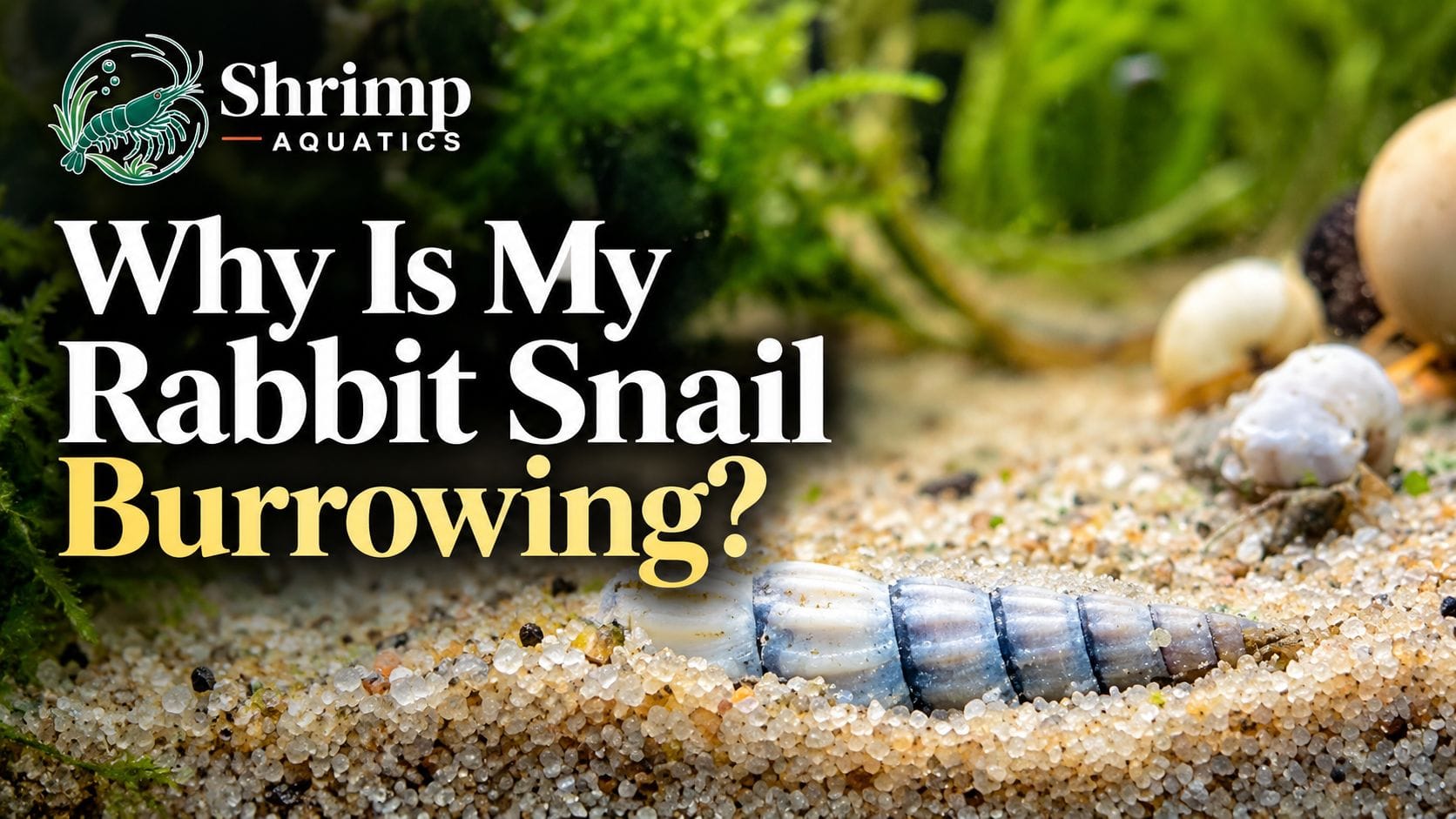
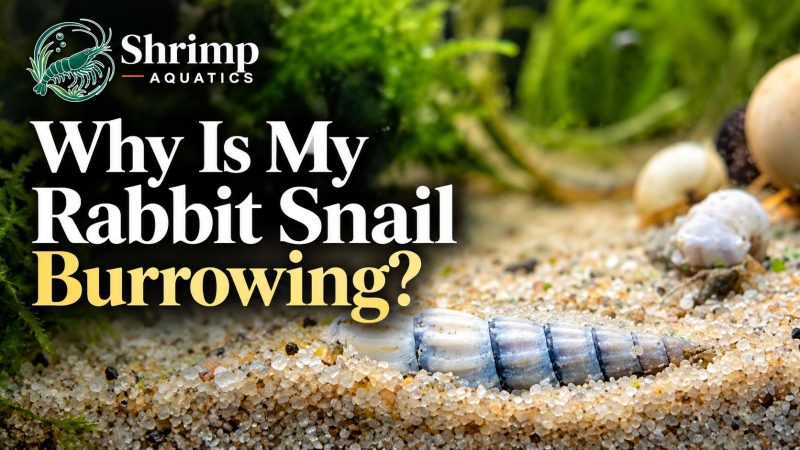
Usually it’s nothing wrong: Sulawesi Keepers describes some rabbit snail species as living in fine sand or mud and not climbing on stones at all, so a snail that spends its time in the sand is often doing what its kind does.1 No one has timed how long they stay down, so judge a buried snail by what changed in your tank, not by the clock.
Does your rabbit snail live in sand or on rock?
It depends on the species, and that’s the main reason one rabbit snail digs all day while another never leaves the rockwork. Researchers working in the Sulawesi lakes sort the species into those found on hard ground (rock and wood) and those found on soft ground (mud or sand), and the two groups even differ in the teeth of their feeding ribbon, the radula.2 Sulawesi Keepers puts the keeping side of it plainly: the hard-surface species spend their time on stones and glass eating biofilm, while the soft-bottom species treat the sand itself as their living space.1
So which one do you have? Honestly, you may not be able to find out. The lines we sell are identified only as Tylomelania sp., so we’d go by the snail’s own habits. Watch it for a week or two. If it has lived in the sand since day one, that’s its normal. If it used to cruise the glass and now won’t come up, that change is what deserves a closer look. The same rule applies when a rabbit snail is hiding among the rocks instead of under the sand: judge the change, not the habit.
How long can a rabbit snail stay buried before you check it?
If it’s new, give it a few days; if it’s settled, check when its usual pattern changes, not after a set number of hours. A rabbit snail that has just been moved may stay withdrawn in its shell for a while, and pulling it out to look only adds to the stress. A safe default is to leave a newly added snail alone for its first few days apart from your normal tank care. Even new rabbit snails that stay withdrawn for a week are a common keeper report, not a sign on their own that something is wrong.
We know it’s tempting to dig it up every morning. Don’t. A snail that surfaces some days and disappears on others is following a pattern. What matters more is whether the tank can feed it: this snail needs rock and glass that already carry a visible film of algae and biofilm, and prepared food doesn’t make up for a young tank that hasn’t grown one yet.
How do you check a buried rabbit snail without hurting it?
Lift it out gently, turn it over and watch the shell opening: a snail that’s alive pulls its body in and closes the trapdoor. That trapdoor is the operculum, the disk on the back of the foot that a snail uses to seal its shell once the head and body are drawn inside.3
- Look before you dig. A snout or tentacles poking out of the sand, or a trail that has moved since yesterday, already tells you the snail is active.
- Scoop it up by the shell with your fingers, not by pulling on the soft body.
- Hold it opening up for a moment in tank water and watch whether the body pulls back and the operculum closes.
- Put it back on the sand where you found it and let it dig in again.
If the body hangs loose from the shell and doesn’t pull back when touched, the snail is in trouble. Take it out of the display tank, keep it in water from the same tank and run the tests in the next section straight away, because whatever affected this snail may be affecting everything else in there too. The trap door is the quickest check on whether a rabbit snail is dead or inactive: a living snail keeps it shut and pulls back.
Which water tests come first when a rabbit snail stays down?
Ammonia and nitrite, because both should read 0 in a cycled tank and either one turns a buried snail into an emergency. In this tank a small reading matters more than it would in cool, soft water. The balance between ammonium and the more toxic, un-ionized form of ammonia shifts about tenfold toward the toxic form for each full pH unit, and roughly twofold for every 10°C of warming, according to the US Environmental Protection Agency.4
Once those two are at 0, compare the rest of your readings with the range below. It’s the same warm, alkaline, mineral-rich water that Sulawesi shrimp need, and a snail kept outside it has a good reason to stay tucked away. Holding every one of those numbers at once is what Sulawesi rabbit snail care asks of the tank.
| Temperature | 79-86°F (26-30°C) |
|---|---|
| pH | 7.5-8.5 |
| GH | 4-8 dGH |
| KH | 3-6 dKH |
| TDS | 150-250 ppm |
| Nitrate | Under 10 ppm |
| Ammonia and nitrite | 0 |
Then think back over the last week. Did anything new go into the tank, such as a decoration, a plant from another tank or a fish medication? Copper and copper-based medications can harm snails, so check the label of anything you’ve dosed. If you do need to correct the water, move it back toward the range slowly, because a fast swing in temperature, pH or hardness is a second shock on top of the first.
What substrate lets a rabbit snail dig safely?
Fine, smooth, inert sand, with open patches left between the rocks. Sulawesi Keepers notes that for the soft-bottom species, stones take away living space, so a tank paved edge to edge with rock leaves that kind of snail nowhere to go.1 Since you probably can’t tell which kind yours is, give it both: a few rocks carrying biofilm to graze and clear sand to dig in. When you can’t be sure of the species, that mix is the best substrate for rabbit snails.
Keep the substrate inert. An active soil that pulls pH down works against the alkaline water in the table above. We also wouldn’t use sharp gravel for an animal that pushes its soft foot through the substrate all day. If you’re still choosing a snail for this setup, every line in our Sulawesi snail range is tank-bred by Shrimp Aquatics, not collected from the wild.
References
4 Sources
- Do you know Sulawesi snails?, Markéta Rejlková, Sulawesi Keepers, March 11, 2026.
- Escalation and trophic specialization drive adaptive radiation of freshwater gastropods in ancient lakes on Sulawesi, Indonesia, T. von Rintelen, A. B. Wilson, A. Meyer and M. Glaubrecht, Proceedings of the Royal Society B 271: 2541-2549, 2004 (University of Konstanz repository copy).
- Operculum, Encyclopaedia Britannica, updated July 1, 2026.
- Aquatic Life Ambient Water Quality Criteria for Ammonia, Freshwater (2013), U.S. Environmental Protection Agency, Office of Water, April 2013.
Ready to get started?
Shop our Sulawesi Snail collection
12 products available · Live Arrival Guarantee