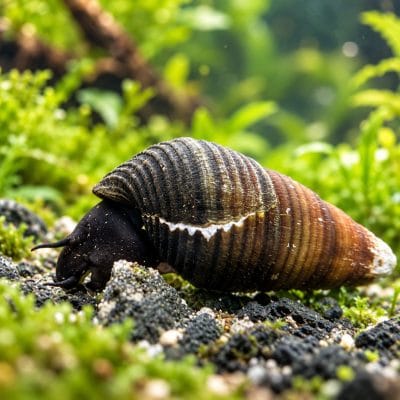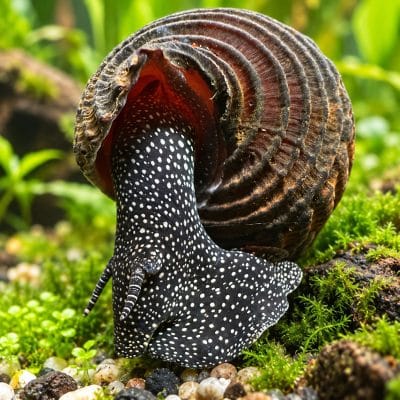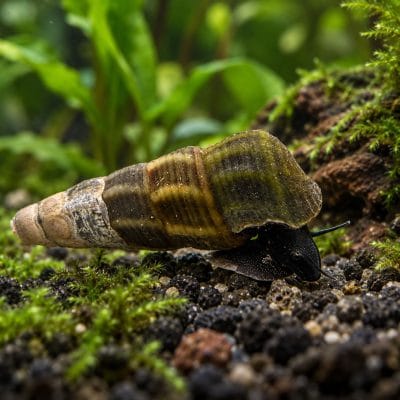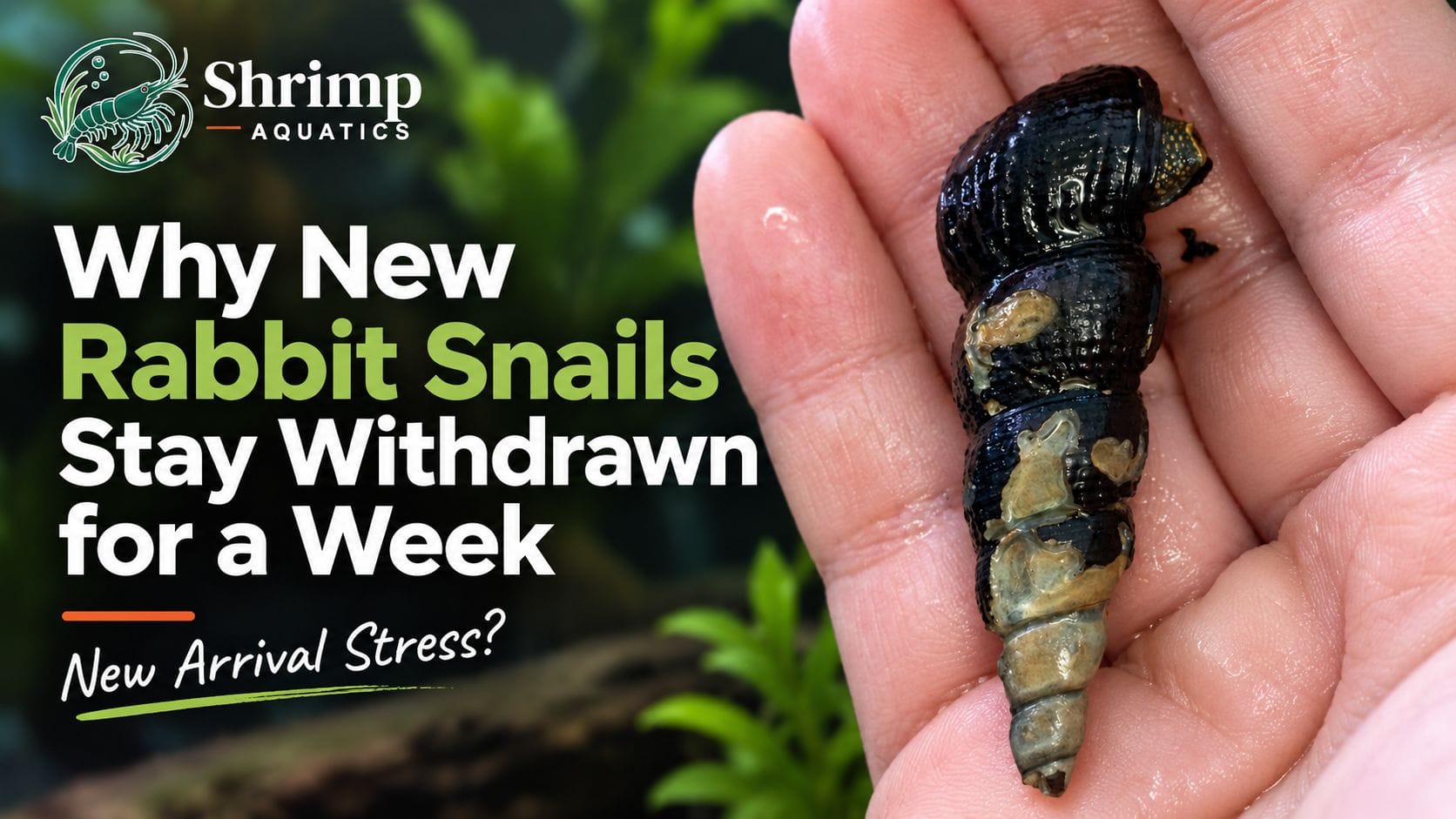
A week shut inside the shell is one of the most common things keepers report after moving a rabbit snail, and on its own it doesn’t tell you the animal is dying. Confirm it’s alive first with a touch test, then work through the tank in order: temperature, ammonia and nitrite, and anything you have dosed. Those three account for most cases where a new snail stays closed past the first few days.
Is your rabbit snail alive? Touch it and watch the trapdoor
Do this before you change a single thing in the tank. A live snail that has sealed itself in responds when you touch it, and a dead one doesn’t. Keepers call the operculum the trap door, and it’s the part to watch.
- Touch the operculum or the exposed edge of the foot with a fingertip or the blunt end of a net handle. Don’t press hard.
- Watch for any change. A live snail usually pulls the trapdoor tighter, flinches, or resists slightly. That reaction is your answer.
- If nothing happens, lift the snail out and smell it. A dead snail smells foul straight away, and you won’t be in any doubt.
- No reaction and no smell is not a verdict. Put it back foot down and try again in a few hours.
Two things are worth saying plainly here. Keepers report that a live rabbit snail retracts when touched or tapped while a dead one hangs loose and smells, and that’s the test the hobby runs, but no published viability test exists for Tylomelania. And a shell that stays shut and quiet doesn’t prove the animal is dead, which is exactly why the touch response matters more than the stillness. If the animal does smell, take it out that day and check your ammonia and nitrite afterwards. The same trapdoor test gets a fuller walkthrough in rabbit snail not moving if the first check leaves you unsure.
Why a rabbit snail seals up for days after a move
Shutting the door is what this animal does when it can’t control what’s around it. It costs almost nothing to stay closed, and a snail can keep it up far longer than a worried keeper expects. In a subtidal marine snail, that kind of metabolic depression let the animals tolerate more than 36 hours out of water and more than 16 hours of low oxygen, with a slowed heart rate that reversed afterwards.1 That’s a different animal in different water, so read it as the reason stillness is a poor health signal in snails generally, not as a time limit for yours.
How long is normal for a rabbit snail? Nobody has published a figure. Keepers commonly report new arrivals staying closed, or sitting half out and going nowhere, for two or more days, and some report a week. We’d rather tell you the hobby doesn’t know than invent a threshold you’d then measure your snail against. It’s the same test we’d use for a settled rabbit snail that is hiding: compare it with what it did last week.
Transport is the other half of it. Follow the instructions that came with your order, since packing method, transit time and species all change the right move, and never pour transport water into your aquarium. If you’ve just done a long shipment, the first day or two of stillness is the least surprising part of this whole page.
If the snail is lying on its back
Keepers report that a rabbit snail can lie on its back with the foot hanging out and the trapdoor open, look thoroughly dead, and be moving again a day later. So treat this as its own case, not as a death. Turn the snail foot down onto flat open substrate where it has something to grip, then leave it alone and check it in a few hours. On coarse gravel a snail can spend a long time failing to right itself, which is one reason we’d put fine sand under these animals.
If a female has just released a young snail
Rabbit snails are live-bearing. Embryos develop inside a uterine brood pouch, surrounded by nutritive material from a large albumin gland, and the young that come out are already shelled, in some species close to 2 cm long.2 A keeper who finds a small, fully formed snail beside a motionless adult has usually found a birth, and keepers commonly report that the female is quiet for a while afterwards. What isn’t published for this genus is how many young a female releases at once, how often, or how long any of it takes, so nobody can tell you what to expect next. We don’t promise breeding, sex or young from any order.
Check the tank temperature first: rabbit snails need 79-86°F (26-30°C)
This is the correction that fixes the most cases, and it’s the cheapest to check. The range we keep these snails in is 79-86°F (26-30°C). A typical community tank sits several degrees below that, and a snail that came from warm water into a cooler tank has every reason to sit still.
If your thermometer reads low, bring the tank up gradually over a day or two instead of jumping it, and keep an eye on the rest of the stock while you do. If you’re already inside the range, leave the heater alone. Pushing toward the top end has a cost: warm water holds less dissolved oxygen than cold water,3 so if you run at 86°F (30°C) you want real surface movement to go with it.
One honest gap. No published study relates temperature to how active a rabbit snail is, so what we have is keeper reports of warmer tanks giving more visible snails, and the range we keep to. That’s enough to act on, and not enough to promise you a snail out grazing by Tuesday.
Test ammonia and nitrite, because a warm alkaline tank makes ammonia more toxic
A cycled tank reads 0 ammonia and 0 nitrite, and a new snail in a tank that reads anything else is being asked to sit in a problem. Test both before you do anything more elaborate.
Here’s why the numbers deserve more respect in this tank than in your other ones. Total ammonia splits between ammonium and un-ionized ammonia, and the un-ionized form is the one that drives toxicity. That share rises about tenfold for each single pH unit and roughly twofold for each 10 degrees Celsius, as EPA’s freshwater ammonia criteria set out for the aquatic life EPA assessed, not for snails or for aquariums.4 A Sulawesi tank runs at pH 7.5-8.5 and 79-86°F (26-30°C). The same small reading on your test kit is simply harsher here than it would be in a cool neutral tank.
If you find ammonia or nitrite, do a modest water change with water you’ve matched for temperature, pH, GH and TDS, and repeat it instead of doing one large change. An unmatched change is its own shock, and you were trying to remove a shock. Skip the bottled cures while you’re at it. Get the source of the ammonia out, whether that’s uneaten food, a dead animal or a filter that was cleaned too thoroughly, and let the tank settle.
Have you dosed anything? Copper and some fish medications are the exception
This one isn’t a wait and see. Copper is toxic in aquatic environments and can harm invertebrates, with acute effects that include mortality, and its bioavailability shifts with pH, alkalinity, dissolved organic carbon and hardness.5 In a related freshwater snail, copper was the most toxic of eight metals tested, with a 96 hour median lethal concentration of 0.14 mg per liter.6 That snail is in a different family, so the number is there to show you the scale of the sensitivity, not to give you a level you can safely run.
Check the labels before you do anything else
Ich and parasite medications, algaecides and some plant fertilizers carry copper. If one of them went into this tank recently, move the snail to clean water you’ve matched to the tank, and plan on the copper staying in the system. We won’t give you a safe concentration, because there isn’t one to give.
Assassin snails belong in the same paragraph for a different reason. They eat other snails, so they’re never tankmates for these, and a rabbit snail sharing a tank with them has a reason to stay shut that no water change will fix.
What to do while your rabbit snail stays shut
Once the touch test says the animal is alive and you’ve been through temperature, ammonia and anything you’ve dosed, the work is mostly holding steady and not fiddling. Snails are slow to tell you things.
- Hold the temperature inside 79-86°F (26-30°C) and keep it there rather than adjusting daily.
- Test ammonia and nitrite every day or two until you’re confident the tank is stable.
- Do small water changes with matched water when a test says you need one, not on a schedule you invented this week.
- Run the touch test once a day, and leave the animal where it is between checks.
- Don’t pull a snail off the glass or a rock. Slide a fingertip under the edge of the foot and wait for it to let go.
- Don’t pile food around a closed snail. It won’t eat while it’s shut, and the food will turn into the ammonia problem you just ruled out.
- Don’t dose salt, medications or stress treatments in the hope of waking it up.
We know you want to do something more active than this. A closed snail in a tank that reads right is a waiting job, and the most useful thing you can do is keep the water boring. If the shell is carrying something new, that is a different reason to stay shut, and leeches and worms on rabbit snails tells a passenger from ordinary stillness.
When a withdrawn rabbit snail is no longer normal
Stop waiting and act when any of these show up. A foul smell from the shell means the animal is dead and needs to come out that day. Tissue hanging slack out of the aperture with no reaction to touch, across more than one check, points the same way. A trapdoor that has sunk far back and hangs loose is different from one held firmly against the aperture, and the loose one is the worrying version. Sorting a snail that has died from one that is only resting gets its own breakdown in dead or just inactive.
A bad test result changes the urgency too. Ammonia or nitrite above zero, a temperature well outside the range, or a recent copper dose all mean the snail is sitting in the cause, and fixing the water is more useful than any further diagnosis from the outside.
If several animals in the tank are affected at once, treat it as a system problem and not as a sick snail. We can’t diagnose an animal from a description, and neither can a care page. If the tank tests clean, the temperature is right, nothing was dosed, and the snail still shows no response to touch after a few days, ask a qualified aquatic vet or an experienced local specialist rather than working through treatments.
Is your tank really a Sulawesi tank?
This is the question underneath most of the cases we see described. The snail itself is a moderate animal to look after, but the system it needs is the demanding part, and a rabbit snail is not an easy way into Sulawesi keeping or a good first resident of a young tank. These are the numbers we keep ours in. Those numbers, and what normal looks like once the tank holds them, are the subject of Sulawesi rabbit snail care.
| Temperature | 79-86°F (26-30°C) |
|---|---|
| pH | 7.5-8.5 |
| GH | 4-8 dGH |
| KH | 3-6 dKH |
| TDS | 150-250 ppm |
| Nitrate | Kept under 10 ppm as a working target |
| Substrate | Inert sand and hardscape, no pH lowering soil |
| Maturity | Established tank with visible algae and biofilm on rock and glass before the snail goes in |
Maturity is the part people skip. A snail this size grazes, and a tank with clean new rock has nothing on it to graze. If your tank is a few weeks old, that alone is a reason for a quiet animal, and the fix is time and light rather than feeding.
If you’re setting a tank up for this animal now, build the water first and stock it second. Our Sulawesi rabbit snails are bred by Shrimp Aquatics and not collected from the wild, so ask us about your water before you order if any of the numbers above look out of reach.
References
6 Sources
- Metabolic Regulation, Oxygen Limitation and Heat Tolerance in a Subtidal Marine Gastropod Reveal the Complexity of Predicting Climate Change Vulnerability, Frontiers in Physiology, 2020.
- Anatomy of an adaptive radiation: a unique reproductive strategy in the endemic freshwater gastropod Tylomelania (Cerithioidea: Pachychilidae) on Sulawesi, Indonesia, and its biogeographical implications, Biological Journal of the Linnean Society, 2005.
- Dissolved Oxygen and Water, U.S. Geological Survey Water Science School, updated August 24, 2026.
- Aquatic Life Ambient Water Quality Criteria for Ammonia, Freshwater, U.S. Environmental Protection Agency Office of Water, April 2013.
- Supplementary Training Materials for Aquatic Life Criteria, Copper, Background, U.S. Environmental Protection Agency Office of Water, updated May 6, 2026.
- Toxicity of Metals to a Freshwater Snail, Melanoides tuberculata, The Scientific World Journal, 2012.
Ready to get started?
Shop our Sulawesi Snail collection
12 products available · Live Arrival Guarantee