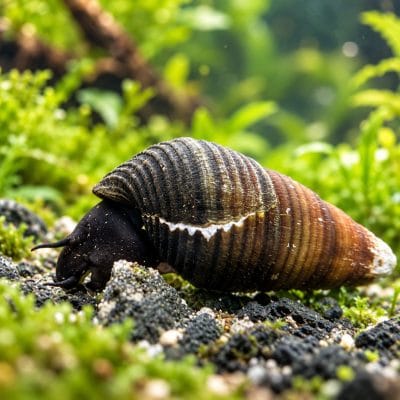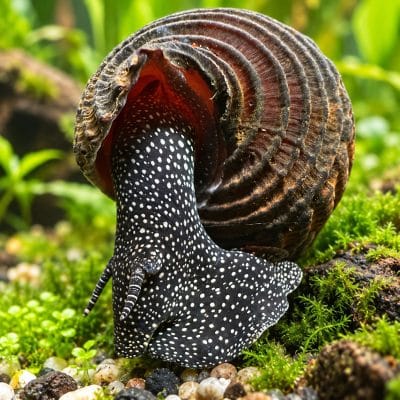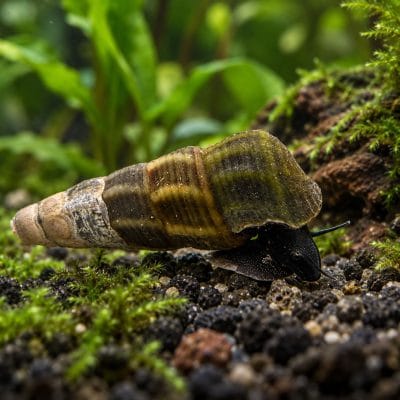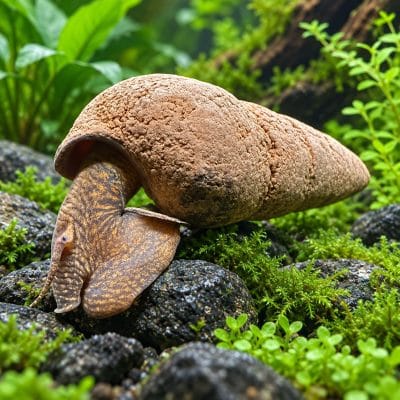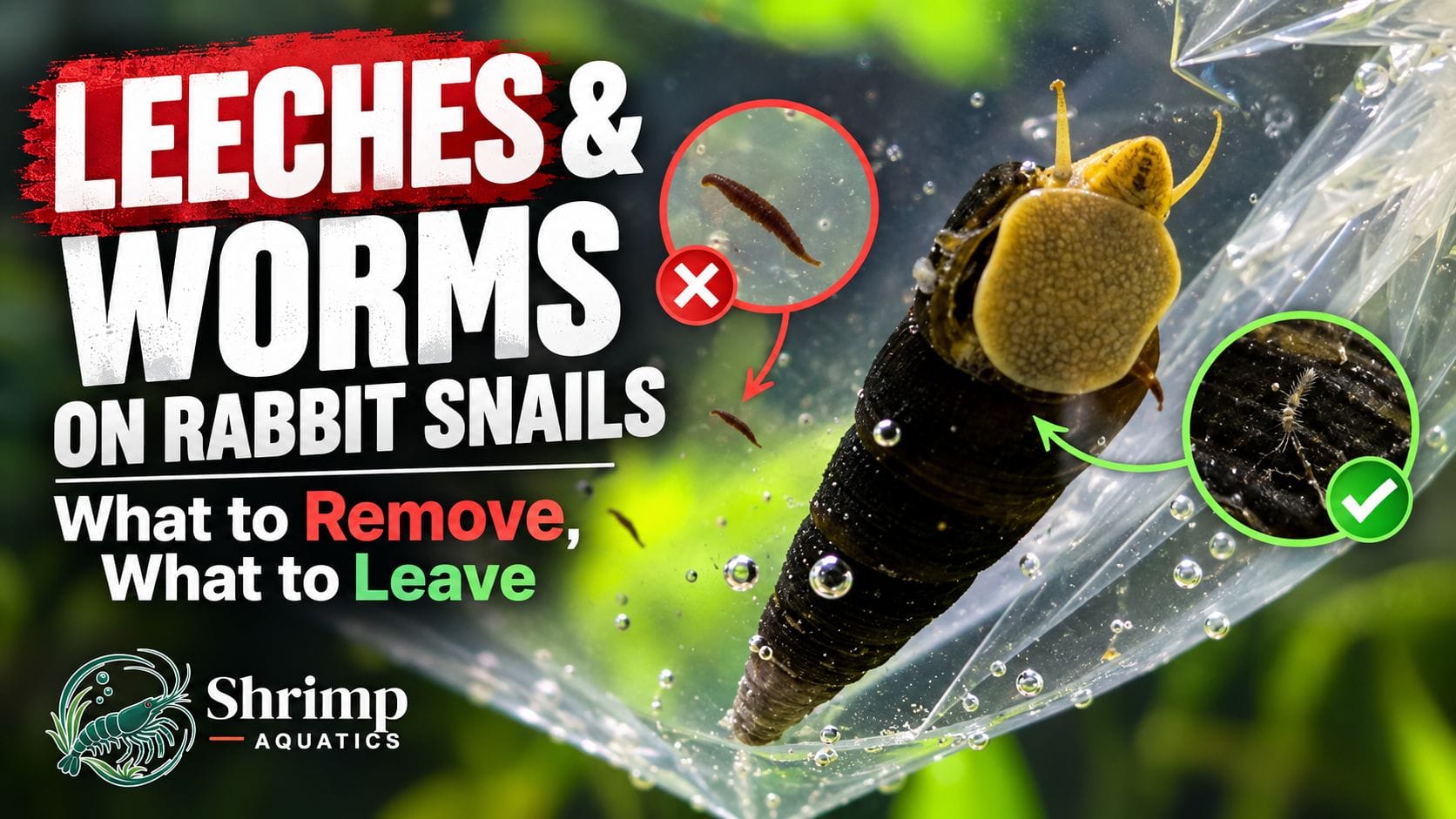
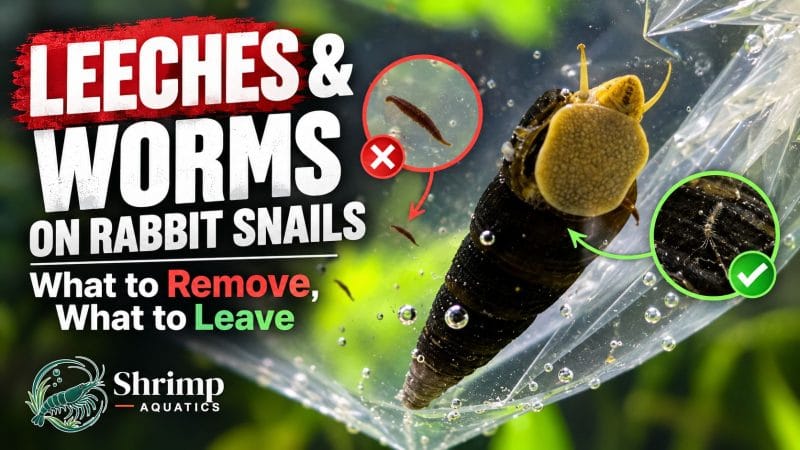
Nearly everything you find crawling on a rabbit snail (Tylomelania sp.) is a hitchhiker grazing the film on the shell. It needs nothing from you. One thing does: a leech anchored to the snail’s soft skin. A snail carrying several of them stops moving and stops feeding. Move that snail into a holding container, lift the leech off by hand, and keep worm and planaria treatments out of the water. Those medications are far more dangerous to your snail than the passengers you want to kill.
Start by telling a leech from everything else on your rabbit snail
Forget shape and color for a moment. The useful question is simpler: is it holding onto the snail, or travelling over it? Hitchhikers wander. They cross the shell, drift off when you move the snail, and take no notice of the animal underneath. A leech behaves like something that has found food. It settles where skin is exposed, at the base of the tentacles, along the snout, or just inside the shell edge. It stays put when you lift the snail or run a gentle flow past it.
That difference matters, because snail-feeding leeches really are specialists. One of them doesn’t bite a piece off. It dissolves solid snail tissue with unusually large salivary cells, then draws it in through a proboscis.1 That study recorded the first case of digestion outside the body in any leech. It also tells you what the damage looks like: tissue dissolved where the leech sits, not a clean bite, while the shell above it still looks perfect.
The snail tells you the rest. One that’s grazing, extending its snout and moving across the glass is not in trouble, whatever rides on its shell. One that stays shut for days, extends only part way, or sits with a slack foot while something flat is fixed to its skin needs help today. Newly arrived snails are the exception. They often stay withdrawn for a while after a move, so check the skin before you read stillness as illness. Quiet after a move is ordinary, and a new snail that stays withdrawn for a week is worth reading before you treat anything.
What we couldn’t find
There’s no published study of leeches, worms or any other passenger on Tylomelania. Every cited finding below was measured on some other freshwater snail, and we say which one each time. That’s the honest state of the evidence, and it’s why this page stops short of a printed dip recipe.
What a snail leech does if you leave it alone
It eats snails, and it isn’t fussy. Helobdella leeches and their close relatives consume freshwater snails indiscriminately, while other common leeches don’t touch them. One adult can take up to its own weight in snails in a day.2 Those were small pond snails in a laboratory, not your animal, so read the figure as a measure of appetite. The practical point still holds. If one snail has a leech on it, every snail you own is food, including the trumpet and ramshorn snails you never bought.
Your snails aren’t helpless. Six snail species tested against the European leech Glossiphonia complanata all had defenses, each working at a different stage of the attack.3 A shell that snaps shut and a thick curtain of mucus are that machinery running. It buys time. It doesn’t clear a leech that’s already feeding, and a snail sealed up all day isn’t grazing. That’s how a slow infestation turns into a thin, weak animal. A snail sealed that long looks much like one that has simply settled, and rabbit snail not moving tells the two apart.
Here’s the reason not to relax after the first pass. These leeches brood their young. A parent Helobdella striata carries cocoons of 2-20 eggs on its underside, and the hatched young ride along for about three weeks.4 So clearing the adults you can see doesn’t mean the tank is clear. Plan on checking your snails every few days for several weeks.
When the tiny white worms on your rabbit snail start to matter
Usually they don’t. Short, pale, restless worms of 1 to 5 mm at the mantle edge or near the tentacles are almost always Chaetogaster, and they aren’t there for the snail. They eat what drifts past, including the swimming larval stages of flukes. In wild snail populations, the snails carrying more of these worms were less likely to be infected by trematodes that swim to their host.5 A handful of them is closer to help than harm.
Numbers change that. Pond snails carrying heavy loads spent less time foraging and more time resting, grew more slowly, and laid more egg masses with fewer and smaller eggs.6 A later study found reproductive success falling as the average worm load in a population rose, with measurable costs once snails carried 10 to 20 worms each.7 Both used pulmonate pond snails, not rabbit snails. Read them as a reason to watch the trend on your animal, not as a threshold for it.
So what do you do? Nothing, if the worms are few and the snail grazes normally. If they keep multiplying, we’d look at feeding first. Cut back the food, siphon the waste more often, and watch whether the numbers fall over the next couple of weeks. The same question comes up with pale hitchhikers, which is where tiny white organisms on a rabbit snail sorts the harmless from the rest. We wouldn’t reach for a medication to kill a worm that eats fluke larvae.
Specks scuttling over the shell are grazers, not lice
Those seed-shaped dots are ostracods or small copepods. Freshwater ostracods run 1 to 3 mm and carry two hinged calcified valves like a minute clam. They eat algae, diatoms, bacteria, molds and organic detritus in the water or on plants.8 Your snail’s shell is a slow-moving pasture of exactly that. They’re on it for the same reason your glass turns green.
And the word lice? That belongs to fish. Argulus, the fish louse, is a crustacean that infests fish. It holds on with two prominent suckers beside the mouth and pierces the host with a needle-like stylet to take body fluids.9 Nothing in that group parasitizes snails, and no aquatic louse of freshwater snails has been described. A shell full of specks is not something to treat.
The last false alarm doesn’t crawl at all. Keepers post photos of a pale strand trailing from under the shell edge every week, sure it’s a worm, and we’d look twice before agreeing. The test we use is simple. If it doesn’t move under its own power, and doesn’t stay attached when the water moves, it isn’t an animal living on your snail.
Getting a leech off without injuring the snail
Work in a separate container. You want to see whatever drops off, and you want the snail out in the open where you can see all of it. Fishing around a planted tank with tweezers helps nobody. Match the holding water to the tank the snail came from, because chasing a leech is no reason to put the animal through a chemistry change as well. Holding water steady during treatment is the same standard Sulawesi rabbit snail care sets for every day, not a special case.
| Temperature | 79-86°F (26-30°C) |
|---|---|
| pH | 7.5-8.5 |
| GH | 4-8 dGH |
| KH | 3-6 dKH |
| TDS | 150-250 ppm |
| Nitrate | Aim under 10 ppm |
| Ammonia and nitrite | 0, on a mature sponge filter moved from a cycled tank |
| Substrate | None. Bare glass shows you everything that drops |
Then work slowly. A rabbit snail that feels safe extends a long way out of its shell, and that’s when you can reach what’s hiding.
- Set the container to 79-86°F (26-30°C) and pH 7.5-8.5 to match the tank, with a sponge filter and a lid. Dim the room and leave the snail alone until it extends.
- Look with a bright light and a loupe. Check the tentacle bases, the snout, the foot margin, and as far inside the shell edge as you can see.
- Lift anything crawling loose with soft tweezers or a fine brush. Passengers come away easily, which tells you something about what they are.
- Leave anything anchored to skin. Pulling a feeding leech tears the tissue it’s embedded in, and that wound is the part you can’t fix.
- Siphon the bottom every day and keep looking for several weeks. Brooded young keep appearing after the adults are gone.4
- Check every other snail in the tank the same way. Vacuum the display substrate down to the glass while you’re at it.
What about the dips? Two methods circulate in the hobby: a short salt bath, and touching the leech with strong alcohol while the snail is out of the water. Both rest on keeper accounts, not on any study. No published work gives a concentration or a duration that a Tylomelania tolerates, so we won’t print numbers we can’t stand behind for your animal. If hand removal has failed and the snail is losing ground, ask an aquatic veterinarian. They can weigh a dip against the state of the animal in front of them.
Why the usual pest treatments are the bigger risk here
Here’s the trap. The shelf of products aimed at planaria, hydra and worms works by poisoning invertebrates. Your snail is an invertebrate, and so are your shrimp. The evidence on the three families of treatment keepers reach for first is not encouraging.
Keep these out of a rabbit snail tank
Copper in any form, betel nut planaria powders, and dewormers such as fenbendazole or flubendazole. Each one has published evidence of killing aquatic invertebrates well below one milligram per litre, and none has been tested on this genus at all.
Betel nut surprises people, because a plant extract sounds gentle. Its active compound is arecoline. In apple snails of about 15 mm, arecoline gave a 72 hour median lethal concentration of 1.05 mg/L, stripping the cilia from the gills, cutting oxygen uptake and blocking an essential nerve enzyme.10 That’s a different snail family from yours. The mechanism it describes, a gill-breathing snail suffocating, is exactly what your animal is.
Copper is worse, and it doesn’t leave. In the related gill-breathing snail Melanoides tuberculata, copper was the most toxic of eight metals tested, with a 96 hour median lethal concentration of 0.14 mg/L.11 It also accumulated in the tissue more than any other metal in that set. The EPA describes copper as toxic to aquatic invertebrates, with effects from death to reduced survival, reproduction and growth, and notes that pH, alkalinity, hardness and dissolved organic carbon change how much of it reaches the animal.12 There’s no safe copper number to publish for a rabbit snail, and that’s the point.
The dewormers are the awkward case. Fenbendazole and flubendazole were screened against four aquatic species. The crustacean Daphnia magna was by far the most sensitive, with 48 hour EC50 values of 19 and 45 micrograms per litre, while the bacterium, the alga and the duckweed shrugged them off.13 If you keep shrimp with your snails, that settles it on its own. An untested medication is a poor trade against a leech you can lift off with tweezers.
Praziquantel comes up in these conversations too, usually with a confident claim attached in one direction or the other. We’ve found no evidence supporting either. We won’t tell you it’s safe, and we won’t tell you it kills rabbit snails. Ask a vet.
How to keep the next hitchhiker out of your tank
Passengers arrive with animals, plants and the water they travelled in. Much of this genus has reached the hobby from wild Sulawesi populations, and wild animals come with company. That’s worth knowing when you buy, and it’s one reason our tank-bred Sulawesi rabbit snails are raised in our own tanks instead of collected from the lakes. Wherever your animals come from, the routine at your end is the same.
- Inspect every new snail under a bright light before it goes near the display tank: tentacle bases, snout, shell edge.
- Hold new arrivals in a bare container for a few weeks and siphon the bottom daily, so anything that drops off is gone instead of buried.
- Rinse new plants and hardscape well, and keep bag water out of your tank.
- Look your snails over every week or two while you feed. Early leeches are easy. Established ones are not.
- Don’t medicate as a precaution. There’s nothing to treat yet, and plenty to lose.
- Don’t move rock or substrate between tanks once you’ve had leeches. We wouldn’t gamble on what came along in it.
If you do find one, the order of operations is the whole trick: isolate, look, lift what’s loose, leave what’s anchored, keep watching. Slow and mechanical beats fast and chemical every time with this animal.
References
13 Sources
- Biology, morphology and taxonomy of a snail-feeding leech from North Carolina, USA, provisionally identified as Helobdella lineata (Glossiphoniidae): First evidence for extra-oral digestion in the Hirudinea, Zootaxa 5453(2), 2024.
- Biocontrol of snail-borne parasites with the glossiphoniid leech, Helobdella austinensis, Biology Letters 19(4), 2023.
- Interactions between the leech Glossiphonia complanata and its gastropod prey, Oecologia 69, 268-276, 1986.
- Reproductive Behaviour and Parental Care of Helobdella striata (Hirudinea, Glossiphoniidae): a Leech that Feeds its Young, Ethology, 1986.
- It’s a worm-eat-worm world: Consumption of parasite free-living stages protects hosts and benefits predators, Journal of Animal Ecology, 2022.
- Density-dependent relationship between Chaetogaster limnaei limnaei (Oligochaeta) and the freshwater snail Physa acuta (Pulmonata), Freshwater Science, 2013.
- Effects of Chaetogaster limnaei limnaei (Oligochaeta, Tubificidae) on freshwater snail communities, Hydrobiologia 785, 2017.
- Ostracods, University of Wisconsin-Milwaukee Field Station, February 3, 2015.
- Argulus (Fish Louse) Infections in Fish, University of Florida IFAS Extension, FA184, revised January 2026.
- Research on the molluscicidal activity and molecular mechanisms of arecoline against Pomacea canaliculata, Ecotoxicology and Environmental Safety, 2022.
- Toxicity of Metals to a Freshwater Snail, Melanoides tuberculata, The Scientific World Journal, 2012.
- Supplementary Training Materials for Aquatic Life Criteria, Copper, Background, U.S. Environmental Protection Agency, Office of Water.
- Toxicity of anthelmintic drugs (fenbendazole and flubendazole) to aquatic organisms, Environmental Science and Pollution Research 22, 2566-2573, 2015.
Ready to get started?
Shop our Sulawesi Snail collection
12 products available · Live Arrival Guarantee