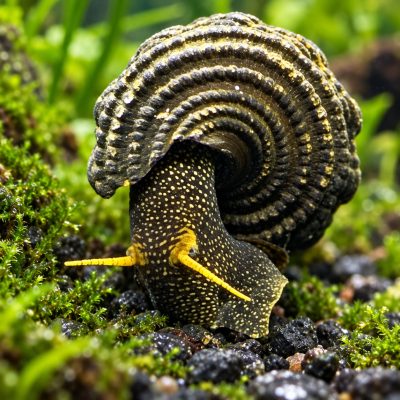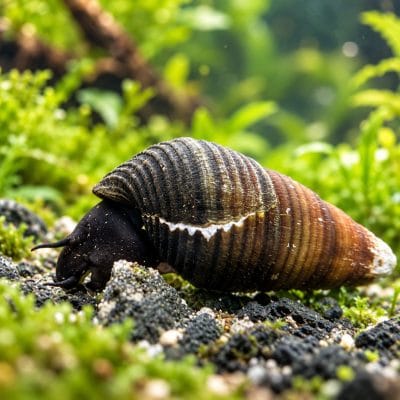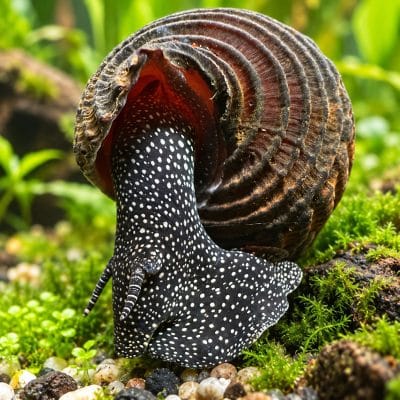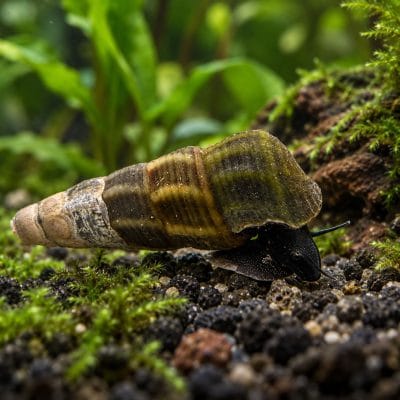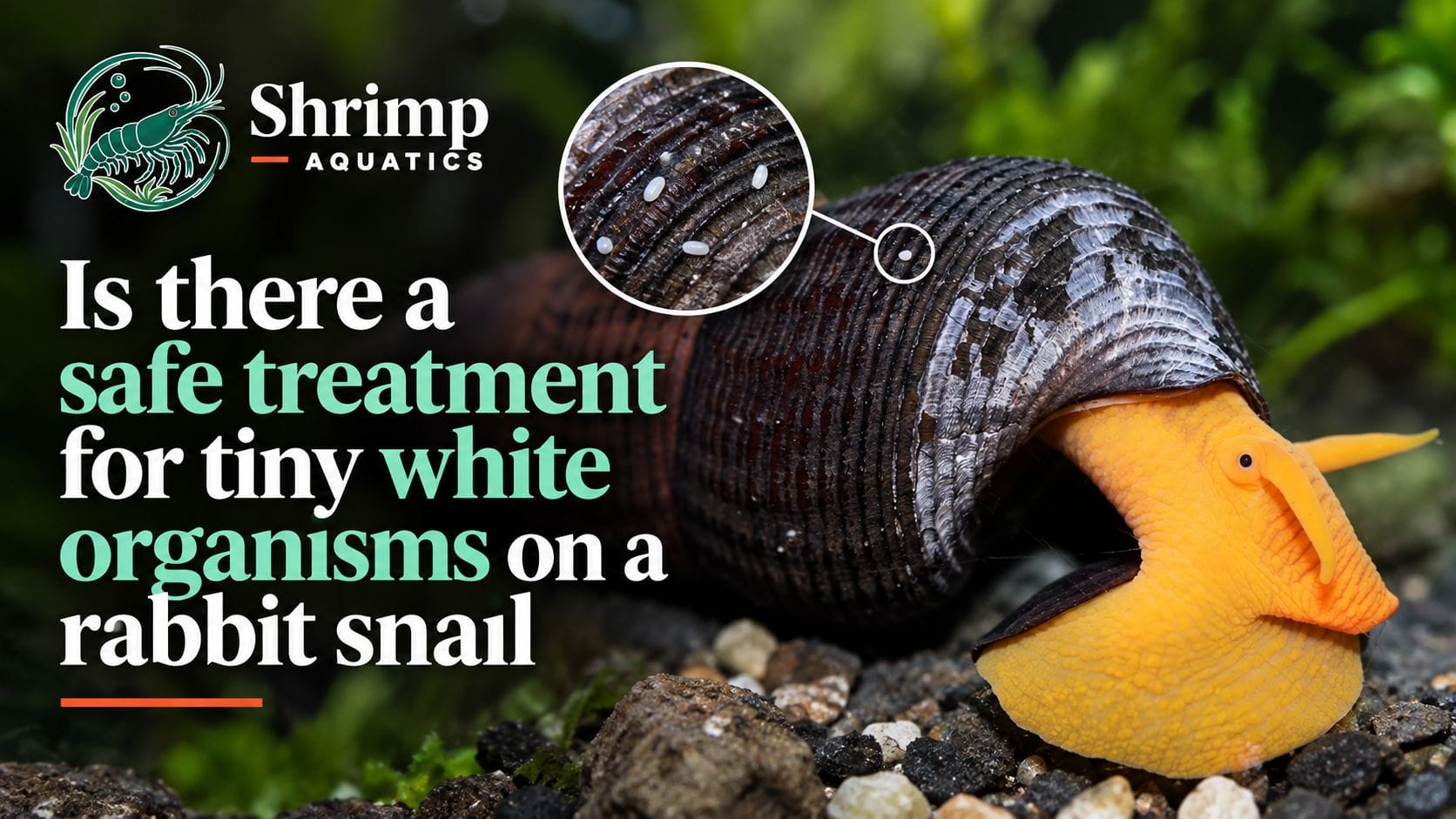
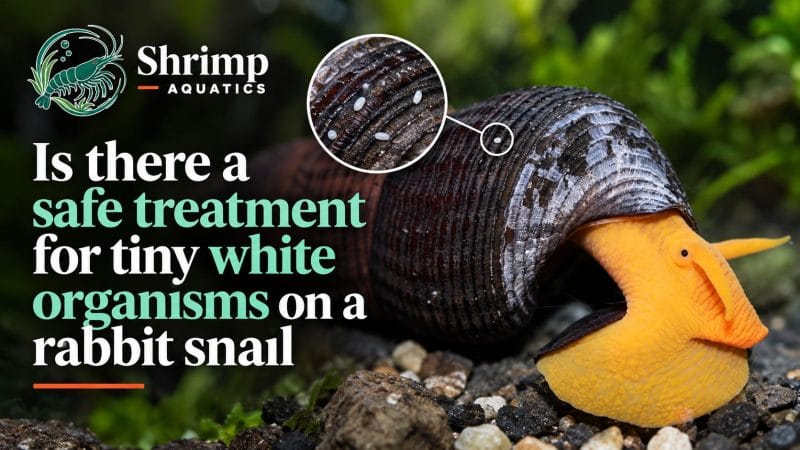
Work out what you’re looking at before you buy anything. Most of the tiny white things that turn up on a rabbit snail (Tylomelania sp.) aren’t parasites. The products keepers reach for to kill them are far more dangerous to the snail than the passengers are. We found no published test of any aquarium antiparasitic on this genus. So the safe answer here is identification, soft tweezers and clean water, not a dose.
What the tiny white things on your rabbit snail usually are
Get a light on it and watch for a full minute. That minute does most of the work, because these things don’t behave alike.
| What you see | How it behaves | What it usually is | What it needs |
|---|---|---|---|
| Fine white fuzz or tiny stalks, in patches on the shell | Fixed in one place and never travels | Attached ciliates living on the shell surface | Nothing. Look at how much food goes in |
| Thin white threads a few millimeters long, near the head or the shell opening | Wriggle, dart out and back, stay with the snail | Small worms riding the snail | Nothing |
| A flat teardrop body gripping the foot or tucked inside the opening | Loops along like an inchworm and holds on hard | A leech | Take it off by hand |
| Pale strands trailing behind the snail | No movement of its own, drifts away | Waste and detritus | Nothing |
The fuzz frightens people most and matters least. Peritrich ciliates settle on hard surfaces, and a snail shell is a hard surface with grooves and sutures to shelter in. In a Brazilian stream study of a different, much smaller snail, peritrichs sat on 60.7 percent of the animals examined.1 Most of them were in the shell’s sutures. They’re using your snail as furniture.
The white threads are usually worms riding along, not something feeding on the snail. Chaetogaster limnaei is the one keepers meet. It’s a small oligochaete that lives on freshwater snails and eats what drifts past. In a field study in Sierra Leone, its numbers on three pond snail species peaked in the dry season. Fewer of those snails carried fluke infections at the same time, and the authors suggested the worms intercept larvae trying to get in.2 That’s a correlation in other snails. It isn’t a proven benefit to yours, and it is a good reason not to panic.
The leech is the one that deserves your attention. Getting a leech off without tearing the snail is its own careful process, set out in leeches and worms on rabbit snails. Leeches in the family Glossiphoniidae feed on freshwater snails, and they are built to hold on. In one study of six European snail species, Glossiphonia complanata took all six.3 Its success dropped as the snails got bigger. A full-grown rabbit snail is a hard target. That’s why you often see one leech on one animal with no obvious damage yet. Deal with it anyway. A leech that keeps feeding costs tissue where it grips, and whether that heals is regrowing an antenna or operculum.
One more thing, and it isn’t a passenger at all. If the white patch doesn’t move, doesn’t lift off and is part of the shell surface, you’re looking at the shell. That’s a different question from this one.
When a rabbit snail actually needs treating, and when it doesn’t
The short version is that only the leech earns an intervention.
Ciliates and hitchhiking worms need no treatment because there’s nothing to treat. If a few specks have become a visible film, that’s telling you about the tank, not about the snail. We’d look first at how much prepared food goes in and how much of it gets eaten. Then at the waste sitting in the substrate. Feed less, siphon more, and the film normally thins out on its own.
How many is too many? There’s no threshold we can hand you for when a crowd of hangers-on starts to cost the animal something.
The leech is different, because it’s feeding on your snail and not on the water around it. One won’t kill an adult overnight. But leeches breed, they hide up in the whorls where you can’t see them, and you can’t dose them out without dosing the snail too.
Why copper and planaria powders are the real danger to your snail
This is where the question usually ends badly. The treatment is more likely to kill the animal than the thing you are treating.
Copper first, because it sits in more bottles than people expect: ich medications, some algaecides, a few plant fertilizers. The EPA calls elevated copper toxic in aquatic environments. Acute effects include mortality, and chronic exposure cuts survival, reproduction and growth.4 For a snail there’s a hard number. Copper was the most toxic of eight metals tested on Melanoides tuberculata in 96 hour exposures. Its median lethal concentration was 0.14 mg/L.5 That snail sits in the same superfamily as rabbit snails, but in a different family. Read it as the reason for the rule, never as a safe limit. How available copper is to an animal shifts with pH, alkalinity, dissolved organic carbon and hardness.4 A dose someone else got away with tells you nothing about your water.
The planaria powders are the other trap. They’re benzimidazole dewormers, and they get sold as invertebrate friendly because keepers dose them in shrimp tanks without obvious losses. The published work doesn’t let you read that across. Fenbendazole and flubendazole were tested on a marine bacterium, a green alga, duckweed and the crustacean Daphnia magna. The crustacean was by far the most sensitive of the four, at 19 and 45 micrograms per liter.6 No mollusc was tested at all. The reassurance you’ve read is a keeper report with no snail data behind it.
So what about praziquantel, the one most often called snail safe? We couldn’t find a published test of it on Tylomelania, or of any other aquarium antiparasitic. That doesn’t make it deadly. It does mean that anyone handing you a dose is repeating something they read somewhere else.
Our advice
We wouldn’t put a rabbit snail back into a tank that has been dosed with a copper medication. And we wouldn’t run a whole tank treatment for something we could lift off with tweezers.
What to do instead of dosing the whole tank
Start with the water. It’s the only thing on this page that helps every case at once. Holding that same water target day to day is what Sulawesi rabbit snail care walks through.
| Temperature | 79-86°F (26-30°C) |
|---|---|
| pH | 7.5-8.5 |
| GH | 4-8 dGH |
| KH | 3-6 dKH |
| TDS | 150-250 ppm |
| Nitrate | Aim under 10 ppm |
If you’re going to work on the animal, take it out of the display tank first. Use a shallow container of its own tank water, a good light, and enough patience to let the snail come out of the shell. A leech will let go under gentle pressure from soft tweezers or a cotton bud. It goes in the bin, not back in the water. Check the same snail again a few days later, because the whorls hide them well.
Keepers do use short salt dips to make a stubborn leech release its grip. We’re not printing a strength and a soak time for it. Nobody has published one tested on this genus, and the animal in the cup can’t tell you when it has had enough. If you decide to go that way, ask someone who has done it on rabbit snails.
There’s one more reason to keep medications out of this tank. A treatment that kills a lot of small life at once, or a snail this size dying unnoticed in the substrate, gives you an ammonia spike. A warm alkaline tank is a bad place to have one. The share of total ammonia in the toxic un-ionized form climbs about tenfold for each pH unit.7 It roughly doubles for each 10 degrees Celsius of warming. The same reading on the same test kit is a harder hit here than in a cool, soft-water tank.
Signs the problem is the snail, not the specks
Sometimes the white things are a coincidence and something else is wrong. Watch the animal, not the passengers. Look for a snail that stays sealed for days, or hangs slack out of the shell with no reaction to a gentle touch. Damage to the foot or tentacles counts too. Those are problems the specks won’t explain. A snail sealed for days whatever is on its shell deserves the fuller check in rabbit snail not moving first.
When that happens, test before you treat. Ammonia and nitrite first, then the numbers in the table above. Move the animal into a clean container of matched water if you suspect the tank itself. We can’t diagnose a snail from a description, and neither can anyone else. If it keeps getting worse while the water tests clean, ask an aquatic vet or a keeper who works with this genus.
Want a second opinion on the water? Email contact@shrimpaquatics.com with your pH, GH, KH, TDS, temperature, tank size, how long the tank has run and what else lives in it.
How to keep the next batch of hitchhikers out of your Sulawesi tank
Nearly everything on this page arrives the same way. It comes in on a plant, in a bag of water, or on an animal that went straight into the display tank.
- Hold new plants and new animals in a separate container for a few weeks before they meet the main tank.
- Look over every new snail under good light, including the shell opening and the upper whorls, before it goes in.
- Dry nets, siphons and tweezers completely between the quarantine container and the display tank, or keep a second set.
- Don’t pour shipping or store water into the tank, whatever arrived in it.
When you’re deciding what goes in next, our Sulawesi snails are bred in our own tanks and not collected from the wild. We’d still put them through the same quarantine as anything else. Nobody’s stock is a promise, and a few weeks in a spare container costs far less than a treatment you shouldn’t be running.
References
7 Sources
- Diversity and Distribution of Peritrich Ciliates on the Snail Physa acuta Draparnaud, 1805 (Gastropoda: Physidae) in a Eutrophic Lotic System, Zoological Studies 57:42, 2018.
- The role of Chaetogaster limnaei in the dynamics of trematode transmission in natural populations of freshwater snails, Zeitschrift fur Parasitenkunde (now Parasitology Research) 54:55-60, 1977.
- Interactions between the leech Glossiphonia complanata and its gastropod prey, Oecologia 69:268-276, 1986.
- Supplementary Training Materials for Aquatic Life Criteria, Copper, Background, U.S. Environmental Protection Agency, Office of Water, updated May 6, 2026.
- Toxicity of Metals to a Freshwater Snail, Melanoides tuberculata, The Scientific World Journal, 2012.
- Toxicity of anthelmintic drugs (fenbendazole and flubendazole) to aquatic organisms, Environmental Science and Pollution Research 22:2566-2573, 2015.
- Aquatic Life Ambient Water Quality Criteria for Ammonia, Freshwater, U.S. Environmental Protection Agency, Office of Water, April 2013.
Ready to get started?
Shop our Sulawesi Snail collection
12 products available · Live Arrival Guarantee