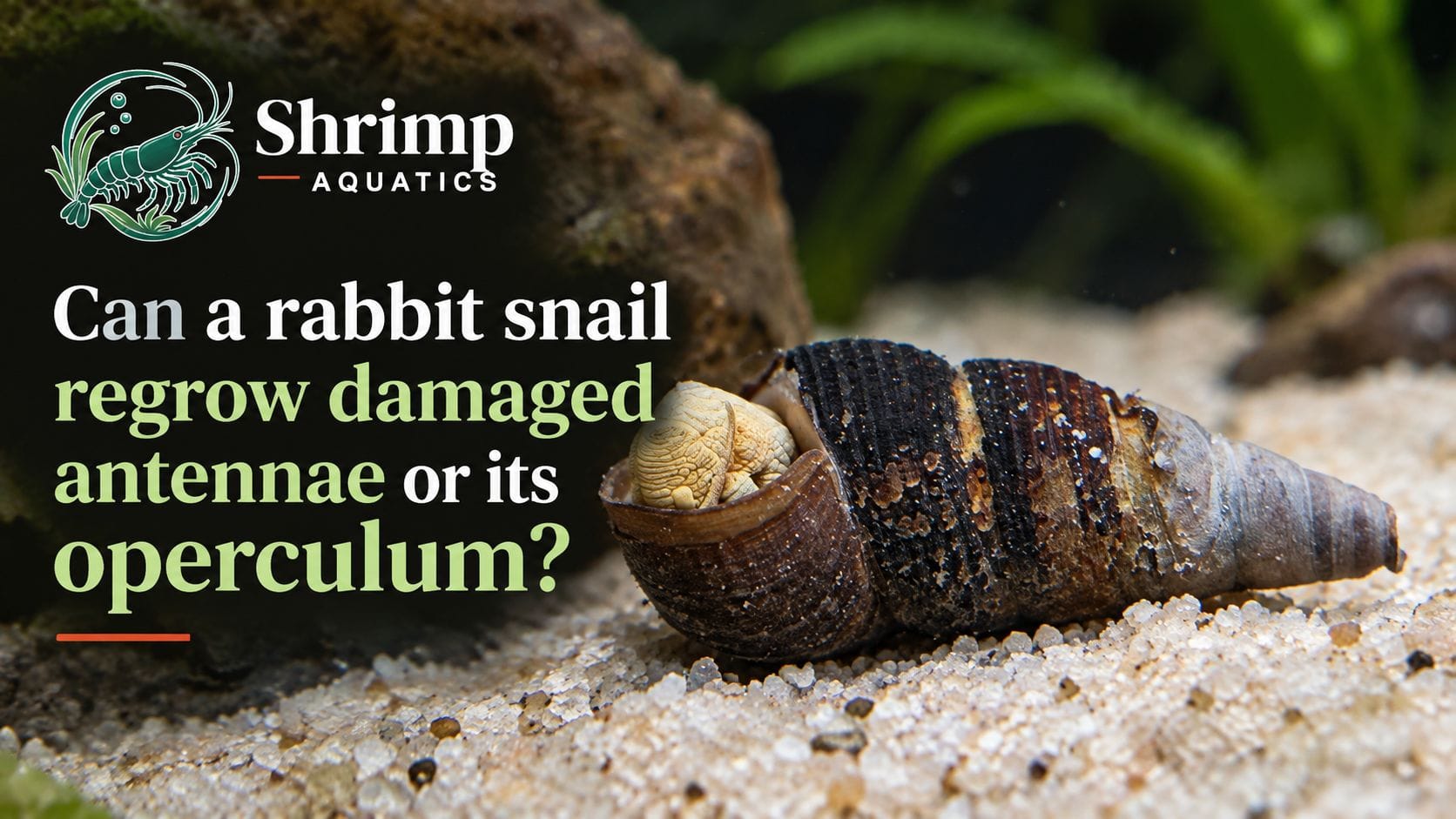
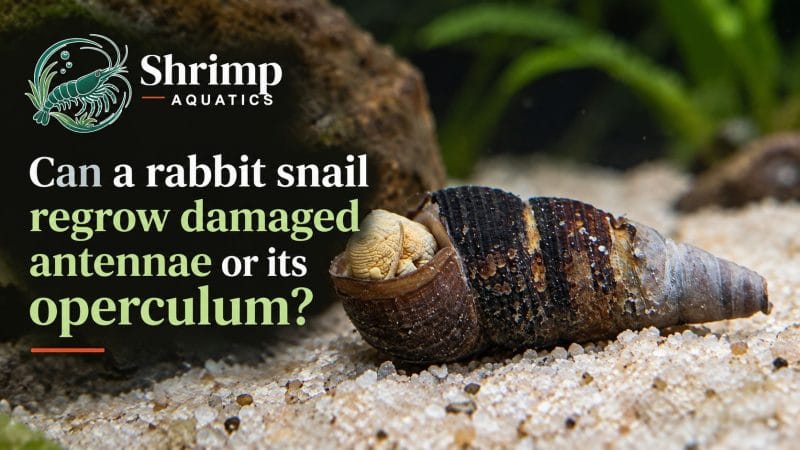
Short answer: yes, most likely, on both counts. Nobody has published a study that follows a rabbit snail (Tylomelania sp.) through either repair, so anyone who gives you an exact timeline is guessing. What we do have is work on other snails and slugs. In those animals a cut tentacle grows back as a working sense organ, and a lost operculum can be rebuilt. The part worth your attention isn’t the missing piece. It’s whatever took it off.
How long does a rabbit snail take to regrow an antenna?
Weeks to a couple of months is the honest expectation, and you’ll see the stub thicken and lengthen before it looks like an antenna again. The closest measured answer comes from a terrestrial slug, Limax valentianus. Its tentacles regenerate on their own after amputation. The regrown tentacle carries what it needs to smell normally, and the slug behaves as it did before. In that study the brain’s olfactory center shrank within 15 days of the cut and had recovered by 58 days as the tentacle regrew and reconnected, with no further change by 75 days.1 That is a slug, not a rabbit snail, so read it as the shape of the process and not as a date on your calendar.
The early part moves faster than you’d expect. Take the apple snail Pomacea canaliculata, a freshwater snail from another family. Cut a tentacle and the wound skins over within 12 hours, with a bud of repair tissue by 24. That early work leans on the snail’s own scavenging blood cells. When those cells were chemically depleted in the same study, the two stages slipped to 24 and 48 hours.2 The practical read is that healing is an immune job as much as a growth job, so the water your snail sits in during the first few days matters more than anything you could add to it.
You don’t need to do anything to the stump. Don’t dab it, don’t isolate the snail in a bare container, don’t dose the tank. Rabbit snails graze the film on the rock and glass they’re already sitting on, and a missing antenna doesn’t take them off that food.
What happens after a rabbit snail loses its operculum
The operculum is the hard door on the back of the foot, and it’s the last thing to close when the animal pulls in. Losing it is not automatically fatal, and it is not permanent either. Operculum regrowth was documented for the first time in the rapa whelk Rapana venosa, a marine snail. Those animals restored an operculum they had lost.3
Expect the new door to look wrong. In those whelks some replacements came back oversized, a shape not seen in any other gastropod. The author reads it as a defense against crabs.3 A thicker, lumpy, off-center operculum that doesn’t seat neatly in the aperture is still a working door. Judge it by whether it covers the opening when the snail withdraws, not by how tidy it looks.
Test first, worry second
A snail that drops its operculum without being crushed or attacked has usually been through something systemic. Test ammonia, nitrite, temperature, pH, GH, KH and TDS before you change anything. That way you’re fixing the cause instead of adding another swing to the water.
Work out what took the antenna or operculum off your rabbit snail
The repair takes care of itself. The cause usually doesn’t, and if it’s still in the tank you’ll be reading this again in a fortnight. Run through these before you settle on an answer:
- Is anything in the tank biting? A grazing snail’s antennae are out in the open most of the time, and a nipping tankmate tends to take them a piece at a time.
- Do you keep assassin snails? They prey on other snails, and they never belong in a tank with rabbit snails.
- Has anything copper-based gone in, including fish medication, a plant fertilizer or an algae treatment?
- Did the snail fall, get moved with the hardscape, or arrive recently? Physical damage during a move looks alarming and usually heals without help.
- What do ammonia and nitrite read right now? Both should be 0. A reading above that is the thing to fix today.
- Has the water drifted? Check temperature, pH, GH, KH and TDS against the numbers below and look for a recent change rather than a wrong figure.
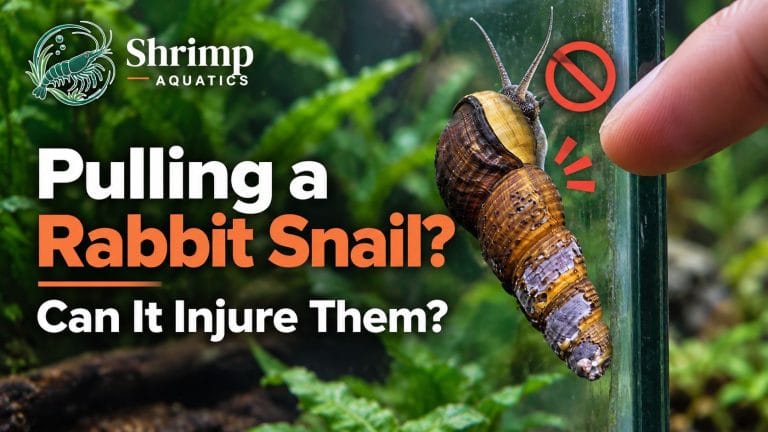
One thing worth saying plainly: an antenna and an operculum don’t mean the same thing. An antenna usually goes to an accident or a tankmate. An operculum that lets go without an obvious injury points at the water or at an animal that is already in trouble, and it deserves the faster response. Handling is one way an antenna comes off in the first place, so read pulling a rabbit snail off the glass before you move one.
Hold your Sulawesi tank steady while the snail rebuilds
There’s no food, additive or supplement that speeds this up, and we’d be selling you something if we said otherwise. What you can do is stop the water moving around while the animal is spending its energy on repair. These are the numbers we keep these snails at, and they’re the same ones the Sulawesi shrimp side of the hobby uses.
| Temperature | 79-86°F (26-30°C) |
|---|---|
| pH | 7.5-8.5 |
| GH | 4-8 dGH |
| KH | 3-6 dKH |
| TDS | 150-250 ppm |
| Ammonia and nitrite | 0 |
| Nitrate | under 10 ppm |
Getting there slowly beats getting there today. If a number is off, correct it over several days with small changes and matched replacement water, because a fast correction is its own shock. Keep the light and feeding routine you already had. Leave the grazing surfaces alone instead of scrubbing them clean, and give the snail a week or two of being ignored. What that steady water looks like day to day is in Sulawesi rabbit snail care, which is most of what the animal needs now. The Sulawesi snails we sell are bred in our own tanks and kept in this same water. A new arrival is coming out of these numbers and into yours.
Keep copper out of the tank completely
This is the one line we won’t soften. Copper is toxic to freshwater snails at very low concentrations. In Melanoides tuberculata, a freshwater snail related to rabbit snails, copper was the most toxic of eight metals tested. Its 96 hour median lethal concentration was 0.14 mg per liter.4 That’s a different family, so treat it as evidence that the margin is thin, not as a safe level, because there is no safe level to publish. Read the ingredients on any medication, fertilizer or algae product before it goes near this tank. If a fish in there needs copper, the fish moves, not the snail. Whatever you reach for to treat visible passengers carries a copper risk, which is the point of tiny white organisms on a rabbit snail.
Signs your rabbit snail is failing, not healing
Healing is boring to watch. The snail grazes, the stub slowly fills out, the new door thickens at the edge. What should worry you is the animal, not the missing part:
- The body hangs out of the shell, loose and unresponsive, and doesn’t pull in when you touch it.
- There’s a strong foul smell when you lift the snail out of the water for a moment.
- The foot no longer grips glass or rock.
- Steady grazing, a snail that withdraws when disturbed and a wound closing over are all fine. Sitting in one spot for a day or two is fine too.
If the snail is unresponsive and smells, it has died and needs to come out before it fouls the water. Is it alive, but the wound still open and raw after several days? Is more than one animal showing the same damage? Stop looking at the snail and test the water again. We can’t diagnose a disease from a description, and neither can anyone else. What you can act on is water quality, whatever is still doing the damage, and time. Telling healing stillness from a snail that has stopped responding is its own question, answered in rabbit snail not moving.
References
4 Sources
- Effects of tentacle amputation and regeneration on the morphology and activity of the olfactory center of the terrestrial slug Limax valentianus, Matsuo R, Kobayashi S, Tanaka Y, Ito E, Journal of Experimental Biology 213(18), 2010.
- Clodronate Liposome-Mediated Phagocytic Hemocyte Depletion Affects the Regeneration of the Cephalic Tentacle of the Invasive Snail, Pomacea canaliculata, Bergamini G et al., Biology 12(7):992, MDPI, 2023.
- Functional morphology and morphological variability of the operculum of Rapana venosa (Gastropoda, Muricidae), Bondarev IP, Marine Biological Journal, 2023.
- Toxicity of Metals to a Freshwater Snail, Melanoides tuberculata, The Scientific World Journal, 2012.
Ready to get started?
Shop our Sulawesi Snail collection
12 products available · Live Arrival Guarantee