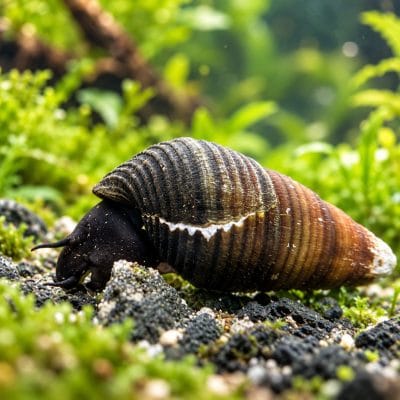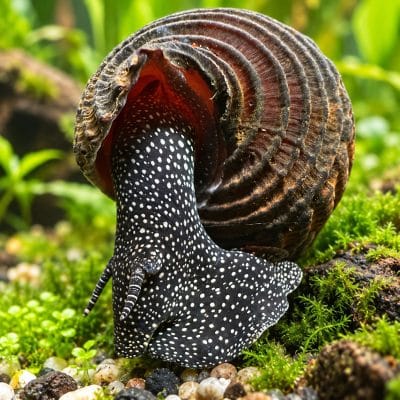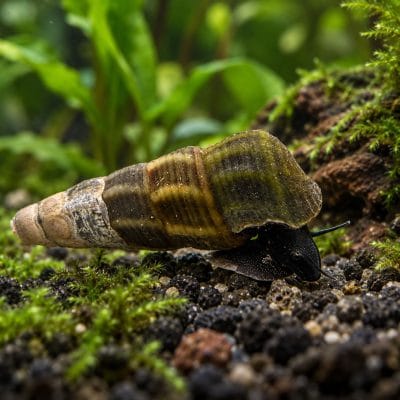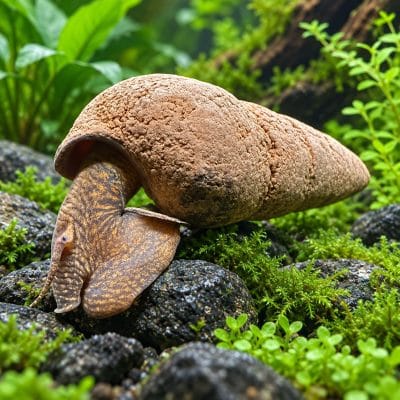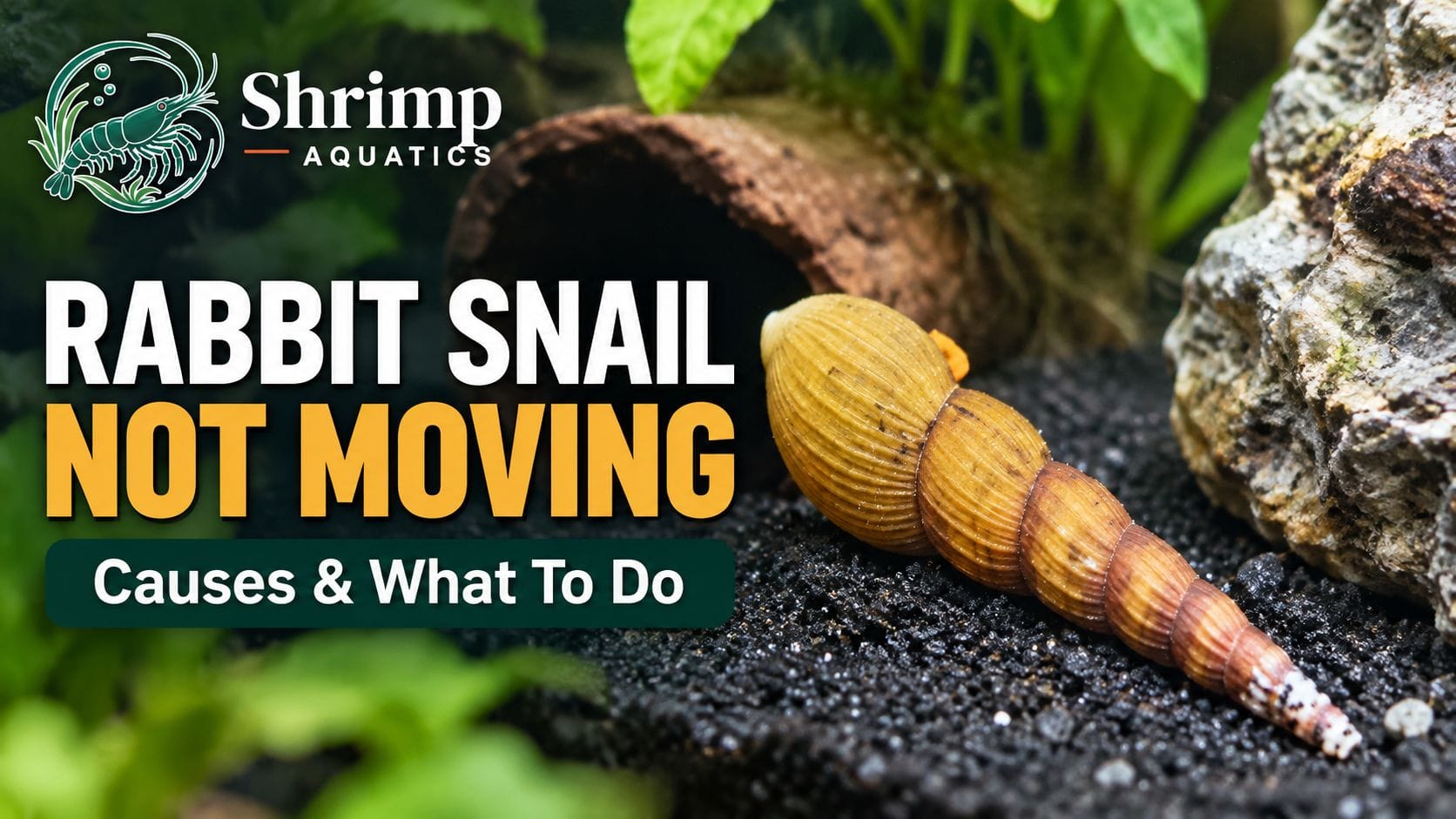
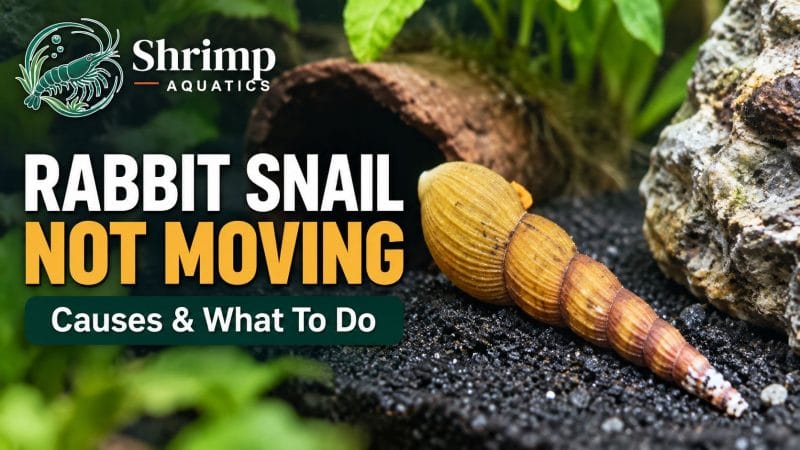
A rabbit snail that hasn’t moved since yesterday is usually alive. These animals are slow, and they shut the trapdoor whenever they want to be left alone. A new one can stay closed for a day or two after a journey. The quick way to settle it: touch the trapdoor and watch for the body pulling deeper into the shell.
Is your rabbit snail dead, or just shut in?
Touch the trapdoor. Use a fingertip or the blunt end of a net handle, press gently, and watch the soft body. A living snail pulls further in. That’s the same check researchers use on snails that carry a trapdoor: in a published air exposure experiment on a small freshwater snail, an animal with a closed trapdoor was scored alive if it retracted its body when the trapdoor was touched, and dead if it didn’t.1 Different animal, same kind of door, and it works just as well at your front glass. A snail gone still because something is attached to it looks the same as one resting, so check leeches and worms on rabbit snails.
Two more signs come from keepers, not from a study. A dead snail smells, and you’ll know it the moment you lift it near your face. And a trapdoor that hangs slack in the opening, or a body drooping loose out of the shell, is what keepers describe once the animal has gone. Rabbit snails are big, so both signs are easy to read. If those signs still leave you unsure, run the second pass in dead or just inactive before you decide.
Leave the trapdoor alone
Don’t pry it open, and don’t pull the snail out of its shell for a better look. Forcing the door risks hurting the animal you’re trying to check on. Touch, smell, wait.
Normal reasons a rabbit snail stops moving
Most stillness is ordinary. Here are the reasons keepers actually run into, with what’s known behind each one, because the honest answer varies a lot between them.
A new rabbit snail that stays sealed after shipping
Give it a day or two before you worry. In that same air exposure study, half the snails were still alive after roughly a day sealed up in open air with no water at all.1 That was a snail a few millimetres long, so it isn’t a rabbit snail figure. What it does show is what a shut trapdoor buys an animal. A rabbit snail sitting closed in good water after a long trip is doing exactly what the trapdoor is for. When a sealed spell runs past a couple of days, work through a new snail that stays withdrawn for a week tank by tank.
Your rabbit snail keeps different hours from you
Keepers report rabbit snails as mostly night animals, and say warmer water makes them more active in bursts with longer rests in between. There’s no published activity study for this genus. There is one account for Melanoides, a relative in the same broad snail group: those snails burrow by day and come out to graze at night, and the rhythm holds even under constant light or constant darkness.2 So an empty patch of rock at two in the afternoon tells you very little. Whether rabbit snails are nocturnal at all, or just avoid bright light, is still an open question.
A female that has just released young
Rabbit snails carry their young inside and release them already shelled, which is documented for the genus.3 What happens to the female afterwards isn’t. Keepers describe her lying still, sometimes flat on her back, for a while after a birth, then picking up again once she’s the right way up. That’s a keeper report and nothing more. If small shelled snails have turned up in your sand lately, ordinary rabbit snail breeding is the likeliest reason one adult has gone quiet.
A rabbit snail lying on its back
On its back with the foot out isn’t the emergency it looks like. In a lab test, a healthy pond snail from a different snail family took about three minutes to turn itself over after being inverted.4 We’d give a big rabbit snail longer than that. Still upside down an hour or two later? Lift it, set it down the right way up against rock or glass it can grip, and leave it there.
A rabbit snail buried in the sand
Keepers describe these snails ploughing through soft sand and disappearing under it for stretches at a time. No published record covers burrowing in this family, so treat it as what keepers see, not as a fact about the animal. If yours goes under and the water tests clean, there’s no reason to dig it up. Some species simply live in the sand, which is most of why a rabbit snail is burrowing.
Tank problems that stop a rabbit snail moving
When stillness runs past a couple of days, stop watching the snail and test the water. The same goes if it looked fine last week and doesn’t now. These are the numbers we keep these snails to, and every check below asks whether your tank has drifted off them. The same order of tests applies when a rabbit snail is hiding instead of sitting in the open.
| Temperature | 79-86°F (26-30°C) |
|---|---|
| pH | 7.5-8.5 |
| GH | 4-8 dGH |
| KH | 3-6 dKH |
| TDS | 150-250 ppm |
| Nitrate | under 10 ppm |
If a test comes back off, bringing it home slowly is the whole job of Sulawesi rabbit snail care. A fast correction is its own shock on top of the first one.
Ammonia and nitrite first
In a cycled tank both read zero. Anything above zero is reason enough for a withdrawn snail. Ammonia is also worse here than the test number suggests. In fresh water, the toxic un-ionized share of ammonia rises about tenfold for every pH unit, and roughly doubles for every rise of ten degrees Celsius.5 A rabbit snail tank is warm and alkaline by design, so the same reading on the kit bites harder here than it would in a cool, soft water tank. Nitrite should read zero too.
Oxygen, the heater and the flow
Check that the heater is holding, and that the surface is actually moving. In a pond snail, which breathes differently from a rabbit snail, cutting off its oxygen held back its movement.6 Temperature pulls the same lever. In another freshwater snail, both resting respiration and voluntary activity dropped away at the top and the bottom of its range.7 Warm water also holds less dissolved oxygen than cold water,8 so a heater stuck high costs you twice.
Anything with copper in it
Go and read the label on every bottle that went into this tank in the last month. In a related freshwater snail, copper was the most toxic of eight metals tested.9 We won’t give you a safe level, because there isn’t one worth publishing for your animal. Fish medications, algaecides and some plant fertilizers are the usual ways in. If copper went in, a large water change with clean remineralized water is the practical response. Pale specks on the shell are worth ruling out too, and tiny white organisms on a rabbit snail separates the harmless ones from the one that needs removing.
Hunger is not the answer
A hungry snail doesn’t switch off. It moves differently. In a pond snail kept a day without food, movement depended on hunger and on where the food was: fast and direct across bare ground, slower and winding once it reached a patch to graze.10 So don’t read stillness as an empty stomach and start dosing food, which only adds waste to warm water. A visible film of algae and biofilm on the rock is most of what rabbit snails eat, and a tank without one was stocked early.
What to do with a rabbit snail that won’t move
- Touch the trapdoor and watch for the body pulling in. If it retracts, the snail’s alive, and the rest of this list is about its water.
- Lift it out for a few seconds and smell it. A dead one is obvious. Put a live one straight back.
- Test ammonia and nitrite, then temperature, pH and KH. Write the numbers down so you can see the drift next time.
- Check the heater against a separate thermometer. Check that the filter outlet still breaks the surface.
- Think back over the last month of bottles, treatments and new plants for anything carrying copper.
- If it’s upside down, set it upright against rock or glass and leave it be.
- If it’s sealed and responsive in water that tests clean, do nothing else. Dim the lights, skip feeding for a day, look again tomorrow. A day of stillness in a stable tank is our line; no study sets a real deadline for this genus.
- If it’s dead, lift it out the same day and test ammonia again afterwards.
A rabbit snail that arrived from us and hasn’t moved
A snail that comes out of the bag sealed shut is almost always alive. That’s the normal way for one to travel. Do the touch test before you decide anything, and give a new arrival a day or two of quiet water before you judge it.
Everything in our catalog is bred or propagated in our own tanks rather than collected from the wild. Our four Sulawesi snail lines all come out of the same warm, alkaline water your tank needs to hold.
If one really did arrive dead
A claim for livestock dead on arrival must be reported within 2 hours of the carrier’s delivery timestamp, with a continuous, uncut unboxing video that starts from the sealed box. We replace the snails that died, and you pay shipping on the replacement box or add it to your next order. There is no cash refund for a live arrival claim. Shipping is a flat USD 120 per order to every country.
References
10 Sources
- Tolerance to air exposure of the New Zealand mudsnail Potamopyrgus antipodarum (Hydrobiidae, Mollusca) as a prerequisite to survival in overland translocations, NeoBiota 14, 2012.
- Species Account: Melanoides tuberculata (Thiaridae), Freshwater Gastropods of North America Project.
- Anatomy of an adaptive radiation: a unique reproductive strategy in the endemic freshwater gastropod Tylomelania (Cerithioidea: Pachychilidae) on Sulawesi, Indonesia, and its biogeographical implications, Biological Journal of the Linnean Society 85(4), 2005.
- The effects of fluoxetine on attachment and righting behaviours in marine (Gibbula umbilicalis) and freshwater (Lymnaea stagnalis) gastropods, Ecotoxicology 27, 2018.
- Aquatic Life Ambient Water Quality Criteria for Ammonia, Freshwater, U.S. Environmental Protection Agency, Office of Water, April 2013.
- The Influence of Hypoxic Conditions on Mating Behavior in a Bimodal Breather, the Great Pond Snail (Lymnaea stagnalis), Ecological and Evolutionary Physiology 98(1), 2025.
- Hypoxia Decreases Thermal Sensitivity and Increases Thermal Breadth of Locomotion in the Invasive Freshwater Snail Potamopyrgus antipodarum, Physiological and Biochemical Zoology 95(3), 2022.
- Dissolved Oxygen and Water, U.S. Geological Survey, Water Science School.
- Toxicity of Metals to a Freshwater Snail, Melanoides tuberculata, The Scientific World Journal, 2012.
- Resource distribution and internal factors interact to govern movement of a freshwater snail, Proceedings of the Royal Society B, 2019.
Ready to get started?
Shop our Sulawesi Snail collection
12 products available · Live Arrival Guarantee