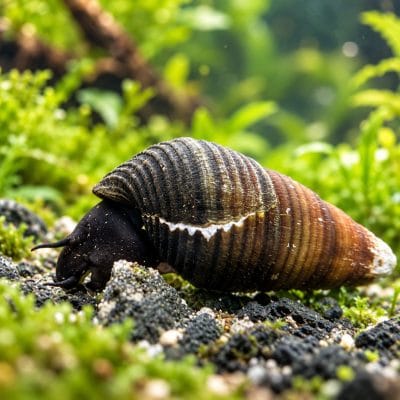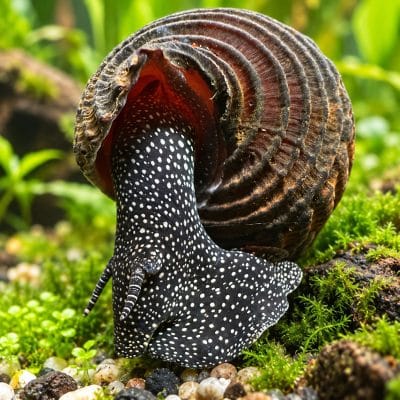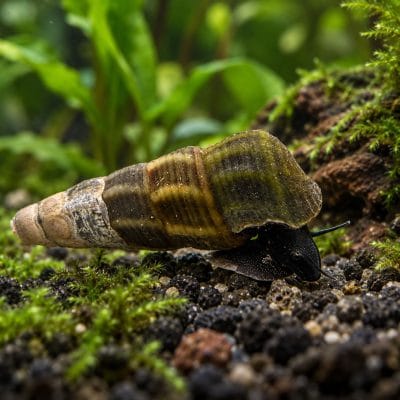
Rabbit snails eat the film. A Tylomelania rabbit snail spends most of its day rasping biofilm, aufwuchs and algae off rock, wood and glass, and that layer, not the food you drop in, is the main meal. What you can act on is where these snails graze, and what that means for the surfaces, the food dish and the plants in your tank.
Give a rabbit snail both hard surfaces and open sand
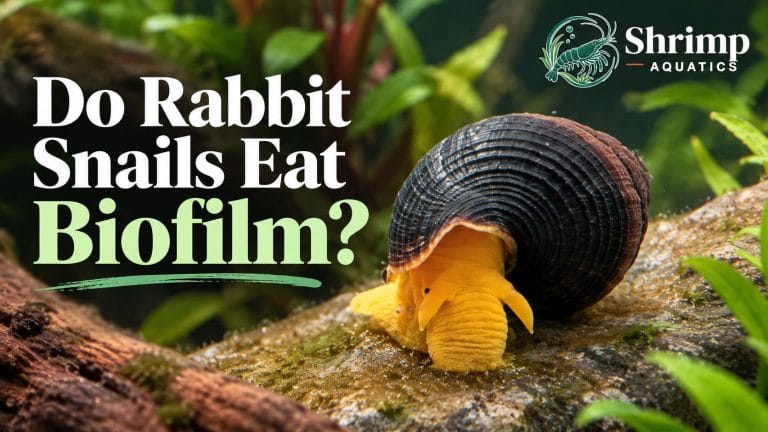
Start with the surfaces, because they decide whether there’s anything to eat. In Lake Towuti, one rabbit snail species lives as two forms side by side, a rock form and a wood form, and their feeding organs differ measurably: 79 percent of the snails found on rock were the rock form, and every snail found on wood was the wood form.1 That study measured the feeding organ and the surface, not the meal, so it doesn’t show a snail eating wood. What it shows is that surface type matters enough to shape the tool the animal feeds with. What that film is, and how to keep enough of it in the tank, is the biofilm rabbit snails graze.
The same split runs through the genus. Sulawesi Keepers, the specialist group that runs a conservation breeding program for these snails, separates the species that graze biofilm off stones, glass and other smooth surfaces from the species that live on fine sand or mud and don’t climb at all, and notes that piling in stones can take living space away from the second group.2 Which group your snail belongs to isn’t recorded for any line in the trade, ours included.
So we’d give it both. A decent area of open, fine sand where a soft substrate feeder can work, and plenty of rock, wood and glass carrying a visible film. A rock grazer dropped into a bare sand tank has nothing to feed on, which is the practical consequence of where rabbit snails come from.
What to feed a rabbit snail, and how little it takes
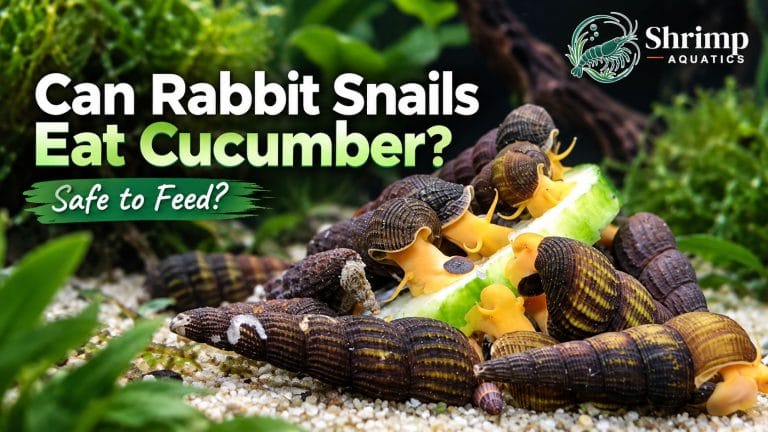
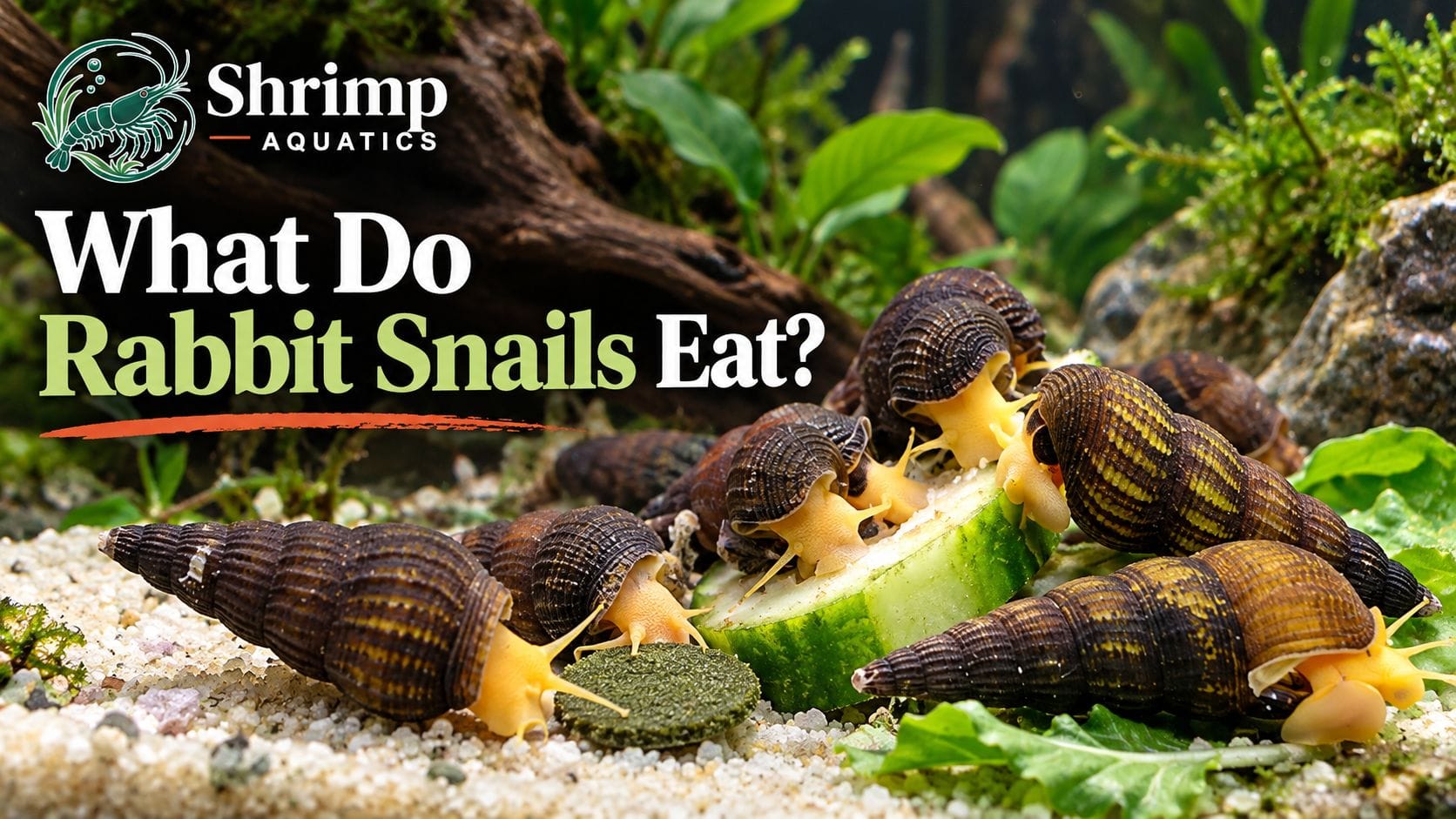
Feed lightly, and take the leftovers out. Drop a small portion on the open sand, well away from the rock the tank grazes, then lift anything the snail hasn’t finished a few hours later. Feeding away from the grazing surfaces keeps the food where you can see it, and keeps it off the layer you’re trying to grow. A cucumber slice follows the same rule, and whether rabbit snails eat cucumber comes down to how much gets rasped off before you lift it.
Why the hurry? Warm water goes to work on uneaten food fast, and as that food breaks down it releases ammonia. The share of ammonia sitting in the un-ionized form, which is the toxic one, rises about tenfold for each pH unit and roughly doubles for each ten degrees Celsius of warming, on EPA figures for fresh water generally.3 A rabbit snail tank is warm and alkaline, so it’s sitting at the unhelpful end of both. Fish food behaves the same way on the sand, which is the real risk behind whether rabbit snails eat fish food.
How much food? No study gives a captive diet or a feeding amount for this genus, so any gram figure you’ve read was invented by somebody. Go by the tank instead. If food is still sitting on the sand when you come to lift it, you put down too much, and a mature tank with good grazing surfaces will want less than you’d think.
Keepers commonly report that vegetables go down better than dry food, with carrot, cucumber, zucchini and green beans taken more readily than flakes, pellets or algae wafers. That’s a report from the hobby, not a menu we recommend, and it doesn’t change the main point: the film is doing most of the feeding. Zucchini is the piece of that list keepers reach for most, so whether rabbit snails eat zucchini has its own page.
Your new rabbit snail hasn’t eaten yet
That’s usually fine. Keepers report that a moved snail can take days, sometimes a couple of weeks, to start grazing with nothing wrong with it. Watching the food dish won’t tell you much. Check three things instead.
- Is the trapdoor sealed tight against the shell, or hanging open with the body slack behind it?
- Are your numbers where they were last week, or has something moved?
- Is there actual film on the rock and glass for the snail to find?
A sealed trapdoor in a tank whose readings haven’t moved is a snail waiting, not a snail failing. A slack, half-open trapdoor in a tank that’s drifted is a different problem, and the checks for that one live on Sulawesi rabbit snail care.
Do rabbit snails need extra calcium?
No, and we wouldn’t add a supplement. Hold GH 4-8 dGH and KH 3-6 dKH and don’t let them sag between water changes. That’s the answer, and it’s less satisfying than dropping something into the tank, which is exactly why it gets skipped.
Minerals do matter to a shell, but every published test we can point at was run on a different animal. In a Florida apple snail, the smallest shell growth and visible shell erosion came from the treatment that combined the lowest calcium with low pH.4 In an African land snail, calcium in the food tracked both shell growth and egg laying, and the deprived group laid no eggs at all.5 Neither animal is a rabbit snail, so the honest instruction is the water, held steady.
What we’d watch
KH is the one that quietly drifts down between water changes, and it’s the one that takes pH with it when it goes. Test it on the same day each week and you’ll see a slide long before the shell does.
Keepers commonly report dropping in a piece of cuttlebone or a crushed eggshell. That’s not something we’d do, and we wouldn’t tell you to. If your hardness is in range and stable there’s nothing there to fix, and if it isn’t, the fix is your remineralizing routine and your water change water, not a lump of calcium carbonate on the sand.
Do rabbit snails eat plants?
Keepers report both: some say their snails eat plants, Java fern most often, and others say theirs never touch one, so treat soft-leaved plants as at risk. There’s no published record of a rabbit snail feeding on living plant tissue. There’s also no published record of one leaving plants alone. That’s an uncomfortable answer for a shop to give, and it’s the true one.
Three pieces of evidence exist, and none of them is about a rabbit snail and a leaf. The home lakes are poor in food: the Malili lakes, Towuti among them, are described as ultra-oligotrophic, meaning very little grows in the open water.6 The feeding tool looks built for surfaces: a finite element study found that the stiffer inner teeth loosen food from a solid surface while the flexible outer teeth collect the loosened particles, modelled in a related snail family.7 And where anyone has traced a diet with isotopes, plants didn’t show up: two snails in South African coastal lakes came out feeding on microphytobenthos, filamentous algae, detritus and sedimentary organic matter, and the macrophytes growing in the same water were left out of the diet model because no trace of them appeared in the guts, in other families.8
Which plants are at risk in a rabbit snail tank
Treat soft-leaved plants as at risk and favor hardy epiphytes tied onto rock or wood, with the rhizome left above the substrate. Java fern is the plant keepers most often report being eaten, which is awkward, because it’s also the epiphyte most people reach for first. Plenty of other keepers run Java fern with rabbit snails for years and never lose a leaf. Both of those are reports, not findings, and we can’t tell you which one your tank will be.
Anubias tied to hardscape is the safer default in our view, and a stem tank full of soft new growth is the gamble. Plant choice in a warm, alkaline, mineral-rich tank is already narrowed by the water before the snail gets a vote.
Eaten leaves, or a dug-up plant?
These get blamed on the same animal and they aren’t the same event. Keepers report that burrowing lifts plants out of the substrate whether or not anything is eaten, so a stem floating loose with every leaf intact is a digging problem. A snail parked on a leaf may simply be scraping the film off the surface of it, which is what it does to your glass. Both of those are keeper reports.
The common belief that a well-fed snail leaves plants alone is a belief. Feeding more to protect your plants mostly gets you leftover food in a warm tank.
Will rabbit snails clean up your algae?
No. Don’t buy one for that job. A grazing snail really can thin a film: in laboratory streams, one freshwater snail cut periphyton biomass and chlorophyll by nearly half at a moderate stocking density, in another species entirely.9 That’s the reason to get grazing surfaces established before the snail arrives, and the reason a rabbit snail competes with your shrimp for the same layer. It isn’t a reason to expect hair algae to vanish. The longer answer to whether rabbit snails clean a tank, from algae to waste, has its own page.
Green filamentous algae aren’t natural food for these snails, and Sulawesi Keepers says some species suffer in a tank overgrown with algae.2 If you’ve got a hair algae problem, the light and the nutrients caused it, and a snail won’t argue you out of that.
Choosing a rabbit snail line for your tank
Get the tank right first, then pick on looks. All four of the lines we sell want the same water and graze the same way, so there’s no feeding reason to prefer one over another. The snail itself is a moderate keep. The tank is the demanding part: mature, warm, alkaline and mineral-rich, with a visible film on rock and glass before a snail goes in, and a snail this size counts toward the grazing load you already have.
Everything in our catalog is bred or propagated in our own tanks rather than collected from the wild, and our tank-bred Sulawesi snails are kept in the same warm, alkaline water this page describes.
For a planted tank, here’s what we’d do: epiphytes tied onto rock and wood, and soft-leaved plants at your own risk. We won’t promise you that a snail leaves your plants alone, and we won’t sell you one as algae control. Shipping is a flat USD 120 per order to every country.
References
9 Sources
- Evolutionary Divergence and Radula Diversification in Two Ecomorphs from an Adaptive Radiation of Freshwater Snails, Genes 13(6):1029, 2022.
- Do you know Sulawesi snails?, Sulawesi Keepers, read September 2026.
- Aquatic Life Ambient Water Quality Criteria for Ammonia, Freshwater, U.S. Environmental Protection Agency, Office of Water, April 2013.
- The effect of calcium and pH on Florida apple snail, Pomacea paludosa, shell growth and crush weight, Aquatic Ecology 43(4):1085-1093, 2009.
- Effects of dietary calcium on growth and oviposition of the African land snail Limicolaria flammea, Revista de Biologia Tropical 56(1):333-343, 2008.
- The Ancient Lakes of Indonesia: Towards Integrated Research on Speciation, Integrative and Comparative Biology, 2011.
- Finite element analysis relating shape, material properties, and dimensions of taenioglossan radular teeth with trophic specialisations in Paludomidae, Scientific Reports 11:22775, 2021.
- Stable Isotope Evidence for Dietary Overlap between Alien and Native Gastropods in Coastal Lakes of Northern KwaZulu-Natal, South Africa, PLOS ONE 7(2):e31897, 2012.
- Effects of Three Herbivores on Periphyton Communities in Laboratory Streams, Journal of the North American Benthological Society 6(2):92-104, 1987.
Ready to get started?
Shop our Sulawesi Snail collection
12 products available · Live Arrival Guarantee