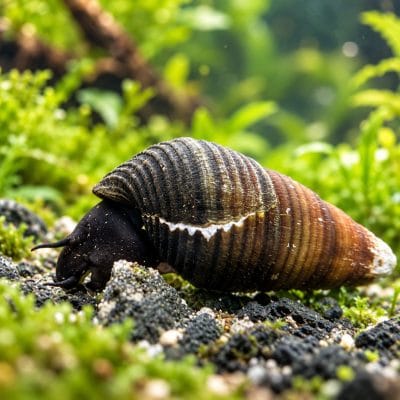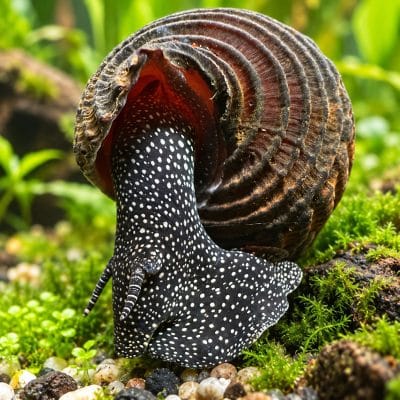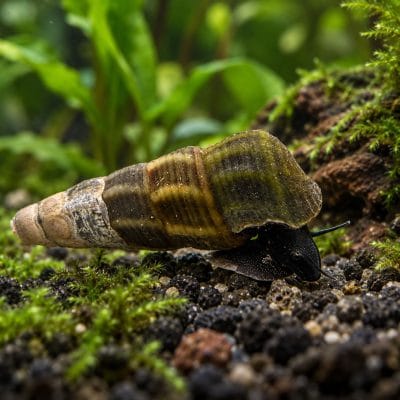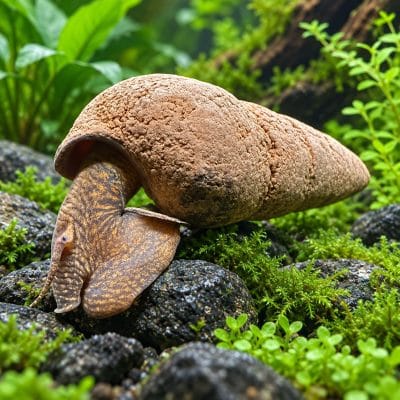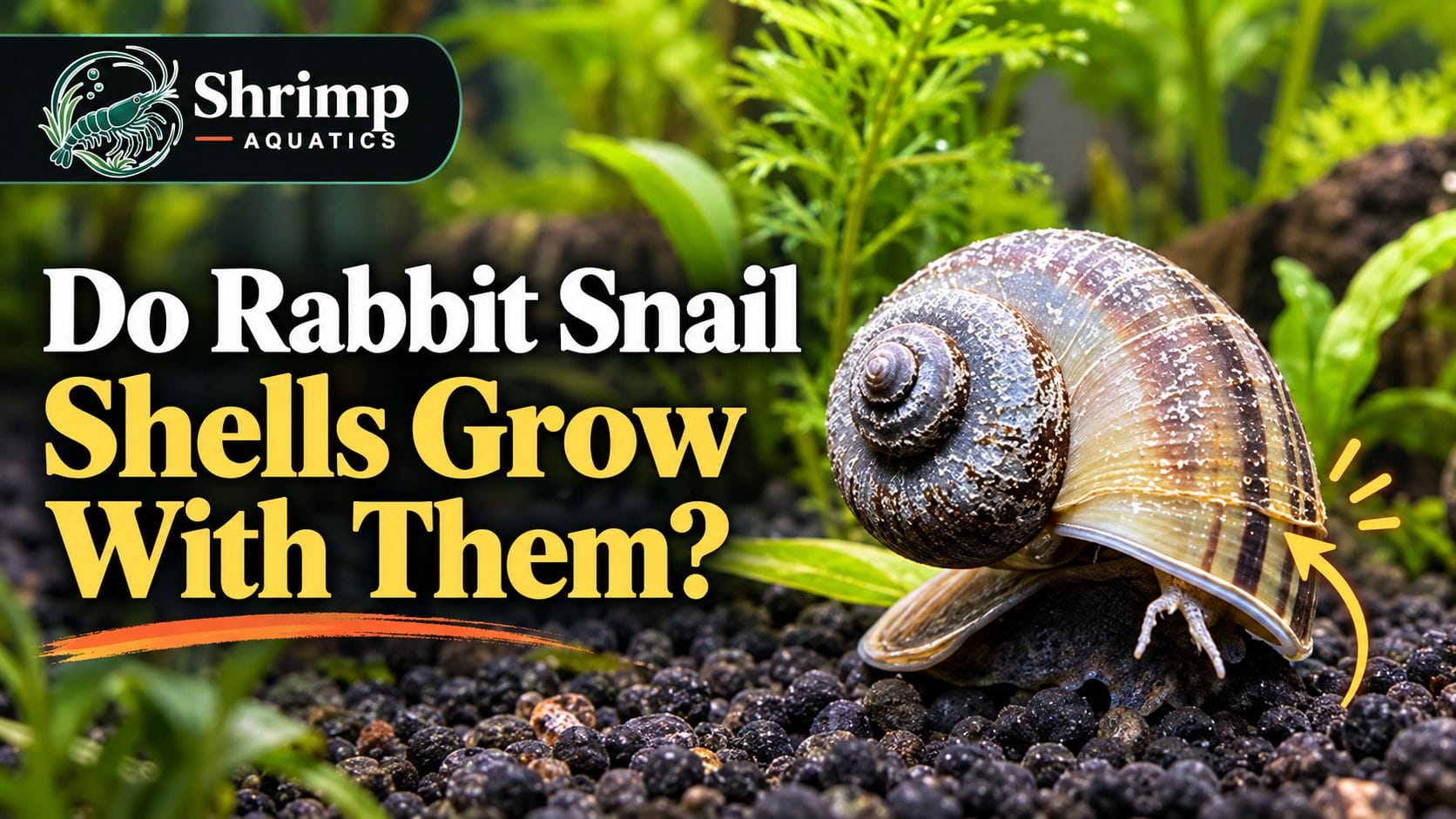
Yes. A rabbit snail’s shell grows with it for its whole life. The snail never sheds or swaps it; it keeps adding new shell at the opening as its body gets bigger.1 How fast that happens hasn’t been measured for any rabbit snail, so judge growth by the shell’s edge, not by a calendar.
Where on the shell does a rabbit snail add new growth?
Right at the opening. The mantle, the thin tissue lining the shell, lays down new material along the lip.1 So the shell gets longer and wider from the mouth outward, and the point at the top stays the oldest part. Think of a tube you can only ever add to at one end.
That’s why a rabbit snail doesn’t molt the way your shrimp do. A shrimp sheds its whole outer skeleton to grow. A snail can’t: it carries the shell it was born with and keeps extending it for the rest of its life.1
What goes into that new edge is mostly calcium carbonate, laid onto a thin organic framework that the mantle secretes along with it.2 Calcium carbonate is exactly the material that soft, acidic water dissolves, which is why the water in your tank decides whether new shell goes on clean.
Is a baby rabbit snail born with a shell?
Yes. Rabbit snails give birth to live young, and the shell starts before birth. In one Lake Mahalona species, the scientists who described it found embryos in the mother’s brood pouch already wearing ribbed shells up to 3.1 mm long.3
That first shell never comes off. The youngster builds onto the lip of the shell it was born with, so the very tip of an adult’s shell is the shell it wore as a baby.1 If you ever get a baby in your tank, you’re watching the start of the same shell it’ll carry as an adult. That’s why caring for baby rabbit snails means holding the adults’ water steady, not setting up a softer nursery tank.
Why does an adult rabbit snail’s shell tip look worn?
Because the tip is the oldest, most exposed part of the shell, and wear there is normal in adults. The same describers note that adults of that Lake Mahalona species always have corroded top whorls.3 They even used the worn tip to tell full-grown snails from younger ones. A chalky, blunt or missing point on an adult doesn’t, on its own, tell you anything is wrong with your water.
Usually normal
A scuffed, chalky or blunt tip on an adult, with a smooth, even edge at the opening.
Test your water
Fresh pitting, thinning or a white, crumbly edge right at the lip, where the snail is building now.
The lip is the part to watch because that’s where the snail is working today. If the newest shell is wearing away, check pH, GH and KH before you change anything else, and don’t try to fix a number in one big jump. If the damage keeps spreading, work out why your rabbit snail shell is eroding in order: pH, KH, GH, then the substrate.
What water keeps a rabbit snail’s new shell growing sound?
Steady, warm, alkaline water with enough hardness: pH 7.5-8.5, GH 4-8 dGH and KH 3-6 dKH at 79-86°F (26-30°C). That’s the range we keep to for every Sulawesi rabbit snail and shrimp we sell. It also needs a mature tank, not a freshly cycled one. Getting that tank ready before the snail arrives is the core of Sulawesi rabbit snail care.
There’s no published pH or hardness figure at which a rabbit snail’s shell starts to erode, so you won’t find a safety margin to aim for. Hold the range, and above all don’t let KH slide, because KH is what keeps pH from sliding with it. If your tap water starts soft, rabbit snails in soft water need KH and pH raised slowly before they go in, not corrected in one dose afterwards.
The closest measured evidence comes from a different snail. In a six-week trial with Florida apple snails, the ones in the softest, most acidic water (3.6 mg of calcium per liter, pH below 6.5) grew the least new shell and showed erosion.4 Shell growth was higher at 28 mg of calcium per liter or more. Rabbit snails weren’t tested, but it’s the direction you’d expect for any shell built from calcium carbonate.
In practice, that means no active aquarium soil that pulls pH down, and some caution with injected CO2, which lowers pH too. We’d get the water right before reaching for cuttlebone or a mineral block, since neither one can hold pH steady for you.
How fast will your rabbit snail’s shell grow?
Watch the lip, not a timetable: a snail that’s doing well keeps a clean, even edge that slowly moves outward. The month counts on care sheets aren’t measurements, and the same goes for how long rabbit snails take to reach full size.
Adult size also differs a lot between species. Because the snails in the trade are sold as Tylomelania sp., there’s no honest way to say how big yours will end up, or how long it’ll take.
That’s also the useful way to choose one. When you pick from our tank-bred Sulawesi rabbit snails, don’t pass over an older snail for a worn tip. What matters is the edge it builds next in your water. We don’t promise the size a snail will reach, or breeding, from any order.
References
4 Sources
- Gastropods, Marvelous Mollusks exhibit, Museum of the Earth, Paleontological Research Institution, undated.
- Huang and Zhang, The Mineralization of Molluscan Shells: Some Unsolved Problems and Special Considerations, Frontiers in Marine Science 9: 874534, 2022.
- Rintelen and Glaubrecht, Tylomelania hannelorae sp. nov. (taxonomic treatment record from Zootaxa 1852: 37-49), Plazi via Zenodo, 2008.
- Glass and Darby, The effect of calcium and pH on Florida apple snail, Pomacea paludosa, shell growth and crush weight (abstract), Aquatic Ecology 43: 1085-1093, 2009.
Ready to get started?
Shop our Sulawesi Snail collection
12 products available · Live Arrival Guarantee