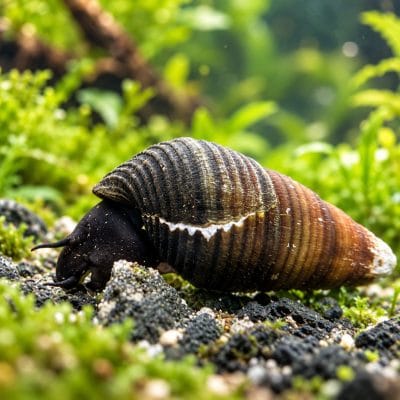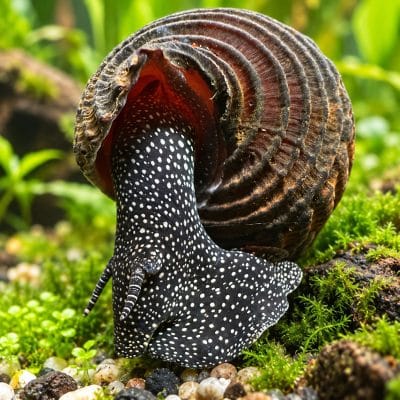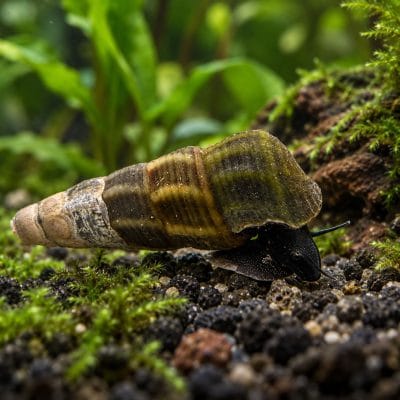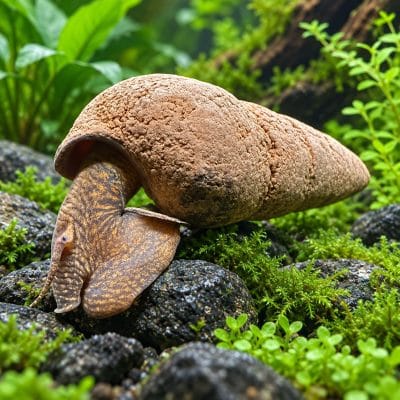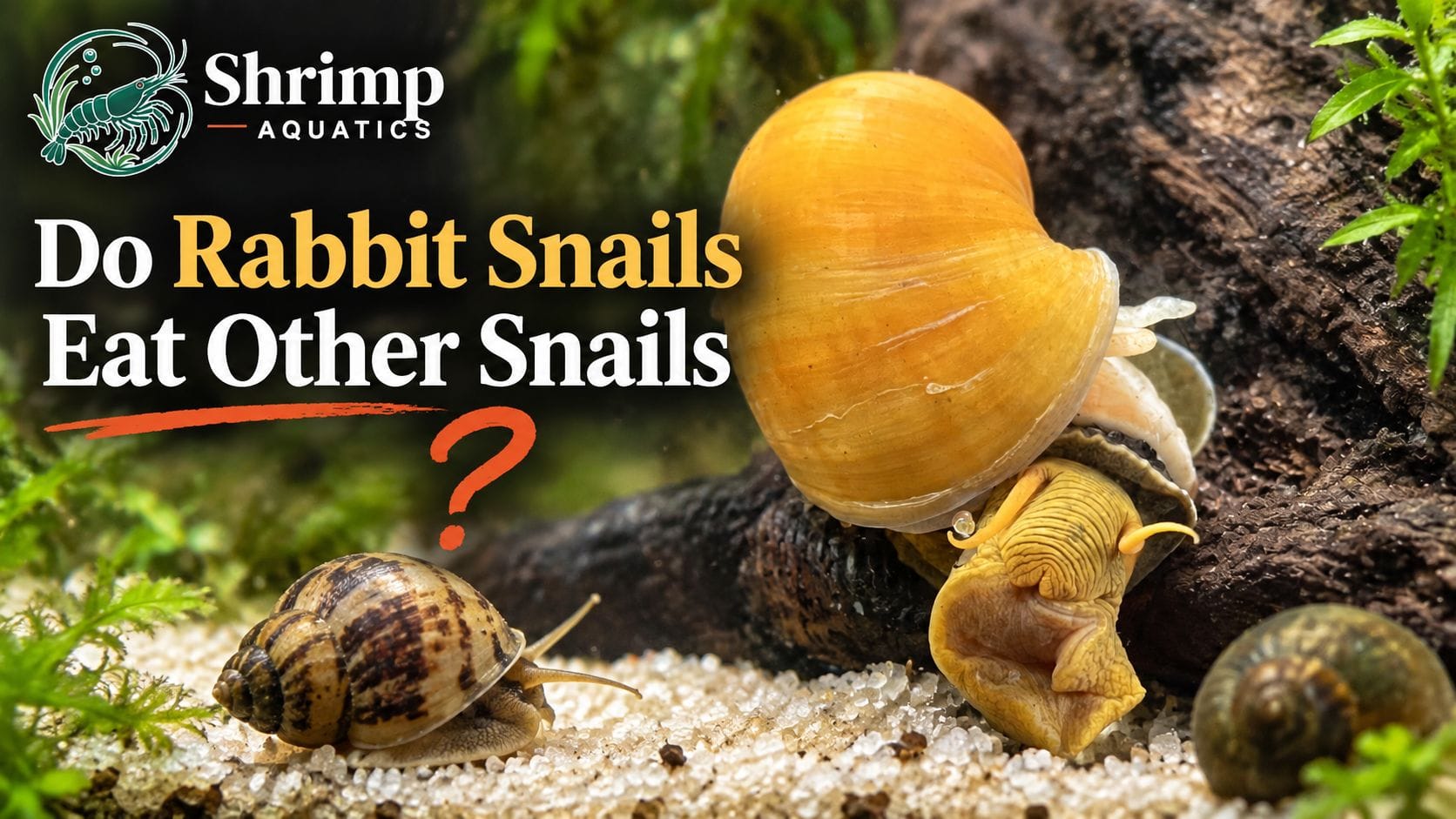
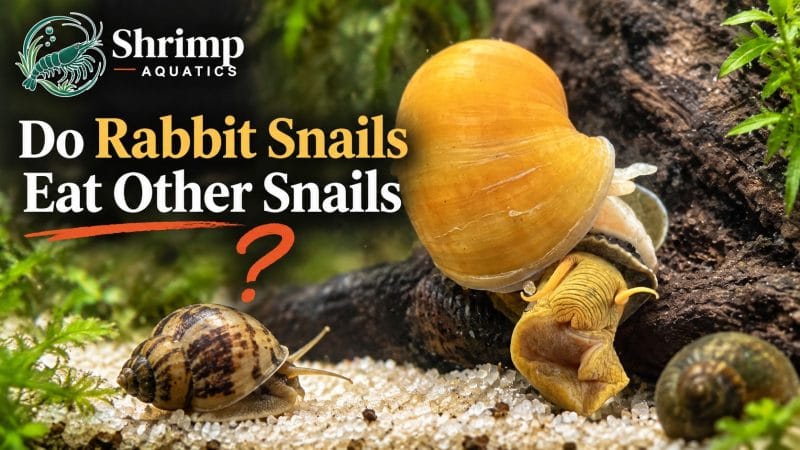
No. Sulawesi rabbit snails (Tylomelania spp.) aren’t known to hunt, kill or eat healthy snails. They’re grazers that work the film of algae and bacteria off rock, wood and glass, and we haven’t found a single published record of one attacking a live snail. What keepers do report is a rabbit snail feeding on a snail that’s already dead or dying. That’s scavenging, and it looks a lot worse than it is.
How sure can you be? Fairly. The conservation group Sulawesi Keepers describes the species that live on hard surfaces as feeding on the biofilm that grows on stones, glass and other smooth surfaces.1 In Lake Towuti, researchers found two forms of Tylomelania sarasinorum living side by side, one on rock and one on submerged wood, with measurably different radulas, the ribbon of tiny teeth a snail feeds with: 79 percent of the snails on rock were the rock form and every snail on wood was the wood form.2 That study measured feeding organs, not stomach contents, but it shows how closely these snails are built around the surface they graze. Nothing in that picture looks like a hunter. What that mouth is built for is the film on hard surfaces, which is the whole of what rabbit snails eat.
The same group also describes some species, the generalists that aren’t tied to hard or soft ground, as omnivorous and “literally voracious”.1 We think that appetite is why keepers keep finding rabbit snails on a dead tankmate, and why the story that they eat other snails won’t go away.
Is your rabbit snail eating a dead snail or a living one?
If the other snail is dead or dying, the rabbit snail may well be feeding on it. If the other snail is alive and moving normally, it’s almost certainly not being eaten. Before you decide which you’re looking at, check whether the other snail is still alive, gently and without prying it off the glass.
When the other snail is already dead
This is the scene behind most “my rabbit snail ate my mystery snail” posts. A snail dies, often quietly and out of sight, and by the time you notice, a rabbit snail has its snout in the shell. Keepers report this often, and nothing we’ve read suggests the rabbit snail caused the death. It found the body. Treat the loss as its own question and look at the water and the other snail’s health, not at the rabbit snail.
The usual rule is simple: lift a dead snail out the moment you find it.
When the other snail is alive and the rabbit snail is on its shell
A snail shell is just another hard surface with film growing on it, and keepers mostly describe rabbit snails climbing onto other snails and grazing that film. A leaf gets the same treatment for the same reason, which is why keeping rabbit snails off your plants starts with the film on your rock. It’s harmless if the other snail keeps moving, feeding and coming out of its shell. It’s worth acting on if the other snail stays shut for long stretches or the rabbit snail keeps returning to the same patch of shell.
What to change if a rabbit snail keeps working at a live snail’s shell
Check your pH and hardness first, then check the grazing. Some keepers link persistent shell rasping to mineral-poor water. We haven’t found a study that tested it in rabbit snails, and there’s no published mineral threshold for their shells, but low minerals are bad for every snail in the tank anyway. In the Florida apple snail, water low in calcium combined with pH below 6.5 gave the smallest shell growth and visibly eroded shells.3
- Test pH, GH and KH and hold them in the range we keep to for rabbit snails: pH 7.5-8.5, GH 4-8 dGH and KH 3-6 dKH.
- Watch KH in particular. If it’s drifting down between water changes, fix that before anything else.
- Look for a visible film of algae and biofilm on the rock and glass. A snail this size counts toward the grazing load, and prepared food doesn’t make up for a tank that’s scraped bare.
- If the other snail stays closed up while the rabbit snail keeps at it, move one of them to another tank with suitable water while you sort out the cause.
We know you’d like a single food or supplement that fixes it. There isn’t one with any evidence behind it for these snails, so steady water and a mature tank are the fix.
Keep assassin snails away from rabbit snails
If you want a snail that really does eat other snails, that’s the assassin snail (Anentome helena). In a published study it’s described as actively hunting other freshwater snails, holding them with its foot and eating them through the shell opening.4 The same paper notes it appears to take prey up to about twice its own weight.4 A large adult rabbit snail may be beyond that, but we wouldn’t gamble on it. Never keep the two together, and don’t add assassins to a rabbit snail tank to clear out pest snails.
Can other snails share a tank with rabbit snails?
They won’t be eaten, so the real limit is water. Rabbit snails need the same warm, alkaline, mineral-rich water as Sulawesi shrimp: 79-86°F (26-30°C) and pH 7.5-8.5. Many common aquarium snails are usually kept cooler than that, so check the other species’ own temperature range before you mix them, not after. If a snail can’t live comfortably at 79°F (26°C) or above, it doesn’t belong in this tank, however peaceful the rabbit snails are. Holding that water steady is the groundwork in Sulawesi rabbit snail care, and it matters more than the mix of snails you keep. Shrimp are the other common tankmate, and will rabbit snails eat shrimp covers whether they are at risk.
If your tank already sits in that range and you’re choosing what to add, our Sulawesi snail lines are bred by Shrimp Aquatics, not collected from the wild.
Do rabbit snails eat snail eggs or each other?
Will rabbit snails eat snail eggs or baby snails?
The only snail-eating keepers describe is scavenging on dead snails. If your snail seems to ignore everything you offer instead, why rabbit snails ignore prepared food covers what that usually means. If you breed another small snail in the same tank, watch the egg clutches for the first few weeks and move them if anything changes.
Do rabbit snails eat each other?
There’s no record of rabbit snails killing each other. If one dies, the others may feed on it like any dead snail, so remove it as soon as you find it.
References
4 Sources
- Do you know Sulawesi snails?, Markéta Rejlková, Sulawesi Keepers, undated (accessed 2026-09-21).
- Evolutionary Divergence and Radula Diversification in Two Ecomorphs from an Adaptive Radiation of Freshwater Snails, Hilgers L. et al., Genes, 2022.
- The effect of calcium and pH on Florida apple snail, Pomacea paludosa (Gastropoda: Ampullariidae), shell growth and crush weight, Aquatic Ecology (Springer Nature), 2009 (abstract).
- Assassin snails (Anentome helena) as a biological model for exploring the effects of individual specialisation within generalist predators, Berkhout B.W. and Morozov A., PLOS ONE, 2022.
Ready to get started?
Shop our Sulawesi Snail collection
12 products available · Live Arrival Guarantee