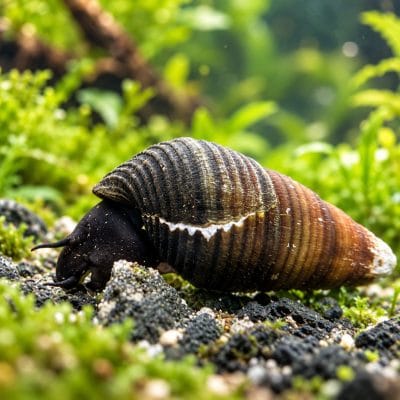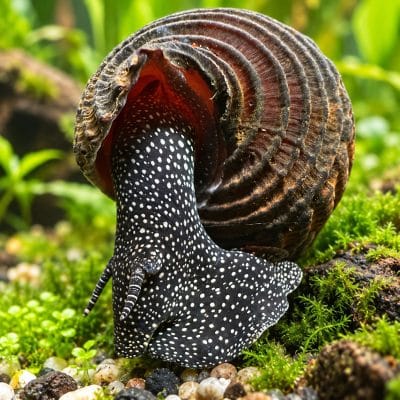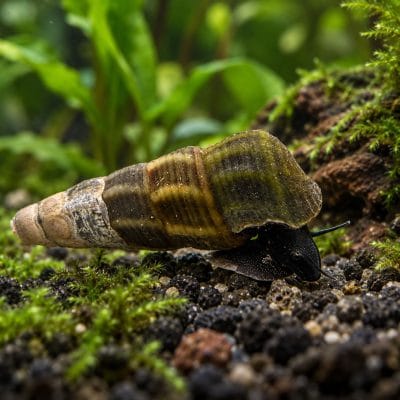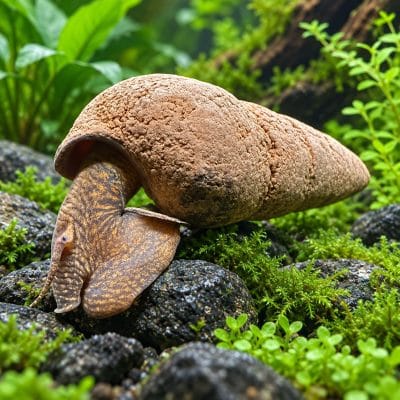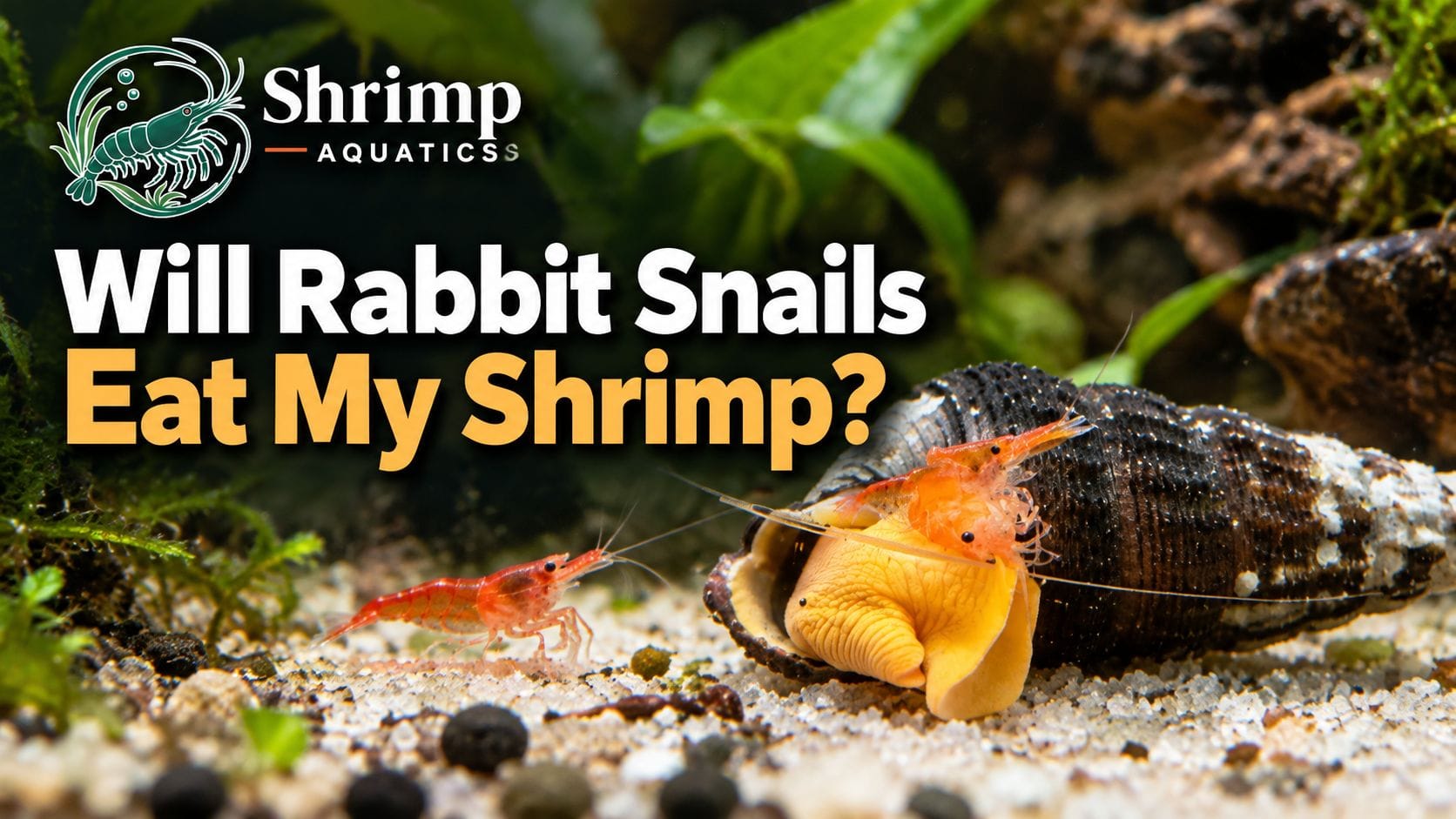
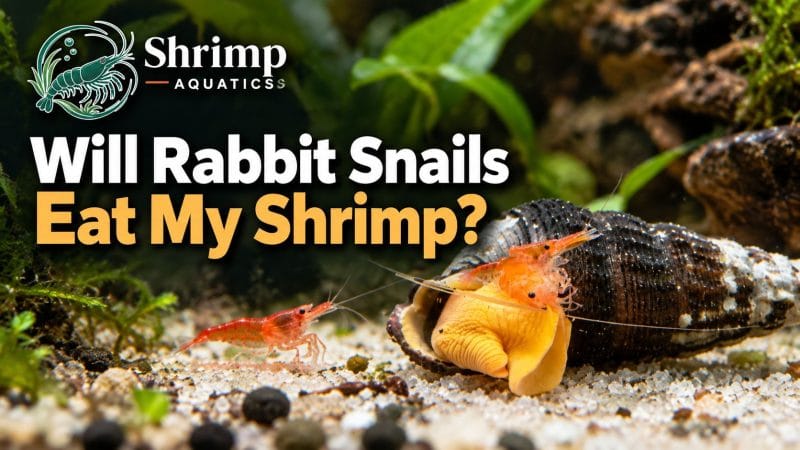
No. Rabbit snails (Tylomelania sp.) are slow grazers that scrape a film of algae and microbes off rock, wood and glass. We couldn’t find a single published record of one catching a live shrimp or shrimplet. If you’ve found a snail on a shrimp, the shrimp had most likely died first. What decides whether your shrimp and a rabbit snail belong together is the water, not the snail’s appetite.
Why rabbit snails don’t hunt shrimp or shrimplets
A rabbit snail eats by grazing. Species that live on hard surfaces spend their time on stones and glass and feed on the biofilm growing there, according to the conservation group Sulawesi Keepers.1 The tool for the job is the radula, a ribbon of tiny teeth the snail draws across a surface. In one Lake Towuti species, snails living on rock and snails living on submerged wood carry measurably different radulae. The researchers call it the snail’s key foraging organ.2 Everything documented about how these snails feed is about working a surface. What else goes on that menu is covered in what rabbit snails eat.
Then there’s speed. A rabbit snail moves slowly, and a healthy shrimp that bumps into one just moves off. Shrimplets are the worry most keepers have, since they’re tiny and spend the day picking at the same film the snail grazes. We haven’t found a report of a rabbit snail taking a live one. If you’re watching a berried female or a tank full of babies, the snail isn’t where we’d look for trouble. Nor does it bully fish: rabbit snails aren’t aggressive toward anything in the tank.
Are rabbit snails strict vegetarians, then? Not all of them. Sulawesi Keepers describes the generalist species as omnivorous and voracious.1 That wider appetite is the likeliest reason keepers find them on shrimp that have already died.
Found a rabbit snail on a dead shrimp?
It’s a sight that sends plenty of keepers to a forum convinced they’ve bought a predator. Keepers commonly report that when they look closely, the snail is feeding on a shrimp that was already dead. It fits everything known about how these snails feed. The snail found the body. It didn’t cause the death. Rabbit snails treat a dead snail the same way, which is whether rabbit snails eat other snails.
So read it as a message about the tank. Lift the body out as soon as you see it, because a dead shrimp breaks down quickly in warm water. In fresh water, the share of ammonia in its most toxic form rises about tenfold for each full step up in pH and roughly doubles for every ten degrees Celsius of warming.3 A warm, alkaline tank like this one gives you less margin when something rots. Then work through the likely causes:
- Ammonia and nitrite, which should both read zero in a cycled tank.
- Temperature, pH, GH and KH against the range in the table below, and whether any of them has swung recently.
- Anything new in the last few days: a tankmate, a water change you didn’t match, a plant, a decoration or a treatment.
- Any medication or plant product that might contain copper, which shrimp and snails shouldn’t be exposed to.
If shrimp keep dying while every reading looks right, don’t guess at a treatment. Ask a local specialist or an aquatic vet who can look at the tank.
Which shrimp can live with rabbit snails?
Only shrimp that want the same water. Rabbit snails need a warm, alkaline, mineral-rich Sulawesi setup. No published source gives them a keeping range of their own, so the range below is the Sulawesi shrimp range, copied number for number. The full pairing with Sulawesi shrimp, stocking included, is Sulawesi shrimp living with rabbit snails.
| Temperature | 79-86°F (26-30°C) |
|---|---|
| pH | 7.5-8.5 |
| GH | 4-8 dGH |
| KH | 3-6 dKH |
| TDS | 150-250 ppm |
| Nitrate | under 10 ppm |
Sulawesi shrimp: a fit
Cardinal, White Sock, Blue Leg and the other Sulawesi lake shrimp live in exactly this range and graze the same rock, so they’re the natural companions for a rabbit snail. They’re also the only Caridina that fit, which is why rabbit snails with Caridina shrimp means Sulawesi species or nothing.
Bee shrimp: not a fit
Bee and Crystal shrimp want soft, acidic water at pH 5.8-6.8 and 60-72°F (15.5-22°C).
Cherry shrimp are a different case. Neocaridina are usually kept at 65-78°F (18-26°C) and a rabbit snail tank starts at 79°F (26°C), so on paper the temperatures don’t meet, and plenty of care sheets list them as tankmates without saying so. In some of our own Sulawesi tanks, though, a small group of Neocaridina lives and breeds at the snail’s temperature. Keep the tank in the snail’s range, keep the group small, and move any shrimp that hide all day or keep dying to cooler water. That’s how we keep rabbit snails with Neocaridina shrimp, and it’s our experience, not a published finding.
How to keep rabbit snails and Sulawesi shrimp from competing for food
With Sulawesi shrimp, the thing to plan for is grazing room. Both animals work the same film on rock and glass, and a snail this size takes a real share of it. We know you want to add the snail on the same day as the shrimp and call the tank finished. Give the surfaces time first. The same arithmetic decides rabbit snail tank size.
- Wait until rock and glass carry a visible film of algae and biofilm before the snail goes in.
- Count the snail as part of the grazing load when you decide how many shrimp the tank can carry.
- Don’t lean on prepared food to make up for a young tank. It won’t stand in for a mature film.
Before you add a rabbit snail to your shrimp tank
As animals go, rabbit snails are a moderate keep, hardier than the Sulawesi shrimp they share water with. The tank is the demanding part. It has to be mature, warm, alkaline and mineral-rich before either animal goes in, so a rabbit snail isn’t an easier way into Sulawesi keeping or a good first animal for a new tank. The tank itself is set out in Sulawesi rabbit snail care.
If your setup already fits, our Sulawesi snail lines are tank-bred by Shrimp Aquatics, not collected from the wild. We don’t promise breeding, sex or the number of young from any order. Not sure your water fits? Email contact@shrimpaquatics.com with your pH, GH, KH, TDS, temperature, tank size, cycle status and current livestock, and we’ll tell you whether it fits.
References
3 Sources
- Do you know Sulawesi snails?, Markéta Rejlková, Sulawesi Keepers, undated page, accessed 2026-09-24.
- Evolutionary Divergence and Radula Diversification in Two Ecomorphs from an Adaptive Radiation of Freshwater Snails, Hilgers L. et al., Genes 13(6): 1029, 2022.
- Aquatic Life Ambient Water Quality Criteria for Ammonia, Freshwater (2013), U.S. Environmental Protection Agency, Office of Water, April 2013.
Ready to get started?
Shop our Sulawesi Snail collection
12 products available · Live Arrival Guarantee