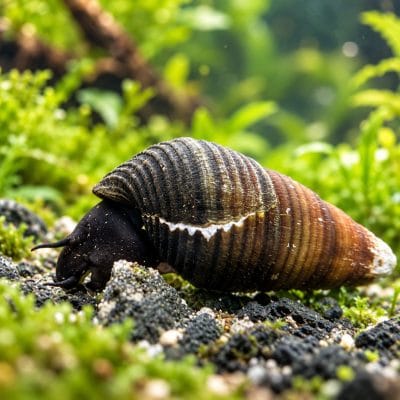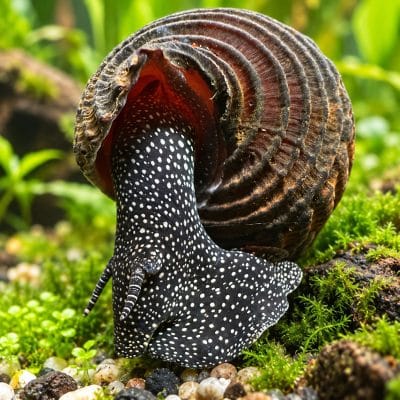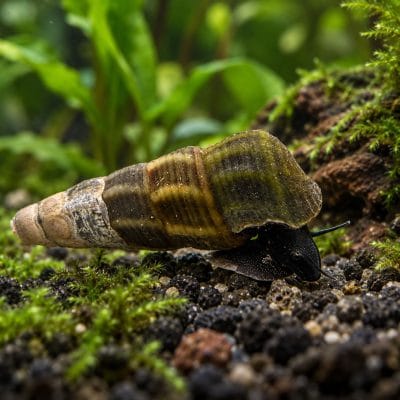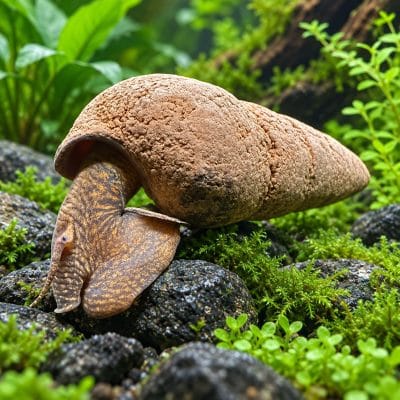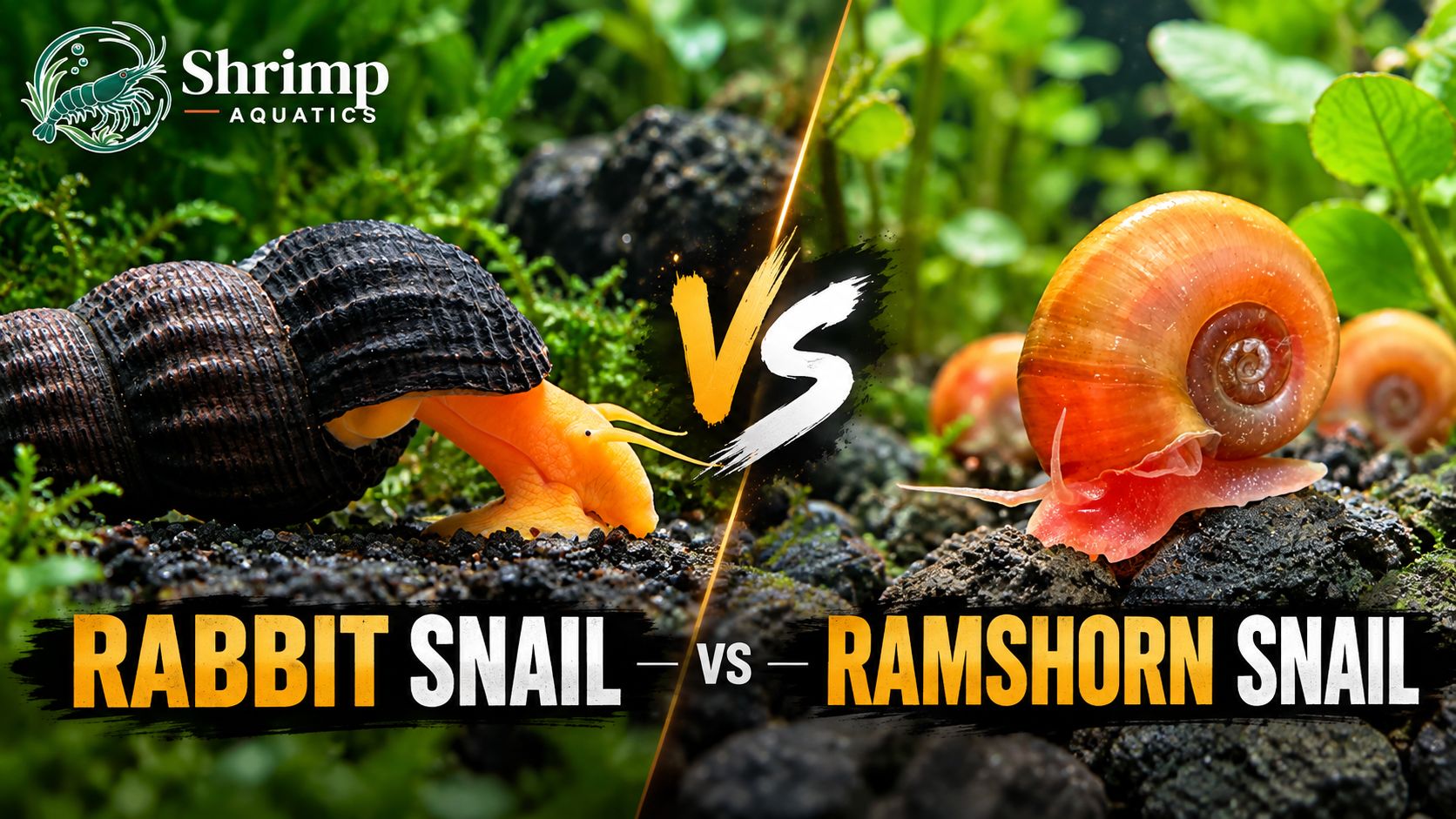
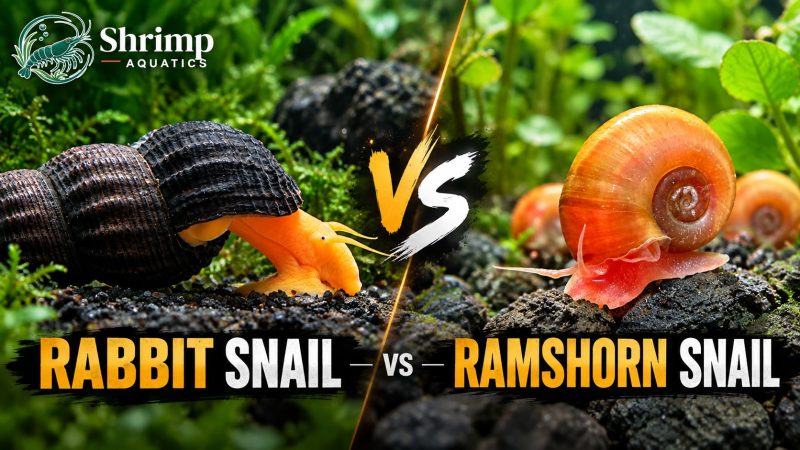
Choose by your water: a rabbit snail (Tylomelania sp.) needs a mature, warm, alkaline Sulawesi tank, while a ramshorn fits the ordinary community tank most keepers already run. Ramshorns also breed far faster, and the snail that strips plants is usually a different animal sold under the ramshorn name.
Does your water suit a rabbit snail or a ramshorn?
If your tank runs warm, alkaline and mineral-rich the way a Sulawesi tank does, it suits a rabbit snail. If it’s an ordinary tropical community tank, it suits a ramshorn and not a rabbit snail. The table puts the two side by side.
| Trait | Rabbit snail | Ramshorn snail (community tank) |
|---|---|---|
| Temperature | 79-86°F (26-30°C) | Roughly 68-78°F (20-26°C), the usual range for common aquarium snails |
| pH | 7.5-8.5 | Neutral to alkaline; check the species you buy |
| Hardness | GH 4-8 dGH, KH 3-6 dKH | Enough minerals to build the shell; no single figure |
| TDS | 150-250 ppm | No single figure |
| Nitrate | Under 10 ppm | Low, as in any cycled tank |
| Shell | Tall cone; an adult’s tip is often worn | Flat coil in one plane |
| Young | Released already shelled from a brood pouch | Hatch from eggs |
| Breeding pace | Slow; brood size depends on the species | One snail can breed alone; a pair breeds readily |
| Sold by us | Yes, tank-bred | No |
The rabbit snail itself is moderate to keep. The tank is the demanding part. It has to be a mature, warm, alkaline Sulawesi setup, with a visible film of algae and biofilm on rock and glass before the snail goes in. That’s why a rabbit snail isn’t an easy way into Sulawesi keeping, and why it doesn’t belong in a young tank or a beginner’s first setup. Getting that setup right is most of Sulawesi rabbit snail care.
That fussiness about water has a simple origin. Rabbit snails are found only on Sulawesi, as strict freshwater animals of its lakes, rivers and streams, and not above about 700 m.1
A true ramshorn is a different kind of snail altogether. It belongs to the family Planorbidae, it breathes air with a lung and has no gills, and its shell coils flat in one plane.2 Wondering why yours keeps crawling to the surface? It’s most likely just taking air. Ramshorns suit an ordinary community tank, where common aquarium snails are usually kept at roughly 68-78°F (20-26°C) in neutral to alkaline water with enough minerals for the shell.
Will ramshorns multiply faster than rabbit snails in your tank?
Yes, by a wide margin. A ramshorn is a hermaphrodite: in a 1988 study, 50 Florida ramshorns (published as Helisoma duryi) raised alone for about 150 days laid 103 eggs between them. Once the same snails could mate, they produced large numbers of eggs.3 So a single hitchhiker on a plant can start a colony, just slowly, and two can start one quickly. It’s the same species the hobby sells in its red form.4
What keeps ramshorn numbers in check is how much you feed. The usual rule is to feed only what your fish or shrimp clear quickly and to lift anything left over.
Rabbit snails go the other way. The genus keeps its developing young in a brood pouch and releases them as comparatively large, fully shelled juveniles.1 How many a female carries depends heavily on the species: preserved females of one river species held 11 to 67 embryos,5 while a small lake species held just 1 or 2.6 It’s the same brood-pouch system behind how rabbit snails reproduce across the genus, with no eggs laid outside the mother.
Brood size, time between births and age at maturity haven’t been published for the lines sold in the hobby, so treat any figure you read for them as a keeper’s guess. We don’t promise breeding, sex or the number of young from any order.
Which snail is the real risk to your plants?
The one to keep out of a planted tank is the giant ramshorn, Marisa cornuarietis. Despite the name it belongs to the apple snail family, and it’s a voracious eater of aquatic plants that has even been used to clear weeds from canals.7
How do you tell a giant ramshorn from a true ramshorn?
Check the scientific name on the listing. A snail sold as Marisa cornuarietis, sometimes called the Colombian ramshorn, grows a flat shell usually 35-50 mm across.7 A true ramshorn will be listed under the family Planorbidae.
For true ramshorns we didn’t find a study showing whether they eat healthy aquarium plants, and keeper reports disagree, so watch soft-leaved plants for the first few weeks.
Rabbit snails get the same honest answer. Treat soft-leaved species as at risk and tie hardy epiphytes to rock. The steps to keep rabbit snails from eating your plants start with a thick grazing film on the hardscape.
Don’t buy either snail to clear algae, though. Sulawesi Keepers reports that filamentous green algae aren’t a natural food for rabbit snails.
Can you keep ramshorns in a rabbit snail tank?
We wouldn’t. Common aquarium snails such as ramshorns are usually kept cooler than a rabbit snail tank runs, so the two temperature ranges don’t meet. Both snails would also be grazing the same film on the rock that the rabbit snail depends on.
If ramshorns do turn up in a rabbit snail tank, don’t bring in assassin snails to clear them: assassins prey on other snails and have no place in a rabbit snail tank. Pick the ramshorns out by hand and cut back the feeding instead. Whatever you use to treat fish, keep copper and copper-based medications out of any tank with snails in it.
Which snail should you order for your tank?
Order a rabbit snail only if you already run a mature Sulawesi tank at 79-86°F (26-30°C) and pH 7.5-8.5 with a visible grazing film. For any cooler community tank, a ramshorn is the snail that fits, as long as you’re happy to manage its numbers. If you’re weighing a rabbit snail vs Malaysian trumpet snail instead, the same water question decides it.
A rabbit snail is a large snail and it counts toward the tank’s grazing load, so plan your rabbit snail tank size and hardscape before you add several. Expect a worn tip on an adult shell: both species descriptions above record the top whorls of adults as always corroded to some degree.56 Fresh erosion at the growing edge of the shell is different, and it’s a reason to test your pH and minerals. Start with pH and KH when you work out why a rabbit snail shell is eroding.
Every one of our Sulawesi snail lines is sold as Tylomelania sp. Each is bred by Shrimp Aquatics, not collected from the wild. We don’t stock ramshorns, so if a ramshorn is the right snail for your tank, a local store is the easier route.
References
7 Sources
- A Snail Perspective on the Biogeography of Sulawesi, Indonesia: Origin and Intra-Island Dispersal of the Viviparous Freshwater Gastropod Tylomelania, von Rintelen, Stelbrink, Marwoto and Glaubrecht, PLOS ONE 9(6): e98917, 2014.
- Planorbidae, Animal Diversity Web, University of Michigan Museum of Zoology, 2000.
- Self-fertilization in the freshwater snails Helisoma duryi and Helisoma trivolvis, Paraense and Corrêa, Memórias do Instituto Oswaldo Cruz 83(4): 405-409, 1988 (ScienceOpen abstract record).
- Helisoma scalare duryi species account, R. T. Dillon Jr., Freshwater Gastropods of North America.
- Tylomelania sinabartfeldi Rintelen and Glaubrecht, 2008, sp. nov., taxonomic treatment from Zootaxa 1852: 37-49, 2008 (Biodiversity Literature Repository).
- Tylomelania hannelorae Rintelen and Glaubrecht, 2008, sp. nov., taxonomic treatment from Zootaxa 1852: 37-49, 2008 (Biodiversity Literature Repository).
- Marisa cornuarietis (giant ramshorn) species profile, U.S. Geological Survey, Nonindigenous Aquatic Species Database.
Ready to get started?
Shop our Sulawesi Snail collection
12 products available · Live Arrival Guarantee