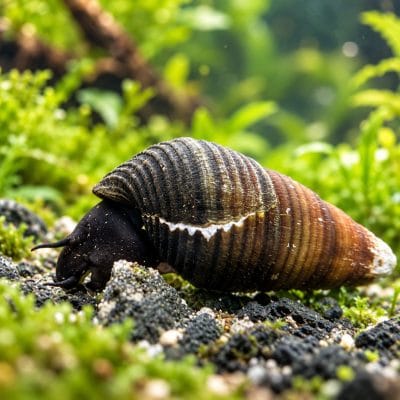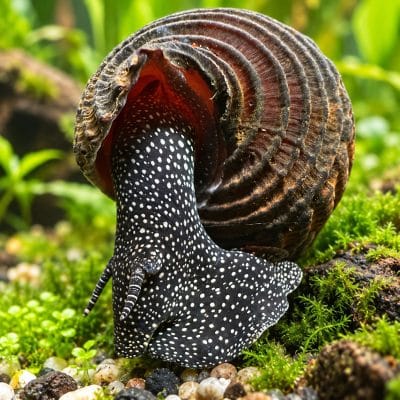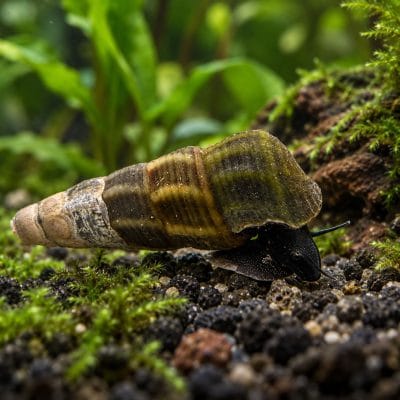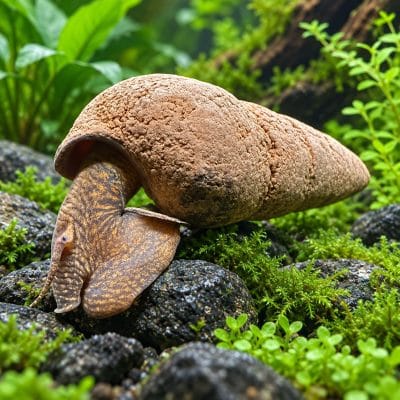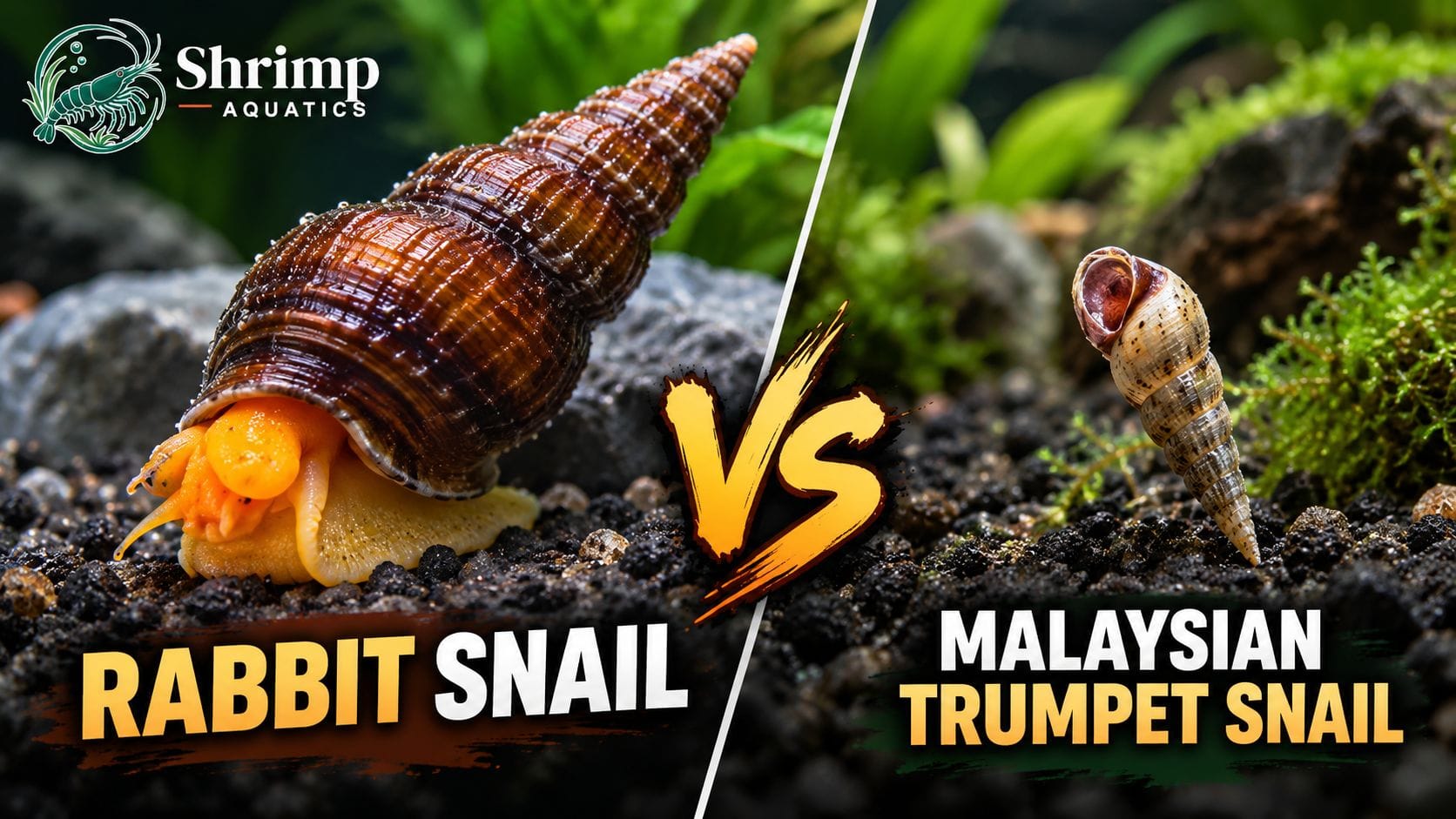
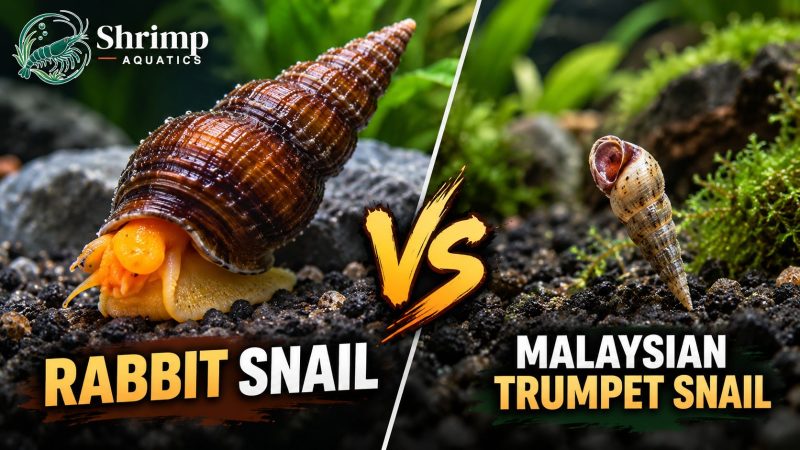
Choose a rabbit snail if you want a slow, showy grazer and already run a mature Sulawesi tank at 79-86°F (26-30°C) and pH 7.5-8.5. Choose a Malaysian trumpet snail only if you’re happy with a small burrower that clones itself and will fill the tank. This page sets their published biology side by side.
| Trait | Rabbit snail (Tylomelania) | Malaysian trumpet snail (Melanoides tuberculata) |
|---|---|---|
| Where it comes from | Only Sulawesi, Indonesia: its old lakes and many of its rivers | Africa and the Middle East through Asia to Australia; now established on other continents1 |
| Water | 79-86°F (26-30°C), pH 7.5-8.5, GH 4-8 dGH, KH 3-6 dKH, TDS 150-250 ppm, nitrate under 10 ppm | Tolerates a wide spread of temperatures and even brackish water |
| Where you’ll see it | Grazing rock, wood and glass; some species live on sand or mud | Buried in the sand by day, out grazing at night |
| Adult size | Large | Usually 20-40 mm (0.8-1.6 in)1 |
| How it breeds | Males and females; young develop in a brood pouch, 1-2 or dozens depending on species | Females clone themselves; one snail can found a colony |
| Main risk | Copper, assassin snails and a young or acidic tank | Takes over the tank and is invasive if released |
Will a rabbit snail cope with water that suits trumpet snails?
Only if that water is already a warm, hard, alkaline Sulawesi setup. Trumpet snails live through far more than a rabbit snail needs. In published records they survived a wide range of temperatures with little loss, and they turn up in brackish mangroves as well as freshwater springs, streams and lakes.1 A rabbit snail gets no such slack.
The range we keep to for rabbit snails is the same as for our Sulawesi shrimp: 79-86°F (26-30°C), pH 7.5-8.5, GH 4-8 dGH, KH 3-6 dKH and TDS 150-250 ppm, with nitrate under 10 ppm. So the question only runs one way. A trumpet snail will usually manage in a rabbit snail’s water. A rabbit snail won’t manage in everything a trumpet snail survives, and a planted tank on acidic, pH-lowering soil is the obvious mismatch.
We rate the rabbit snail itself as moderate. That rating is for the animal, not the tank. It still needs a mature system with a visible film of algae and biofilm on rock and glass before it goes in. It isn’t an easy way into Sulawesi keeping, and it isn’t a snail for a young tank. That mature system is what Sulawesi rabbit snail care is built around.
Rabbit snails graze rock and glass while trumpet snails work the sand
If you want the substrate turned over, that’s the trumpet snail’s job; a rabbit snail stays on the surface. Trumpet snails tend to bury themselves in the substrate by day and come out to graze at night,2 feeding on detritus and microalgae.1 Rabbit snails graze the biofilm on hard surfaces, and Sulawesi Keepers notes that some species specialize in stone while others live on fine sand or mud.3 Fine, smooth sand with rock on top is the best substrate for rabbit snails of either kind.
Don’t buy a rabbit snail as an algae crew, though. Green filamentous algae aren’t a natural food for these snails.3 And if you keep soft-leaved plants, treat them as at risk. Hardy epiphytes tied to rock are the safer choice. What they graze is the film of algae and biofilm on rock and glass, and the rest of what rabbit snails eat is a small top-up of sinking food.
Why trumpet snails multiply by the hundred while rabbit snails add young slowly
A single Malaysian trumpet snail can fill a tank, because males are missing from most populations and the females reproduce by cloning themselves.2 Each female carries her young in a brood pouch and releases them as tiny shelled snails about 2 mm long,2 at an estimated 365 embryos a year, and those young can be mature within about 3-7 months.1 That’s why a few trumpet snails turn into hundreds.
Rabbit snails are much slower. They’re live-bearers with separate sexes, and you can’t tell a male from a female by looking.3 How many young a female carries depends heavily on the species: a Lake Mahalona species holds just 1-2 embryos,4 while a species from the Larona River holds 11-67.5 No one has published how often a female gives birth or how many young leave at once, and the lines in the trade are sold as Tylomelania sp. without a species name. So we don’t promise breeding, sex or the number of young from any order.
Is that new baby snail a young rabbit snail or a trumpet snail hitchhiker?
If tiny snails appear in the sand by the dozen, they’re almost certainly trumpet snails. Newborn trumpet snails measure about 1.0-4.5 mm and one parent can produce hundreds a year,1 and they spend the day buried and come out at night.2 Size alone won’t settle it while they’re small, because rabbit snail embryos already reach up to 3.1 mm inside the pouch in one species4 and 5.0 mm in another.5 Numbers and habits will: a sudden crowd of little snails that hides in the sand by day fits a trumpet colony, not a rabbit snail brood. Once one is moving, baby rabbit snail identification is quicker by the head: a long, wrinkled snout and thick tentacles mark a rabbit snail.
Trumpet snails spread mainly through the aquarium trade,1 so the usual route into a rabbit snail tank is a new plant or decoration from another tank. If you don’t want them, check new plants and their pots before they go in, and rinse them well.
Can rabbit snails and trumpet snails share one Sulawesi tank?
They can live in the same water, but we wouldn’t add trumpet snails to a rabbit snail tank on purpose. Trumpet snails feed on detritus and microalgae1 and rabbit snails graze biofilm,3 so both draw on the same living film. That film is what limits how many snails and shrimp your tank can carry. A trumpet colony that grows by hundreds a year takes its share every night. Where the species has spread in the wild, it has displaced native snails, possibly by competing for food.1 Ramshorns raise the same question, and our rabbit snail vs ramshorn snail answer is the same: we wouldn’t add them.
If trumpet snails are already in, thin them by hand after the lights go out, when they come up to graze, and lift out any uneaten food. Don’t reach for an assassin snail: assassin snails eat other snails and have no place in a rabbit snail tank. Keep copper out as well. In lab tests copper was the most toxic of eight metals to trumpet snails,6 and we treat rabbit snails with the same caution.
Choosing between a rabbit snail and a Malaysian trumpet snail for your tank
Pick the rabbit snail if you run, or are ready to build, a mature Sulawesi tank and want an animal to watch. Pick the trumpet snail if you want the sand turned over in a tank where it can’t escape, and you accept that you’ll never have just a few.
Whichever you choose, never release either one into local water. Trumpet snails have spread across tropical America and beyond through the aquarium trade.1 They’ve displaced native snails there, and in the wild they host dozens of parasitic flukes, some of which infect people.1 Rabbit snails come from nowhere but Sulawesi, from its old lakes and from rivers across most of the island.7
Ours are tank-bred by Shrimp Aquatics, not collected from the wild, and every line we sell is listed under our Sulawesi snail category. If you’re not sure your tank is ready, email contact@shrimpaquatics.com with your pH, GH, KH, TDS, temperature, tank size, cycle status and current livestock before you order.
References
7 Sources
- Melanoides tuberculata species summary, Marine Invasions Lab, Smithsonian Environmental Research Center (PanNEMO database), accessed 2026.
- Species Account: Melanoides tuberculata, R. T. Dillon Jr. and colleagues, The Freshwater Gastropods of North America, 2026.
- Do you know Sulawesi snails?, Markéta Rejlková, Sulawesi Keepers, 11 March 2026.
- Tylomelania hannelorae Rintelen & Glaubrecht, 2008, sp. nov., species treatment from T. von Rintelen and M. Glaubrecht, Zootaxa 1852: 37-49, 2008 (Zenodo record).
- Tylomelania sinabartfeldi Rintelen & Glaubrecht, 2008, sp. nov., species treatment from T. von Rintelen and M. Glaubrecht, Zootaxa 1852: 37-49, 2008 (Zenodo record).
- Toxicity of metals to a freshwater snail, Melanoides tuberculata, M. Shuhaimi-Othman, R. Nur-Amalina and Y. Nadzifah, ScientificWorldJournal, 2012 (PubMed abstract record).
- Freshwater snails of Sulawesi: a brief overview, Thomas von Rintelen, Sulawesi Keepers, 3 August 2022.
Ready to get started?
Shop our Sulawesi Snail collection
12 products available · Live Arrival Guarantee