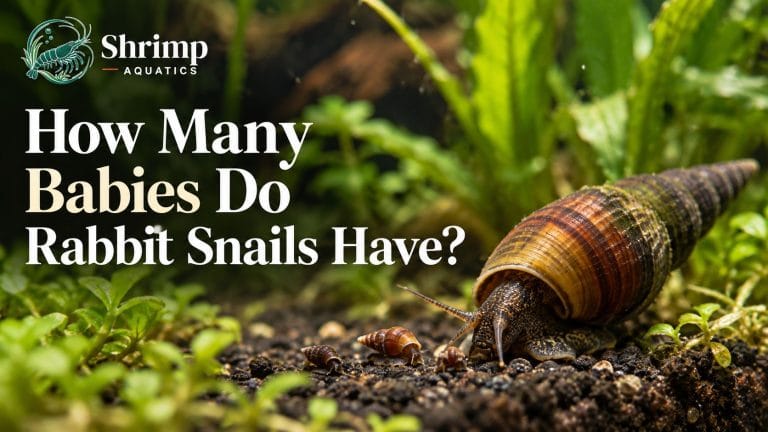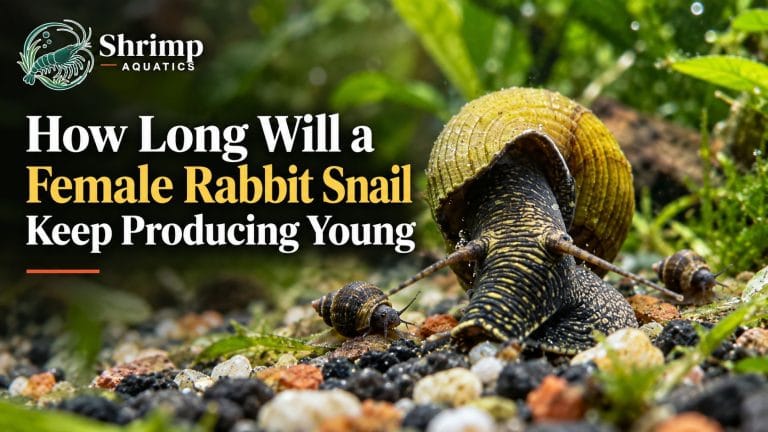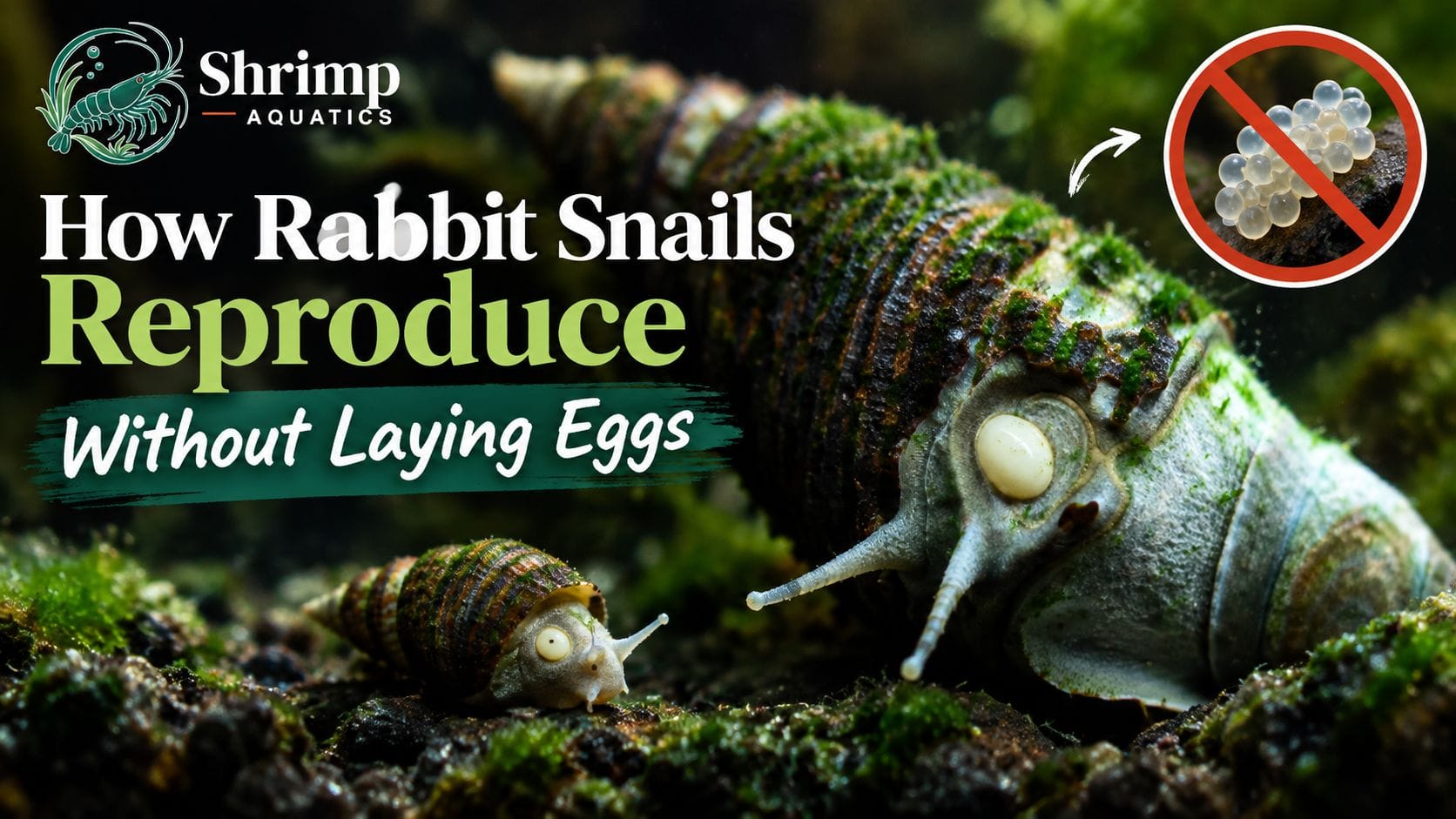
If you’ve been scanning the glass for a clutch of rabbit snail eggs, you can stop. There’s nothing to find. The eggs stay inside the female, and what eventually leaves her shell is a small snail with a shell already on its back.
Why you never find rabbit snail eggs on the glass
Most aquarium snails leave their eggs where you can see them, on glass, wood or a leaf, and that is how keepers learn to spot breeding. Rabbit snails never do, and the reason is anatomical. That anatomy, not a choice on her part, is why whether a female holds her babies inside is answered no even in poor water.
In Tylomelania, the part of the reproductive tract that would package an egg and send it out has been rebuilt into a uterine brood pouch. Eggs and embryos are retained inside it, embryos are produced continuously, and each one develops surrounded by nutritive material from a very large albumin gland. The young that come out are already shelled, and in some species they are the largest juveniles known in any live-bearing gastropod, close to 2 cm long at release.1
So the egg stage is real. You just can’t see it, because it happens inside an animal that’s opaque and usually sitting still under a piece of rock.
What you actually see when a rabbit snail gives birth
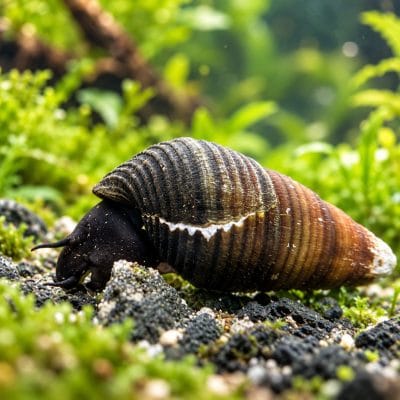
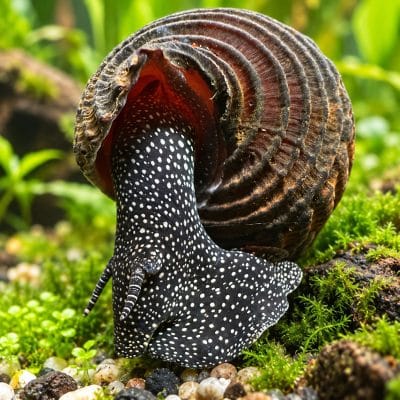
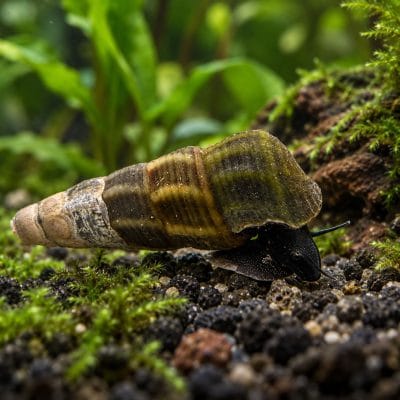
So what does a birth look like? Almost always, you see the result and not the event. One morning there is a second, much smaller snail on the glass, shell fully formed, moving and grazing like a tiny adult. People often assume they bought a pregnant snail, or that something hitchhiked in on a plant.
Keepers also report finding a soft pale capsule beside a newborn, or a juvenile that seems to be wrapped in a membrane for a short while after birth. We found no published description of that capsule, so treat the forum photographs as reports and not as something you’re meant to manage. You don’t have to do anything about it either way.
Two things you can’t do: you can’t watch the pregnancy, and you can’t count what’s coming. A female carrying embryos looks exactly like one that is not, which is why nobody can sell you a gravid rabbit snail with a straight face.
Keepers commonly see young turn up within days of a snail arriving or being moved to another tank. Whether the move brought it on, or the animal was simply due, isn’t something we can tell you.
How many young one rabbit snail carries
So how many should you expect? The hobby answer is “one at a time, every few weeks.” The first half is right for some species and wrong for others, and the second half has no published basis at all. The published counts behind how many babies rabbit snails have come from preserved wild females, not from tanks.
Where the genus has been examined properly, brood size varies a lot by species. In Tylomelania sinabartfeldi from the Malili lakes, the brood pouch held 11 to 67 embryos, the largest of them 5.0 mm.2 In Tylomelania baskasti, described in the same work, it held 4 to 12, reaching 8.4 mm.3 Both counts come from preserved wild specimens, so they tell you what a female of that species was carrying, not how many young leave the shell on one day. How that brood size question plays out for the lines sold in the hobby is rabbit snail breeding.
Our snails, and almost every rabbit snail in the trade, are sold as Tylomelania sp. because the species behind the trade names is not settled. No one has published a brood count for those lines. If a care sheet tells you a rabbit snail produces one baby every four to six weeks, that number came from someone’s tank, not from a study, and your tank has not agreed to it.
Will rabbit snails breed in your tank?
Maybe, slowly, and not on a schedule you set. That’s the honest version, and it’s worth knowing before you buy a second snail hoping for a colony.
Start with the obvious problem: we know of no published way to tell a male rabbit snail from a female one. Shell shape, size and color will not do it. The usual approach among keepers who want young is to keep five or six animals of the same type and let them sort it out, which is also why a single snail that never produces anything isn’t a sick snail.
The water the young need is the water the adults need, held steady: 79-86°F (26-30°C), pH 7.5-8.5, GH 4-8 dGH, KH 3-6 dKH and TDS 150-250 ppm. Warm and alkaline is the easy part. Steady is the part that takes equipment and habit, and it matters more here than in a Neocaridina tank, because nothing about this animal is fast enough to recover quickly from a swing.
The second requirement is food that is already there. A newborn grazes the same film on rock and glass that the adults do, so a tank that was set up last month hasn’t got anything to offer it. Wait for a visible layer of algae and biofilm before you add adults, let alone expect young.
If you are still building the group, our tank-bred Sulawesi rabbit snails are bred by Shrimp Aquatics and not collected from the wild. We sell them as individual animals of an unconfirmed species, and we don’t promise sex, a pair or any number of young. Buy them because you want the snail. Treat anything that appears later as a bonus.
What to do when a baby rabbit snail turns up
Nothing, mostly. That’s the whole answer, and it’s hard for people who arrive here from breeding fish or shrimp.
- Leave it where it is. A juvenile that emerged on its own is on a surface it chose.
- Skip the breeder box. A closed box has no grazing film in it, which is the one thing the animal needs.
- Don’t clean the glass and rock it is feeding on, at least not all of it in one session.
- Keep the water steady and the changes small for the next few weeks. The water numbers behind that steady routine are in Sulawesi rabbit snail care, not just the advice to hold things steady.
- Do not add anything copper based to the tank while it grows out, including fish medications that carry copper.
Everything else is patience. The first months are slow, and slow is normal here.
When a young rabbit snail is old enough to breed
How long until yours are old enough? We don’t know, and neither does anyone else. No published work gives an age or a size at first reproduction for any Tylomelania, and no published growth rate exists either. Keepers usually say six months to a year, or about two inches of shell, and those numbers deserve exactly the confidence an unmeasured hobby figure deserves.
The closest published figure comes from a relative. Brotia hainanensis, a snail in the same family living in a Hong Kong forest stream, reached sexual maturity in about 8.5 months.4 Different genus, different water, wild stream rather than a glass box, so read it as a sense of scale and not as a date for your tank. The relative in question, and the months it took to mature, are in when rabbit snails start breeding.
Practically, that means you plan in seasons. You’ll know the group is working when a second size class appears on the glass, and if a year passes with nothing, the likeliest explanations are the group you happen to have and a tank that is still too young, in that order.
References
4 Sources
- Anatomy of an adaptive radiation: a unique reproductive strategy in the endemic freshwater gastropod Tylomelania (Cerithioidea: Pachychilidae) on Sulawesi, Indonesia, and its biogeographical implications, Biological Journal of the Linnean Society 85(4), 2005.
- Tylomelania sinabartfeldi Rintelen & Glaubrecht, 2008, sp. nov., taxonomic treatment from Zootaxa 1852, Biodiversity Literature Repository, 2008.
- Tylomelania baskasti Rintelen & Glaubrecht, 2008, sp. nov., taxonomic treatment from Zootaxa 1852, Biodiversity Literature Repository, 2008.
- The life history of Brotia hainanensis (Brot, 1872) (Gastropoda: Prosobranchia: Thiaridae) in a tropical forest stream, Zoological Journal of the Linnean Society 76(2), 1982.
Ready to get started?
Shop our Sulawesi Snail collection
12 products available · Live Arrival Guarantee