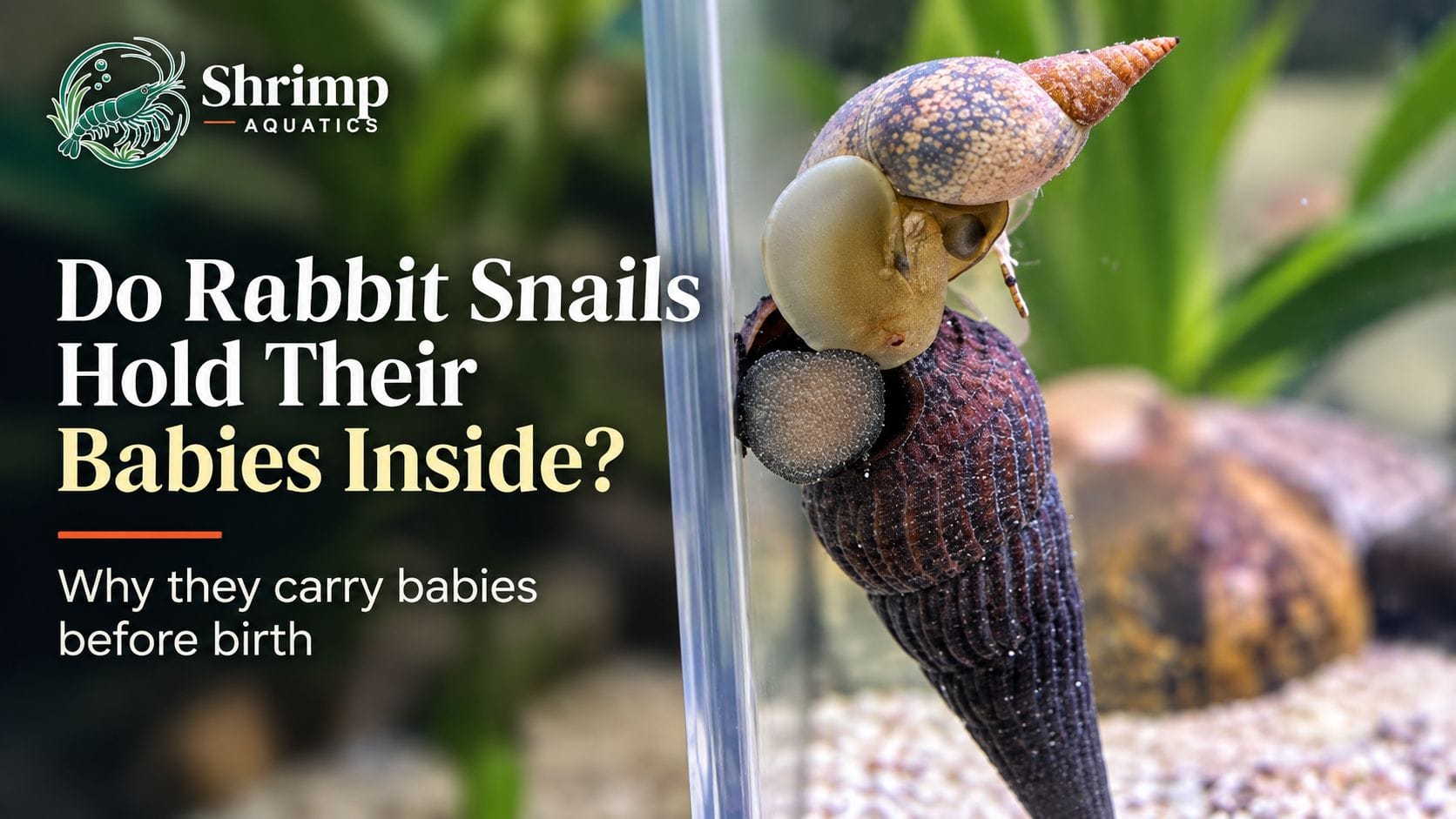
No. Nothing published shows a rabbit snail (Tylomelania sp.) holding her young inside the shell to shield them from bad water. Nothing shows her sealing the brood pouch against it either. She carries young because that’s how this genus reproduces, in poor water and in good. If your snail has shut up tight and no babies have appeared, that’s a reason to test the water today. It isn’t a sign she’s got it under control.
What a rabbit snail is really doing when she carries young inside
Rabbit snails are live-bearers. The female keeps her eggs and embryos in a uterine brood pouch, which is her pallial oviduct remodelled into a nursery. She produces embryos continuously, and a large albumen gland feeds them while they develop. The young leave already shelled, and in some species they’re close to 2 cm at birth, among the largest juveniles known from any live-bearing snail.1 That work is an anatomical and molecular review of the genus. It describes how the animal is built, not how she answers a bad test result.
The wider family runs the same way: larger but fewer egg capsules than most snails produce, with live birth evolving three separate times in the group.2 So a female with young inside her is a female doing the ordinary thing. She was doing it last month too, in water you were happy with. The ordinary background rate of carrying young is rabbit snail breeding, separate from any water question.
We think that’s where the idea comes from. You notice the missing babies at the same moment you notice the tank is off, and the two get joined up into a story where she’s holding on for their sake. It’s a kind story. There’s nothing behind it.
Sealing the brood chamber was measured in another snail, and it went wrong within hours
It’s a fair question to ask, because some brooding molluscs really can close their brood chamber off from the outside. Someone has measured what happens next. In the estuarine gastropod Crepipatella dilatata and the oyster Ostrea chilensis, females shut the pallial cavity when the water around them turned brackish. Salinity inside stayed high, so the seal did its job at first. Then oxygen inside fell below 1.5 mg per litre within 12 hours for the snail, and within 20 minutes for the oyster. The internal fluid acidified to a low of 6.4, and ammonium climbed the longer the female stayed closed. The authors describe the brood cavity turning from a protective nursery into a prison. Our own snail keeps a similar brood pouch without sealing it, which is how rabbit snails reproduce.3
Those are marine animals brooding in a mantle cavity, not a rabbit snail with a uterine pouch. A salinity drop isn’t an ammonia spike either. Read it for the part that carries across. A sealed brood chamber is a closed box with two metabolisms breathing inside it, and closed boxes go bad. We wouldn’t expect a Sulawesi snail to have a better version of a trick that failed in the species built for it.
A closed-up snail tells you to test the water, not to wait it out
So what do you actually do with a rabbit snail that’s pulled in and gone still? You test, in this order.
- Ammonia and nitrite, both reading 0. In a warm alkaline tank the number alone understates the risk. The share of total ammonia sitting in the toxic un-ionized form climbs about tenfold for every pH unit, and roughly twofold for every 10 degrees Celsius of warming.4 A trace reading a cool soft-water tank shrugs off is a different animal at 84°F and pH 8.2.
- Temperature, then surface movement. Warm water holds less dissolved oxygen than cold water,5 and this tank runs warm on purpose. A heater that’s overshot, or a surface gone still under a floating mat, starves her of oxygen before anything shows up in a test tube.
- Recent water changes, top-offs and anything new in the tank. Mineral drift between tests is the quiet one, and it drags pH along with it.
- Don’t reach for a snail treatment. Copper is the thing to rule out, not to add. In a related freshwater operculate snail, copper was the most toxic of eight metals tested, with a 96 hour median lethal concentration of 0.14 mg per litre.6 Check every medication, plant dip and conditioner that’s been near the tank.
- Don’t lift her out for a look. You learn nothing from the outside, and handling is one of the few stressors a keeper can add for free.
If all of that comes back clean and she still hasn’t moved after a day or two, you’ve slid into a different question. That one is whether she’s alive at all, and keepers judge it by whether she reacts to a gentle touch. It isn’t the question you started with. Do the water checks first anyway, because they’re the ones you can fix. Reading condition from the outside is just as tricky in a newborn, which is when a baby shows adult color.
What a rabbit snail tank should be reading before you blame the snail
| Temperature | 79-86°F (26-30°C) |
|---|---|
| pH | pH 7.5-8.5 |
| GH | 4-8 dGH |
| KH | 3-6 dKH |
| TDS | 150-250 ppm |
| Ammonia and nitrite | 0, in a fully cycled tank with an established filter |
| Nitrate | Under 10 ppm |
That’s the same warm alkaline water our Sulawesi shrimp live in, and it’s the demanding part of keeping this animal. Hold the tank there for a few weeks before anything goes in. The Sulawesi rabbit snails we ship are bred in our own tanks, and they arrive expecting water that already behaves. The numbers behind water that already behaves are in Sulawesi rabbit snail care, worth reading before a snail arrives.
KH is the one we’d watch hardest between tests, since it’s what keeps pH from sliding. Where the mechanism was studied in a freshwater snail, low calcium together with low pH gave the least shell growth, visible erosion and the weakest shells.7 That study is on a Florida apple snail, a different family. Take it as how snail shells behave in general, not as a threshold for this one.
If young arrive early or still wrapped in the white capsule
We have to be straight with you here, because the care sheets aren’t. Nobody has published how many young a traded rabbit snail releases at once, how long she carries them, or how often a birth comes round. Brood contents differ enormously between the few species anyone has examined. A count taken from one species tells you nothing about the line in your tank. The confident figures you’ll find are keeper reports that got repeated until they looked like data.
If young turn up and you weren’t expecting them, don’t do anything dramatic. Leave them where they are. They arrive already shelled,1 and grazing on mature biofilm is the feeding mode this genus is documented for. A tank mature enough for the parent already has food in it. A bare container has none, which is why moving them is usually the wrong instinct.
And don’t read an early birth as a verdict on your water. Premature release under handling or transport stress has been described in live-bearing snails related to this one, never in Tylomelania itself. Treat it as something seen in relatives, not as a diagnosis of your tank. Fix the numbers you can measure, keep your hands out, and let her get on with it.
References
7 Sources
- Anatomy of an adaptive radiation: a unique reproductive strategy in the endemic freshwater gastropod Tylomelania (Cerithioidea: Pachychilidae) on Sulawesi, Indonesia, and its biogeographical implications, Biological Journal of the Linnean Society 85(4): 513-542, August 2005.
- Multiple Origin of Viviparity in Southeast Asian Gastropods (Cerithioidea: Pachychilidae) and Its Evolutionary Implications, Evolution 58(11), 2004.
- Brood chamber isolation during salinity stress in two estuarine mollusk species: from a protective nursery to a dangerous prison, Marine Ecology Progress Series 374: 145-155, 2009.
- Aquatic Life Ambient Water Quality Criteria for Ammonia, Freshwater, U.S. Environmental Protection Agency, Office of Water, April 2013.
- Dissolved Oxygen and Water, U.S. Geological Survey, Water Science School, updated August 2026.
- Toxicity of Metals to a Freshwater Snail, Melanoides tuberculata, The Scientific World Journal, 2012.
- The effect of calcium and pH on Florida apple snail, Pomacea paludosa (Gastropoda: Ampullariidae), shell growth and crush weight, Aquatic Ecology 43: 1085-1093, 2009.
Ready to get started?
Shop our Sulawesi Snail collection
12 products available · Live Arrival Guarantee