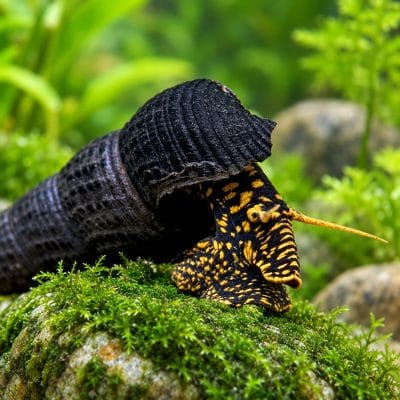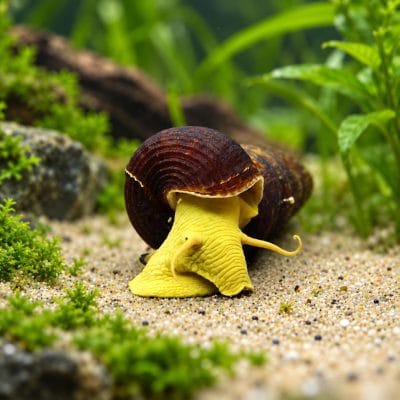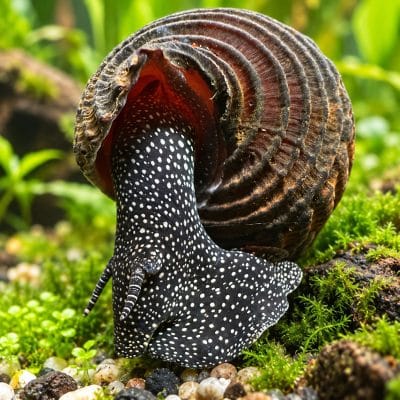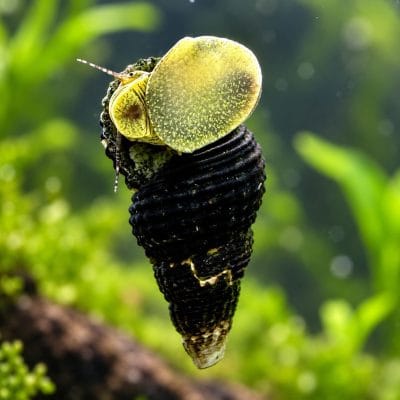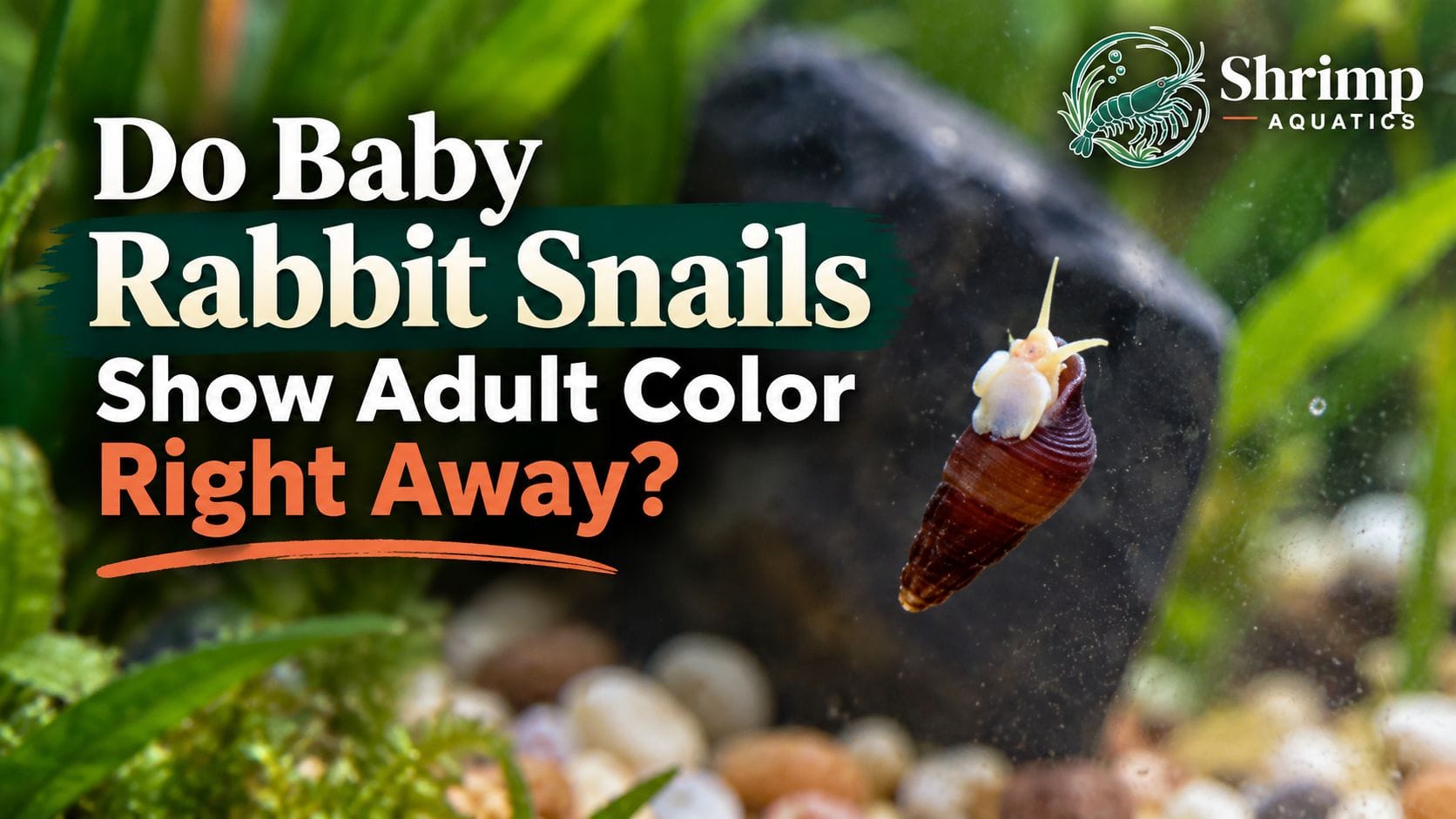
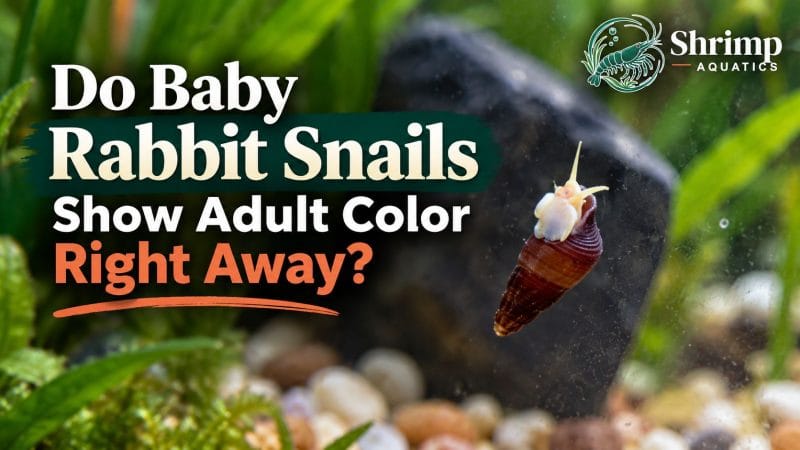
Yes, as far as anyone can tell from watching them. A baby rabbit snail (Tylomelania sp.) leaves its mother as a finished miniature snail, shell and all. The body color you see on day one is the color you keep. What does change with age is the shell.
Why there is no stage where a rabbit snail’s color fills in
Rabbit snails don’t drop a clutch of eggs in your tank and they don’t pass through a free swimming larval stage. The female keeps her eggs and embryos inside her own body, in a brood pouch formed from part of the oviduct. Each embryo sits in a mass of nutritive material produced by a very large albumin gland.1 What leaves her is a small snail with a shell already on it. In some species those newborns are close to 2 cm long, the largest juveniles known in any live-bearing snail.1
Chris Lukhaup, writing in Practical Fishkeeping, describes the young leaving inside a whitish egg that dissolves within seconds to reveal a fully formed snail. He puts the size across species at about 0.28-1.75 cm, in a magazine account by a named keeper, not a study.2
So where would a color change fit? There isn’t a window for it. A snail that arrives with a working foot, a pair of long tentacles and a shell did all of that developing out of sight, and its color came with it. Keepers report exactly that: a yellow line gives yellow young, a spotted line gives spotted young, from the first crawl across the glass. We could not find a published study that tracks pigment development in Tylomelania, so take that as what the hobby sees and not as a measured fact.
What changes as a young rabbit snail grows is the shell
Here is where the confusion usually starts. Put a newborn beside a full grown adult and the two shells look like they belong to different animals. The newborn hasn’t had time to wear its shell down, so the spire is a clean cone from tip to opening. The adult’s shell is thicker, and the tip is usually worn or broken away.
That wear is normal for the genus. When Paul and Fritz Sarasin described these snails from Celebes in 1897, they recorded the upper whorls as mostly considerably eroded from the third whorl onward. Three snails taken alive had the ribs worn completely off the top whorls. A worn tip says nothing about the animal underneath, so baby rabbit snail identification checks the head and the trapdoor instead.3 A scarred apex on an adult is not a verdict on your water.
So why do people say the babies color up? Most of the time they’re watching a shell age, not an animal change. Watch the growing edge instead. New shell goes on at the opening. Fresh pitting or a soft, chalky edge there, on material the snail laid down in your tank, is worth a mineral and pH check.
When a baby rabbit snail doesn’t match the parent you bought
This happens, and keepers post about it: a yellow female produces young that come out dark or spotted. The honest answer is that nobody has published why. You’ll see stored sperm and hybrid parentage offered as explanations on forums, and neither has been shown in this genus, so we won’t tell you it’s either one. A color mismatch says nothing about which male was involved, a gap rabbit snail breeding leaves open too.
What we can tell you is that trade names here are not species names. Specialists have trouble putting a species to these animals, so we list ours as Tylomelania sp. A name like “golden spotted” or “Poso orange” on a tank label is marketing, not an identification. If the parents sat in a mixed holding tank at any point upstream of you, you have no way to know what fathered the brood.
Practical version: don’t wait for a mismatched young snail to turn into its parent’s color, because it won’t. If predictable color matters to you, buy young stock from a seller who keeps one line to a tank and ask what has lived with the parents. Ours are tank-bred Sulawesi rabbit snails, bred by Shrimp Aquatics and not collected from the wild.
If a young rabbit snail looks pale, check the tank before you wait it out
Color that disappoints you on a new snail won’t improve with time, so the useful question is whether the animal is doing well. Start with the water. These are the numbers to hold, and they’re the same for the young as for the adults. The same instinct to check the tank applies when an adult closes up, which is whether a female holds her babies inside.
| Temperature | 79-86°F (26-30°C) |
|---|---|
| pH | 7.5-8.5 |
| GH | 4-8 dGH |
| KH | 3-6 dKH |
| TDS | 150-250 ppm |
| Nitrate | Nitrate under 10 ppm as a working target |
| Substrate | Inert sand, gravel and rock; no pH lowering soil |
These snails aren’t delicate animals, but the tank is the demanding part: warm, alkaline, mineral rich and mature before anything goes in. A young snail eats what the glass and the rock already grow. Sulawesi Keepers, a conservation group working with these snails, describes the hard surface species as feeding on biofilm from stones and glass. The same article says green filamentous algae are definitely not their natural food.4 If you moved a baby into a clean new tank, that’s the first thing to fix. Dropping in more food won’t stand in for a film that isn’t there yet. That grazing layer is the same setup Sulawesi rabbit snail care asks you to build before any juvenile goes in.
Shell trouble in freshwater snails tracks calcium and pH together. In trials on Florida apple snails, a different family, snails held at low calcium with pH below 6.5 grew the least shell, showed visible erosion and had the weakest shells.5 Read that as a general snail mechanism. The practical version is the table above: hold the pH and don’t let KH drift down between water changes.
Keep copper away from them
Don’t treat a tank holding rabbit snails with a copper based medication, and read the label on anything else you add. In 96 hour tests on Melanoides tuberculata, another freshwater snail, copper was the most toxic of eight metals, with a median lethal concentration of 0.14 mg per liter.6 Different family, so that figure is not a safe limit for your snails. It is a reason to keep copper out of the tank.
If the water holds, the snail is grazing and the shell edge is clean, you have a healthy snail in the color it was born with. Judge the animal, not the shade.
References
6 Sources
- Anatomy of an adaptive radiation: a unique reproductive strategy in the endemic freshwater gastropod Tylomelania (Cerithioidea: Pachychilidae) on Sulawesi, Indonesia, and its biogeographical implications, Biological Journal of the Linnean Society, 2005 (abstract).
- Snails from Sulawesi, Chris Lukhaup, Practical Fishkeeping, March 2009.
- Materialien zur Naturgeschichte der Insel Celebes, volume 1, Paul and Fritz Sarasin, C. W. Kreidel’s Verlag, 1897.
- Do you know Sulawesi snails?, Marketa Rejlkova, Sulawesi Keepers, undated.
- The effect of calcium and pH on Florida apple snail, Pomacea paludosa (Gastropoda: Ampullariidae), shell growth and crush weight, Aquatic Ecology, 2009 (abstract).
- Toxicity of Metals to a Freshwater Snail, Melanoides tuberculata, The Scientific World Journal, 2012.
Ready to get started?
Shop our Sulawesi Snail collection
12 products available · Live Arrival Guarantee