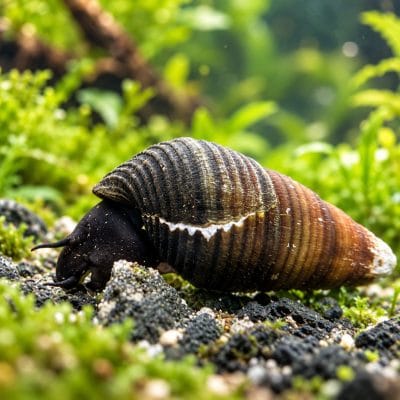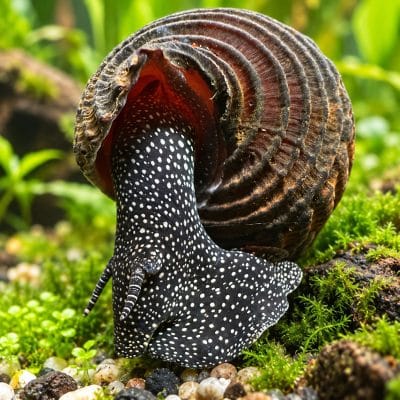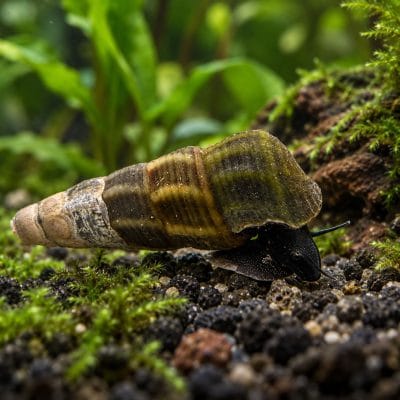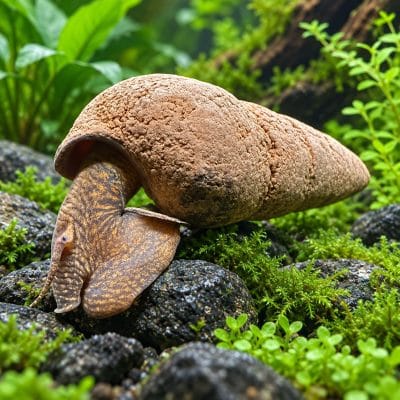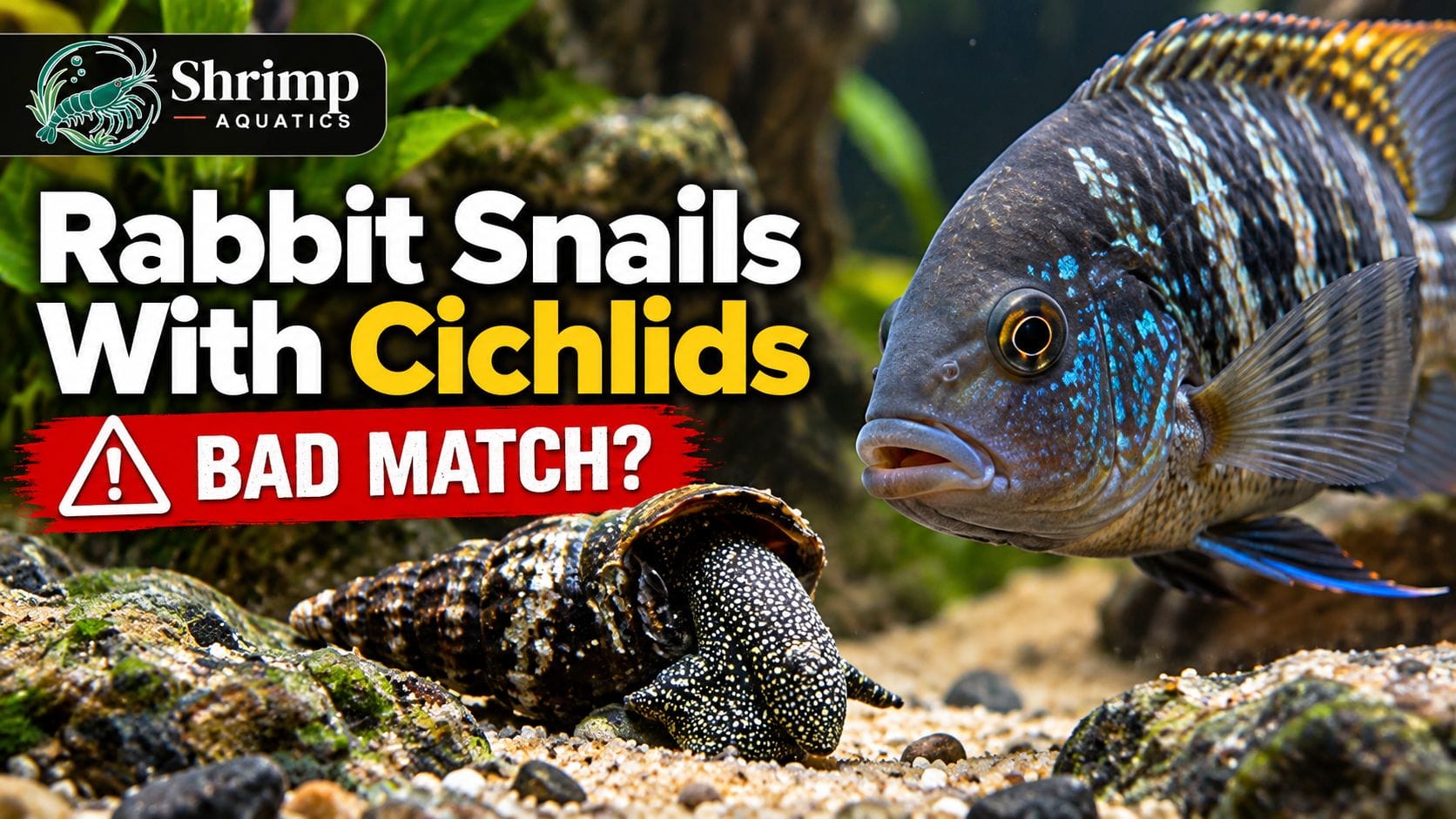
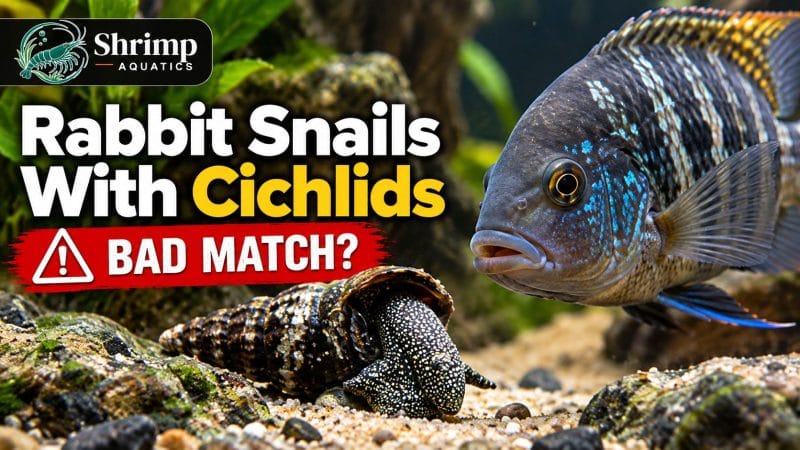
No. We wouldn’t put a Sulawesi rabbit snail (Tylomelania sp.) in with any cichlid. Keepers and care sites routinely list cichlids among the fish to keep away from these snails. No study has tested the two in one aquarium, so the case rests on what cichlids eat and what water each one needs.
Why doesn’t shared hard water make African cichlids safe for rabbit snails?
Because water was never the only question. If you keep Malawi or Tanganyika cichlids, your tank probably already runs warm, hard and alkaline, and that’s exactly why the pairing looks tempting. The problem is what a cichlid can do to a shell.
A cichlid doesn’t need a big mouth to break a snail. In the Cuatro Ciénegas cichlid of Mexico (Herichthys minckleyi), one form grows stout teeth and heavier muscle on the jaws in its throat and is specialized for crushing snails.1 That’s one species, and plenty of cichlids never specialize that far. We’d still treat it as a warning for the whole family. You can’t tell by looking which fish in your tank will learn that a slow snail is food.
Are peacock cichlids gentle enough for rabbit snails?
No, and in a Malawi tank they may be the worst match of all. In lab tests, the peacock cichlid Aulonocara stuartgranti used widened sensory canals on its head to find and eat small invertebrate prey in the dark.2 FishBase describes the same species as a feeder on sand-dwelling invertebrates.3 A rabbit snail grazing across the bottom is a large, slow invertebrate right in that hunting zone.
Temperature doesn’t help either. FishBase lists A. stuartgranti as a cooler fish whose top temperature only just reaches the bottom of the range a rabbit snail needs.3 So even the water match you were counting on is thinner than it looks.
Can rams or other dwarf cichlids live with rabbit snails?
No, and the water rules them out before behavior even comes up. Rabbit snails need the same water as Sulawesi shrimp, and every number below has to hold at once.
| Temperature | 79-86°F (26-30°C) |
|---|---|
| pH | 7.5-8.5 |
| GH | 4-8 dGH |
| KH | 3-6 dKH |
| TDS | 150-250 ppm |
Now set that beside a ram. FishBase lists the German blue ram (Mikrogeophagus ramirezi) in water that sits entirely below pH 7.5.4 There’s no middle setting that suits both. Lower the pH for the fish and the snail’s shell pays for it; raise it for the snail and you’ve left the ram’s range.
Why does acidic water matter so much to a snail? In Florida apple snails raised in very soft, low-calcium, acidic water, shells grew the least and showed signs of erosion.5 That’s a different snail, but it’s the reason we’d never lower the pH for a dwarf cichlid and hope the rabbit snail copes. The same applies if your tap water is naturally soft: rabbit snails in soft water need KH and pH brought up before they go in, not after.
Do flowerhorns and other large cichlids eat rabbit snails?
Yes, and the clearest evidence comes from the rabbit snail’s own home lake. Flowerhorn cichlids are an invasive alien fish in Lake Matano on Sulawesi. In surveys in 2015 and 2016 they made up about 54 percent of the fish caught, and Tylomelania snails were among the foods the lake’s fish used most.6 The same study found the flowerhorn able to use every food source in the lake and sitting at the top of its food chain.6
That study didn’t measure how many snails the flowerhorns themselves ate, so we won’t put a number on it. But think about the scale. If a large cichlid can take over a lake full of rabbit snails, one in your tank has nothing to stop it. The snail has nowhere to retreat to. Once a fish has learned that a snail is food, nothing you add to the tank will reliably stop fish attacking rabbit snails.
What should you do if your rabbit snail already lives with cichlids?
Move the snail out now, before you see damage. It needs a tank that already holds 79-86°F (26-30°C) and pH 7.5-8.5, with a visible film of algae and biofilm on the rock and glass for it to graze. Those numbers and a mature film are the base of Sulawesi rabbit snail care, whatever else lives in the tank.
- Don’t wait for a chipped shell or missing antennae. A snail that stays sealed in its shell to avoid pecking isn’t grazing.
- Match the new tank’s water to the numbers above before the move, and keep the transfer calm and slow.
- If you can’t find the snail, search the rockwork and under decor before you assume it’s fine.
We know you’d like a middle path. The usual suggestions are a bigger tank, more rockwork and feeding the snail after lights out. We wouldn’t rely on any of them, because none of them changes what a cichlid does when it finds a slow animal on the bottom.
Which tank is right for a rabbit snail instead of a cichlid tank?
A warm, hard Sulawesi tank with no fish that treat snails as food. Sulawesi shrimp are the natural partners. They live in the same water and graze the same film, so the only question is whether your rock grows enough for everyone. Any fish you add has to fit the same temperature and water and leave slow animals alone, and we’d leave cichlids of every size off that list. Check every candidate against the same range before it goes on your list of rabbit snail tankmates.
If you’re planning that tank, the Sulawesi snail lines we sell are all tank-bred by Shrimp Aquatics, not collected from the wild. We can’t promise how any snail will get on with the fish in your tank. If you’re unsure, email contact@shrimpaquatics.com with your temperature, pH, GH, KH, TDS, tank size and current fish before you order.
References
6 Sources
- Habitat segregation among trophic morphs of the Cuatro Ciénegas cichlid (Herichthys minckleyi), Cohen, Hendrickson, Parmesan and Marks, Hidrobiológica 15(2): 169-181, 2005.
- Feeding in the dark: lateral-line-mediated prey detection in the peacock cichlid Aulonocara stuartgranti, Schwalbe, Bassett and Webb, Journal of Experimental Biology 215: 2060-2071, 2012 (University of Rhode Island repository copy).
- Aulonocara stuartgranti species summary, FishBase, accessed September 2026.
- Mikrogeophagus ramirezi species summary, FishBase, accessed September 2026.
- The effect of calcium and pH on Florida apple snail, Pomacea paludosa, shell growth and crush weight, Glass and Darby, Aquatic Ecology 43: 1085-1093, 2009 (abstract page).
- Interaksi trofik komunitas ikan di Danau Matano, Sulawesi Selatan pasca berkembangnya ikan asing invasif, Hedianto and Sentosa, Jurnal Penelitian Perikanan Indonesia 25(2): 117-133, 2019 (Indonesian, English abstract).
Ready to get started?
Shop our Sulawesi Snail collection
12 products available · Live Arrival Guarantee