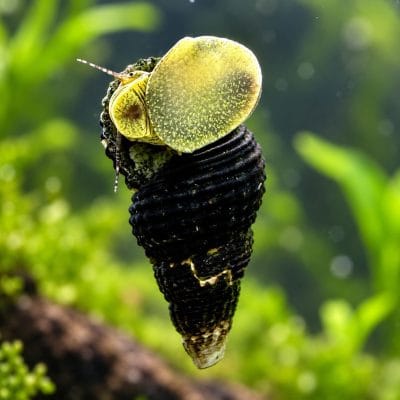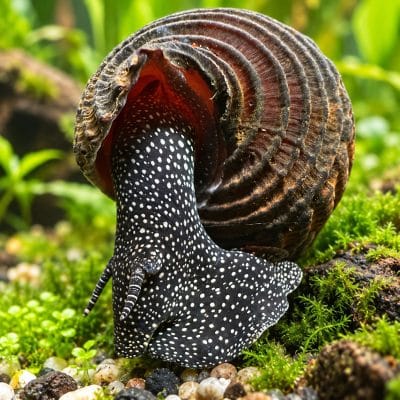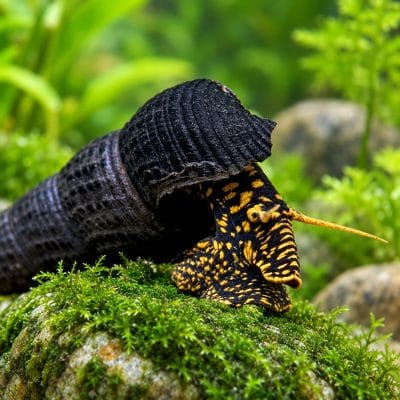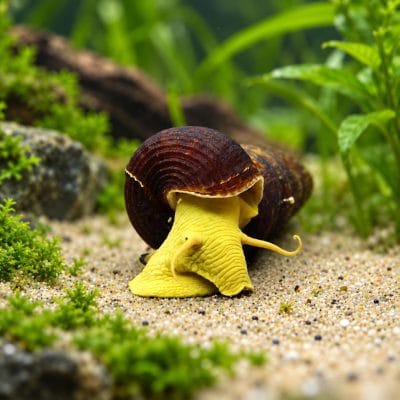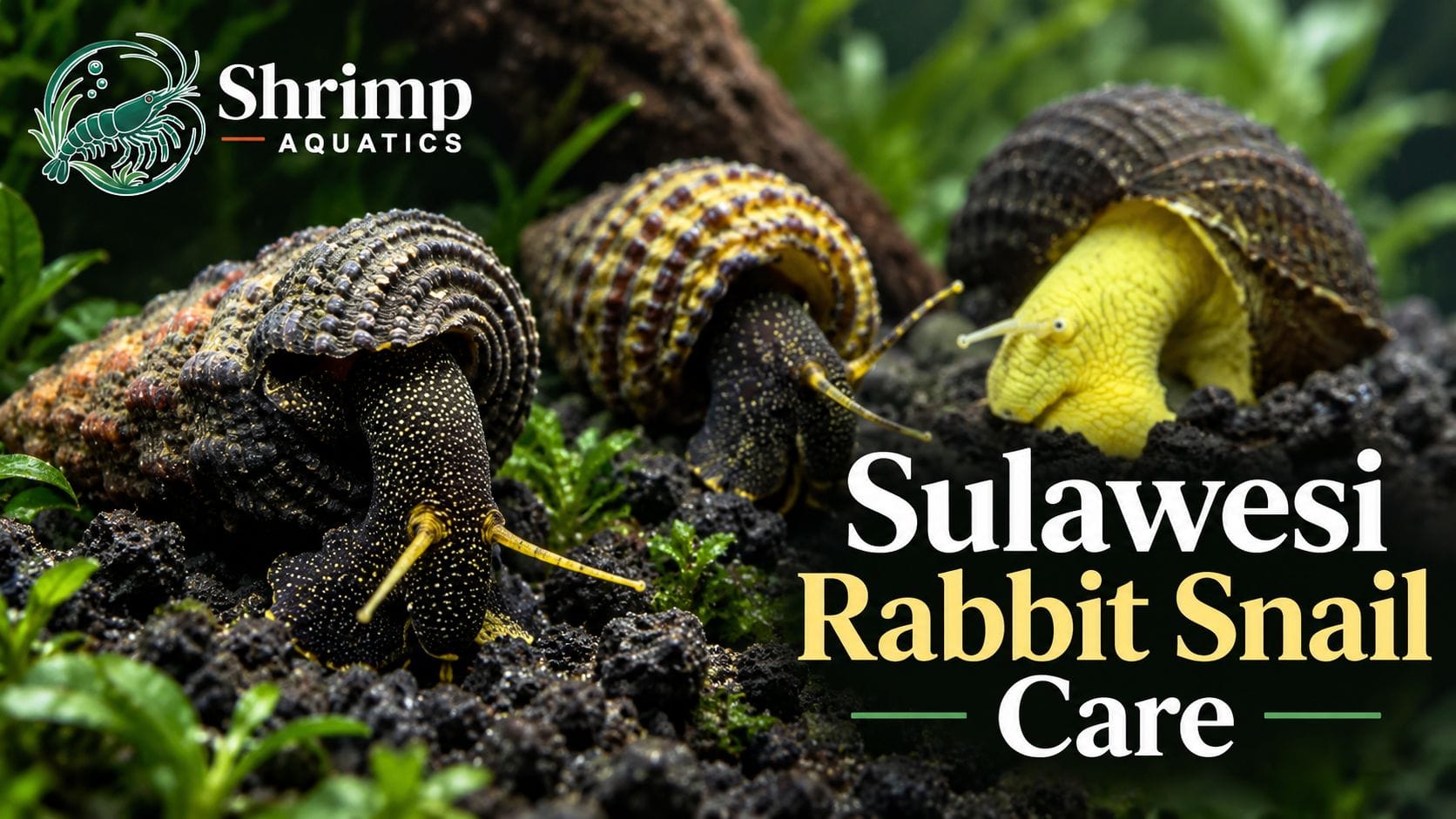
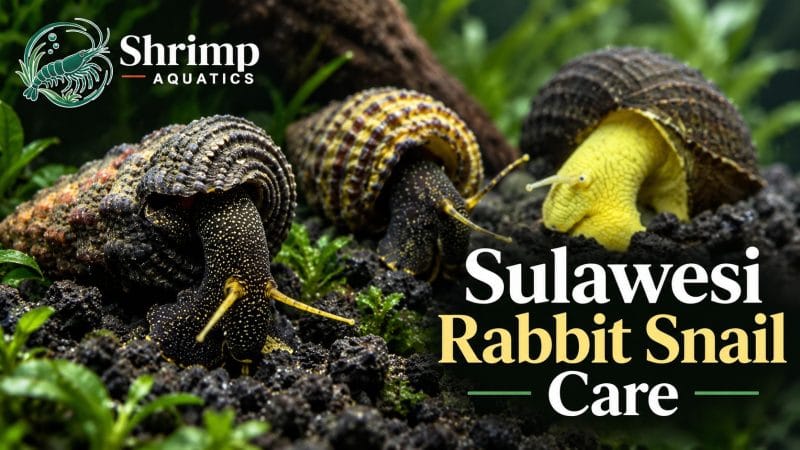
A rabbit snail’s name tells you its color, not its species. Yellow, orange poso, chocolate, gold, black spotted: these are labels sellers wrote to describe how a snail looks. For buying, that’s good news. The lines sold in the hobby all want the same warm, alkaline water, so you can simply pick the look you like.
What a rabbit snail name actually tells you
Only what somebody thought the snail looked like. Names like yellow, gold or chocolate were written to sell an animal in a tank, not to identify it. Scientists tell real species apart by shell sculpture, the shape of the shell opening and the trap door, not by color.1 Even a trade survey needed the genus’s own taxonomist to name the snails it found on sale.2
That includes us. All four rabbit snail lines we sell are listed as Tylomelania sp., since none has a confirmed species. With no confirmed species there is no published lifespan either, and how long rabbit snails live shows what keepers rely on instead.
What this means for you: choose on looks, and don’t pay extra for a name that promises a rare species. The tank you need is the same either way, and holding it steady is the real work of Sulawesi rabbit snail care.
Which rabbit snails you can buy
In shops you’ll meet a short list of names, spelled differently everywhere: yellow, orange poso, gold, chocolate, black spotted, mini yellow. Treat each as a description of a batch. The same name at two shops can be two different animals.
We keep four lines, all bred in our own tanks rather than collected from the wild: Yellow Rabbit, Golden Spotted, Mini Tylo Poso and Himalayan.
All four live in the same water as our Sulawesi shrimp: 79-86°F (26-30°C) and pH 7.5-8.5. Choosing between them is a choice about looks, not about the tank you build. Read the names literally, too. “Mini” and “Poso” are trade words, not a measured size and not a confirmed lake of origin.
We rate the snail moderate to keep. The tank is the demanding part: mature, warm and alkaline, with grazing already growing on rock and glass. It isn’t a soft way into Sulawesi keeping. If your tank is already there, see all four together in our tank-bred Sulawesi rabbit snails range.
How many kinds of rabbit snail are there?
Around 50 described species, all from Sulawesi’s lakes and rivers.34 Plenty of what reaches the hobby is not a described species at all but a population someone collected, bred and named.5 Whether an unnamed population belongs to a threatened species is not something a trade name tells you, which is are rabbit snails endangered. Where they live in the wild is covered in where rabbit snails come from.
Can you keep two types of rabbit snail together?
Yes, they can share a tank, since they want the same water. Whether they’ll crossbreed is a question nobody can answer. The genus does hybridize in the wild,3 but no one has tested whether two traded color lines interbreed in a tank, or what their young would look like.
What we’d do
If the look of a line matters to you, keep it in its own tank. We won’t promise you hybrids and we won’t promise you clean lines. What is known about how these snails reproduce is on our rabbit snail breeding page.
Keepers also ask whether a rabbit snail can cross with a mystery snail. Nothing published on this genus speaks to it, and the two differ in almost everything else as well, from how they breed to what they eat, as rabbit snail vs mystery snail sets out side by side.
How big do rabbit snails get?
Bigger than most aquarium snails: an adult reaches about 7 cm, just under 3 inches. The wild species described in the original papers range from about 16 mm to about 82 mm, a little over 3 inches.16 The 4 to 5 inches you’ll see quoted online sits above every one of those measurements. Plan for a large snail and don’t buy on a promised size.
| Tylomelania patriarchalis | About 82 mm, Lake Matano, and about 62 mm in its Lake Towuti variety |
|---|---|
| Tylomelania gemmifera | 46.5 mm, Lake Matano |
| Tylomelania towutica | 42-44 mm, Lake Towuti |
| Tylomelania sarasinorum | 35-42 mm, Lake Towuti |
| Tylomelania zeamais | 29 mm, Lake Matano |
| Tylomelania carbo | 16.5 mm, Lake Poso |
| Tylomelania insulaesacrae | 16 mm, Lake Towuti |
Those are the largest shells in each original description, measured on wild museum specimens. They are not the size of anything on sale. How long a snail takes to grow toward that ceiling is the question in how long rabbit snails take to reach full size.
References
6 Sources
- Ueber die Molluskenfauna der grossen Suesswasser-Seen von Central-Celebes, Zoologischer Anzeiger volume 20, 1897.
- Molluscs for Sale: Assessment of Freshwater Gastropods and Bivalves in the Ornamental Pet Trade, PLOS ONE, 2016.
- Mitogenomes do not substantially improve phylogenetic resolution in a young non-model adaptive radiation of freshwater gastropods, BMC Ecology and Evolution, 2024.
- The complete mitogenome of Tylomelania sp. “Poso A” (Caenogastropoda: Pachychilidae) from Lake Poso assembled from long-read sequencing data, Molecular Biology Reports, 2026.
- Freshwater snails of Sulawesi: a brief overview, Sulawesi Keepers, article by Thomas von Rintelen, undated, read 2026-09-17.
- Verzeichnis der von Herrn E.C. Abendanon in Celebes gesammelten Suesswasser-Mollusken, Bijdragen tot de Dierkunde volume 19, 1913.
Ready to get started?
Shop our Sulawesi Snail collection
12 products available · Live Arrival Guarantee