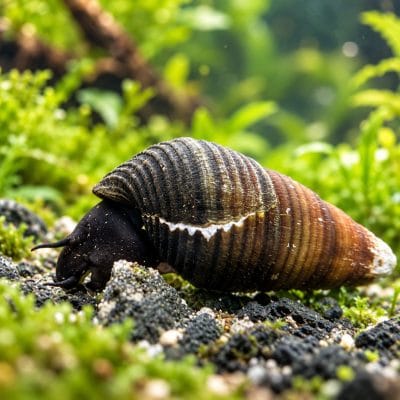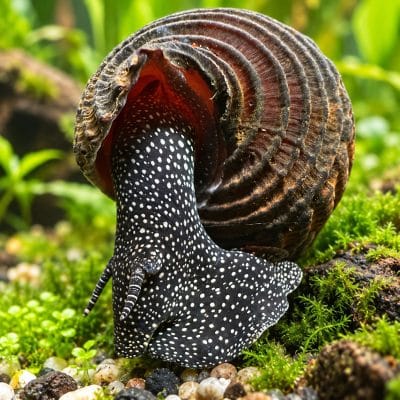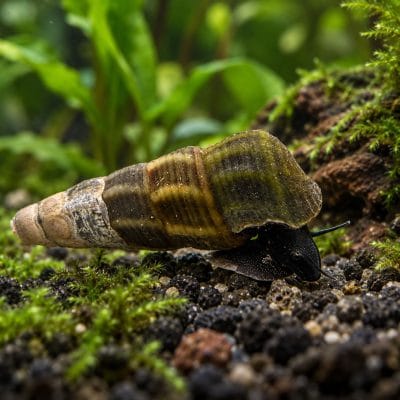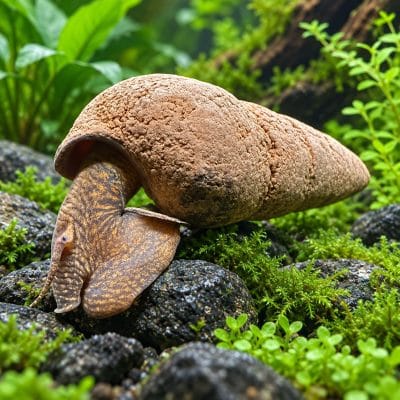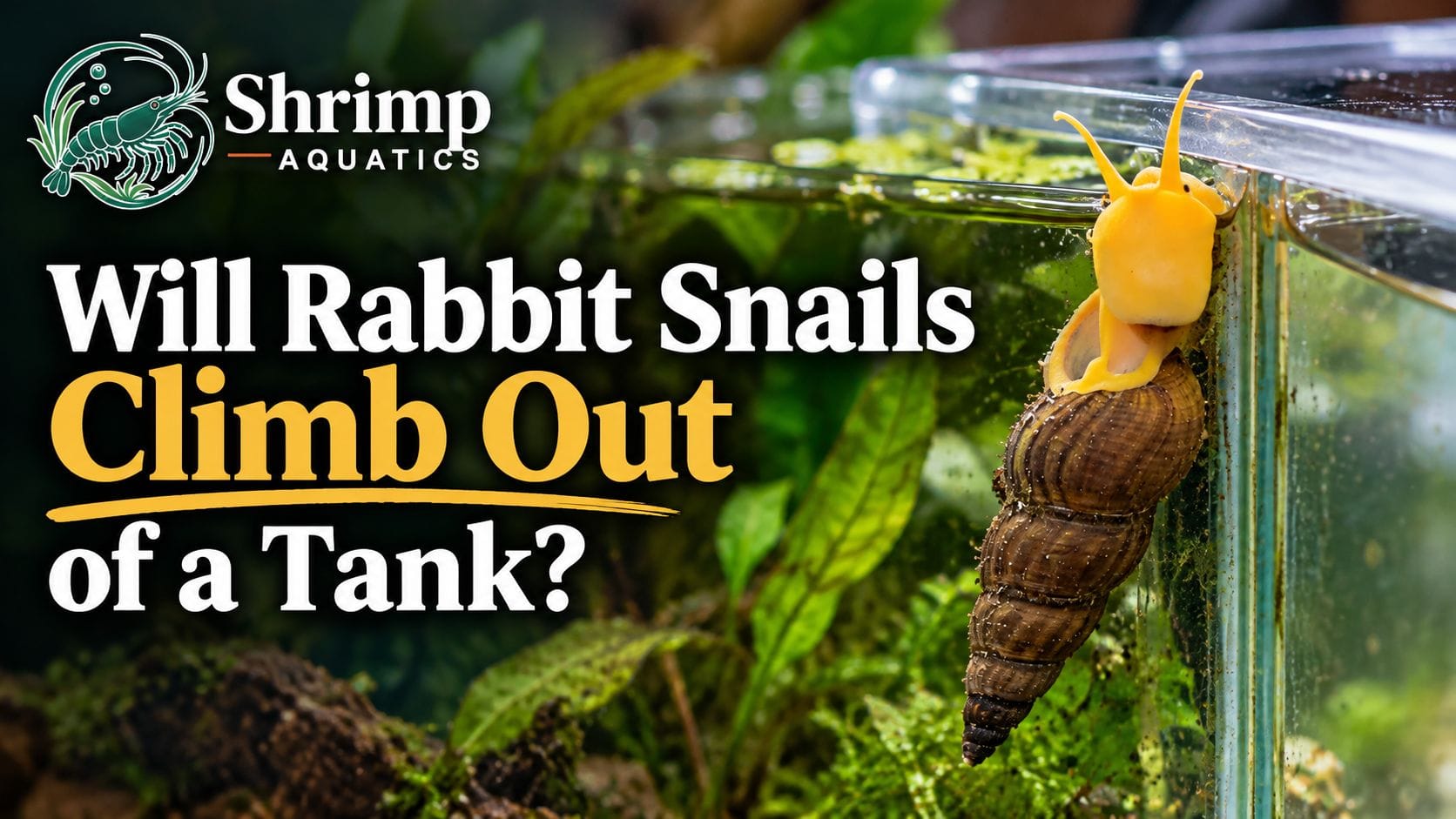
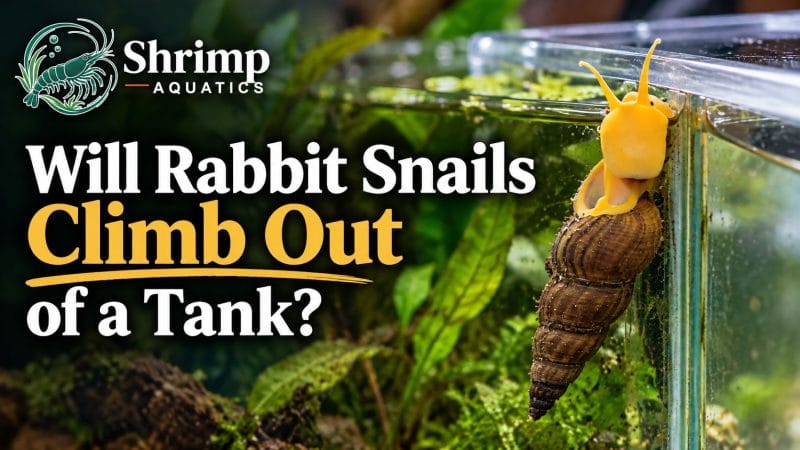
Yes, rabbit snails (Tylomelania) can climb out of a tank. They crawl up aquarium glass like any other snail, and most rabbit snail care guides tell you to keep a lid on for exactly that reason. Treat what follows as keeper experience plus the bits of biology that explain it. Our advice is short: cover the tank, close the gaps, and if a snail keeps parking at the waterline, test your water.
Are rabbit snails more likely to escape than mystery snails?
We don’t think so, and the reason is how the two breed. Female mystery snails (Pomacea diffusa) lay their eggs above the water surface, on plants or hard surfaces, and the snails carry both a lung and a gill.1 So a perfectly healthy mystery snail has a built-in reason to leave the water now and then.
Rabbit snails don’t lay eggs at all. The female keeps the eggs and developing young inside her body and releases fully shelled juveniles.2 Nothing in that cycle needs dry land, so a rabbit snail that climbs out isn’t following a breeding urge. It’s one of the differences that matter when you weigh a rabbit snail vs mystery snail for the same tank, alongside the water each one needs.
That doesn’t mean it never happens. Care guides still describe rabbit snails climbing the glass and ending up outside open tanks, and at least one describes escaped snails drying out on the floor and dying. Think of the lid as cheap insurance you fit once.
How do you stop rabbit snails climbing out of an open tank?
Fit a lid that covers the whole top, then close the gaps in it. Care sites point out that even a small opening can be enough for a determined snail, and the cutouts for filter pipes, heater cables and airline are the openings most covered tanks still have. A strip of mesh or rigid plastic trimmed to fit closes them.
Running a rimless tank without a lid? The usual workaround is to drop the water level a few inches below the rim, so there’s a band of dry glass to cross. It lowers the odds; it doesn’t close the door. Anything that bridges that band, like hardscape, a tall plant or a filter body that reaches the top, turns the dry glass back into a ladder.
If you’re setting up for our tank-bred Sulawesi snail lines, fit the lid before the snails arrive, not after the first one turns up on the rim. Every rabbit snail we sell is bred by Shrimp Aquatics, not collected from the wild.
What should you check when a rabbit snail keeps heading for the rim?
Test the water first. When snails in general start leaving the water, the reasons care sites give are mostly about the tank: poor water quality, too little food, pH out of range, temperature swings, crowding or fish that pick at them. Nobody has tested which of those sends a rabbit snail up the glass, so work through the ones you can check.
- Ammonia and nitrite both read 0, in a tank that’s fully cycled.
- Temperature sits inside 79-86°F (26-30°C) and hasn’t jumped since your last water change.
- pH sits inside 7.5-8.5.
- The surface is moving. Warm water holds less oxygen than cool water,3 and this tank runs warm, so keep a gentle ripple from the filter outlet or an air stone, lid or no lid.
- There’s a visible film of algae and biofilm on the rock and glass for the snail to graze.
- No tankmate is picking at its head or tentacles.
If everything reads right and the snail still wanders up the glass now and then, it may simply be grazing. One climb isn’t a diagnosis. What you want to act on is a snail that sits at or above the waterline day after day. Check that tank against the full range for Sulawesi rabbit snail care, not just one reading.
Found a rabbit snail outside the tank? Put it back first
Put it straight back in the tank, even if it looks dead. We haven’t found any measured figure for how long a rabbit snail lasts out of water, so don’t stop to examine it on the floor. Set it upright on the substrate and give it a few hours to come out of its shell before you judge it. If it still hasn’t moved by then, work through the signs of a rabbit snail dead or inactive before you take it out.
Then find out how it got out. A snail that slipped through an open cable cutout needs the gap patched. A snail that keeps trying needs the water checks above.
References
3 Sources
- Spike-topped Applesnail (Pomacea diffusa) Ecological Risk Screening Summary, U.S. Fish and Wildlife Service, November 2016, revised February 2017.
- Anatomy of an adaptive radiation: a unique reproductive strategy in the endemic freshwater gastropod Tylomelania (Cerithioidea: Pachychilidae) on Sulawesi, Indonesia and its biogeographical implications (abstract), T. von Rintelen and M. Glaubrecht, Biological Journal of the Linnean Society 85(4): 513-542, 2005.
- Dissolved Oxygen and Water, U.S. Geological Survey, Water Science School, updated August 24, 2026.
Ready to get started?
Shop our Sulawesi Snail collection
12 products available · Live Arrival Guarantee