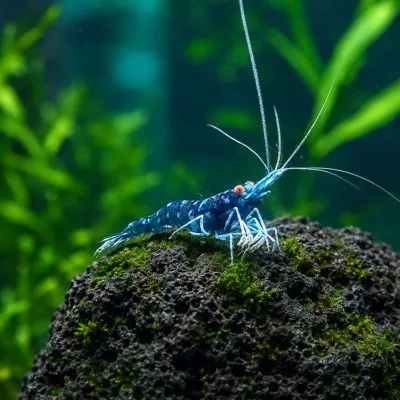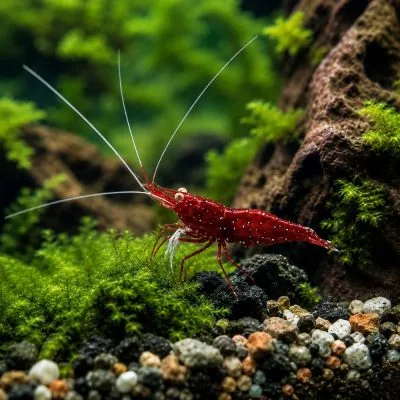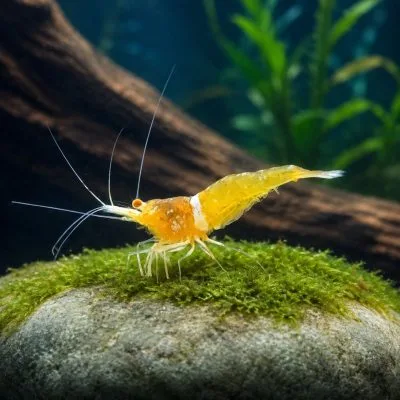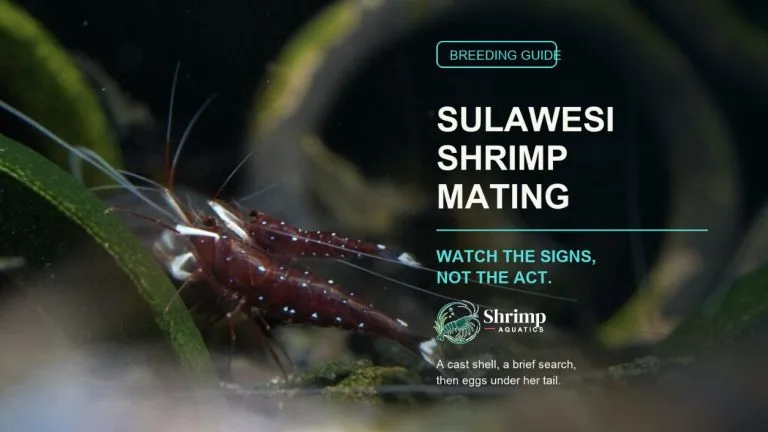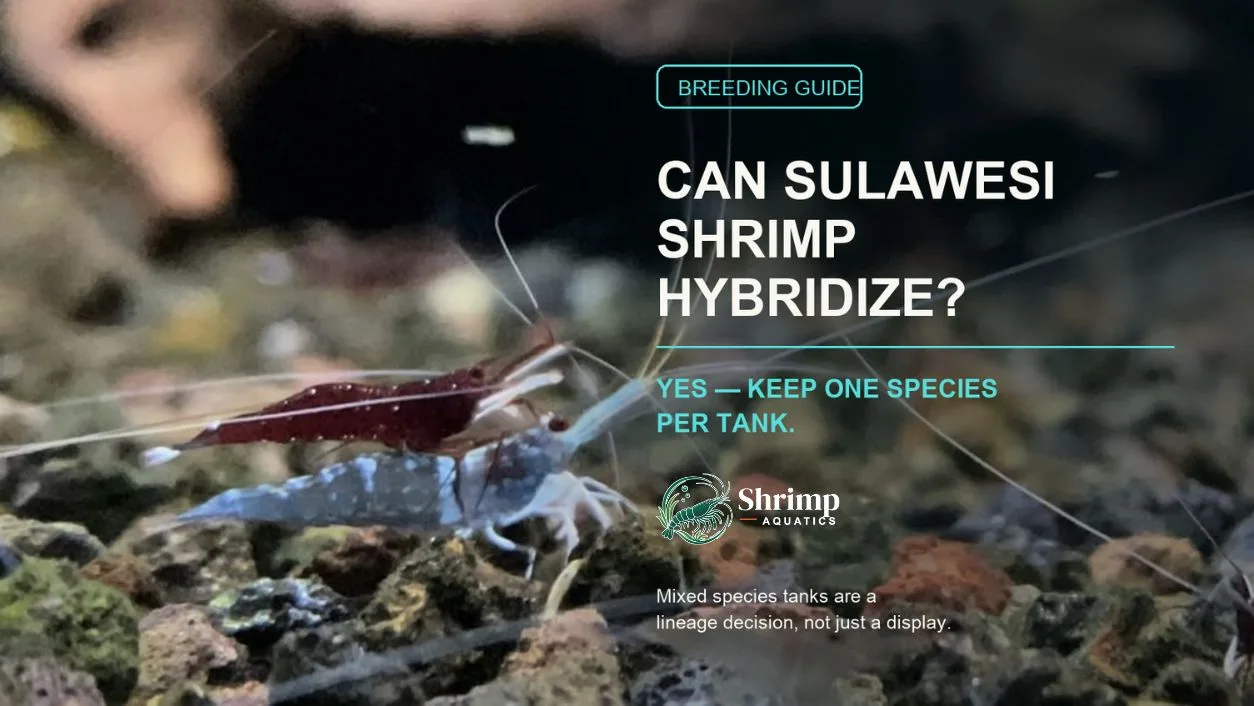
Can two kinds of Sulawesi shrimp in one tank really produce hybrids? Yes: they’re separate species, but that doesn’t stop them mating once they share water. The conservation group Sulawesi Keepers has published breeder accounts and photographs of crosses between Sulawesi lake species.1 One is a cross of Yellow Nose with White Sock, and a Lake Poso pairing went as far as a berried female.1 The breeder quoted there rates the chance of any two species pairing off as low, and low isn’t zero.1 That’s what turns a mixed species tank into a breeding decision, not a display choice.
Which Sulawesi shrimp pairings can actually cross
Two different Sulawesi lake species can cross, and so can two trade lines that may turn out to be one species. A Sulawesi shrimp next to a cherry or Bee shrimp is another question entirely, and it has nothing to do with hybrids. So the risk isn’t spread evenly across everything sold as a Sulawesi shrimp, and it helps to know which situation your tank is in.
| Pairing | What has been reported | What it means for your tank |
|---|---|---|
| Two Sulawesi lake species, for example Yellow Nose with White Sock | Mating and hybrid offspring described and photographed by keepers, and one Lake Poso pairing that carried eggs | Real. Keep one species per tank if you want stock you can still name in a year |
| Two trade lines that may belong to one species, such as White Sock, Blue Ghost, Yellow Ghost and Oiran | Breeders working with these lines treat them as likely to cross when housed together | Real, and easier to miss, because the parents read as color variants rather than as species |
| A Sulawesi lake species with Neocaridina | No hybrid has been described anywhere in the literature | Not a hybrid question. Grazing competition and total stocking are what decide this one |
| A Sulawesi lake species with Bee or Crystal Caridina | No hybrid has been described, and the two groups need water that doesn’t overlap | Not a hybrid question either. These groups can’t share a tank in the first place |
Keeper reports put the risk between Sulawesi species at low but real
The clearest published account comes from Sulawesi Keepers, written with the Chinese breeder Jude Sun. Sun says plainly that the species can interbreed and that the chance of it is low. Two pairings are named. Yellow Ring, also sold as Yellow Nose (C. spinata), crossed with White Sock (C. dennerli) and produced the animal the hobby now calls Yellow Socks.1 In the other, Blue Leg Poso (C. caerulea) with Pink Boxer (C. longidigita), the female went on to carry eggs. Harlequin, Red Line and Tigri are named alongside them as species involved in crossing.1
Take that evidence for what it is. It’s photographs and breeder experience across a lot of tanks, not a controlled trial, and no parentage testing has been published for any of the offspring. It supports a stocking decision. It can’t predict what your particular pair of species will do. What it does rule out is the reassurance you’ll read on most care pages, that separate species simply don’t interbreed.
Trade names don’t tell you whether two Sulawesi shrimp are the same species
A hobby name tells you what a shrimp looks like, not who its parents were. And a shipment rarely arrives with documented parentage. So you can buy three names in good faith and end up with three groups of one animal, or with two species and one unknown. Nothing in the tank will tell you which of those happened. If two names come from the same lake and read as variations on one pattern, assume they can breed together until you’ve got something better than a label.
At Shrimp Aquatics, in our Sulawesi shrimp tanks we haven’t seen routine crossing among unrelated Sulawesi species, but we treat White Sock, Blue Ghost, Yellow Ghost and Oiran as lines that may cross when kept together. If you want those four to stay distinct in your own tanks, give each of them its own.
Neocaridina and Bee shrimp aren’t the hybridization risk in this tank
No hybrid between a Sulawesi lake Caridina and a cherry shrimp (Neocaridina davidi) has ever been described. The usual explanation, that they sit in different genera, is weaker than it sounds. A 2024 mitogenomic study placed Neocaridina inside Caridina, so the genus printed on a label is a poor measure of how related two shrimp are.2 If you’re weighing that mix, think about competition for grazing surfaces and total stocking. Hybrids aren’t the issue.
Bee and Crystal Caridina are a different case again, and a simpler one. Bee tanks typically run 60-72°F (15.5-22°C) at pH 5.8-6.8, against a typical Sulawesi range of 79-86°F (26-30°C) at pH 7.5-8.5. There’s no water both groups could share, so whether they’d breed never even comes up.
Why wild separation of Sulawesi species fails inside one aquarium
In the lakes most of these shrimp never meet. An aquarium takes away both the distance and the different lives that keep them apart. The 2009 revision of the group recognizes 21 species from Sulawesi’s ancient lakes, 15 from the Malili system and 6 from Lake Poso, and treats them as lacustrine endemics.3 White Sock (C. dennerli) is known only from Lake Matano.3 Sulawesi Blue Leg Poso (C. caerulea) and Pink Boxer (C. longidigita) are Lake Poso animals.3 A shrimp that never meets another species can’t cross with it. Geography, not some private genetic wall, does most of the work.
Where species do share a lake, they stay apart by living differently, and they’re told apart by color. The same revision lists Yellow Nose (C. spinata), Red Line (C. striata) and Harlequin (C. woltereckae) among the rock-dwelling Lake Towuti shrimp species.3 All three live side by side with C. glaubrechti.3 Preserved in alcohol, C. glaubrechti is almost identical to the other two, yet the color pattern of a living animal always separates them cleanly.3
An aquarium removes both of those separations at once. Species that evolved in different lakes end up in one water volume with one set of surfaces. The pool of possible partners shrinks to whoever’s swimming next to them. It’s a small dinner party where nobody gets to leave. That’s the honest reason the hobby sees crossings that field biologists don’t.
Can you recognize a Sulawesi hybrid in your own tank?
Usually not with any confidence, and that’s the part worth planning around. Species in this group are separated in the scientific literature by the color pattern of living animals,3 which is exactly the character a cross blurs. Keepers who’ve raised hybrids describe them by eye, against the parents swimming beside them. There’s no test you can send a shrimp away for, and no published reference for what a first generation cross should look like.
Here’s the practical version. Adults you bought as a named species stay identifiable. Anything born in a tank that held two species, or two lines you couldn’t verify, is of unknown parentage from then on. And once a colony has bred for a generation, you can’t sort it back into pure groups by looking at it.
Before you pass shrimp on
If a tank has held two species, or two lines you couldn’t verify, don’t sell, trade or give away the offspring under a species name. Say what was in the tank and let the next keeper decide what to do with them. Undocumented stock is how a mixed line spreads through a hobby that has very few animals to spare.
How to stock Sulawesi shrimp so crossing never starts
Keep one species per tank. That’s the whole answer, and it’s far easier to apply when you’re buying than at any point after. Pick one line from our tank-bred Sulawesi shrimp and order enough of it to hold a colony. A single species tank also gives you a cleaner read on your own water, because every animal in it wants the same thing.
- Decide the species before the tank is set up, not after the shrimp arrive.
- Buy one species in a group large enough to breed, not four groups too small to.
- Keep a written note of what went in, when, and where it came from, so the line is still traceable later.
- Quarantine and grow out new arrivals separately, so a mislabelled animal is caught before it joins a colony.
- Don’t add a second species to a settled tank to fill a color gap.
- Don’t plan to watch the tank and separate a pair before anything happens.
That last one isn’t caution for its own sake. Across decapod shrimps mating comes at the female’s premating molt, and where males search for females instead of guarding them, it’s over within seconds or a few minutes.4 You can’t see a cross beginning in time to stop it. In a tank the size most people keep, you won’t see most of what happens behind the rockwork at all. That same molt-driven window is why group ratios matter so much in how to breed Sulawesi shrimp.
What to do when Sulawesi species are already mixed
Separate them calmly and in order. Nothing about this is an emergency, and moving shrimp in a hurry does more harm than a few more weeks of sharing a tank. Change one thing at a time.
- List what’s actually in there. Photograph the adults you can recognize and compare them against the names you bought. A mixed tank often turns out to hold fewer species than the invoice suggests.
- Decide which line you most want to keep clean. That line stays in the established tank, because the colony you least want to disturb should be the one that doesn’t move.
- Set up and mature the second tank before anything goes into it. Match the parameters of the tank the shrimp are leaving, so the move isn’t also a chemistry change.
- Move the adults of the other species across, a few at a time, and leave the juveniles where they are for now.
- Treat every juvenile that was already in the mixed tank as unverified. Grow them out if you want to, and keep them as a display group you don’t breed from or pass on under a species name.
Can’t run a second tank? Then the honest choice is to stop the mixed tank producing now. That usually means rehoming one species to a keeper who can house it alone, and telling them straight what it’s been living with.
Why pure lines matter for a Critically Endangered shrimp
Because the cardinal shrimp sold as White Sock may already be gone from the wild, and a hybrid can’t rejoin either parent line. White Sock (Caridina dennerli) was assessed by the IUCN in August 2018 as Critically Endangered and tagged Possibly Extinct in the Wild.5 It’s endemic to Lake Matano, with a decreasing population and international trade in the species recorded.5 For an animal in that position, the tanks in the hobby are a meaningful share of what’s left.
So the tank space a hybrid takes up is space a threatened species isn’t using. The hours you spend raising it are hours not spent on a colony that could supply somebody else. Torn between one more color in the tank you have and a second tank on the shelf below it? We’d pick the second tank. It’s the answer that keeps both lines nameable.
What the research says about Sulawesi shrimp crossbreeding
Two of the studies behind this guide come from outside the Sulawesi lakes. Read them as background, not as measurements of your tank. The first is a 2024 mitogenomic study of caridean shrimps. It recovered Neocaridina nested inside Caridina and found Caridina itself not monophyletic.2 That makes a genus name on a label a poor guide to how closely two shrimp are related.2
The second is Raymond Bauer’s work on mating across decapod shrimps. Mating takes place at the female’s premating molt.4 In species where males search for receptive females and don’t guard one through her molt, recognition and mating happen within seconds or a few minutes.4 Sulawesi shrimp haven’t been described in that literature themselves. Still, the shape of the event explains why watching your tank won’t stop a cross. By the time you’d notice, it’s over.
References
5 Sources
- Crossbreeding Sulawesi shrimps, Markéta Rejlková and Jude Sun, Sulawesi Keepers, 25 March 2025.
- Integrative Taxonomy Reveals New Insights into the Species Validity of the Neocaridina davidi-N. denticulata-N. heteropoda Complex and Mitogenomic Phylogeny of Caridean Shrimps, Yang and colleagues, Current Issues in Molecular Biology 46(11), 2024.
- Radiation of endemic species flocks in ancient lakes: systematic revision of the freshwater shrimp Caridina from the ancient lakes of Sulawesi, Indonesia, with the description of eight new species, von Rintelen and Cai, Raffles Bulletin of Zoology 57(2): 343-452, 2009.
- Ray Bauer research: mating behavior and sexual strategies, research page, Raymond T. Bauer, University of Louisiana at Lafayette.
- Caridina dennerli, IUCN Red List assessment, von Rintelen, K., IUCN Red List of Threatened Species, assessed 20 August 2018.
Ready to get started?
Shop our Sulawesi Shrimp collection
27 products available · Live Arrival Guarantee
Featured Sulawesi Shrimp
Sulawesi Orange Eyes White Sock
Caridina dennerli
Advanced · 79-86°F · pH 7.5-8.5
From $19.99View ProductSulawesi Orange Eyes Yellow Ghost
Caridina dennerli
Advanced · 79-86°F · pH 7.5-8.5
$120.00View Product