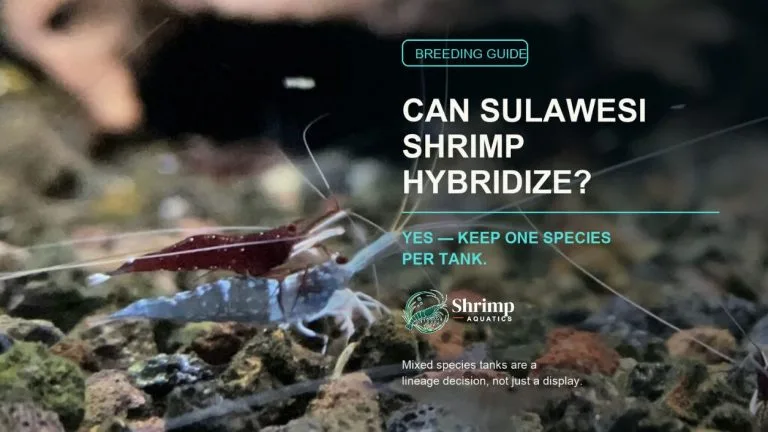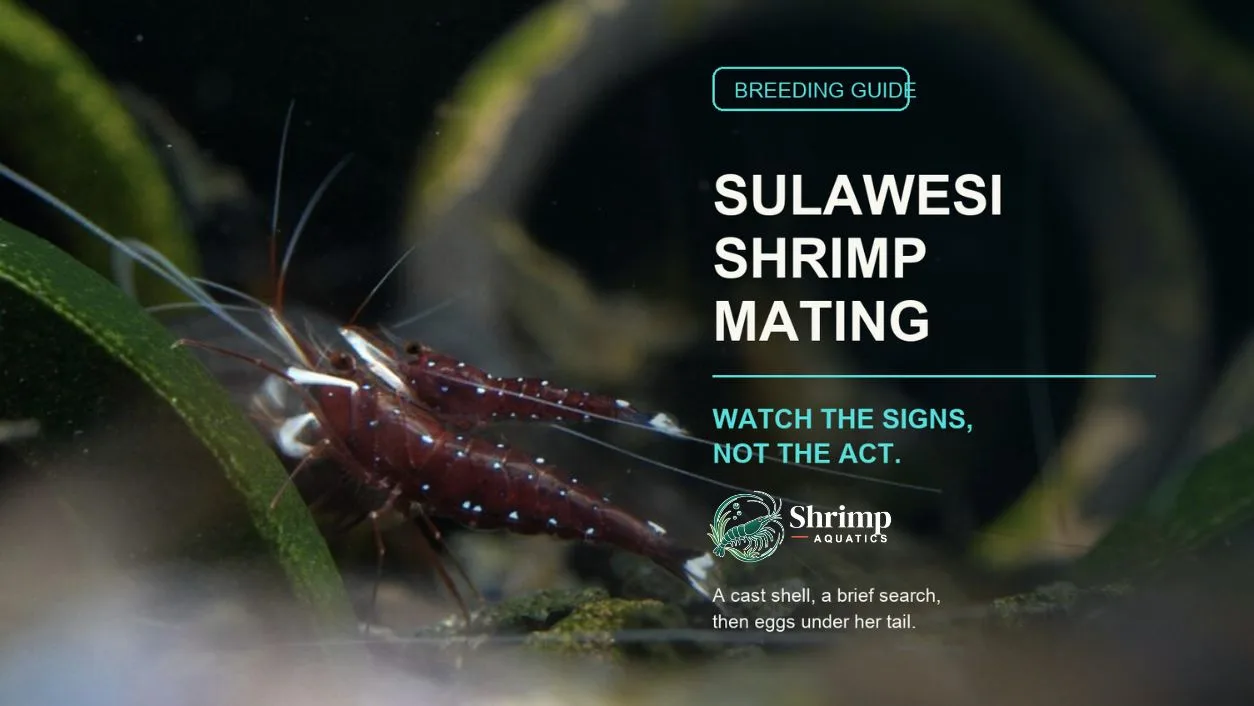
There’s a fresh shell lying on the rock, and two males have suddenly started darting across the glass. Those are two of the four signs that Sulawesi shrimp (Caridina spp.) are mating: a freshly cast shell, a short burst of searching by one or two males, sometimes a brief mount, and days later a female carrying eggs under her tail. You’ll almost never catch the act itself. The middle of that chain is over faster than most of us check a tank. Learning to read the signs is far more useful than waiting to witness it.
Why a cast shell is the first sign worth watching for
Because in shrimp, mating follows the female’s molt, so a fresh shell tells you the window is open right now. Shrimp have to cast the exoskeleton regularly in order to grow. In the freshwater prawn studied most closely for aquaculture, mating only succeeds between a ripe female fresh from her premating molt and a hard-shelled male.1 That isn’t a Sulawesi study, but it tells you where to look. The molt comes first, and everything else follows it.
In practice that makes an empty, clear exuvia lying on the rock the most useful thing on this page. It’s the one sign you can find without watching the tank at the right minute. Leave it where it is. Fishing a shed shell out means a hand or a net in the tank at the very moment a soft female most needs to be left alone. And the shell itself does no harm.
So how often does that window come around? Nobody can say for these species. No figure for how often Sulawesi shrimp molt turned up in the literature we searched. Lab cultures of other small shrimp put the interval at days to a couple of weeks,23 but both ran cooler than a Sulawesi tank. Watch for shells instead of counting days.
What the brief mating burst looks like in a Sulawesi tank
It looks like a change of pace, not a display: one or two males suddenly start moving fast and with purpose. In most shrimps the males don’t guard a female in advance. They find a just-molted, receptive female, and recognition and mating take seconds to a few minutes.4
At the glass, the difference is easy to see once you know it. Grazing shrimp move slowly and stay on a surface. A searching male moves fast and with direction, crossing open rock and glass, changing course, covering ground he wasn’t covering an hour earlier. If two or three males are doing that at once, there’s a fresh shell on the substrate and the water tests clean, the search phase is the reasonable reading. The next section covers what to rule out before you settle on it.
How much of the mounting description is actually documented
Hobby accounts of Sulawesi mating are unusually specific. They describe a male riding on the female’s back, not the belly to belly position usually described for other dwarf shrimp. They describe several males lining up behind one another, and sometimes a second male stacked on the first. Those accounts come from keeper photographs and video. We haven’t found a published description of courtship or of a mating posture in the Sulawesi lake species, so treat them as observation, not documented behavior.
So look for a mount and note it when you see one, but don’t rely on it. Never seeing a mount doesn’t mean nothing happened, and seeing one doesn’t mean eggs are coming.
Is that sudden burst of swimming a mating frenzy or a water problem?
It can be either, so test the water before you decide it’s mating. Sulawesi shrimp swimming fast and erratically is also what you see when the water is wrong, and a wrong guess costs far more one way than the other. Test ammonia and nitrite first, then temperature, then TDS and pH, before you settle on any behavioral explanation.
Why be so careful in a Sulawesi tank in particular? Total ammonia in water sits partly as the ammonium ion and partly as un-ionized ammonia, and it’s the un-ionized form that drives toxicity. In fresh water the ratio of un-ionized ammonia to ammonium rises about tenfold for each rise of a single pH unit and roughly twofold for each 10 degrees Celsius rise between 0 and 30 degrees Celsius.5 Those figures come from a national water quality criteria document covering freshwater aquatic life generally, not from work on shrimp, and they set no safe level for any species. What they do tell you is that warm alkaline water carries a larger toxic share of the same total ammonia reading than a cool acidic tank would. A number you might shrug at elsewhere deserves attention here.
Test before you interpret
While you’re working out what you’re looking at, don’t add anything to the water. No medication, no extra mineral, no large water change. A soft, newly molted female sits in whatever the water is doing, and a large correction made on a guess can do more damage than whatever prompted it.
If the whole colony has changed behavior, treat it as a water quality problem until testing says otherwise. Search behavior involves a small number of males, so a tank-wide change isn’t the explanation to reach for first.
How to tell a berried Sulawesi female from one that’s only saddled
Look under the tail, not behind the head: eggs sit under the abdomen, while a saddle is a patch behind the head. The two look similar to a new keeper and mean completely different things. A saddled female is getting ready. A berried one has already spawned, and that’s the clearest confirmation you’ll get that the sequence finished.
At Shrimp Aquatics we sex mature Sulawesi shrimp by combining three cues, and we treat no single cue as conclusive on its own. Mature females usually have a deeper, rounder lower abdomen, with the abdominal plates extending farther down to create more brood space near the tail. A yellow or darker patch in the cephalothorax behind the head is the ovarian saddle, and it’s the strongest female cue when it’s visible. In our lines the upper central antenna pair is often around one-half of body length in males and around one-third in females; for that comparison use only the two upper central antennae, not the lower central appendages and not the long pair extending to the sides.
Pigmentation, age and reproductive stage can all hide the saddle, so the absence of a visible saddle doesn’t make a shrimp male. On a deeply colored line, expect to work from the abdomen and the antennae more often than from the saddle.
Eggs sit somewhere else entirely. In the 2009 revision that described most of these species, wild caught ovigerous females carried their eggs on the pleopods, the swimmerets under the abdomen, in small clutches of large eggs.6 Caridina dennerli females carried 8-14 eggs measuring roughly 1.0-1.2 by 0.5-0.7 mm.6
| Species | Eggs per ovigerous female | Females examined |
|---|---|---|
| Caridina dennerli | 8-14 | 7 |
| Caridina spongicola | 12-18 | 4 |
| Caridina spinata | 17-31 | 3 |
| Caridina woltereckae | 19-29 | 2 |
| Caridina longidigita | 24-29 | 2 |
Those are wild females at the moment of collection, and most rows rest on two to four animals. They show what these species carry, not what your tank should produce. Across the Sulawesi lake species in the same revision, counts ran from 8 to 80 eggs depending on species, which is why no single group figure is worth quoting. What matters for reading your own tank is the shape of the clutch: few, large, individually visible eggs under the tail, not a dense mass. A dark patch behind the head isn’t a brood.
Once you do see eggs, settle in for a wait. Keepers report that a berried Sulawesi female carries her eggs for about three weeks before the young hatch. One keeper logged the first berried female as day one and found young about three weeks later.
What to do while a newly molted female is being pursued
Nothing invasive: this is the moment to keep your hands out of the tank. Don’t net shrimp, don’t rearrange hardscape and don’t start a water change. A soft female needs cover and steady water more than she needs anything you could add.
The part you can control is the group. Her window of attractiveness is short and pressure during it carries a real cost, so the useful lever is how many males are chasing her in the first place.
At Shrimp Aquatics, when we can sex the shrimp with reasonable confidence, we usually build a Sulawesi breeding group with either 2 males to 8 females or 3 males to 7 females. We use a female heavy group to reduce mating pressure on newly molted females, which are still soft and vulnerable, and we confirm sex from multiple visible cues before setting the ratio.
Structure matters for the same reason. Stacked rock, caves and mature grazing surfaces give a soft female somewhere to sit the window out. An open, sparsely decorated tank doesn’t.
Why you may never see Sulawesi shrimp mate even in a healthy colony
Because the event is brief, it happens in cover and these shrimp are shy, so plenty of keepers run productive Sulawesi tanks for years without once watching a mount. That isn’t a problem to solve. Most of us look at the tank for a few minutes a day, and the shrimp aren’t working to our schedule. What’s worth checking is whether the colony is in a position to breed at all.
- Maturity. No published time to maturity for these species turned up in our research, so judge by size and by the cues above. A group of half grown shrimp isn’t a breeding group yet.
- Group size and sex balance. A handful of shrimp, or a group that turns out to be mostly male, gives you few windows and heavy pressure on each one.
- Stability. Holding temperature and chemistry steady inside 79-86°F (26-30°C) does more for breeding behavior than any single number you could raise.
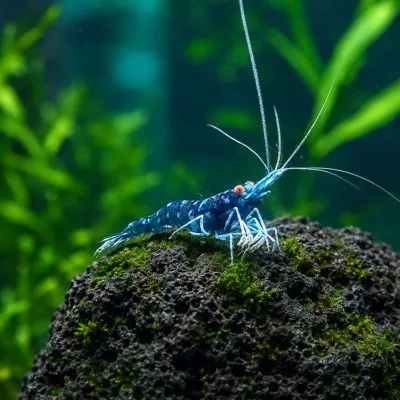
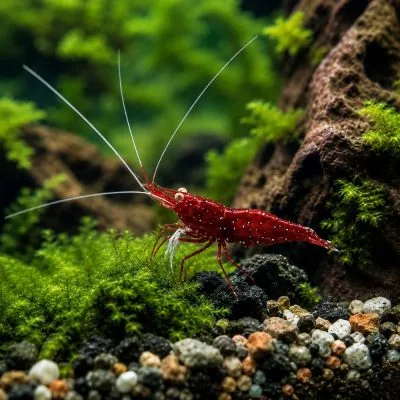
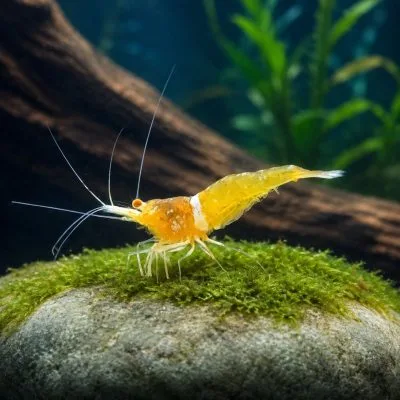
If the group is small or male heavy, adding mature females of a line you already keep is the change worth making. Check the line name on the listing before you order, because Sulawesi shrimp are sold under trade names that don’t map one to one onto species. Our Oiran, White Sock and Blue Ghost lines are all Caridina dennerli, while Yellow Cheek and Yellow Nose are Caridina spinata.
Tempted to nudge things along with heat? Raising the Sulawesi shrimp tank temperature isn’t a lever for this. In a crab study, warmer rearing water shortened the time between molts but also cut growth at each molt.7 Don’t treat heat as a free accelerator in a group you’re trying to breed.
Judge the colony by what comes out of it. Berried females turning up without you ever seeing a mount means the sequence is working and you’re simply not in the room at the right moment. Seeing mounts but never a berried female is the pattern worth investigating. It points back at maturity, group composition and stability, not at anything you can add to the water. Those three things are what how to breed Sulawesi shrimp actually comes down to.
What the research says about Sulawesi shrimp mating signs
None of the molting and mating studies behind this guide was done on the Sulawesi lake species. Read them as the general pattern for shrimp, not as a description of your own tank. The molt-and-mating link comes from the giant river prawn, Macrobrachium rosenbergii. There, successful mating can only take place between a ripe female that has just completed her premating molt, and is therefore soft-shelled, and a hard-shelled male.1
Raymond Bauer’s work on shrimp mating describes pure search species, where males don’t guard a female ahead of her molt. They encounter a just-molted receptive female, recognition and mating happen within seconds to a few minutes, and the partners separate quickly.4 That short period of attractiveness is itself protective, because prolonged harassment of a female shrimp can injure or even kill her.4
The nearest measured molt intervals come from laboratory cultures of other shrimp. Adult male cherry shrimp (Neocaridina davidi) molted at roughly ten day intervals.2 The Atlantic ditch shrimp Palaemon varians ran a 6-12 day cycle with a mean of 8.7 days, and smaller individuals molted faster than larger ones.3 Both cultures were held well below the temperature a Sulawesi tank runs at. Take them as evidence that the interval in small shrimp is measured in days to a couple of weeks, not as a number for your colony.
The caution about heat comes from a study of the lesser blue crab. Elevated rearing temperature shortened the interval between molts but also reduced growth at each molt, leaving smaller animals at every stage.7 That’s a crab, not a shrimp, and it describes a mechanism, not a prescription.
References
7 Sources
- Farming freshwater prawns: a manual for the culture of the giant river prawn (Macrobrachium rosenbergii), biology chapter, FAO Fisheries Technical Paper 428, Food and Agriculture Organization of the United Nations.
- Characterization of the molt cycle of the cherry shrimp, Neocaridina davidi, conference abstract, Kelleher and Mykles, Colorado State University, Society for Integrative and Comparative Biology.
- Moult cycle and setal development of the Atlantic ditch shrimp Palaemon varians Leach, 1814, Journal of Crustacean Biology 44(4), December 2024.
- Ray Bauer research: mating behavior and sexual strategies, research page, Raymond T. Bauer, University of Louisiana at Lafayette.
- Aquatic Life Ambient Water Quality Criteria for Ammonia, Freshwater, U.S. Environmental Protection Agency, Office of Water, April 2013.
- Radiation of endemic species flocks in ancient lakes: systematic revision of the freshwater shrimp Caridina from the ancient lakes of Sulawesi, Indonesia, with the description of eight new species, Raffles Bulletin of Zoology 57(2): 343-452, 2009.
- Elevated temperature induces a decrease in intermolt period and growth per molt in the lesser blue crab Callinectes similis Williams, 1966, abstract, Journal of Crustacean Biology 39(1), January 2019.
Ready to get started?
Shop our Sulawesi Shrimp collection
27 products available · Live Arrival Guarantee
Featured Sulawesi Shrimp
Sulawesi Orange Eyes White Sock
Caridina dennerli
Advanced · 79-86°F · pH 7.5-8.5
From $19.99View ProductSulawesi Orange Eyes Yellow Ghost
Caridina dennerli
Advanced · 79-86°F · pH 7.5-8.5
$120.00View Product