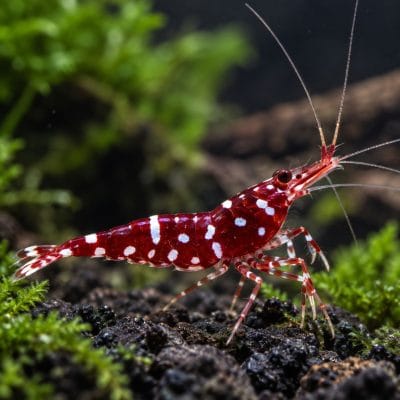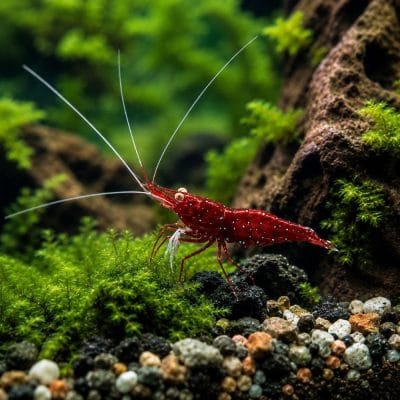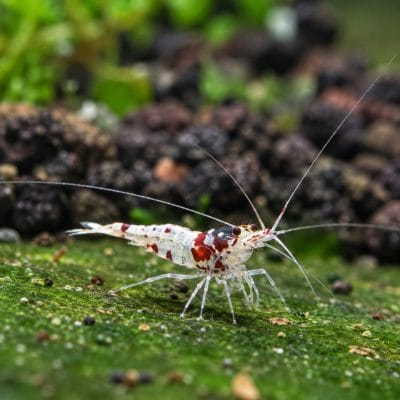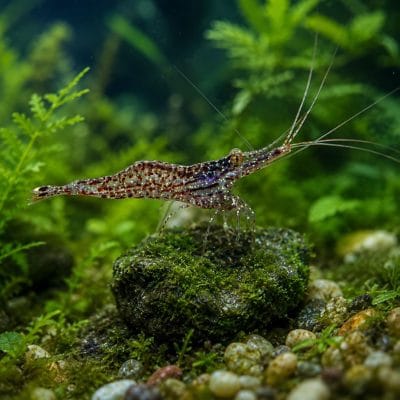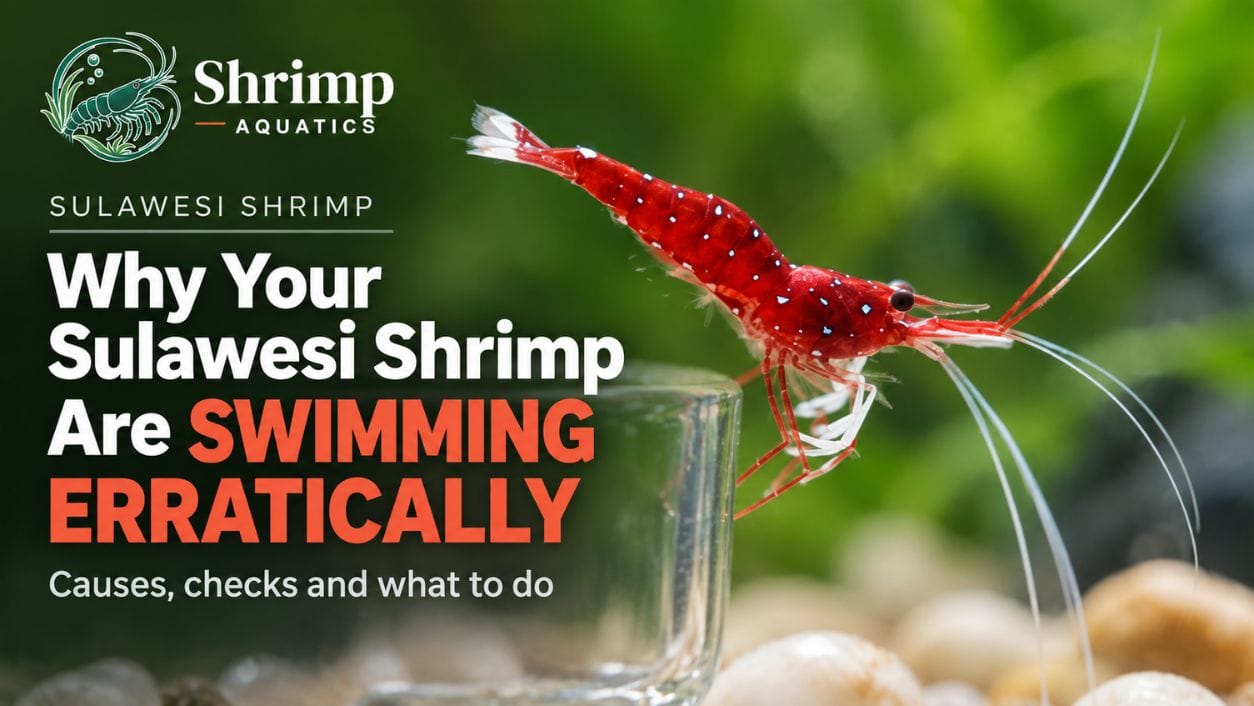
Sulawesi shrimp are supposed to sit on the rock and graze. When they leave it and start swimming laps, one of two things is happening. Either the adult males are responding to a female, or something is wrong with the water. Which one it is comes down to who is swimming, and you can usually tell in under a minute.
Who is swimming tells you whether your Sulawesi shrimp are mating or in trouble
Look for a freshly cast shell before you read the swimming, because a female shrimp becomes receptive right after she molts, and that’s when the mating signs in Sulawesi shrimp start. In freshwater prawns, successful mating happens only between a female that has just finished her pre-mating molt and is still soft-shelled, and hard-shelled males.1 In shrimps that search for females rather than guard them, recognition and mating happen within seconds or a few minutes, and the partners separate quickly.2 That short window of attractiveness is what spares the female harassment serious enough to injure or kill her.2
Neither of those is a Sulawesi measurement. So what you’re matching is a pattern, not a number. A handful of adult males quarter the glass and swim into the filter current, while the females stay out of sight in the rockwork. That resolves on its own, usually within a few hours, and there’s nothing to fix.
Only the males are moving, so leave the tank alone
Only adult males, and only some of them. Steady, directional searching along the glass and against the flow. Normal color. Females hidden and still. Everyone else grazing as usual. No gasping at the surface.
Every size class is moving, so treat it as a fault
Juveniles, berried females and settled adults all moving at once. Ricocheting rather than searching. Shrimp riding the surface film or stacked on the filter outlet. Color washing out across the colony. Anything spinning or unable to right itself.
What to test first when the whole Sulawesi colony is off the rock
Test before you adjust. Run these in order, because the first two decide whether this is an emergency and the rest tell you what moved.
- Ammonia, with a liquid reagent kit rather than a strip. It should read zero.
- Nitrite. It should read zero as well. A tank that can’t hold both at zero isn’t ready for these shrimp.
- Temperature, at the glass and again at the far end. A stuck heater shows up here before it shows up anywhere else.
- TDS, then pH. You’re looking for movement since your last reading, not for a perfect number.
- The surface. Is it moving at all, and is anything sitting on the filter outlet?
Why warm alkaline water makes the same ammonia reading worse
Total ammonia splits between the ammonium ion and the un-ionized form, and it’s the un-ionized form that does the damage. The EPA’s freshwater ammonia criteria document puts the relationship plainly. The ratio of un-ionized ammonia to ammonium ion in fresh water rises 10-fold for each single pH unit, and by roughly two-fold for each 10 degrees Celsius of warming from 0-30 degrees Celsius.3 At high external concentrations the un-ionized form reduces or reverses the animal’s diffusive gradients, so ammonia builds up in its tissues and blood.3
That criteria document assesses a whole freshwater community, not shrimp, and it sets no aquarium threshold. What it gives you is the direction, and the direction is the point. A Sulawesi tank runs at pH 7.5-8.5 and 79-86°F (26-30°C). A Bee tank runs a couple of pH units lower and much cooler. The same reading on the test card is a very different amount of free ammonia in those two tanks. An uneaten pellet you’d get away with in soft acidic water is worth taking seriously here.
Why shrimp collect around the filter outlet when the tank runs warm
Cold water can hold more dissolved oxygen than warm water.4 USGS is describing surface water there, not aquariums. Still, a tank held in the high 80s Fahrenheit has less room for oxygen than the same tank in the low 80s. A flat, unmoving surface takes away the rest. If your shrimp are hanging on the outflow or riding the surface film, treat oxygen as the first thing you fix. It’s also the only fix on this page that can’t shock them.
Retrace what went into the Sulawesi tank in the last two days
Colony-wide swimming that starts abruptly almost always follows something you did. Retrace the last couple of days honestly, including the thing you’re sure was fine.
Mineral salt or powder that went in before it had dissolved
Sulawesi Mineral 7.5 and 8.5 are not the same to mix. SaltyShrimp’s own instructions for Sulawesi Mineral 8.5 say to add it to water outside the aquarium. The salt dissolves almost completely only after CO2 is run into it for about 3-4 days at roughly one bubble a second, and the water then needs at least three hours of air stone aeration to expel that CO2 before use.5 Tip it into a display tank early and you’ve added undissolved solids and a gas swing to a colony that was fine an hour ago. The same caution goes for bacterial and enzyme powders. Mix everything outside the tank, and give it time.
Why topping off with remineralized water pushes TDS up
Water leaves your tank as vapor. The minerals don’t go with it. Evaporation concentrates dissolved solids in the water that remains.6 USGS describes that mechanism for groundwater, not for aquariums, but your TDS meter does the same arithmetic. Top off with plain RO water and save the remineralized water for actual water changes. If your TDS has climbed since last week and nothing else has changed, this is usually why.
Copper, new tap water and fish medications a shrimp colony cannot take
Elevated copper is toxic in aquatic environments and may adversely affect invertebrates. Its toxicity is primarily related to how much of the metal binds to a biochemical receptor such as a gill membrane, and pH, alkalinity, dissolved organic carbon and hardness all change how bioavailable it is.7 In practice, suspect new tap water, a plant that arrived from an unknown system, or a fish medication dosed into a shared tank. Don’t reach for a fish treatment while you’re still guessing. Say no to that one flatly: an invertebrate colony that is already stressed is the worst possible place to test a formulation.
How to steady a Sulawesi tank without causing a second shock
Don’t fix it fast
A large water change, a pH adjuster poured into the display or a medication dosed on suspicion does more harm than the fault you’re chasing. Every correction on a Sulawesi tank is slow and small.
- Add air. An extra air stone costs nothing and carries no risk. Aim it for surface movement, not a current through the shrimp.
- Stop feeding. Lift anything uneaten within a few minutes. In warm alkaline water, leftovers are the fastest route back to the ammonia problem you just tested for.
- Prepare replacement water outside the tank to stabilize Sulawesi shrimp water. Mix it, aerate it, warm it until the thermometer matches the display, and test the finished water before any of it goes in.
- Drip it in. Keep the exchange small. A tenth of the tank, dripped at one to two drops a second, does more for a stressed colony than a third poured in.
- Then wait. Retest the next morning and the morning after. Resist the urge to change a second thing before you know what the first one did.
At Shrimp Aquatics, our Sulawesi systems run biological filtration together with a Kaldnes moving-bed filter, and we tune the outlet so the shrimp aren’t pushed around while they graze. The goal is high oxygen with gentle movement at shrimp level. If you’re adding aeration during an emergency, that’s the balance to copy: more gas exchange, not more flow through the rockwork.
When one Sulawesi shrimp is swimming badly and the colony is fine
A single animal behaving strangely while everyone else grazes is a different problem, and it usually isn’t the water. A Sulawesi shrimp with a failed molt will thrash, snap its tail and dart backwards. There’s nothing you can safely add to the tank to help it in that moment. Leave it alone, keep the water steady, and let the colony be your evidence: if nobody else follows, your parameters probably aren’t the cause.
Tissue that has gone milky or opaque is worth separating from a shrimp that has simply gone pale. In farmed freshwater prawns, opaque abdominal muscle alongside lethargy and degeneration of the telson and uropods is a described clinical sign of white tail disease. That disease produced up to 100 per cent mortality within four days in the animals studied.8 It’s a different species, so it isn’t a diagnosis for your tank. What the hobby honestly has here is a gap: nobody has published what opaque muscle means in lake Caridina. If you’re seeing it spread through a colony, that’s the point to ask a qualified aquatic veterinarian before you dose. Spot that difference before you treat anything, the first step in common health problems in Sulawesi shrimp.
References
8 Sources
- Farming freshwater prawns: a manual for the culture of the giant river prawn (Macrobrachium rosenbergii), biology chapter, Food and Agriculture Organization of the United Nations, FAO Fisheries Technical Paper 428.
- Ray Bauer research: mating behavior and sexual strategies, Raymond T. Bauer, University of Louisiana at Lafayette, research page.
- Aquatic Life Ambient Water Quality Criteria for Ammonia, Freshwater, U.S. Environmental Protection Agency, Office of Water, April 2013.
- Dissolved Oxygen and Water, U.S. Geological Survey, Water Science School, updated August 24, 2026.
- Sulawesi Mineral 8,5: minerals and trace elements, SaltyShrimp, manufacturer product information.
- Chloride, Salinity, and Dissolved Solids, U.S. Geological Survey, Water Resources Mission Area, March 1, 2019.
- Supplementary Training Materials for Aquatic Life Criteria, Copper, Background, U.S. Environmental Protection Agency, updated May 6, 2026.
- White Tail Disease of Freshwater Prawn, Macrobrachium rosenbergii, abstract, Indian Journal of Virology 23(2), 2012.
Ready to get started?
Shop our Sulawesi Shrimp collection
27 products available · Live Arrival Guarantee
Featured Sulawesi Shrimp
Sulawesi Orange Eyes White Sock
Caridina dennerli
Advanced · 79–86°F · pH 7.5–8.5
From $19.99View Product