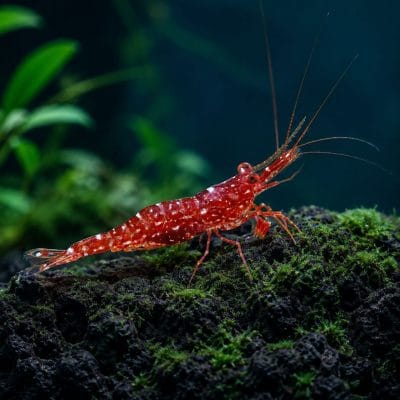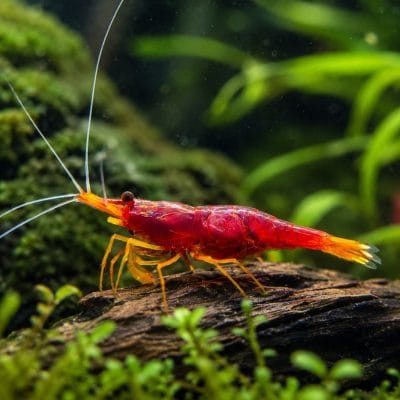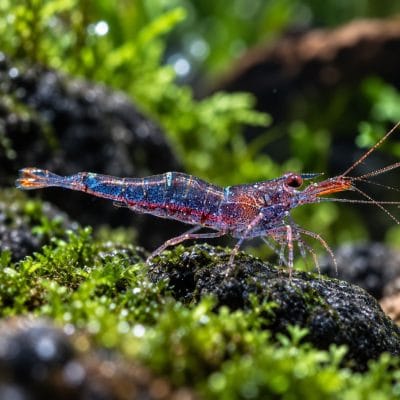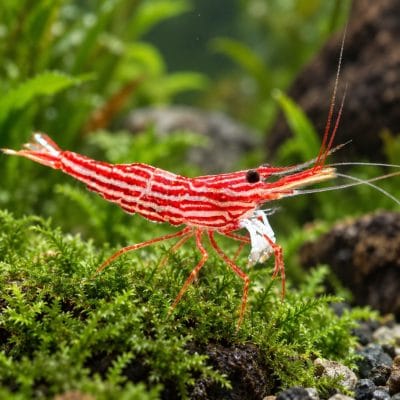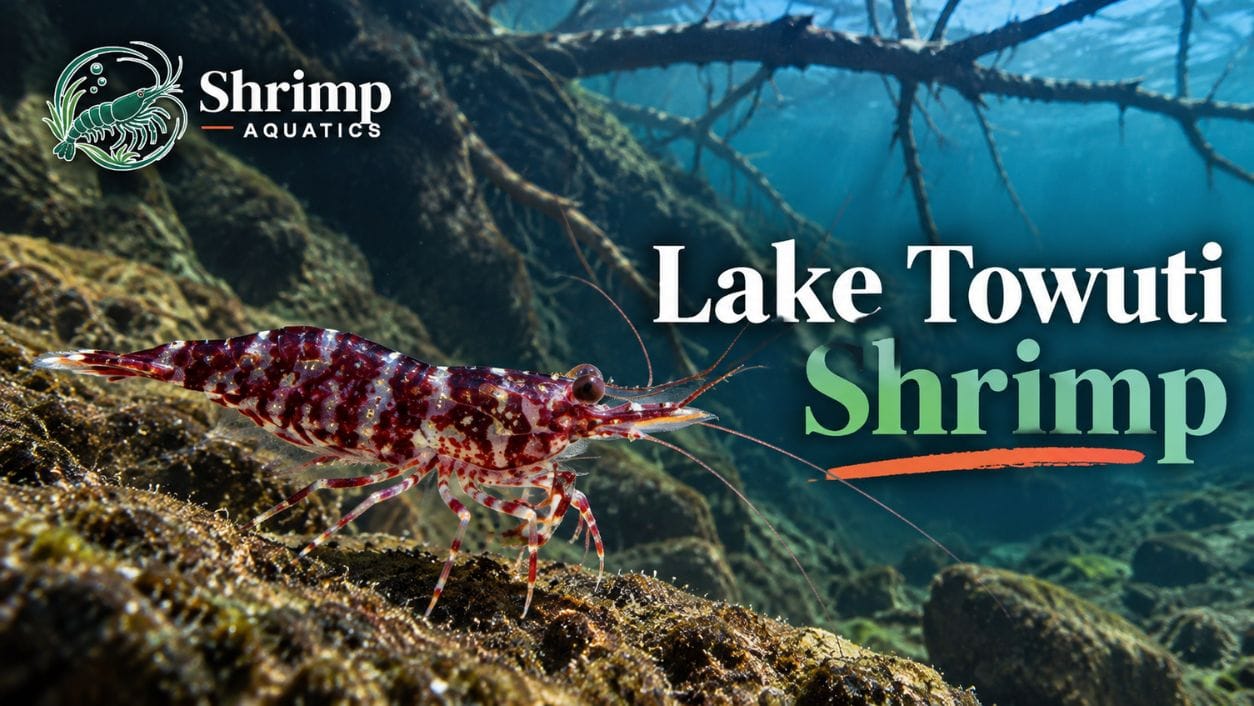
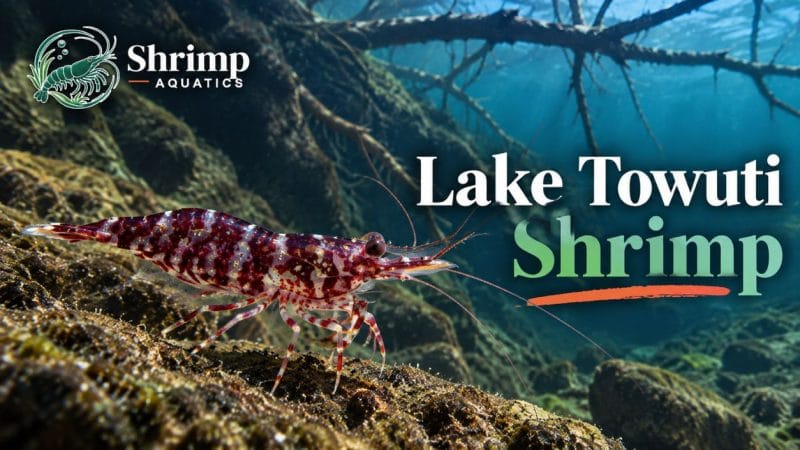
Eleven described Caridina species have been recorded from Lake Towuti, the largest lake in the Malili system of South Sulawesi. Only a few of them ever reach a home tank. Below is the list, matched to the names you’ll actually meet on a stock sheet. It also covers what a Towuti origin does and doesn’t tell you about the water you need.
Which Caridina species live in Lake Towuti?
The working list comes from the 2009 systematic revision of the Sulawesi lake Caridina. That paper recognized fifteen species in the Malili lake system, where ten had been described before.1 Eleven of the fifteen have distributions that include Lake Towuti. Four are recorded from that lake and nowhere else: Caridina spinata, C. woltereckae, C. glaubrechti and C. profundicola.1
One name on the Towuti lists deserves a second look. The shrimp sold as the Towuti Tiger is C. masapi, and the revision’s own identification key separates it by collections from Lake Masapi and Lake Lontoa.1 The trade name points at the wrong water.
| Species and authority | Sold as | What the revision records |
|---|---|---|
| Caridina spinata Woltereck, 1937 | Yellow Nose, Yellow Cheek, Goldflake | Rock dweller, recorded only from Lake Towuti |
| Caridina woltereckae Cai, Wowor & Choy, 2009 | Harlequin, Towuti Beauty | Rock dweller, recorded only from Lake Towuti |
| Caridina glaubrechti von Rintelen & Cai, 2009 | Red Orchid, Brown Camo | Endemic to Lake Towuti, mainly the western part of the lake |
| Caridina profundicola von Rintelen & Cai, 2009 | Sun Stripe | Recorded only from Lake Towuti |
| Caridina striata von Rintelen & Cai, 2009 | Red Line | Rock dweller in Lake Towuti, often alongside C. glaubrechti and C. woltereckae |
| Caridina spongicola Zitzler & Cai, 2006 | Sponge shrimp | The outlet of Lake Towuti, on and inside a freshwater sponge |
| Caridina loehae Woltereck, 1937 | Mini Blue Bee | Lake Towuti and Lake Matano |
| Caridina lanceolata Woltereck, 1937 | Needle shrimp, Lanceolate shrimp | Distribution includes Lake Towuti |
| Caridina lingkonae Woltereck, 1937 | Lingkona shrimp | Distribution includes Lake Towuti |
| Caridina tenuirostris Woltereck, 1937 | Slender snouted shrimp | Distribution includes Lake Towuti |
| Caridina holthuisi von Rintelen & Cai, 2009 | Holthuis’s dwarf shrimp | All three major Malili lakes and the Petea River |
Read that last column as habitat, not as chemistry. Several of these shrimp sit on the same rock at the same time. The revision records C. glaubrechti in Lake Towuti alongside C. profundicola, C. spinata, C. striata and C. woltereckae, with rock dwellers spread from shallow cobbles down onto boulders below 3 m.1 The lakes also mix from top to bottom, with no stable thermocline dividing deep water from shallow.1 So a shrimp taken off a deep boulder wasn’t living in different water from one taken off a shallow cobble. You don’t need a deep tank for one and a shallow tank for another.
Can you keep the sponge shrimp without its sponge?
No, and it’s the clearest example of why this list is longer than anything you can buy. Caridina spongicola was described from the outlet of Lake Towuti, west of Cape Tokaluku.2 It lives on a freshwater sponge and inside the sponge’s openings, at depths of 2-5 m.2 The shrimp don’t eat the sponge tissue, they shelter in its cavities.2 Adults are tiny, with a carapace of 1.8-2.8 mm.2 Keeping the shrimp means keeping the host alive as well, so we wouldn’t expect to see it offered, and we wouldn’t buy it if we did.
Does a Mini Blue Bee on a stock sheet come from Lake Towuti?
Not necessarily. Caridina loehae is recorded from Lake Towuti and is also one of the Lake Matano shrimp species.3 The species alone doesn’t tell you which lake a given shrimp traces back to. For your tank that hardly matters, since you’d set up the same water either way. It matters if you’d rather keep one lake population together than mix two.
Which Lake Towuti shrimp can you actually buy?
Far fewer than eleven. We’d treat the deep water and sponge dwelling species as lake animals rather than aquarium stock. We’d also expect the small translucent ones to stay out of the trade, because nobody pays for a clear shrimp. The four you’ll keep meeting are the high contrast rock dwellers: Yellow Nose, Harlequin, Red Orchid and Red Line.
Two of them are lines we raise ourselves. If you’re deciding what to stock, you’ll find them with the rest of our Sulawesi shrimp: C. spinata is listed as Sulawesi Yellow Nose, and C. glaubrechti as Sulawesi Red Orchid.
Those two names are also the reason to distrust color words. Sellers don’t share one naming system, and the same species picks up a different label in each market. A color name tells you nothing about which lake the animal came from. Ask for the scientific name, then check it against the types of Sulawesi shrimp you’re likely to be offered.
What water do Lake Towuti shrimp need?
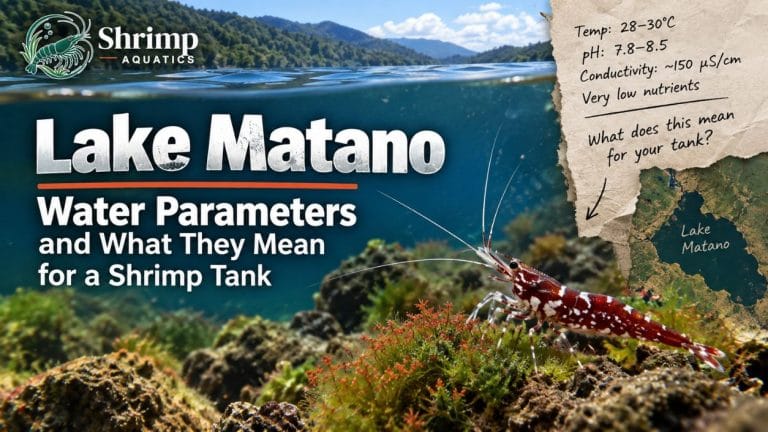
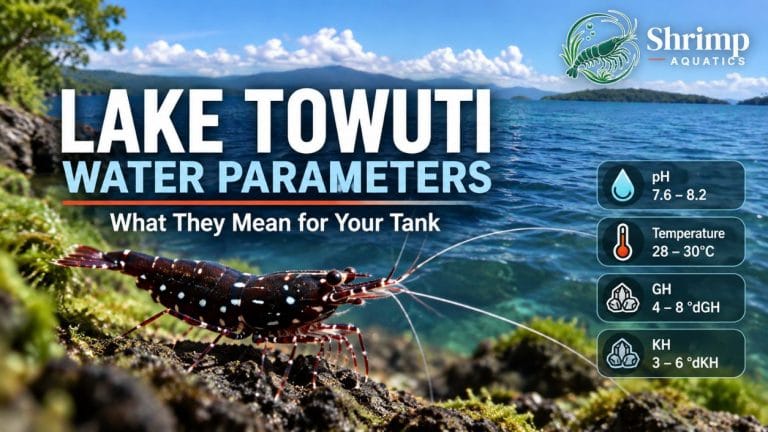
One set of numbers covers every species in the table. That’s the useful consequence of them all coming out of the same warm, mildly alkaline, mineral poor Lake Towuti water. You aren’t choosing between eleven setups. You’re choosing whether you can hold one set of values steady for years.
| Difficulty | Advanced to expert |
|---|---|
| Temperature | 79-86°F (26-30°C) |
| pH | 7.5-8.5 |
| GH | 4-8 dGH |
| KH | 3-6 dKH |
| TDS | 150-250 ppm |
| Nitrate | Under 10 ppm, with ammonia and nitrite at 0 |
| Substrate | Inert sand and rock, never an acid buffering shrimp soil |
What the lake does change is the furniture. These shrimp graze hard surfaces, so build rock area with mature biofilm on it, not a planted aquascape. Mix and test your replacement water outside the tank. Matching Sulawesi shrimp care parameters before that water goes in is what keeps a routine top-off from turning into a shock.
A Towuti origin is not a difficulty discount
None of these species is among the best Sulawesi shrimp for beginners. Every one of them sits at advanced to expert, and a name being easy to find in the trade doesn’t move it. If your tank has been running less than a month, or your KH drifts between tests, fix that before you order anything from this list.
What to check before you order a Lake Towuti shrimp
Run through this with your test kit in hand, not from memory.
- Your tank is mature, not merely cycled: ammonia and nitrite at 0, with visible biofilm and algae on the rock.
- Temperature, pH, KH and TDS have held steady across at least three tests on different days.
- The listing gives a scientific name, not only a color name.
- The stock is tank-bred rather than collected, whoever you buy from.
- Don’t order while you’re still adjusting the water. Every correction after the shrimp arrive is a second shock.
Provenance is the question people skip. These are wild populations confined to one small lake basin. Before you commit, it’s worth knowing which endangered Sulawesi shrimp you’re buying into, because a species whose wild population has collapsed is one you should only ever take as tank-bred stock. Everything we sell is bred by Shrimp Aquatics, not collected from the wild.
References
3 Sources
- Radiation of endemic species flocks in ancient lakes: systematic revision of the freshwater shrimp Caridina from the ancient lakes of Sulawesi, Indonesia, with the description of eight new species, Raffles Bulletin of Zoology 57(2): 343-452, Lee Kong Chian Natural History Museum, National University of Singapore, 2009.
- Caridina spongicola, new species, a freshwater shrimp (Crustacea: Decapoda: Atyidae) from the ancient Malili lake system of Sulawesi, Indonesia, Raffles Bulletin of Zoology 54(2): 271-276, Lee Kong Chian Natural History Museum, National University of Singapore, 2006.
- Caridina loehae Woltereck 1937, taxonomic treatment record, Plazi TreatmentBank on Zenodo, extracted from Cai, Wowor & Choy, Partial revision of freshwater shrimps from Central Sulawesi, Indonesia, Zootaxa 2045, 2009.
Ready to get started?
Shop our Sulawesi Shrimp collection
27 products available · Live Arrival Guarantee