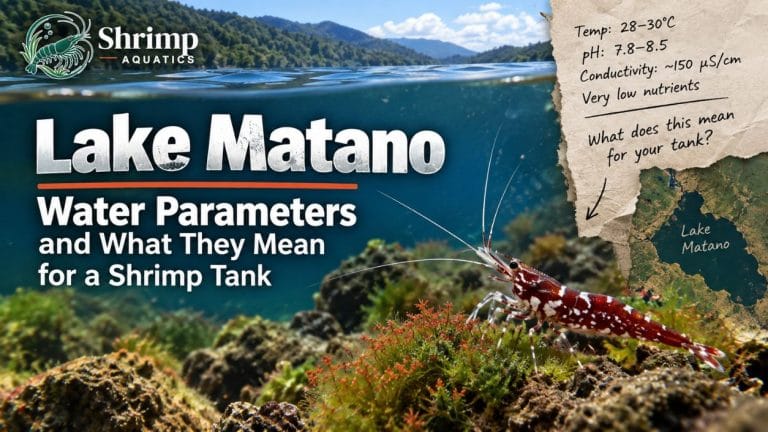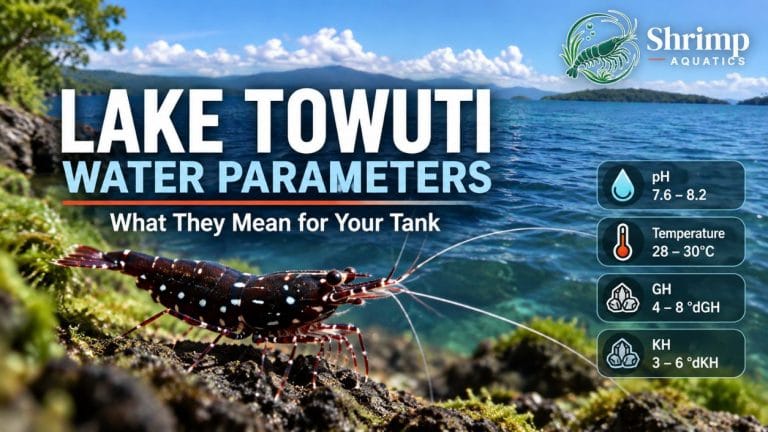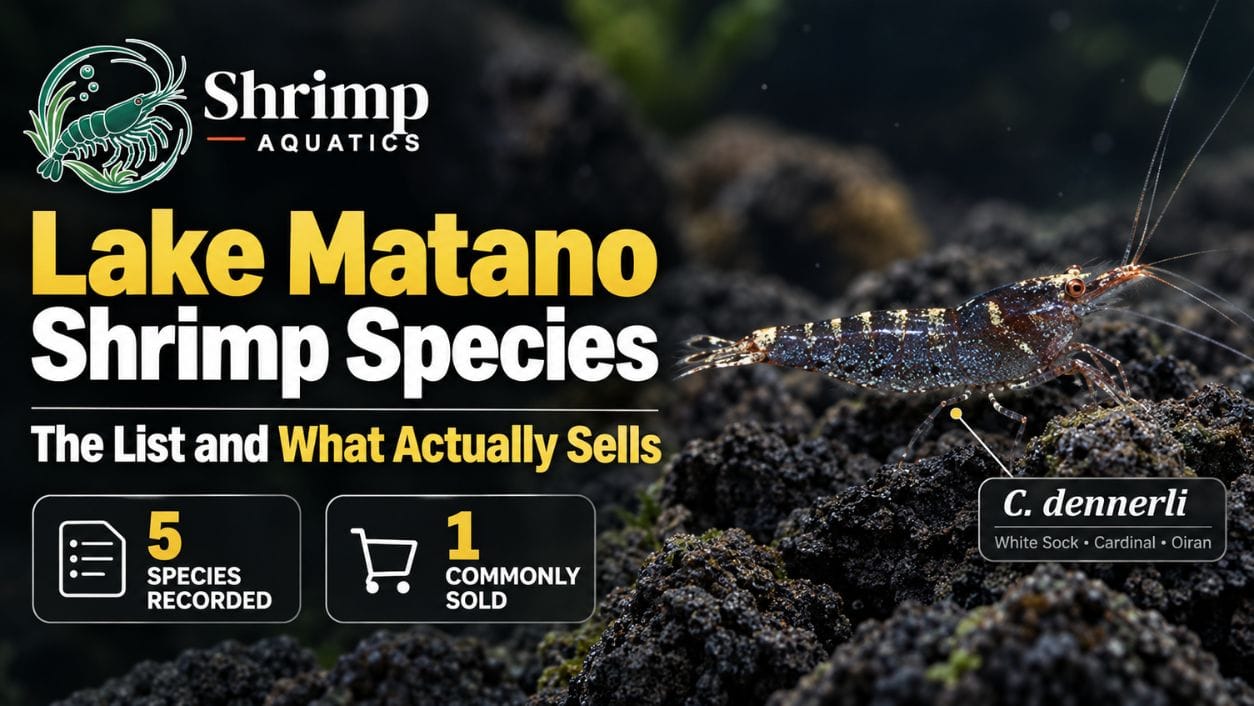
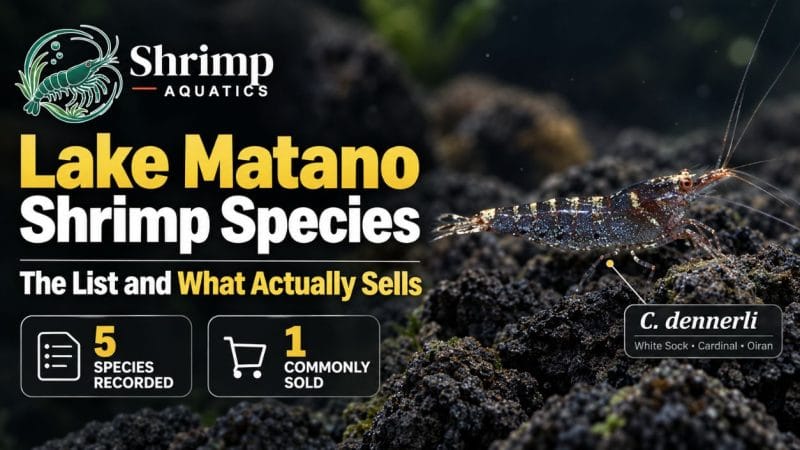
If you’re trying to work out which shrimp actually come from Lake Matano, the honest answer is short. They’re all Caridina, only a handful of species have published records from the lake, and just one of them is likely to appear on a stock list you can order from.
Which shrimp species live in Lake Matano?
Lake Matano is one of five connected lakes in the Malili system, all drained westward by the Larona River into Bone Bay.1 That matters for a shrimp list, because a species can be spread across those lakes or stuck in just one of them. Caridina dennerli is the strict case: it’s endemic to Lake Matano and widely distributed within the lake, and it’s a hard substrate dweller that turns up on rock at a range of depths.1 Caridina holthuisi is the opposite case, endemic to the Malili system as a whole and recorded from all three major lakes and the Petea River.1
| Species | Recorded from | What you’ll see it sold as |
|---|---|---|
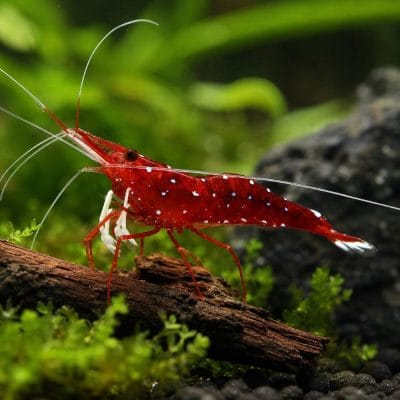
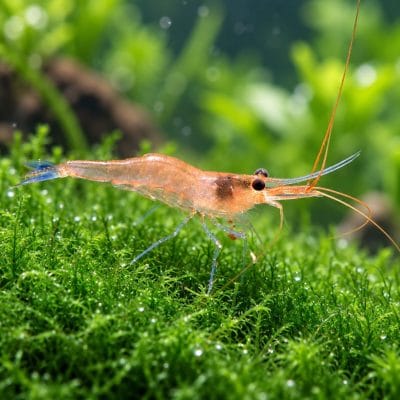
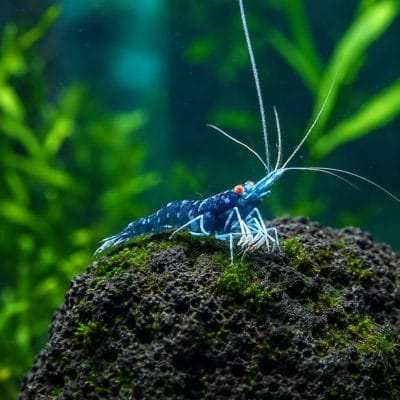
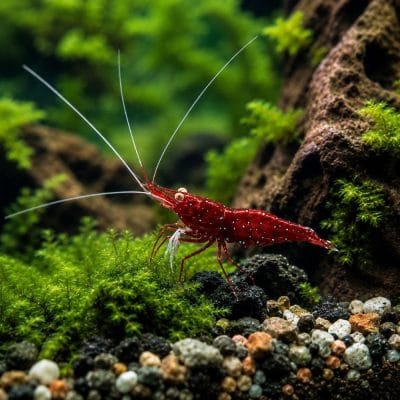
| Caridina dennerli | Lake Matano only1 | White Sock, Cardinal, Oiran, Blue Ghost, Yellow Ghost, Galaxy and the Orange Eye lines |
| Caridina holthuisi | Lake Matano, Mahalona, Towuti and the Petea River1 | Not a line we stock |
| Caridina lanceolata | Lake Matano, Lake Mahalona and the Petea River2 | Not a line we stock |
| Caridina loehae | Lake Matano and Lake Towuti3 | Not a line we stock |
| Caridina masapi | Lake Matano and the other Malili lakes and channels4 | Not a line we stock |
Read that middle column carefully if provenance matters to you. Only C. dennerli belongs to Lake Matano and nowhere else. The other four are Malili species that happen to have been collected in Matano as well, so a shrimp of one of those species isn’t necessarily a Matano animal at all.
Only one Lake Matano shrimp reaches the hobby
Here’s the part most species lists skip. The Matano shrimp you can actually buy is Caridina dennerli, and almost every trade name among the most colorful Sulawesi shrimp in this corner of the hobby is a color line of it. White Sock and Cardinal are the same species. So are Oiran, Blue Ghost, Yellow Ghost, Galaxy and the Orange Eye versions of each. Our own Sulawesi White Sock is C. dennerli, and so is everything else in our tank-bred Sulawesi shrimp range that carries a Matano name.
That’s good news for your planning and bad news for anyone hoping a rarer name buys an easier animal. A different color line doesn’t come with different water, a different diet or a different tolerance for a young tank. It’s one species wearing several price tags.
Why a Lake Matano label on a listing proves less than it looks
Lake names travel further than the shrimp do. The Blue Leg Poso shrimp, Caridina caerulea, turns up filed loosely under Sulawesi and sometimes under Matano, but every specimen in its species description came from Lake Poso and its immediate shoreline, with no Matano or Malili record anywhere in it.5 Lake Poso shrimp species come from a separate system, not part of the Malili chain at all.
So treat the lake name as a starting point and ask two things before you pay. Which species is it, in Latin? And was it bred in a tank or taken out of a lake? If a seller can’t answer the first question, the second answer isn’t worth much either. It also helps to know where Sulawesi shrimp come from as a group, because the same trade names get attached to species from three different lake systems.
Lake Matano origin tells you the water is warm and alkaline, and little else
All five species above share one lake, so they share one set of numbers. This is the range we keep to for every Sulawesi lake species we sell.
| Difficulty | Advanced to expert |
|---|---|
| Temperature | 79-86°F (26-30°C) |
| pH | 7.5-8.5 |
| GH | 4-8 dGH |
| KH | 3-6 dKH |
| TDS | 150-250 ppm |
| Nitrate | Under 10 ppm |
What the lake doesn’t tell you is the hard part. Holding one steady point inside that band matters more than picking the prettiest number in it, and that asks for a mature tank with grazing surfaces already grown in, not a new one. If you want the detail on building and holding it, that sits with the Sulawesi shrimp care parameters.
Test your own water before you shortlist a species
None of the names in the table changes the answer. If your tank can’t sit in that band on its own for a few weeks, the species you pick isn’t the thing standing between you and a dead colony.
What to check before you order a Matano shrimp
- Your tank has been running long enough to grow visible biofilm on rock and glass, not just to clear a cycle on paper.
- Ammonia and nitrite read zero, and they’ve read zero for weeks.
- Your water already sits inside the band above without daily correction.
- The listing names a species, not only a lake and a color.
- The listing says the stock is tank-bred.
That last one isn’t a formality. You saw above that C. dennerli lives in one lake and nowhere else on earth, which is a thin margin for any animal. At Shrimp Aquatics every shrimp we ship is bred by us rather than collected from the wild, and on a single-lake species we wouldn’t buy it any other way.
References
5 Sources
- Radiation of endemic species flocks in ancient lakes: systematic revision of the freshwater shrimp Caridina H. Milne Edwards, 1837 (Crustacea: Decapoda: Atyidae) from the ancient lakes of Sulawesi, Indonesia, with the description of eight new species, Raffles Bulletin of Zoology 57(2): 343-452, 2009.
- Caridina lanceolata Woltereck, 1937, taxonomic treatment, Plazi TreatmentBank record of Raffles Bulletin of Zoology 57(2), 2009.
- Caridina loehae Woltereck, 1937, taxonomic treatment, Plazi treatment on Zenodo of Cai, Wowor and Choy, Zootaxa 2045: 15-32, 2009.
- Caridina masapi Woltereck, 1937, taxonomic treatment, Plazi TreatmentBank record of Raffles Bulletin of Zoology 57(2), 2009.
- Caridina caerulea von Rintelen and Cai, 2009, taxonomic treatment, Plazi TreatmentBank record of Raffles Bulletin of Zoology 57(2), 2009.
Ready to get started?
Shop our Sulawesi Shrimp collection
27 products available · Live Arrival Guarantee
Featured Sulawesi Shrimp
Sulawesi Orange Eyes White Sock
Caridina dennerli
Advanced · 79–86°F · pH 7.5–8.5
From $19.99View Product