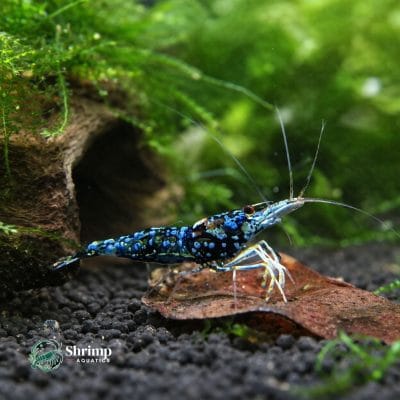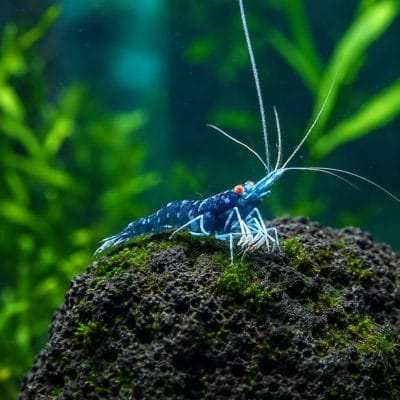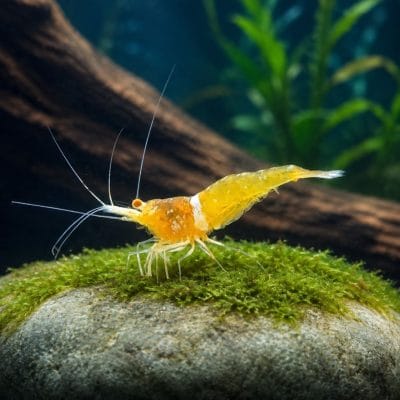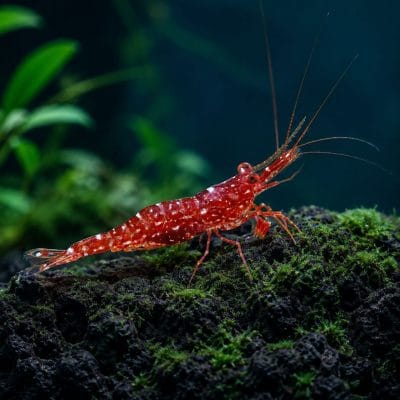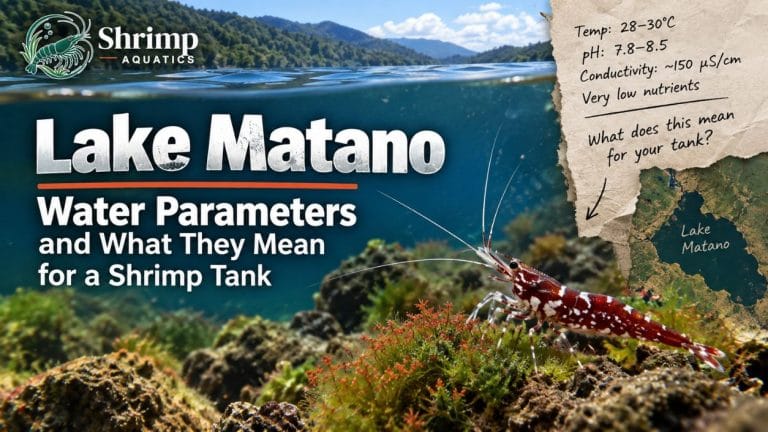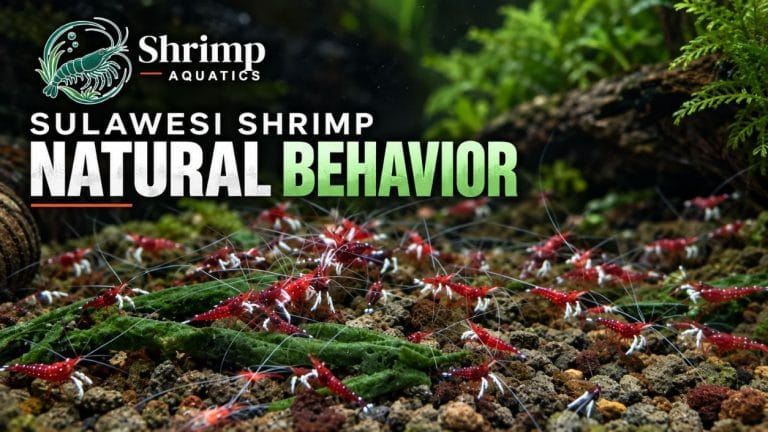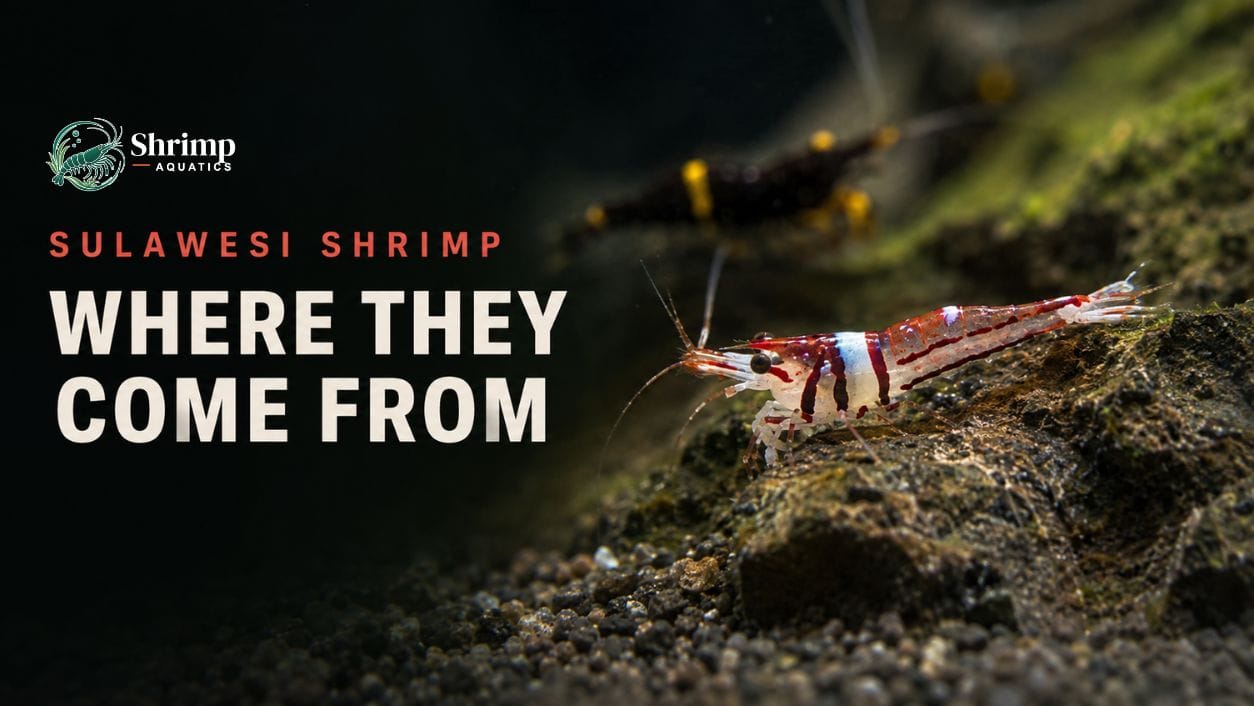
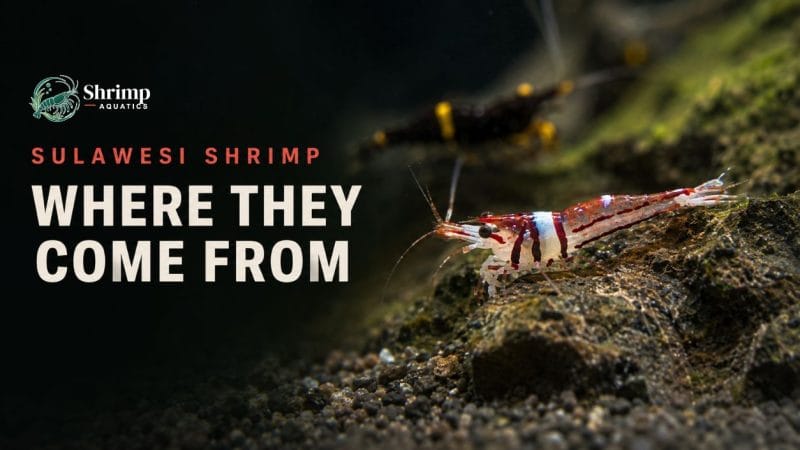
Sulawesi shrimp come from the Indonesian island of Sulawesi, and from two ancient lake systems inside it that have never shared water. One is the Malili system, five connected lakes drained westward by the Larona River into Bone Bay. The other is Lake Poso.1 Nearly every colored line sold under the Sulawesi name traces back to one of those two systems, and usually to a single lake inside one of them.
That’s the short answer. For most keepers it’s also the useful one, because where these shrimp come from decides the water, the difficulty and the one question you should put to a seller. Everything below is about the lake Caridina the hobby calls Sulawesi shrimp. It doesn’t apply to Bee or Crystal Caridina, which share the genus and nothing else.
Each Sulawesi species belongs to one lake, not to the island
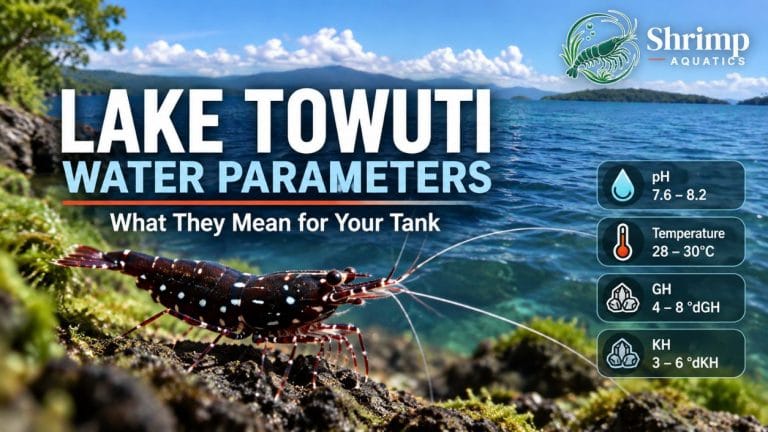
The 2009 revision of the group recognizes 21 endemic Caridina species across the two lake systems, 15 in the Malili lakes and six in Lake Poso.1 Endemic here is meant literally. Caridina dennerli, the cardinal shrimp, lives in Lake Matano and nowhere else. Caridina glaubrechti, sold as the red orchid, is endemic to Lake Towuti, where it was mainly found in the western part of the lake.1 Those endemic species are broken down lake by lake in Sulawesi lake ecosystems.
| Lake or system | What the revision records |
|---|---|
| Malili lake system | Five connected lakes, drained westward by the Larona River into Bone Bay, holding 15 of the 21 endemic species |
| Lake Matano, in the Malili system | Caridina dennerli, the cardinal shrimp, endemic here and widely distributed within the lake |
| Lake Towuti, in the Malili system | Caridina glaubrechti, the red orchid shrimp, endemic here and mainly found in the west of the lake |
| Lake Poso | Completely isolated from the Malili system, holding the other six endemic species |
So what’s the right question to ask about a shrimp on a shop page? Not which island it came from. Which species it is. Two lines can both carry the Sulawesi label and come from basins that have never exchanged a drop of water. In practice that matters less than it sounds, because the lakes are alike enough that the whole group is kept on one set of water values. It still matters when you buy. It matters a lot when you mix lines of Sulawesi shrimp that might crossbreed, because the name on the bag is what tells you whether two shrimp are the same species.
Why Lake Towuti’s own readings aren’t your tank targets
Lake Towuti, at the downstream end of the Malili chain, is the lake in this group with published present-day measurements. Monthly water temperature sits around 79°F (26°C) and moves by roughly a degree Celsius through the year. The pH is only just above neutral, between 7.3 and 7.7. And the water is thin rather than hard, at a conductivity of 210 µS/cm, with a chemistry dominated by magnesium and bicarbonate.2 What that lake water means for the shrimp living in it is the Sulawesi shrimp natural environment.
Read that against the usual advice and something jumps out. The native lake is warm, but it’s barely alkaline and it’s dilute. That’s not the hard alkaline water Sulawesi shrimp are so often described as needing. What we and other keepers hold in a tank is a husbandry range built for a small closed box, not a copy of a deep tropical lake. It sits a little above those field readings. Warm, dilute water that is only mildly alkaline is part of why Sulawesi lakes are unique.
| Temperature | 79-86°F (26-30°C) |
|---|---|
| pH | 7.5-8.5 |
| GH | 4-8 dGH |
| KH | 3-6 dKH |
| TDS | 150-250 ppm |
Why the gap? Volume and time. A lake that size changes slowly, and a shrimp living in it never meets a sudden swing. A small tank follows the room it sits in. So the numbers you aim at are the ones you can hold steady, not the ones a field probe happened to read on one trip. Sit in the middle of that range, keep it boring, and you’re closer to the animal’s real experience than you’d be chasing any single lake measurement. Lakes that change slowly, where a shrimp never meets a sudden swing, define the Sulawesi shrimp natural habitat.
Don’t tune a tank to a field reading
A published lake measurement is a snapshot of one lake on one sampling trip, not a target for your aquarium. Set up to the group range above, then change it slowly or not at all. This is an advanced to expert group, and stability is the part that decides how it goes. Treat a lake reading as a snapshot, not a target, the rule a Sulawesi biotope aquarium is built on.
Sourcing a Sulawesi shrimp now means tank-bred stock
There’s a harder part of the answer, and it’s about whether Sulawesi shrimp are extinct in the wild. Caridina dennerli was assessed on 20 August 2018 as Critically Endangered and flagged as possibly extinct in the wild, with a decreasing population trend.3 The same assessment records it as endemic to Lake Matano in the Malili Lakes system.3
That’s the species behind several of the lines sold as cardinal, blue ghost and yellow ghost. So the question that matters when you order isn’t which lake the species evolved in. It’s which tank the animal in front of you was born in. All livestock sold by Shrimp Aquatics is bred by Shrimp Aquatics and isn’t collected from the wild. So when you pick between our tank-bred Sulawesi shrimp lines, you’re choosing between captive generations, not wild imports.
Before you order from anyone, ask two things: which species the line actually is, and whether it was bred in captivity. A seller who can’t name the species can’t tell you which lake it belongs to either. After everything above, that’s the one piece of provenance worth having.
References
3 Sources
- Radiation of endemic species flocks in ancient lakes: systematic revision of the freshwater shrimp Caridina from the ancient lakes of Sulawesi, Indonesia, with the description of eight new species, Raffles Bulletin of Zoology 57(2): 343-452, Lee Kong Chian Natural History Museum, 2009.
- Hydrological connectivity and mixing of Lake Towuti, Indonesia in response to paleoclimatic changes over the last 60,000 years, Palaeogeography, Palaeoclimatology, Palaeoecology 417: 467-475, 2015, author-hosted PDF.
- Caridina dennerli, IUCN Red List of Threatened Species, assessment page, IUCN, assessed 20 August 2018.
Ready to get started?
Shop our Sulawesi Shrimp collection
27 products available · Live Arrival Guarantee
Featured Sulawesi Shrimp
Sulawesi Orange Eyes Yellow Ghost
Caridina dennerli
Advanced · 79–86°F · pH 7.5–8.5
$120.00View Product