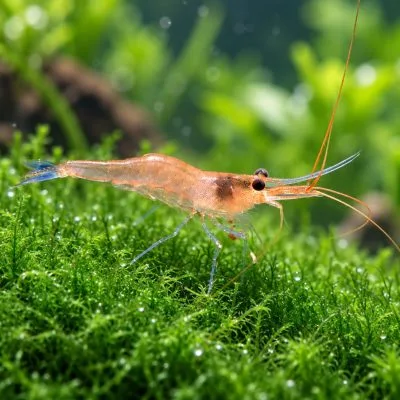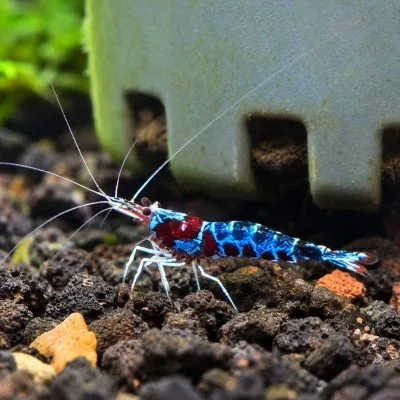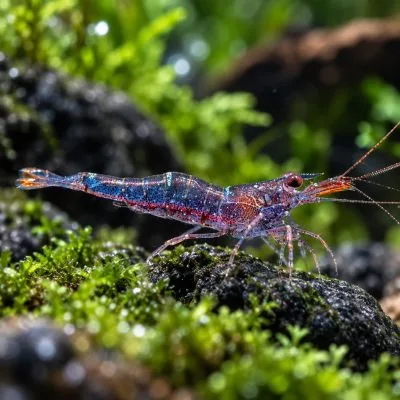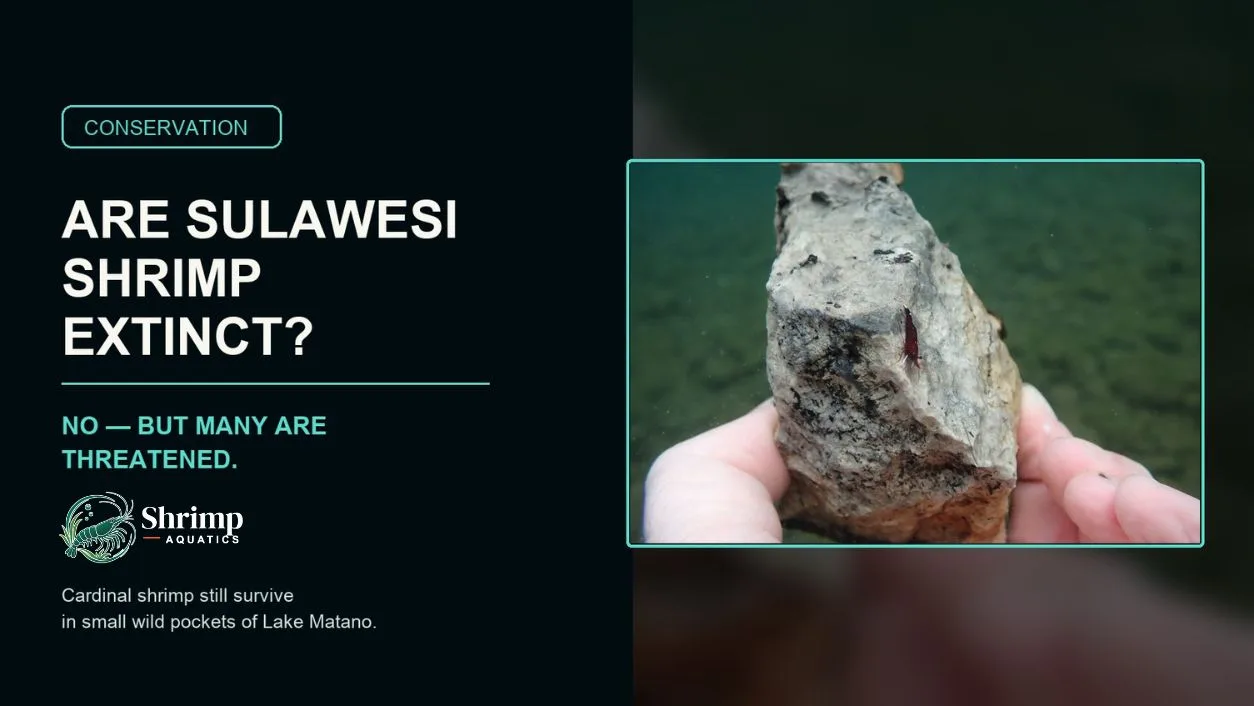
The cardinal shrimp in your tank, or the one you’re about to order, keeps turning up online with “extinct in the wild” next to its name. Sulawesi shrimp aren’t extinct in the wild, and no Caridina species sits in the Extinct or Extinct in the Wild category of the IUCN Red List. The idea comes from one species. The Sulawesi cardinal shrimp is listed as Critically Endangered with the tag Possibly Extinct in the Wild, and that tag gets read as a death certificate. What it actually records is that surveys stopped finding the animal. Field workers have found it in Lake Matano again since that assessment was written.
Why the Caridina dennerli listing reads Possibly Extinct in the Wild
The cardinal shrimp’s Red List entry was assessed on 20 August 2018 by K. von Rintelen and published the same year. The entry for Caridina dennerli gives the category and criteria as Critically Endangered (Possibly Extinct in the Wild) A2e, and records the population trend as decreasing. It gives 2013 as the year the species was last seen, and describes it as endemic to Lake Matano in the Malili lakes of Sulawesi. The previous assessment, in 2013, had placed it at Endangered. So the 2018 entry moved the species one category closer to extinction within five years.1
That’s the whole basis of the extinction story. So what does the tag actually mean? Picture an assessor with no confirmed wild record of a species for five years, who also knows targeted searching has failed. The honest option is to attach the Possibly Extinct in the Wild tag instead of pretending the animal is fine. It’s a statement about what surveyors could find, not a declaration that the last shrimp died.
The assessment’s own reasoning backs that reading. No specimen turned up in 2017 or 2018 at sites where the shrimp had previously been abundant. A decline of more than 90% over ten years is suspected.1 The tag itself rests on the trade. In the assessment’s words, it applies given this species is still extant in the aquarium trade from captive bred individuals.1 In 2018, the species was known to survive in tanks.
The category and the tag aren’t the same thing
Critically Endangered is the category the assessment assigns. Possibly Extinct in the Wild is a flag attached to it. Extinct in the Wild is a separate category, and the cardinal shrimp isn’t in it. A species can carry the flag and still turn up in the lake, which is what happened here.
Has anyone found cardinal shrimp in Lake Matano since the 2017 and 2018 searches?
Yes, a field report published in September 2024 states that the cardinal shrimp isn’t extinct in the wild. After the intensive 2017 and 2018 searches turned up nothing, shrimp were relocated in 2019 at two places in Lake Matano under a thick layer of stones. A 2022 expedition filmed the same conditions, and a 2024 trip found a locality where the shrimp weren’t hiding under rocks at all. The report describes surviving shrimp sheltering at least 30 cm down among stones. That’s exactly why transects across the open, familiar sites came back empty.2
The report comes from Sulawesi Keepers, a nonprofit registered in the Czech Republic. It connects aquarists, scientists, conservation organizations and local communities in work on Indonesian freshwater fauna. Its team includes a zoo curator and a university specialist in freshwater crustaceans.3 That matters for how much weight you give it, because almost nobody else is diving these sites.
A rediscovery isn’t a recovery, though, and it doesn’t rewrite the listing. The Red List entry still shows 20 August 2018 as its assessment date. The category and tag you see quoted everywhere online are still the 2018 ones. What the field reports change is the honest answer to your question: the shrimp are still there, in small pockets, behaving differently than they used to.
Which Sulawesi shrimp species carry a Critically Endangered listing
Searching the Red List for Caridina returns 18 species in the Critically Endangered category and 33 listed Vulnerable.4 It returns none at all in the Extinct or the Extinct in the Wild category. Fourteen of them are Critically Endangered Sulawesi shrimp, all lake endemics from Lake Matano, Lake Towuti, the wider Malili system and Lake Lindu.5
| Species | Red List category | Lake or lake system |
|---|---|---|
| Caridina dennerli | Critically Endangered (Possibly Extinct in the Wild) | Lake Matano |
| Caridina spinata | Critically Endangered | Lake Towuti |
| Caridina woltereckae | Critically Endangered | Lake Towuti |
| Caridina spongicola | Critically Endangered | Lake Towuti |
| Caridina glaubrechti | Critically Endangered | Lake Towuti |
| Caridina profundicola | Critically Endangered | Lake Towuti |
| Caridina loehae | Critically Endangered | Malili lakes |
| Caridina lanceolata | Critically Endangered | Malili lakes |
| Caridina linduensis | Critically Endangered | Lake Lindu |
Not every Sulawesi shrimp sits in that group, though: the same Red List search returns Caridina caerulea, the blue leg shrimp of Lake Poso, and Caridina longidigita as Vulnerable, not Critically Endangered. So the accurate answer depends on which shrimp you’re asking about. A trade name on a stock list rarely tells you which one that is.
Ask where a Critically Endangered shrimp was bred before you order
Ask for the scientific name and where the stock was bred before you start buying endangered Sulawesi shrimp. At Shrimp Aquatics every Sulawesi line is raised in our own breeding tanks, so the tank-bred Sulawesi shrimp we ship were bred here, not collected from the lakes.
What evidence would change the cardinal shrimp’s Red List status
New surveys, taken into a revised assessment, would change it. The 2018 entry itself calls for further surveys to settle whether the shrimp survives in the lake.1 Field teams have gone looking since, and the 2019 relocations, the 2022 footage and the 2024 locality are exactly that kind of evidence.2 No new assessment has taken them in yet, which is why every listing still quotes the 2018 wording.
The evidence could also run the other way. If surveys confirmed the lake population gone, the captive-bred animals the tag already leans on would be all that’s left of the species. Which way it goes depends on the lake. The assessment lists four pressures: fishing and harvesting, dams and water management, invasive species and effluent pollution.1 Invasive fish show up in the field reports too. The 2024 report says flowerhorn cichlids push the survivors deep under stones.2
So the answer to your question is no, with a date on it. It rests on relict groups in one lake, reported by the few people who survey those sites, and on an assessment that hasn’t been revised since 2018.
References
5 Sources
- Caridina dennerli, The IUCN Red List of Threatened Species 2018: e.T198055A109683594, assessment by von Rintelen, K., IUCN, assessed 20 August 2018, viewed 3 September 2026.
- Caridina dennerli is not yet extinct in 2024, Marketa Rejlkova, Sulawesi Keepers, 5 September 2024.
- About us, Sulawesi Keepers, viewed 3 September 2026.
- Search results for Caridina, IUCN Red List of Threatened Species, IUCN, version 2026-1, viewed 3 September 2026.
- 14 Critically Endangered species of Sulawesi shrimps, Sulawesi Keepers, published 16 June 2022, last modified 8 May 2025.
Ready to get started?
Shop our Sulawesi Shrimp collection
27 products available · Live Arrival Guarantee