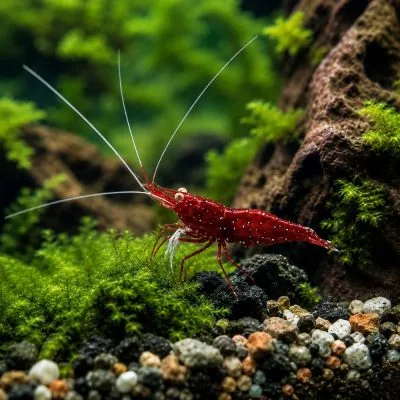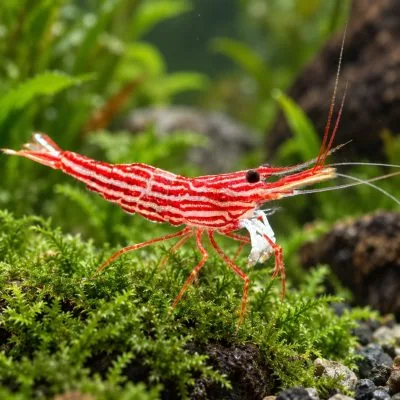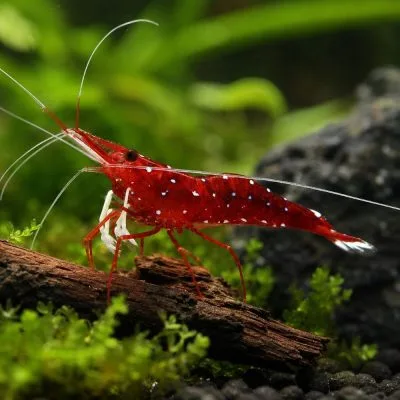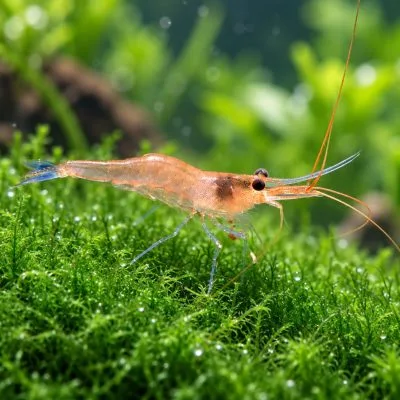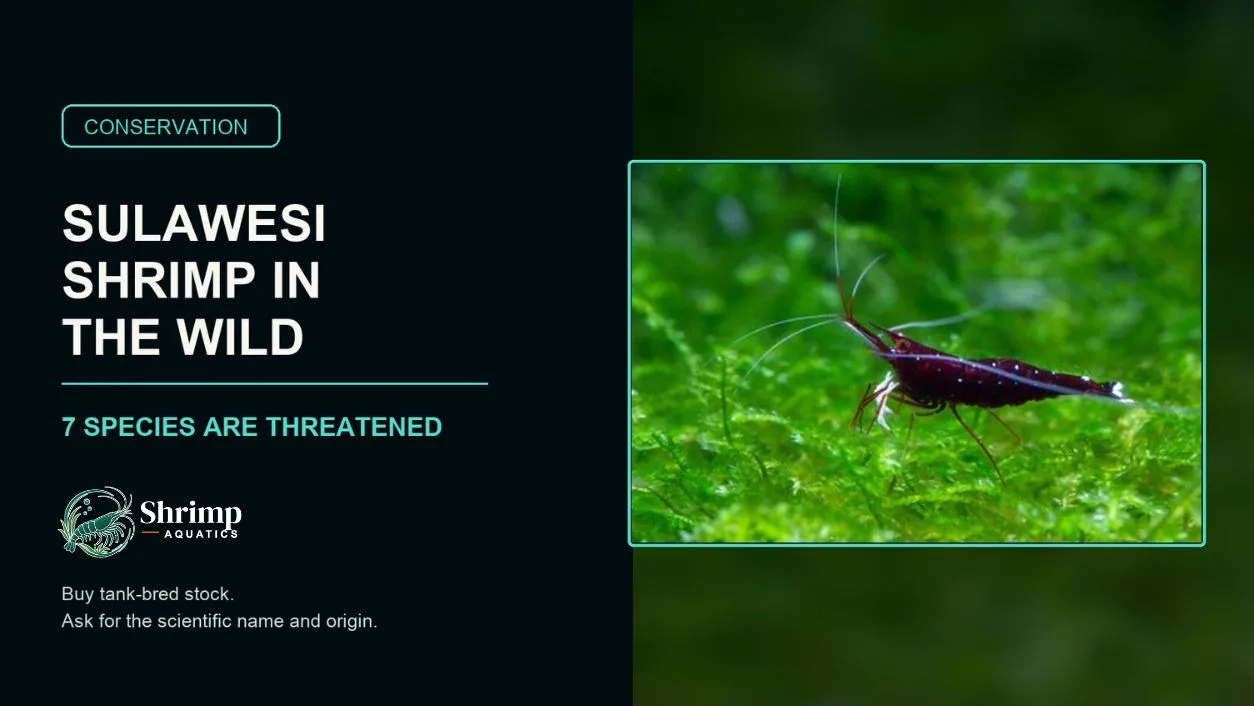
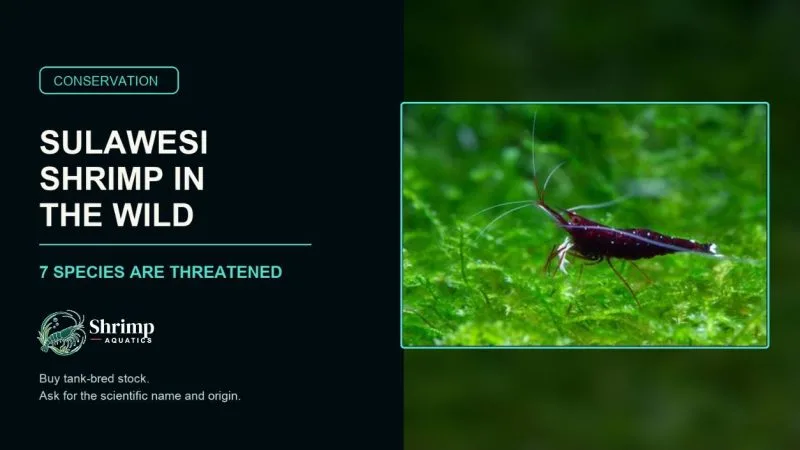
Are Sulawesi shrimp actually endangered? In the wild, yes: every Sulawesi shrimp in the table below carries a current IUCN Red List assessment in a threatened category, five as Critically Endangered and two as Vulnerable. One of the five, the cardinal shrimp, also carries the Possibly Extinct in the Wild tag. That status describes the shrimp in their home lakes, not the shrimp on a shop shelf, and the two have drifted a long way apart.
Which Sulawesi shrimp are listed as threatened in the wild
All seven in the table below are, five as Critically Endangered and two as Vulnerable. The Red List assesses species, not color lines, so the table covers the Sulawesi lake Caridina you’re most likely to meet in the hobby, grouped by the lake each one belongs to. Each row gives the category, the criteria code and the date of the assessment. The English name in the first column is the one printed on the assessment, which isn’t always the name a shop uses.
| Species and name on the assessment | Where it lives | IUCN Red List status | Assessed |
|---|---|---|---|
| Caridina woltereckae, Harlequin Shrimp | Lake Towuti, rocky substrate | Critically Endangered, criteria A3e1 | 6 December 2018, published 2019 |
| Caridina spinata, Yellow Goldflake | Lake Towuti, rocky substrate | Critically Endangered, criteria A3e2 | 6 December 2018, published 2019 |
| Caridina spongicola, no English name on the assessment | Lake Towuti | Critically Endangered, criteria A3cde and B1ab(iii,v)+2ab(iii,v)3 | 19 February 2018, published 2018 |
| Caridina striata, Red Line Shrimp | Lakes Mahalona and Towuti | Critically Endangered, criteria A3e4 | 6 December 2018, published 2019 |
| Caridina longidigita, no English name on the assessment | Lake Poso | Vulnerable, criteria D2, annotated Needs updating5 | 27 June 2012, published 2013 |
| Caridina caerulea, no English name on the assessment | Lake Poso | Vulnerable, criteria D2, annotated Needs updating6 | 16 November 2011, published 2013 |
| Caridina dennerli, Sulawesi Cardinal Shrimp or White Glove Shrimp | Lake Matano | Critically Endangered (Possibly Extinct in the Wild), criteria A2e7 | 20 August 2018, published 2018 |
Two columns matter more than the category names. The first is the criteria code. Every Critically Endangered row carries an e. On the cardinal shrimp assessment that letter is written out as the effects of introduced taxa, hybridization, pathogens, pollutants, competitors or parasites.7 These aren’t species that were collected out of existence. They’re species whose lakes changed around them.
The second is the date. The two Lake Poso listings were made in 2011 and 2012, and both carry the annotation shown in the table. So Vulnerable there is the last word from more than a decade ago, not a current all-clear. The table isn’t the whole fauna either. It covers the species most often kept, so a Sulawesi shrimp missing from it hasn’t been cleared. It simply isn’t listed here.
What Possibly Extinct in the Wild means for the cardinal shrimp
It means surveys in 2017 and 2018 found no cardinal shrimp at sites where it had been abundant, while captive-bred animals were still in the trade.7 The cardinal shrimp is one of the endemic Lake Matano shrimp species, and the tag flags a possible loss, not a confirmed one. Whether Sulawesi shrimp are extinct in the wild turns on the further surveys the assessment calls for.7
What is pushing Sulawesi shrimp out of their lakes
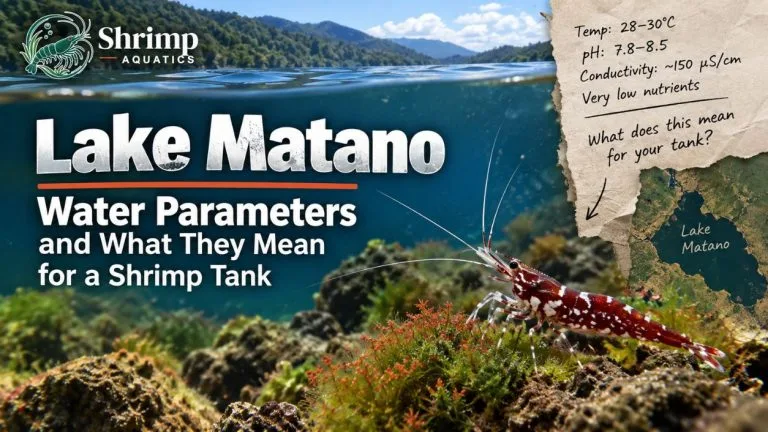
Changes to the lakes themselves, and Lake Matano is the best-documented case. The cardinal shrimp assessment names four pressures there.7 Nickel mining is one. Hydro-electric installations on the lake outlet change outflow and the natural rise and fall of water level. Siltation comes from erosion around a growing human population. And invasive species threaten the shrimp through direct predation.7
Surveys in 2017 and 2018 also found thick algal cover on rocks, submerged roots and soft substrates at all six sites visited, spreading well beyond the patchy cover seen before. What caused it? The assessors record that as an open question: either the invasive Flowerhorn Cichlid removing native grazers, or water level regulation.7
Matano isn’t the only lake changing. A 2022 study of Lake Poso, home of the two Vulnerable species in the table, lists records of 17 non-native fish species there, and introduced fish now outnumber the natives.8 The authors call introductions a substantial and increasing threat to the lake’s fauna. They also report that the flowerhorn spread rapidly through the Malili lakes, and that no other introduced species has colonized Sulawesi’s lakes as successfully.8
That’s also why none of these listings is likely to improve soon. The Matano assessment records the causes of the past decline as understood, but not ceased and not reversible, and states that no conservation plans are currently in place for the species.7 Nothing on that list is a problem you can fix from a tank, which makes it worth being precise about the part the hobby does own.
Does buying Sulawesi shrimp put pressure on the wild population?
Not much, according to the cardinal shrimp assessment, which is unusually direct about the trade. It records the species as available in the aquarium trade. It states that the rest was still wild caught, while adding that current levels of harvesting aren’t thought to have a considerable impact.7 Give both halves equal weight. Collection was real and was still the larger share of supply when the assessment was made, but it wasn’t the thing that emptied Lake Matano.
So does a single order doom or save a species? Neither. What it does decide is whether your money asks for another animal to be taken out of a lake, and you can settle that before you check out. The Sulawesi shrimp lines sold here are bred by Shrimp Aquatics rather than collected from the wild. That’s the one link in the chain a buyer can actually ask about and expect a straight answer on.
Check the species name and origin before you order a Sulawesi shrimp
Look for the scientific name first, because it’s the only part of a listing the Red List can find. Trade names travel badly. A color line name is a seller’s label, not a species name, so a listing that says only White Sock or Oiran tells you the look and nothing you can look up.
- Read the scientific name on the listing, then search that exact name on the IUCN Red List to see its category and assessment date.
- Ask whether the stock was bred in tanks or collected, and ask how long the seller has held the line. A week in a shop tells you nothing about origin.
- Ask what water the colony is kept in now, so you can match it before the shrimp arrive.
- Check your own country’s rules on importing live aquatic animals before ordering from abroad, and contact the store if anything about the destination is unclear.
- Don’t treat a Critically Endangered species as the animal you learn on. An unfinished tank is a poor place to test a species this demanding.
- Don’t treat the purchase itself as conservation. Tank-bred stock keeps your order from adding collection pressure, and that’s all it does.
What a listed Sulawesi shrimp asks of you as a keeper
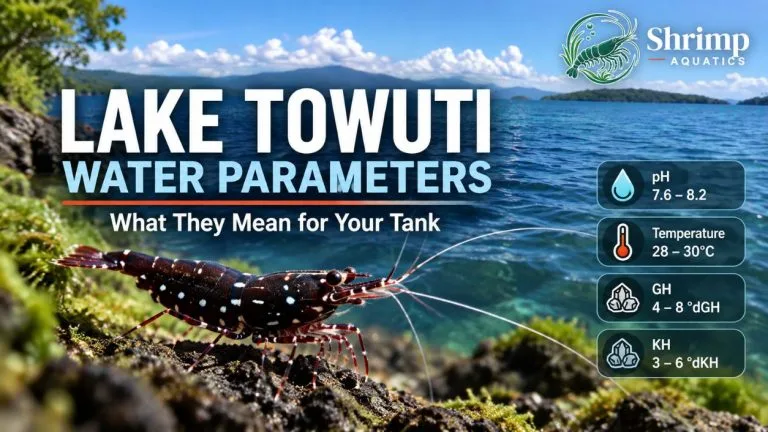
Steady water, the same as any Sulawesi shrimp, because a Red List category changes nothing about the water. It stays 79-86°F (26-30°C), pH 7.5-8.5, GH 4-8 dGH, KH 3-6 dKH and TDS 150-250 ppm, with nitrate kept under 10 ppm, in a mature Sulawesi tank with established grazing surfaces. You’ll spend more effort holding Sulawesi shrimp care parameters steady than reaching them in the first place. And these remain advanced to expert animals, whatever their conservation status.
What the listing does change is what happens after the colony settles. A group that reproduces turns one purchase into shrimp you can pass on to other keepers, instead of a colony that quietly needs replacing. Getting there is mostly a setup question, and our guide to breeding Sulawesi shrimp has the sequence. That’s the realistic contribution a home aquarium makes here. It keeps your own demand off a wild population that has little left to give. It doesn’t repair a lake, and we’d rather say so plainly.
Before you order
If your tank isn’t yet cycled, stable and grazed in, wait. A species that may already be gone from its lake is the wrong animal to learn stability on, and nothing about a rare label makes an immature tank safer for it.
References
8 Sources
- Caridina woltereckae, Red List assessment page, IUCN Red List of Threatened Species, assessed 6 December 2018, published 2019, viewed 2 September 2026.
- Caridina spinata, Red List assessment page, IUCN Red List of Threatened Species, assessed 6 December 2018, published 2019, viewed 2 September 2026.
- Caridina spongicola, Red List assessment page, IUCN Red List of Threatened Species, assessed 19 February 2018, published 2018, viewed 2 September 2026.
- Caridina striata, Red List assessment page, IUCN Red List of Threatened Species, assessed 6 December 2018, published 2019, viewed 2 September 2026.
- Caridina longidigita, Red List assessment page, IUCN Red List of Threatened Species, assessed 27 June 2012, published 2013, viewed 2 September 2026.
- Caridina caerulea, Red List assessment page, IUCN Red List of Threatened Species, assessed 16 November 2011, published 2013, viewed 2 September 2026.
- Caridina dennerli, Red List assessment page, IUCN Red List of Threatened Species, assessed 20 August 2018, published 2018, viewed 2 September 2026.
- More non-native fish species than natives, and an invasion of Malawi cichlids, in ancient Lake Poso, Sulawesi, Indonesia, Herder and colleagues, Aquatic Invasions 17(1): 72-91, 2022.
Ready to get started?
Shop our Sulawesi Shrimp collection
27 products available · Live Arrival Guarantee
Featured Sulawesi Shrimp
Sulawesi Orange Eyes White Sock
Caridina dennerli
Advanced · 79-86°F · pH 7.5-8.5
From $19.99View Product