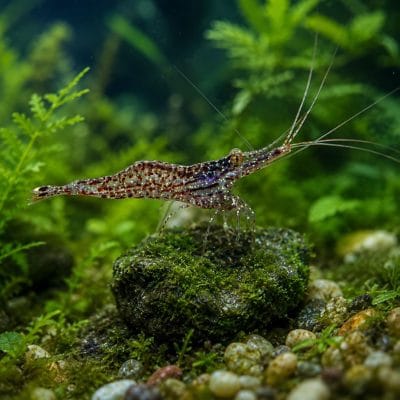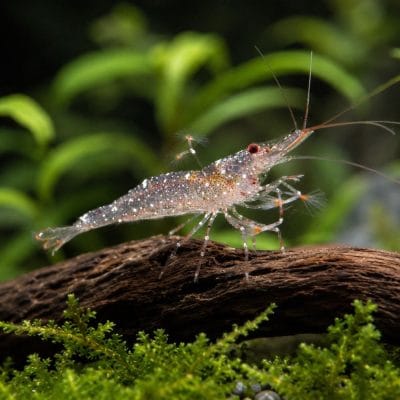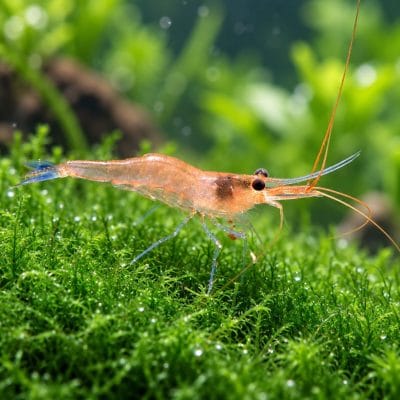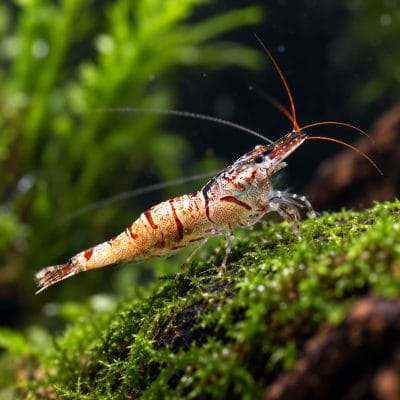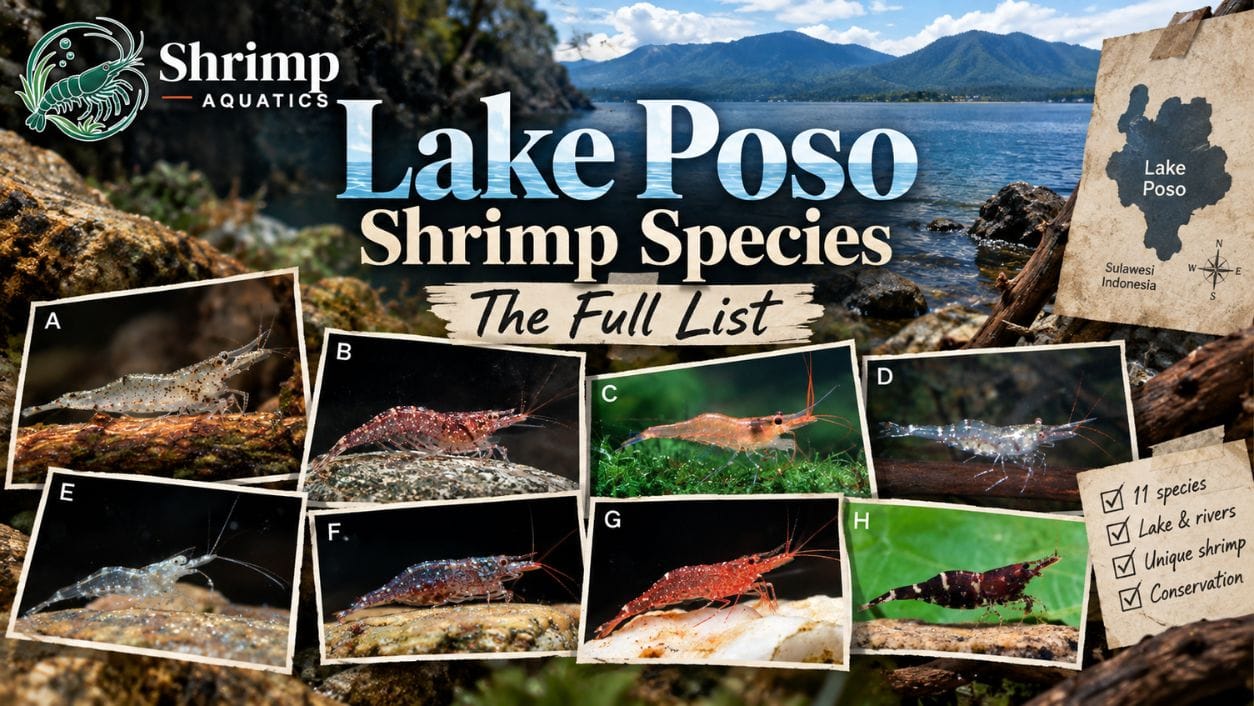
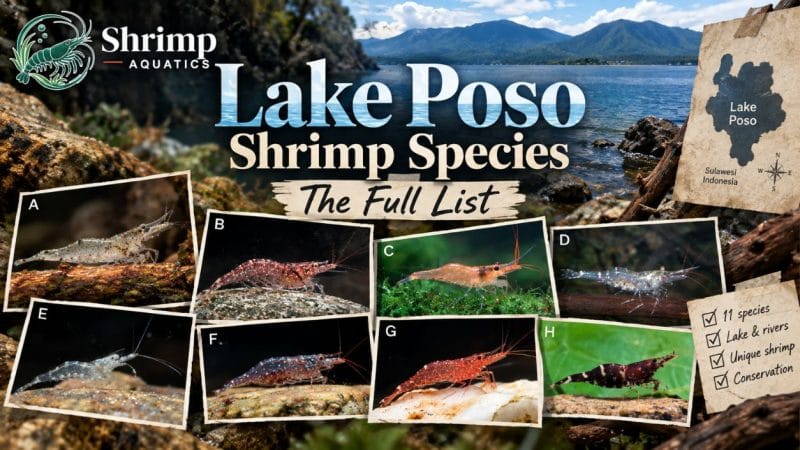
Lake Poso in central Sulawesi holds eleven shrimp species of the genus Caridina that live nowhere else. Nine live in the lake itself. Two live only in the streams that feed it, and five of the nine were described as recently as 2021.1 Here’s the full list, what separates one from the next, and which of them you can realistically keep.
The nine Caridina species that live in Lake Poso itself
All nine are endemic to the lake and absent from the rivers around it.1 Two carry names more than a century old. Two more were described in 2007 and 2009, and five arrived in the 2021 revision that more than doubled the known lake fauna.1 If half the table below is new to you, that’s why.
| Species | Coloration in life | Recorded habitat |
|---|---|---|
| Caridina caerulea von Rintelen & Cai, 2009 | Bluish legs and rostrum, with two conspicuous blue patches on the tail fan. | Lake only. |
| Caridina ensifera Schenkel, 1902 | Yellowish to reddish legs and rostrum, with two conspicuous red patches on the tail fan. | Lake only. |
| Caridina fusca Klotz, Wowor & K. von Rintelen, 2021 | Dark reddish or brown, with white bands across the first, third, fifth and sixth abdominal segments. | Under rocks in deep water, more than 5 m down. |
| Caridina lilianae Klotz, Wowor & K. von Rintelen, 2021 | Transparent whitish, with no pattern. | Fine sand and soft sediment in shallow water, 1.5-2.5 m. |
| Caridina longidigita Cai & Wowor, 2007 | No distinguishing live coloration is given in the revision. | Lake only. |
| Caridina marlenae Klotz, Wowor & K. von Rintelen, 2021 | Bright reddish, with large white dots. | Lake only. |
| Caridina mayamareenae Klotz, Wowor & K. von Rintelen, 2021 | Females whitish, often with broad red stripes and blotches. Males mostly transparent with white blotches. | Hiding in empty snail shells. |
| Caridina poso Klotz, Wowor & K. von Rintelen, 2021 | A clearly visible red and white stripe pattern. | Lake only. |
| Caridina sarasinorum Schenkel, 1902 | Dark reddish or brown, with well defined white transverse bands. | Leaf litter deposits, wood and macrophytes. |
Two things in that table are worth a pause. The first is how recent half of it is. Before 2021 the lake was credited with six shrimp species in total, and the revision that year restated the flock as eleven.1 The second is that these descriptions rest on museum material, not on tanks. Nobody has published how any of the nine behave, feed or breed in an aquarium. The color and habitat notes above are the honest limit of what’s known.
The two Poso shrimp that never leave the rivers
Caridina acutirostris Schenkel, 1902 and Caridina schenkeli von Rintelen & Cai, 2009 are the odd pair. Both are endemic to the Lake Poso catchment, and both are exclusively riverine.1 They live in the inflowing streams rather than in the lake. Neither carries the color that makes the lake species collectible, since both are described as transparently yellowish or brownish.1
Why does that matter to you? Because “from Lake Poso” on a label is not one habitat. A stream shrimp and a shrimp taken from open lake water have been living in different places, and neither has an aquarium track record you can lean on. If you want the geography behind that split, start with where Sulawesi shrimp come from before you decide what to stock.
How to tell the lake species apart by where they sit
Eleven species in one lake sounds crowded until you look at where each one was collected. C. mayamareenae lives inside the empty shells of dead snails, and it is the first atyid shrimp known to be shaped for that.1 C. lilianae sits out on fine sand and silt in shallow bays at 1.5-2.5 m, where a rock grazer would have nothing to hold.1 C. fusca goes the other way and stays under rocks below 5 m.1 C. sarasinorum works leaf litter, wood and plants.1 They’re not competing for the same square meter.
For you that’s a hardscape note more than an identification key. Rock, wood, sand and a litter layer are all somebody’s home in this lake, and a bare tank with one flat stone gives most of these shrimp nothing to work. It won’t help you name a shrimp from a photo on a shop page either, and we wouldn’t try. Trade names in this group are invented, reused and sometimes plain wrong. The count of how many types of Sulawesi shrimp there are depends entirely on whether you count species or labels.
Which Lake Poso species actually reach the aquarium trade
Most of the eleven have never been traded at all. The five described in 2021 were named from field collections in the lake.1 There’s no keeping history behind any of them. What you’ll actually find offered is a short list, and two of those species sit in our own Sulawesi shrimp lines. Caridina poso is the one we sell as the Sulawesi White Orchid, and Caridina longidigita is sold as the Sulawesi Pink Boxer. Both are bred by Shrimp Aquatics rather than collected from the wild.
Expect a slow colony whichever one you buy. Females of this flock carry few, large eggs, a brood size of roughly 5-36 at about 0.7-1.1 mm each, and the developed eggs show eyespots.1 That points to young that hatch as miniature shrimp, with no drifting larval stage to feed. Good news in one sense. It also means ten adults don’t become two hundred in a season, and a colony that loses its breeding females takes a long time to come back.
Before you order
These are advanced to expert shrimp, and the species name on the listing is the least of your problems. A tank that isn’t mature enough to feed a grazer will empty out whichever Poso species goes into it. If your readings aren’t already sitting where the table below says, wait.
The water every Poso species needs, whichever one you buy
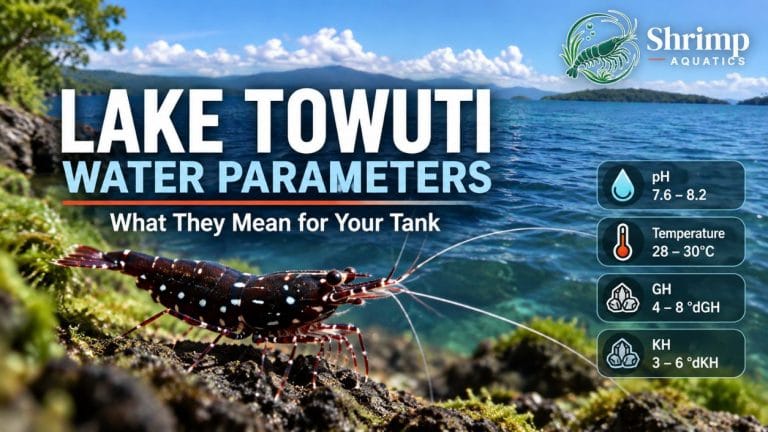
No published evidence says one Lake Poso species wants different water from another, and no aquarium trial has compared them. So we keep every Sulawesi lake species we sell to the same numbers. Steadiness matters more than the exact reading you pick inside them.
| Difficulty | Advanced to expert. |
|---|---|
| Temperature | 79-86°F (26-30°C). |
| pH | 7.5-8.5. |
| GH | 4-8 dGH. |
| KH | 3-6 dKH. |
| TDS | 150-250 ppm. |
| Nitrate | Under 10 ppm as a cautious target. |
| Substrate | Inert substrate and hardscape, never an acidic soil. |
| Tank | Mature and stable, with established grazing surfaces. |
Hitting those numbers once is easy. Holding Sulawesi shrimp care parameters steady for months is the part that decides whether the colony lasts. Top-offs, water changes and a heater that drifts are where most first attempts come apart.
What is still unknown about Lake Poso shrimp
Quite a lot, and it’s better to say so. There’s no lifespan, no growth curve and no feeding study for any of these species. The five described in 2021 came without a Red List assessment. The authors who described them recommended treating the new species as facing the same threats as the species already described from the lake, and assigning them the same conservation category and criterion.1 That’s a recommendation, not a listing.
It still shapes a buying decision. Lake Poso is one small, oligotrophic lake, more than a million years old and 450 m deep at most, and every species above lives only there.1 Wild-collected stock from a lake like that is a poor thing to put in a tank you’re still learning on. Several traded Sulawesi species already carry serious Red List categories, which is worth checking against the list of endangered Sulawesi shrimp before you order anything from this region.
Even the map of the lake keeps moving. Shrimp from Lake Poso were long reported down to about 20 m. In 2025, bamboo traps set on the bottom brought up C. caerulea from 74 m and C. longidigita from about 60 m.2 A flock that is still being described this decade isn’t a group with settled husbandry, and that’s the honest frame for any listing you see.
References
2 Sources
- Lake Poso’s shrimp fauna revisited: the description of five new species of the genus Caridina (Crustacea, Decapoda, Atyidae) more than doubles the number of endemic lacustrine species, Klotz W, von Rintelen T, Wowor D, Lukhaup C, von Rintelen K, ZooKeys 1009: 81-122, 2021.
- First report on deep-water Caridina spp from Lake Poso, Sulawesi, Dwiyanto D, Bandjolu KP, Wowor D, Annawaty, von Rintelen T, Farajallah A, Perwitasari D, BIO Web of Conferences 185: 02002, 2025.
Ready to get started?
Shop our Sulawesi Shrimp collection
27 products available · Live Arrival Guarantee