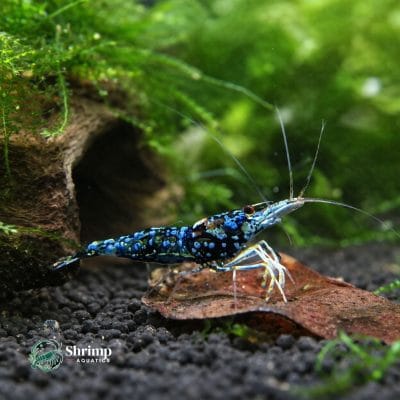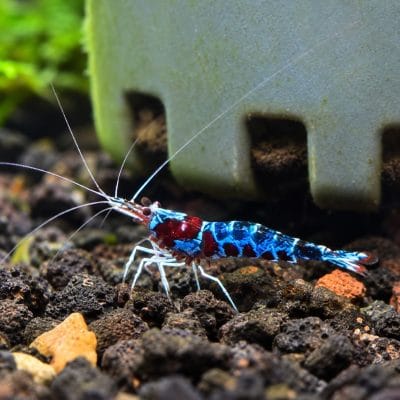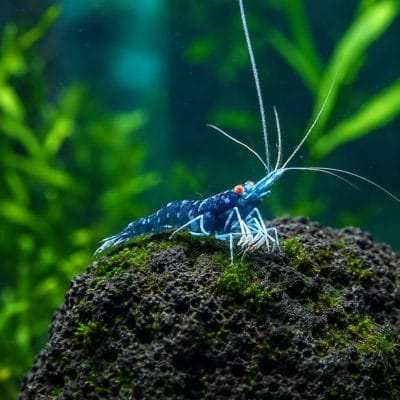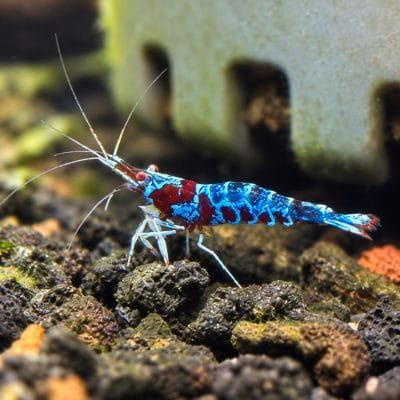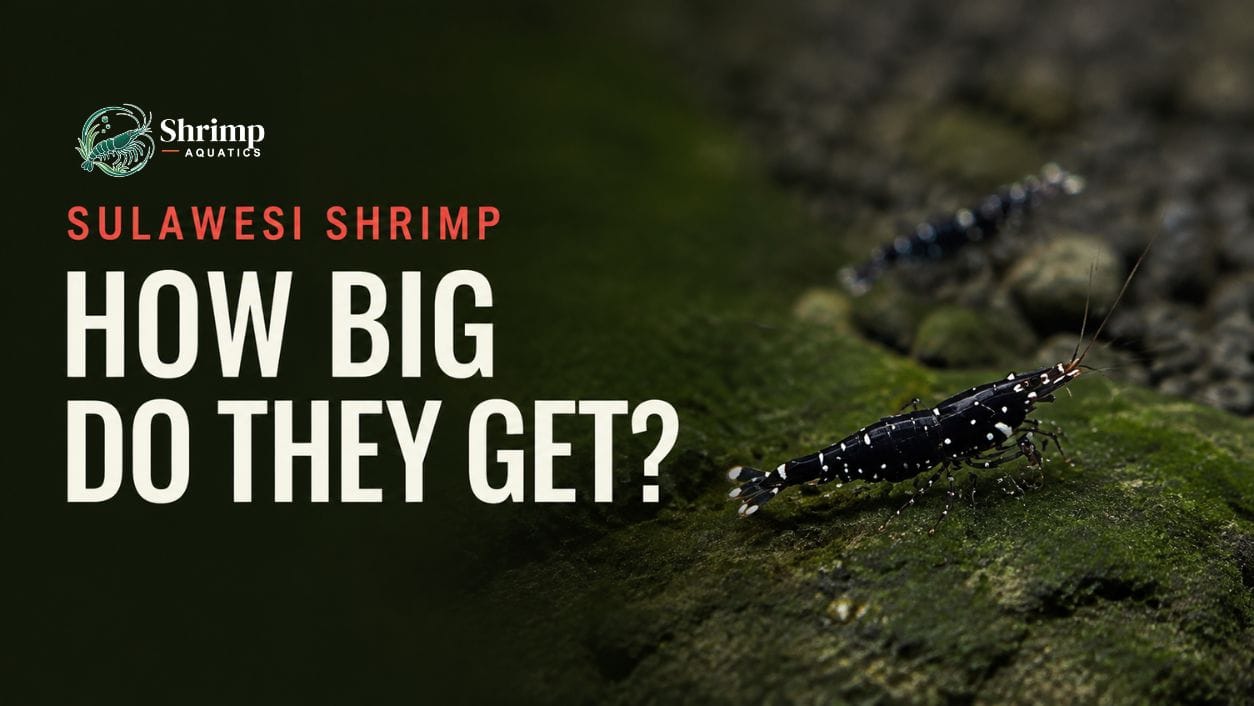
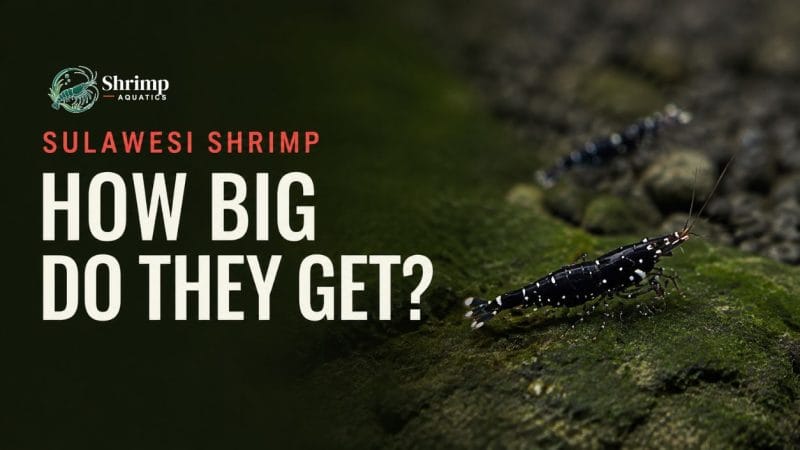
Sulawesi shrimp are dwarf shrimp, and the honest answer is that nobody has published a measured adult maximum for them. The 2009 revision that describes most of the group measures carapace length, the shield over the head and thorax, rather than whole-body length: 1.5-3.4 mm for the Cardinal shrimp (Caridina dennerli), 2.3-3.4 mm for Caridina glaubrechti and 2.3-3.8 mm for Caridina holthuisi.1 The only published whole-body figure for any Sulawesi species comes from a 2025 rearing trial, in which the shrimp entered at an average total length of 1.445 cm, about 0.57 in.2 Everything else in circulation, including the up to one inch line on most care sheets, is hobby convention rather than measurement.
Carapace length and total length aren’t the same measurement
Two sets of numbers circulate for this group and they don’t describe the same thing. Taxonomic descriptions give carapace length, the hard shield covering the head and thorax, because it’s a repeatable landmark on a preserved specimen. Care sheets give total length, rostrum tip to tail, which shifts with how straight the animal is holding itself. A shrimp with a 3 mm carapace isn’t a 3 mm shrimp, and there’s no published conversion for this group that would let you turn one figure into the other.
That’s the whole reason the research numbers look impossibly small beside the aquarium numbers. The table keeps the two measurement types apart instead of blending them into one range.
| Species | Where the material came from | What was measured | Published figure | Specimens |
|---|---|---|---|---|
| Cardinal shrimp (Caridina dennerli) | Lake Matano | Carapace length | 1.5-3.4 mm | n=53 |
| Caridina glaubrechti | Lake Towuti | Carapace length | 2.3-3.4 mm | n=11 |
| Caridina holthuisi | Malili lake system | Carapace length | 2.3-3.8 mm | n=29 |
| Cardinal shrimp (Caridina dennerli) | 2025 rearing trial, not wild material | Total length at the start of the trial | 1.445 cm average, standard deviation 0.212 cm | trial average |
Read down that table and the useful conclusion isn’t a number but a boundary. Carapace length is measured and small. Total length is barely measured at all, and the single figure that exists describes shrimp at the start of a growth trial, not finished adults.
Does the Sulawesi species you buy change how big it gets?
Slightly, and less than the trade names suggest. Across the three species with a published carapace measurement the spread runs from 1.5 mm at the small end of the Cardinal shrimp to 3.8 mm at the large end of Caridina holthuisi, and the ranges overlap heavily through the middle. On an animal you’re already watching through glass, that’s a difference of a millimeter or two, not the difference between a small shrimp and a large one.
The lines sold under hobby names have no published measurement of their own. They’re selected and named for color and pattern, and the sizes attached to them in the hobby don’t trace back to a measured population. The trade names on our Sulawesi shrimp lines describe color, not size, so choose on color and on whether your water and tank maturity suit the group.
Why your Sulawesi shrimp look the same size month after month
Because at this size a month of growth is a fraction of a millimeter. In the 2025 trial the best treatment, commercial pellets with plant cover, produced an average total-length gain of 0.119 cm over 30 days, while the weakest, a bacterial starter with stone shelter, produced 0.013 cm over 37 days.2 Just over a millimeter in a month is the good case. A tenth of a millimeter is the poor one.
Growth also doesn’t arrive smoothly. Crustaceans have to cast the exoskeleton in order to grow at all,3 so size changes in steps at each molt and not at all in between. The steps also come further apart as the animal gets larger. In a laboratory study of another caridean shrimp, held at a constant temperature below the Sulawesi range, the molt cycle averaged 8.7 days with a standard deviation of 1.4 days across 30 animals, and larger individuals molted more slowly than smaller ones, with a correlation of 0.93 and a p value below 0.0001.4 Applied to a Sulawesi tank, that means visible growth slows twice over: each molt adds less, and Sulawesi shrimp molt less often.
So the practical check is a comparison, not a calendar. Set a shrimp you’ve kept for months against a recent arrival of the same line. When the older animal is no longer visibly gaining on the newer one from molt to molt, it’s at or near its adult size, and waiting longer won’t change that.
Will a warmer tank or heavier feeding grow them any bigger?
Neither is a size lever, and the temperature route can work against you. Laboratory and field work suggests that temperature affects both the interval between molts and the growth added at each molt in many crustaceans. In lesser blue crabs reared at elevated temperature both decreased, producing smaller sizes at each instar, and the authors state that if the pattern continued through the pubertal molt, elevated temperature would result in smaller size at maturity.5 That’s a crab, not a Caridina, so read it as the direction the mechanism points and not as a measured Sulawesi outcome. It’s still the opposite of what a keeper reaching for the heater expects.
Heat isn’t a growth setting
Hold the group range of 79-86°F (26-30°C) and move it slowly if you move it at all. Faster molting isn’t the same thing as a larger shrimp, and a warm tank punishes every other mistake faster.
Feeding is the other common lever. The trial above does show that feed type changed both measured growth and survival, which is worth knowing. What it doesn’t show is that more food in a stocked aquarium produces larger adults: those were bare rearing containers on a 30-37 day clock, with none of the established grazing surface a Sulawesi tank runs on.
At Shrimp Aquatics, mature algae and biofilm do most of the feeding in our Sulawesi systems. We normally offer prepared food only about once a week and remove leftovers, both because many of the shrimp in these systems show limited interest in it and because food that sits in warm water adds organic waste and can raise ammonia, nitrite and nitrate as it breaks down.
The decision that follows is about the tank, not the feeding dish. Grazing surface, a mature system and steady chemistry are what a shrimp turns into new shell at each molt. Extra portions mostly turn into waste.
What the measured sizes mean when you choose Sulawesi tankmates
Every published measurement for this group sits well under an inch, and nothing in the record points to an adult size that would put these shrimp out of a fish’s reach. Most shrimp keepers plan on shrimplets being eaten and adults being left alone. Here the adults stay close enough to shrimplet size that the usual reasoning doesn’t carry, and fish described as generally shrimp-safe can still take shrimplets and sometimes adults. Sulawesi shrimp kept alone in a single-species tank with no fish is the setup these measurements argue for.
Two smaller things follow from the same measurement. Sight lines matter more than volume, because at this scale a shrimp behind a rock is simply gone, and a tank you can see into is worth more than a larger one you can’t. And a new arrival that looks small will keep looking small for weeks. That’s the growth rate doing what it does, not a sign that anything is wrong with the animal.
References
5 Sources
- Radiation of endemic species flocks in ancient lakes: systematic revision of the freshwater shrimp Caridina from the ancient lakes of Sulawesi, Indonesia, with the description of eight new species, Raffles Bulletin of Zoology 57(2): 343-452, Lee Kong Chian Natural History Museum, National University of Singapore, 2009.
- Effect of Using Different Shelter and Feed Types on Growth and Survival Rate of Sulawesi Endemic Ornamental Shrimps (Caridina dennerli), journal PDF, Jurnal Ilmiah PLATAX 13(1): 191-204, Universitas Sam Ratulangi, 2025.
- Farming freshwater prawns. A manual for the culture of the giant river prawn (Macrobrachium rosenbergii), biology chapter, FAO Fisheries Technical Paper 428, Food and Agriculture Organization of the United Nations.
- Moult cycle and setal development of the Atlantic ditch shrimp Palaemon varians Leach, 1814, Journal of Crustacean Biology 44(4), Oxford University Press, December 2024.
- Elevated temperature induces a decrease in intermolt period and growth per molt in the lesser blue crab Callinectes similis Williams, 1966, abstract, Journal of Crustacean Biology 39(1), Oxford University Press, January 2019.
Ready to get started?
Shop our Sulawesi Shrimp collection
27 products available · Live Arrival Guarantee