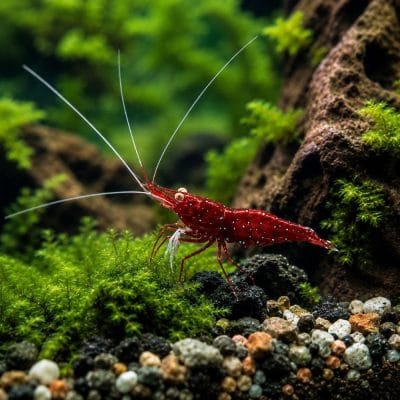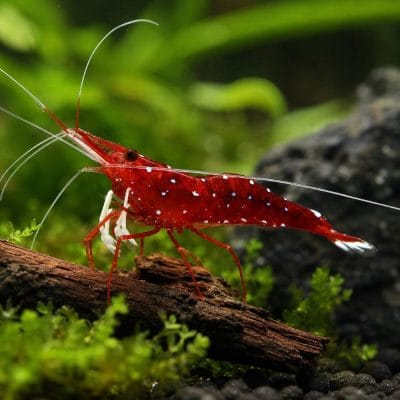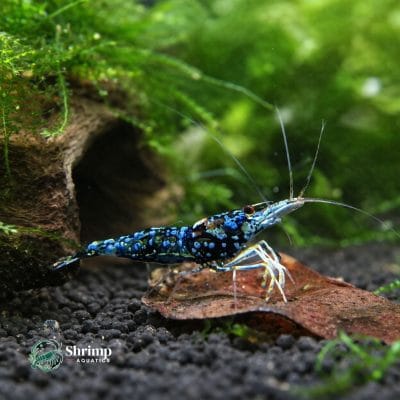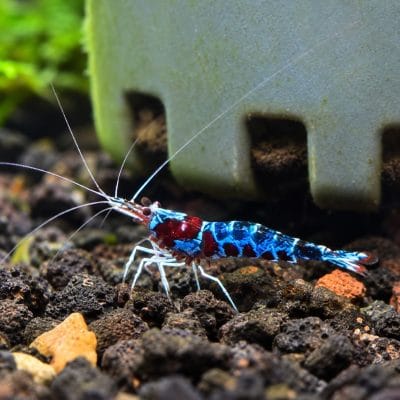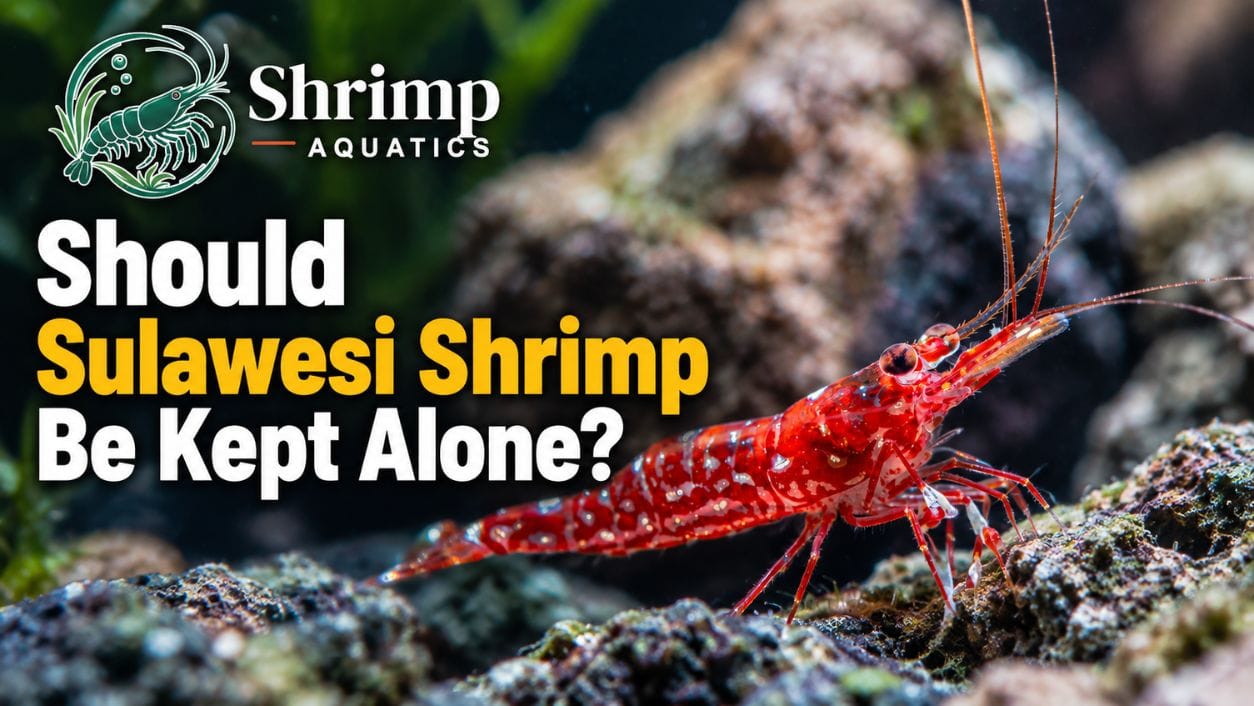
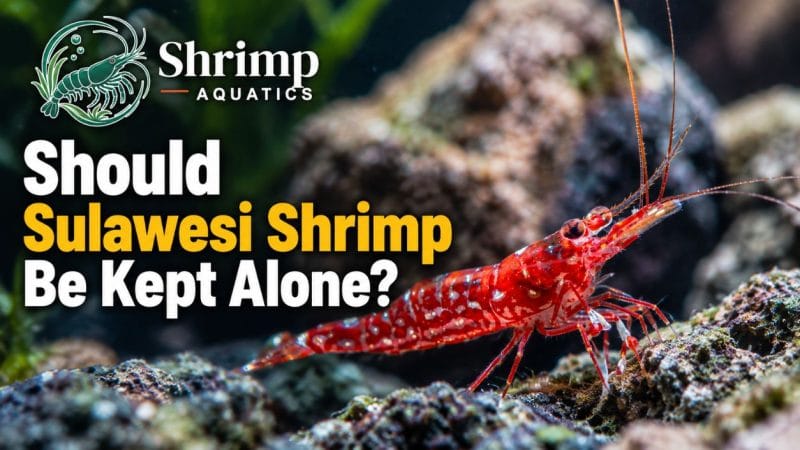
Yes. Keep Sulawesi shrimp in a tank of their own. The only tankmate we would add on purpose is a Sulawesi rabbit snail, and even that is a waste decision rather than a chemistry one. But “alone” is the wrong word for what you’re actually doing, because a single shrimp in a big rock pile is a mistake of its own.
A species-only tank still needs a group of Sulawesi shrimp
When people ask whether these shrimp should be kept alone, they usually mean two different things at once. One is whether the tank should hold anything else. The other is whether a shrimp is fine by itself. The answers point in opposite directions, so it’s worth splitting them before anything else.
Buy a group, not a pair, and not one. These shrimp are shy by nature, and a handful of them spread through a rock pile will give you a tank that looks empty most of the day. A group also gives you both sexes without having to sex anything, which matters because the numbers coming out the other end are small. Published counts from wild-caught females put Caridina dennerli at 8 to 14 eggs on the pleopods at the time of collection, and across the Sulawesi lake species in that revision the per-brood counts ran from 8 to 80 depending on the species.1 Those are wild measurements from small samples, not what your tank will do, but they set the scale: a Sulawesi colony rebuilds itself slowly, a dozen or so eggs at a time.
That slow rebuild is the thread running through the rest of this page. Almost every question below about the best tankmates for Sulawesi shrimp comes down to the same arithmetic. Whatever you add either takes from that small cohort, or takes from the water quality the cohort depends on.
Why one extra animal costs more in a Sulawesi tank
Here’s the part that surprises people coming from a cherry shrimp tank. The animals aren’t more fragile in some mysterious way. The water they’re kept in is simply less forgiving of waste, and that’s a chemistry problem, not a husbandry opinion.
| Temperature | 79-86°F (26-30°C) |
|---|---|
| pH | 7.5-8.5 |
| GH | 4-8 dGH |
| KH | 3-6 dKH |
| TDS | 150-250 ppm |
| Nitrate | Under 10 ppm as a cautious target |
Look at the top two rows together. Total ammonia in water splits between the ammonium ion and un-ionized ammonia, and the un-ionized form is the one that drives ammonia toxicity in aquatic animals. That split moves with the water: the ratio of un-ionized ammonia to ammonium ion in fresh water rises about tenfold for each single pH unit, and about twofold for each 10 degree Celsius rise in temperature between 0 and 30 degrees Celsius.2 Warm and alkaline is exactly the corner of that relationship a Sulawesi tank sits in. The same ammonia reading that a cherry tank shrugs off at 72°F and pH 7.0 is not the same event here.
Warmth costs you on the other side too. Cold water holds more dissolved oxygen than warm water, so oxygen concentration falls as temperature rises.3 Your tank is already running at the warm end before you add a single extra animal breathing in it.
So when you put a fish in this tank, you’re not just adding a mouth near the shrimplets. You’re adding daily feeding, and waste, to water that punishes waste harder than any other shrimp setup in the hobby, while the colony replacing itself does so a dozen eggs at a time. That’s the trade every tankmate has to be worth.
Rabbit snails are the one tankmate we would add
Sulawesi rabbit snails, Tylomelania spp., come from the same two ancient lake systems as the shrimp: Lake Poso and the Malili lakes, which include Danau Matano, Mahalona and Towuti.4 That’s why they’re the exception. You don’t have to compromise on temperature or pH to keep them, because they evolved in the same water.
They also don’t take over a tank the way a pond snail does. Tylomelania brood their embryos inside the pallial oviduct, which is modified into a uterine brood pouch, and release juveniles that are already shelled; in some species those juveniles are almost 2 cm long at hatching, the largest known of any viviparous gastropod.5 One big baby at a time is a very different stocking problem from a clutch of pond snail eggs on the glass.
The catch is what that size means for your filter. A rabbit snail is a large animal that eats a lot and passes a lot, and the waste it produces lands in the water we just described. So treat a snail as a bioload decision: add one, leave it a few weeks, and watch your nitrate and TDS before you think about a second.
Check the readings, not the tank size
A snail per so many liters is a rule of thumb, and it’s a poor one in a tank this sensitive. Let your own nitrate and TDS readings decide whether the tank has room for another one, and go back to your test kit before you add anything at all. The practical limits, and what to watch after a snail goes in, sit on our guide to rabbit snails in a Sulawesi tank.
One more thing worth knowing before you order. Tylomelania gemmifera, one of the rabbit snails sold internationally in the pet trade, was assessed as Endangered on the IUCN Red List in 2018, with a decreasing population trend.6 It’s a good reason to ask a seller whether the snails are tank-bred rather than pulled from the lakes.
What happens when two Sulawesi species share one tank
This is the mix people most want to build, and we understand why. A rock pile carrying White Sock, Blue Leg and an orchid line looks like the display tank in your head. The problem is that you can’t supervise it. Breeding happens deep in the rock, out of sight, and you find out which line met which only when the shrimplets are big enough to look at.
If your tank already holds two species and you want to know how seriously to take the risk before you separate them, how far the evidence goes is worked through for Sulawesi shrimp crossbreeding.
Why does it matter more here than in a cherry tank? Because of what these lines are. Caridina dennerli was assessed by the IUCN in 2018 as Critically Endangered, tagged Possibly Extinct in the Wild, under criterion A2e, with international trade recorded as a use of the species.7 The tank-bred lines in the hobby are, in a real sense, most of what’s left of it. Our advice is one species per tank, and if you want three lines, run three tanks.
Can another dwarf shrimp share Sulawesi water?
Neocaridina can physically live in it, and that’s the honest starting point. Neocaridina are kept at 65-78°F (18-26°C), so a Sulawesi tank sits above the band they’re usually held in. They also graze the same surfaces your Sulawesi shrimp graze, and a colony left to breed means steadily more mouths on those surfaces. That’s why we’d keep a small managed group at most, and never a breeding colony, in a tank built for Sulawesi shrimp.
In some of our Sulawesi systems at Shrimp Aquatics, we keep about five Neocaridina and have observed the Sulawesi shrimp remain more visible, or retreat less, when people approach the tank. That’s the one reason we’d consider it at all, and it still needs suitable temperature overlap, enough grazing surface and stocking capacity for both groups.
If you’re weighing it up seriously, the numbers on both sides, and what warm water asks of a cherry colony, are set out for Sulawesi shrimp with Neocaridina.
Bee and Crystal Caridina are a flat no, and it isn’t close. Bee shrimp are kept at 60-72°F (15.5-22°C) in soft acidic water, which shares nothing with the table above except a sliver of GH. A setting halfway between the two belongs to neither animal, and we think you’d be failing both. Splitting an existing mixed tank, and matching each half to your room, is worked through for Sulawesi shrimp and bee shrimp.
What a fish costs a Sulawesi colony
Run any candidate fish past two questions. Does its documented water fall inside the band in the table above, and will it leave shrimplets alone? Most nano fish get recommended for shrimp tanks in general, not for warm alkaline ones, so look up the documented range for that exact species before you trust a shrimp-safe label. And treat shrimp-safe as meaning lower risk to adults, never safe for shrimplets.
There’s also the quiet cost. Feeding a fish means feeding the tank daily, and we’ve already been through what daily waste does in warm alkaline water. If you have a species in mind, we’ve run the usual candidates through both tests for fish tankmates for Sulawesi shrimp. Our own answer is that the shrimp are better off without one.
Stop hitchhikers before they reach your Sulawesi tank
You can decide to keep a species-only tank and still end up with tankmates. Plants from an unknown system can carry pests, pesticide residue or treatments that are risky to shrimp, and bags of livestock arrive with their own water and whatever is in it. The usual rule is to treat anything wet going into the tank as a tankmate you didn’t choose.
So rinse and quarantine new plants somewhere else first, keep new hardscape out until it’s been cleaned, and never pour shipping water into the aquarium. None of that is exciting, and it’s a lot easier than deciding later whether a tank you spent months maturing has to come apart.
What we would put in a Sulawesi tank, and in what order
If you’re setting one up now, here’s the order we’d work in. It’s deliberately slow, and the slowness is the point: every step below buys stability before the next one adds a load to it.
- Mature the tank properly first, with grazing surfaces visible on the rock, not just a cycled filter.
- Add one species of tank-bred Sulawesi shrimp as a group, and leave them alone apart from gentle water changes.
- Give the colony months, not weeks, and watch whether your nitrate and TDS hold steady between changes.
- Only then consider a single rabbit snail, and only if those readings never moved.
- Leave fish, Neocaridina and bee shrimp out of it, and run a second tank if you want them.
That’s a duller answer than a stocking list, and it’s the one that keeps a colony alive. The reward for a species-only tank isn’t a quieter conscience. It’s a rock pile with shrimp visibly grazing on it, which is the thing you wanted when you started reading.
References
7 Sources
- Radiation of endemic species flocks in ancient lakes: systematic revision of the freshwater shrimp Caridina from the ancient lakes of Sulawesi, Indonesia, with the description of eight new species, Raffles Bulletin of Zoology 57(2), Lee Kong Chian Natural History Museum, National University of Singapore, 2009.
- Aquatic Life Ambient Water Quality Criteria for Ammonia, Freshwater, U.S. Environmental Protection Agency, Office of Water, April 2013.
- Dissolved Oxygen and Water, U.S. Geological Survey, Water Science School, updated August 24, 2026.
- The species flocks of lacustrine gastropods: Tylomelania on Sulawesi as models in speciation and adaptive radiation, abstract, Hydrobiologia 615, Springer Nature, 2008.
- Anatomy of an adaptive radiation: a unique reproductive strategy in the endemic freshwater gastropod Tylomelania (Cerithioidea: Pachychilidae) on Sulawesi, Indonesia, and its biogeographical implications, abstract, Biological Journal of the Linnean Society 85(4), Oxford University Press, 2005.
- Tylomelania gemmifera, The IUCN Red List of Threatened Species, assessed 9 July 2018, published 2019.
- Caridina dennerli, The IUCN Red List of Threatened Species, assessed 20 August 2018, published 2018.
Ready to get started?
Shop our Sulawesi Shrimp collection
27 products available · Live Arrival Guarantee
Featured Sulawesi Shrimp
Sulawesi Orange Eyes White Sock
Caridina dennerli
Advanced · 79–86°F · pH 7.5–8.5
From $19.99View Product