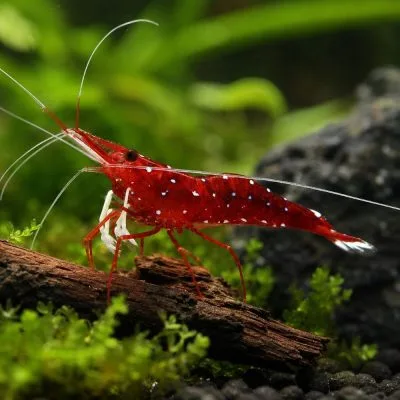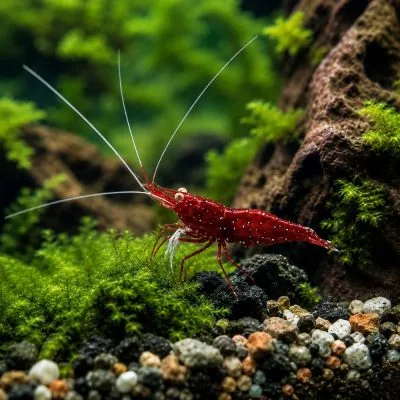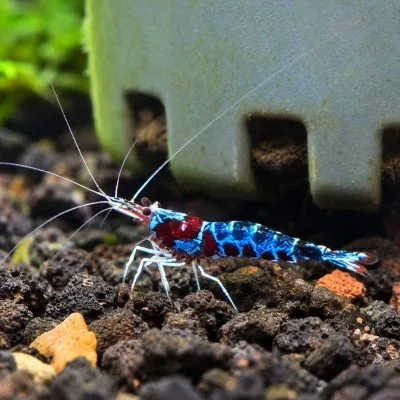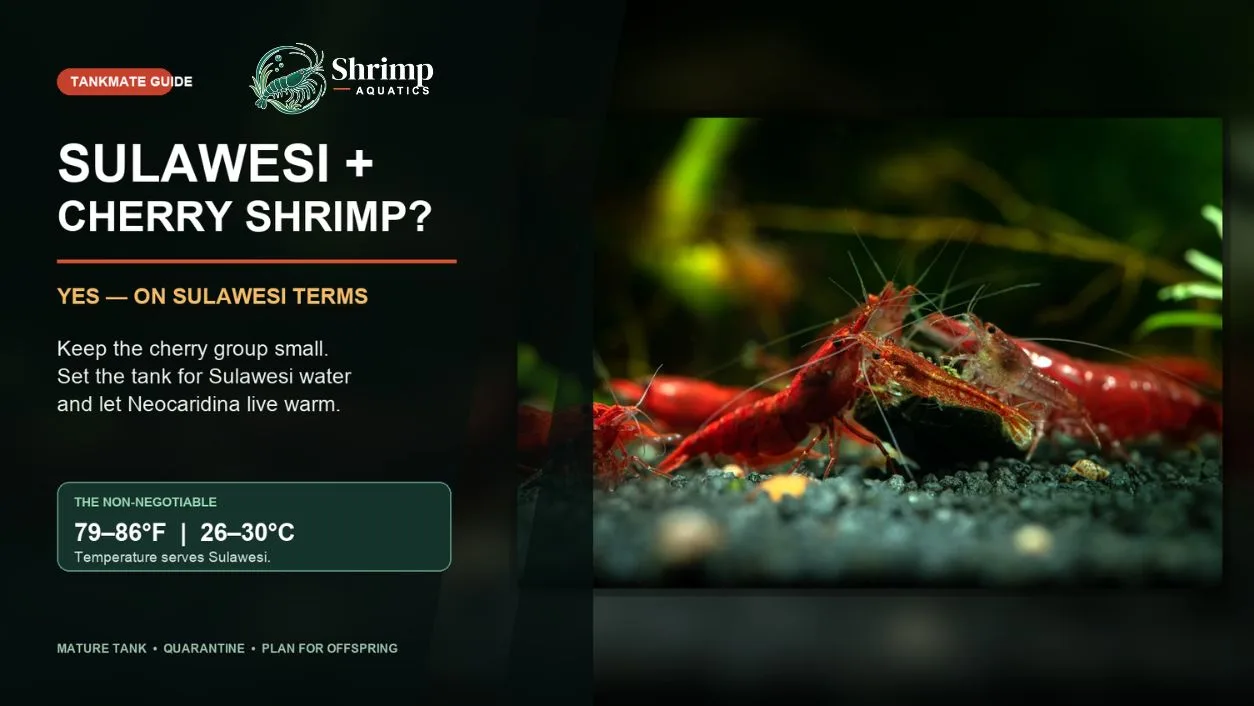
Will cherry shrimp hold up in the heat of a Sulawesi tank, or are you setting them up to fail? Sulawesi shrimp and Neocaridina can live in the same tank, but only on Sulawesi terms, with the water set for the Sulawesi shrimp. The Neocaridina stay a small group you manage, not a second breeding colony. The ranges we publish for the two groups overlap on pH, GH, KH and TDS, and temperature is closer than it looks. Neocaridina are usually kept at 65-78°F (18-26°C), but they grow and breed at 82°F (28°C),1 and in some of our Sulawesi tanks they live and breed at up to 86°F (30°C). What this decision really turns on is the waste and grazing pressure a cherry colony adds.
Sulawesi water suits Neocaridina, and temperature is the tight part
Sulawesi water fits the Neocaridina range on pH, GH, KH and TDS, and temperature is the one value where the ranges don’t overlap. Sulawesi shrimp are the lake-dwelling Caridina species from Sulawesi, sold as Cardinal, Sulawesi White Sock, Sulawesi Blue Leg Poso and similar lines. Neocaridina are the cherry shrimp group, usually Neocaridina davidi in the hobby. Put the two ranges side by side and the conflict is narrower than most tankmate advice suggests.
| Parameter | Sulawesi shrimp | Neocaridina | Overlap |
|---|---|---|---|
| Difficulty | Advanced to expert | Often beginner-friendly in a stable, suitable tank | Not comparable; the tank runs at the harder standard |
| Temperature | 79-86°F (26-30°C) | 65-78°F (18-26°C) | None |
| pH | 7.5-8.5 | 6.5-8.0 | 7.5-8.0 |
| GH | 4-8 dGH | 6-12 dGH | 6-8 |
| KH | 3-6 dKH | 2-8 dKH | 3-6, the whole Sulawesi band |
| TDS | 150-250 ppm | 150-300 ppm | 150-250, the whole Sulawesi band |
Four of the five water values leave room for both groups. A Sulawesi tank held at pH 7.5, in the hardness band the two share and inside the Sulawesi TDS range, sits inside the published Neocaridina range on all four. Only the alkaline end of the pH range goes past what we publish for cherry shrimp. Nothing obliges you to run a Sulawesi tank at the top of it.
Temperature is closer than the two bands make it look. The Sulawesi floor of 79°F (26°C) sits just above 78°F (26°C), the top of the range Neocaridina are usually kept in. But that range isn’t their limit. In the culture trial below, cherry shrimp grew and bred best at 82°F (28°C), so 79-82°F (26-28°C) is a published fit for both groups. From 82°F to 86°F (28-30°C), the support is our own tanks.
Don’t split the difference
Cooling the tank toward the middle of the Neocaridina band takes the Sulawesi shrimp out of theirs. They’re the group with the smaller margin and the advanced to expert care level. If the two species share a tank, the thermostat serves the Sulawesi shrimp and the Neocaridina live warm.
What 79-86°F does to a Neocaridina colony
Cherry shrimp grew and bred best at the bottom of the Sulawesi range in a culture trial.1 The temperature that hurt Neocaridina breeding there, 90°F (32°C), sits above the top of it. You’ll often hear that Sulawesi heat burns cherry shrimp out within months. The measured picture is more specific. The 90-day trial reared the cherry shrimp as Neocaridina heteropoda heteropoda at 75°F (24°C), 82°F (28°C) and a rise to 90°F (32°C). Survival tended to be highest at 82°F (28°C) and lowest at the warmest treatment, while body weight ended up similar across all three by day 90. The largest share of females carrying eggs came at 82°F (28°C), and the authors name that temperature the optimum for culture. At the warmest treatment, every female that matured and mated lost her eggs, which the authors read as high temperature stressing ovarian maturation. Actual fecundity across the incubation experiment averaged 24.2 juveniles hatched per female.1
Lay that over a real Sulawesi tank. The bottom of the range, 79-82°F (26-28°C), lands right on the trial’s best temperature, and the Neocaridina failure point at 90°F (32°C) sits above the top of it. The trial has no data between 82°F and 90°F, so for that stretch we go on our own tanks. At Shrimp Aquatics, we keep a small group of Neocaridina in some of our Sulawesi tanks, in the same warm, alkaline, mineral-rich water as our rabbit snails, and they live and breed there. Those tanks never run above 86°F (30°C), and neither should yours.
The trial’s optimum also sits above the 65-78°F (18-26°C) band we publish for Neocaridina. We keep that band as their usual range, because it’s a general care range for the whole group, not a survival limit. We read the trial as showing they still grow and breed at 82°F (28°C). If you want cherry shrimp to breed properly, though, give them their own tank at their own temperature.
Why extra shrimp waste is riskier in a warm alkaline tank
Extra waste is riskier here because ammonia gets more toxic in warm, alkaline water. Ammonia in water splits between the ammonium ion and the un-ionized form, and the un-ionized form is the one that drives toxicity. The ratio of un-ionized ammonia to ammonium in fresh water goes up 10-fold for each rise of a single pH unit. It roughly doubles for each temperature rise of 10°C across the range the criteria cover.2 A Sulawesi tank sits high on both scales at once. Warm water also holds less dissolved oxygen than cold water,3 so the tank is working with a smaller oxygen reserve at the same time.
That doesn’t make a Sulawesi tank fragile. It means your margin for extra bioload is smaller than in a cool, near-neutral cherry tank. A feeding or filtration habit a Neocaridina tank forgives is less forgiving here. Add shrimp only to a mature Sulawesi tank, fully cycled and reading 0 ammonia and 0 nitrite. Keep prepared food restrained and take out what isn’t eaten. Keep nitrate under 10 ppm in a Sulawesi tank, and treat that as a target.
How many Neocaridina a Sulawesi tank can carry
A Sulawesi tank can carry a handful of Neocaridina, and the reason people want any at all is visibility.
At Shrimp Aquatics, in some of our Sulawesi systems we keep about five Neocaridina. We’ve observed the Sulawesi shrimp remain more visible, or retreat less, when people approach the tank. This setup still requires a hardy group living above its usual range, enough grazing surface and stocking capacity for both groups.
Five is a working number, and the reason to keep the group near that size is food. Both groups eat the same thing: mature aufwuchs, biofilm and algae grazed off rock and glass. In a Sulawesi tank that film is the main food supply, not a top-up. A cherry group that starts breeding takes that grazing base at a different pace from the shrimp the tank was built for. Wild Caridina dennerli females carrying eggs had 8-14 eggs each in the taxonomic revision of the Sulawesi flock.4 Compare that with the mean of 24.2 juveniles per female in the cherry shrimp trial above. Neither figure is a colony growth rate, and one comes from a wild sample of seven females. They still describe two groups that don’t restock at the same speed on the same surface.
So the honest version of this setup is a handful of Neocaridina you’re prepared to take out again, not a mixed colony. Count them against what the tank can carry before you add another group of tank-bred Sulawesi shrimp, and check the following before anything goes in.
- The tank has held Sulawesi values steadily for weeks, with 0 ammonia and 0 nitrite.
- There’s more grazing surface than the Sulawesi colony is currently using.
- You have a second container ready and you’re genuinely willing to net out cherry offspring.
- Don’t add cherry shrimp while the Sulawesi shrimp are newly arrived, hiding or not yet feeding.
Will Neocaridina and Sulawesi shrimp interbreed?
Not as far as we could find, and the crossing that is documented happens between Sulawesi species. Sulawesi Keepers, a noncommercial Sulawesi conservation organization whose keepers photographed the pairs and the offspring, reports that Sulawesi shrimp can crossbreed in aquaria at a low chance. It names Caridina spinata with Caridina dennerli as the pairing behind the animal the hobby sells as Yellow Socks. It advises keeping species in separate tanks where line purity matters. That’s keeper documentation with photographs, not a controlled study or a genetic test.5
For the Neocaridina question itself, no published description of a hybrid between the two genera turned up while this guide was researched. Treat that as an absence of evidence. What’s worth retiring is the reason usually given for it. A mitogenomic phylogeny of caridean shrimp places Neocaridina as a subgroup within Caridina and finds the genus paraphyletic, with the authors calling for substantial taxonomic revision of the family.6 So the genus label is a poor guide to how closely two shrimp are related, and a shaky thing to hang a stocking decision on.
In practice, adding Neocaridina isn’t what puts a Sulawesi line at risk. Keeping several Sulawesi species in one tank is.
What a new group of Neocaridina can bring into the tank
New cherry shrimp bring whatever lived on them in their old tank, so quarantine them first. Scutariella japonica, a temnocephalid epibiont linked to the ornamental trade, has been recorded on introduced Neocaridina davidi in European waters. It most likely came in by accident with ornamental shrimp. It spends most of its life in the host’s gills, where it lays its eggs, and adults are often visible around the rostrum. In that survey, 5.83% of 120 shrimp examined carried scutariellids. The authors note that in most cases it doesn’t affect host health as long as numbers stay small.7
What no study we found measures is how a Sulawesi shrimp responds to the same passenger, and that’s the reason to quarantine. Hold new cherry shrimp in a separate cycled container for a few weeks. Look closely at the rostrum and the gill area under good light before they move, and watch how they behave and molt while they’re still separate. Don’t dose a Sulawesi tank on suspicion. Copper and several common fish medications can harm shrimp and snails, and safety depends on the exact formulation and concentration. If you see something on an animal that you can’t identify, ask a specialist or an aquatic veterinarian before anything goes into the water.
When a small Neocaridina group earns its place in a Sulawesi tank
Add a handful once the Sulawesi colony is settled
Your Sulawesi shrimp are established but stay hidden, and the tank is mature with grazing surface and capacity to spare. You keep the cherry group to a handful, and you have somewhere to move offspring the moment they appear.
Skip them while the tank is young or the line matters
You’re building numbers of a species that was hard to source, or breeding a line you want to keep clean. The tank is young or unstable, the temperature sits near the top of the Sulawesi range, or you have no plan for cherry offspring beyond hoping they stay few.
The question behind this one usually isn’t about compatibility at all. A new Sulawesi colony spends its first weeks in the rockwork, and the tank looks empty. A handful of Neocaridina is a reasonable answer to that, and it’s a decision you can undo with a net. A breeding cherry colony in the same tank is a different proposal, and it costs the animals you set the tank up for.
References
7 Sources
- Effect of Temperature on Biochemical Composition, Growth and Reproduction of the Ornamental Red Cherry Shrimp Neocaridina heteropoda heteropoda (Decapoda, Caridea), PLOS ONE, March 13, 2015.
- Aquatic Life Ambient Water Quality Criteria for Ammonia, Freshwater, U.S. Environmental Protection Agency, Office of Water, April 2013.
- Dissolved Oxygen and Water, U.S. Geological Survey, Water Science School.
- Radiation of endemic species flocks in ancient lakes: systematic revision of the freshwater shrimp Caridina from the ancient lakes of Sulawesi, Indonesia, with the description of eight new species, Raffles Bulletin of Zoology 57(2), 2009.
- Crossbreeding Sulawesi shrimps, Sulawesi Keepers, March 25, 2025.
- Integrative Taxonomy Reveals New Insights into the Species Validity of the Neocaridina davidi-N. denticulata-N. heteropoda Complex and Mitogenomic Phylogeny of Caridean Shrimps, Current Issues in Molecular Biology, PubMed Central copy, 2024.
- First report of Scutariella japonica (Matjasic, 1990), a temnocephalid epibiont from South-East Asia, found on introduced ornamental freshwater shrimp in European waters, Knowledge and Management of Aquatic Ecosystems 422, 19, 2021.
Ready to get started?
Shop our Sulawesi Shrimp collection
27 products available · Live Arrival Guarantee
Featured Sulawesi Shrimp
Sulawesi Orange Eyes White Sock
Caridina dennerli
Advanced · 79-86°F · pH 7.5-8.5
From $19.99View Product