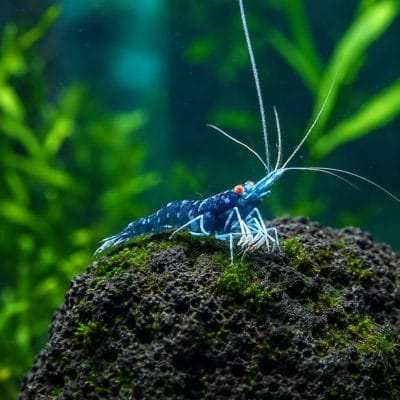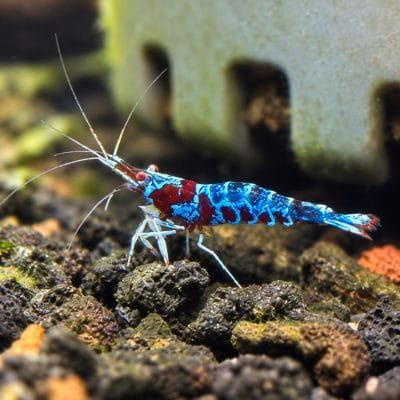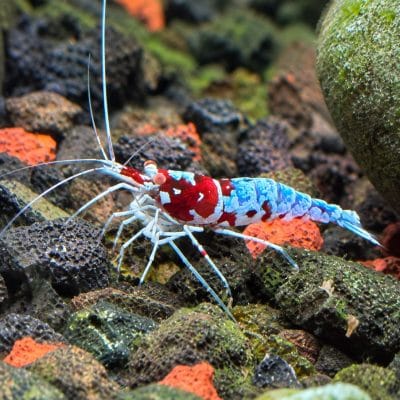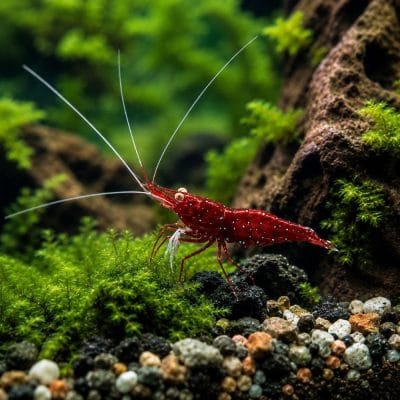
Rabbit snails are the only tank mate that fits a Sulawesi shrimp tank without asking the shrimp to give something up. A short list of nerites, two or three endemic fish and a handful of Neocaridina can work in a big, mature tank, and every one of them costs you either shrimplets, grazing surface or waste headroom. If you’re trying to build a colony, the shrimp on their own is still the safest tank in the room.
What a tank mate has to survive in a Sulawesi tank
Start here, because it removes most of the internet’s suggestions in one step. A Sulawesi tank is warm, mildly alkaline and mineral-poor, and it is held there permanently. Anything you add has to live in that water for years, not tolerate it for a season.
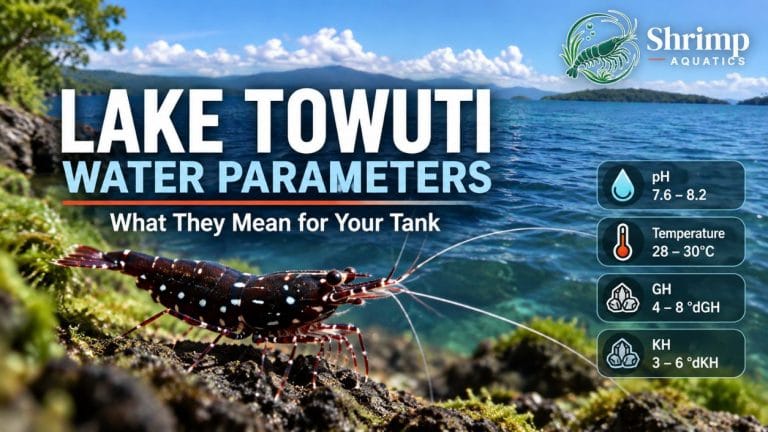
| Temperature | 79-86°F (26-30°C) |
|---|---|
| pH | 7.5-8.5 |
| GH | 4-8 dGH |
| KH | 3-6 dKH |
| TDS | 150-250 ppm |
| Nitrate | Kept under 10 ppm |
| Difficulty | Advanced to expert |
Then apply three more tests, in this order. Can the animal live in that water permanently, not just survive an acclimation? Does it feed somewhere other than the rock and sand your shrimp graze? Is its mouth too small to take a shrimplet? A candidate that fails the first test is finished. One that passes the first and fails the other two is a trade you make deliberately, with your eyes open, not a recommendation.
Notice what isn’t on that list: temperament. A peaceful fish that eats shrimplets ends your colony just as surely as an aggressive one, only slower, and you won’t see it happening. That same peaceful fish belongs on the list of fish to avoid with Sulawesi shrimp once shrimplets are the priority.
Rabbit snails fit a Sulawesi tank because they came from the same lakes
Rabbit snails (Tylomelania spp.) are the one addition we’d make without arguing about it. The genus is endemic to the same two ancient lake systems the shrimp come from, Lake Poso and the Malili lakes.1 They aren’t tolerating your water. It’s their water.
In practice they work the parts of the tank the shrimp don’t. They turn over sand, break down the coarse detritus that collects under rockwork, and they’re big enough to stay visible in a tank where the shrimp spend half the day in a crevice. Most common aquarium snails are kept cooler than a Sulawesi tank ever runs, while the Sulawesi Tylomelania are kept warm enough to sit inside that band, and that single difference is why they’re the best snail for a Sulawesi tank, the one that holds up here when most of the others don’t.
Two things to plan for. They’re live-bearers with a uterine brood pouch, and the juveniles they release are already shelled and, in some species, close to 2 cm long.2 So you won’t get a pest snail population explosion, but you also don’t get a slow start: each snail is a real animal’s worth of waste from the day it arrives. And a big snail eats and produces accordingly. Before you add one, work through what a large snail’s waste and grazing pressure do to a small tank in the guide to rabbit snails with Sulawesi shrimp.
What that snail needs on its own is in Sulawesi rabbit snail care.
Start with one
One rabbit snail in a mature tank tells you more in a month than any stocking chart. Watch your nitrate before and after. If it climbs, the tank is telling you it can’t take the second one yet.
Where nerite snails help a Sulawesi tank and where they compete
Nerites are the sensible substitute when rabbit snails aren’t available or the tank is too small for one. They suit neutral-to-alkaline, mineral-adequate water, they stay small, and they can’t take over: their eggs get laid in freshwater but development generally needs different salinity conditions depending on the species, so the eggs go nowhere in your tank.
Here’s the honest cost. A nerite makes its living scraping algae and biofilm off hard surfaces, which is exactly what your shrimp are grazing. In a mature tank with plenty of rock, there’s enough to go around. In a young tank still growing its first film, a nerite is a competitor with a better tool for the job. We’d wait until the rock has visibly colored up before adding one.
Skip assassin snails. They prey on other snails, so putting one in with rabbit snails or nerites is a plan with an ending.
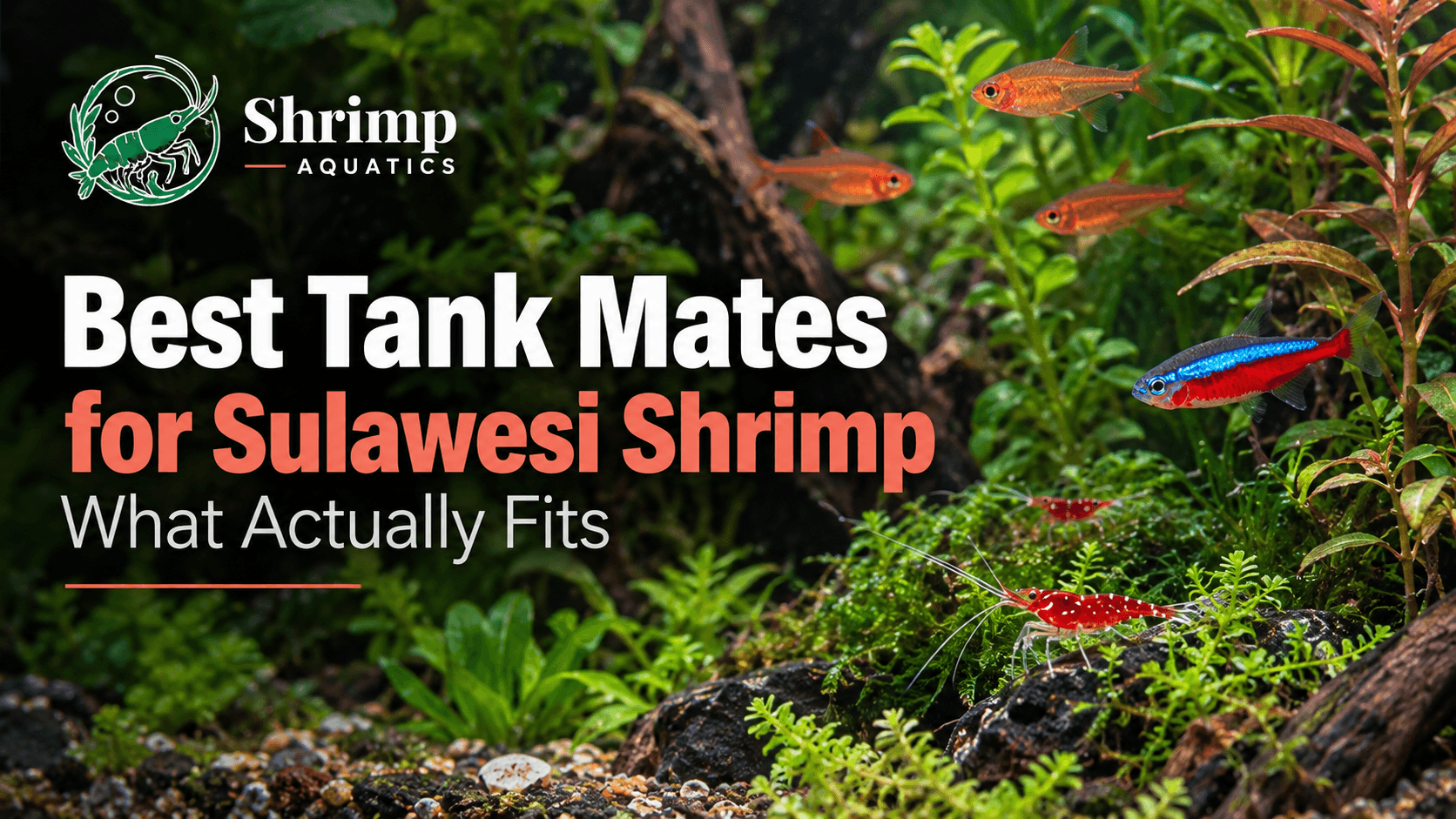
Which fish can share warm alkaline water without eating your shrimplets
Almost none. That’s the whole answer, and it’s worth sitting with before you go looking for the exception.
The reason is plain arithmetic. Wild Caridina dennerli females were recorded carrying 8-14 eggs per brood, and other Sulawesi lake species in the same survey ran from about 10 to 80 depending on the species.3 A cherry shrimp colony can absorb steady shrimplet losses because it replaces them faster than you can count. A Sulawesi colony can’t. Lose the shrimplets from a handful of broods and the colony doesn’t grow at all, which looks to the keeper like a breeding problem rather than a stocking one.
A few Sulawesi endemics genuinely share the water and feed at the surface, so they’re the only names worth evaluating. Each one still has to be checked against adult size and feeding position rather than a reputation for peacefulness. The eight species that come up most often, and where each of them fails, are worked through in the honest list of fish tankmates for Sulawesi shrimp.
Adding fish means giving up your medicine cabinet
Elevated copper is toxic in aquatic environments and can adversely affect invertebrates, and how toxic depends on pH, alkalinity, dissolved organic carbon and hardness.4 Plenty of ordinary fish treatments are copper based. Once fish share the tank, you can’t treat them where they live, so you need a hospital tank ready before the fish goes in, not after something goes wrong.
Neocaridina make shy Sulawesi shrimp visible, then outbreed them
This is the tempting one, so let’s be specific about both halves.
| Parameter | Sulawesi | Neocaridina | Bee/Crystal Caridina |
|---|---|---|---|
| Temperature | 79-86°F (26-30°C) | 65-78°F (18-26°C) | 60-72°F (15.5-22°C) |
| pH | 7.5-8.5 | 6.5-8.0 | 5.8-6.8 |
| GH | 4-8 dGH | 6-12 dGH | 4-6 dGH |
| KH | 3-6 dKH | 2-8 dKH | 0-2 dKH |
| TDS | 150-250 ppm | 150-300 ppm | 100-150 ppm |
Read the temperature row first. Sulawesi starts at 79°F (26°C) and Neocaridina finish at 78°F (26°C), so the two don’t meet on the number that matters most. Everything else overlaps well enough that keepers try it anyway, and a small number of cherry shrimp held at the bottom of the Sulawesi band is the version that sometimes works.
At Shrimp Aquatics, we keep about five Neocaridina in some of our Sulawesi systems, and we’ve seen the Sulawesi shrimp stay more visible, or retreat less, when people approach the tank. That still needs suitable temperature overlap, enough grazing surface and stocking capacity for both groups. Five Neocaridina is about the ceiling for that kind of mixing, the same limit that shapes a Sulawesi shrimp community tank.
The trap is the second half. Warm water speeds a cherry shrimp colony up, and a fast colony grazing the same biofilm as a slow one wins. If you aren’t willing to remove offspring regularly, don’t start. The temperature compromise, the quarantine you owe the new shrimp and how small the group has to stay are covered in the guide on keeping Sulawesi shrimp with Neocaridina.
Mixing Sulawesi species and color lines costs you the color you paid for
Other Sulawesi shrimp are the easiest tank mates of all on water, because there’s nothing to reconcile. The question isn’t whether they survive together. It’s what comes out of the eggs.
Keepers have documented crosses between Sulawesi species kept together, and nobody has published a genetic study confirming parentage, so what’s known comes from watching tanks. If you want a line to stay what it is, keep it on its own; if you’re happy with whatever the tank produces, mix freely. What has actually been observed, and between which lines, is set out in the guide to whether Sulawesi shrimp crossbreed. When you’re deciding which line to build the tank around, our Sulawesi shrimp lines list the species and the care level on each listing.
Bee shrimp, Otocinclus and mystery snails do not belong in this tank
These three come up constantly, and each fails for a different reason worth understanding.
- Bee and Crystal Caridina. Look at the comparison table again. Bee shrimp are kept at 60-72°F (15.5-22°C) and pH 5.8-6.8, against 79-86°F (26-30°C) and pH 7.5-8.5. Only GH overlaps at all, and a setting halfway between two ranges belongs to neither animal. The full case, and how to separate a tank that already holds both, is in the guide on Sulawesi shrimp with bee shrimp.
- Otocinclus. They rarely bother shrimp, which is why they get recommended. They’re also sensitive fish that need a mature system with plenty of grazing and feeding, and they earn a living stripping the same surfaces your shrimp depend on. You’re adding a specialist competitor to feed a specialist grazer.
- Mystery snails and most common aquarium snails. Most of them are kept cooler than a Sulawesi tank runs, and a large bulk feeder produces waste faster than warm alkaline water can forgive. Wanting a big visible snail is fair. The one that fits is a rabbit snail.
How much extra waste a warm alkaline tank can absorb
This is the part most tank mate lists skip, and it’s the reason a stocking decision that looks fine on paper kills a colony three months later.
Total ammonia in water sits between ammonium, which is comparatively harmless, and un-ionized ammonia, which is the form that does the damage. The split moves with pH and temperature: the ratio of un-ionized ammonia to ammonium in fresh water increases about 10-fold for every single pH unit, and roughly doubles for each ten-degree Celsius rise in water temperature across the range EPA assessed.5 Your tank sits high on both. The same uneaten pellet that a pH 7.0 community tank shrugs off is a different event at pH 8.5 and 84°F (29°C).
Warmth costs you on the other side too, since cold water holds more dissolved oxygen than warm water.6 So you’re asking a tank with less oxygen headroom to process waste that’s more toxic per milligram, and every animal you add makes both numbers worse.
Let nitrate decide, not a stocking rule
We keep nitrate under 10 ppm in these tanks. If adding an animal pushes your readings up and they stay up, that’s your answer about the next one. Add one animal at a time and give the tank a few weeks to show you what it did.
How to add a tank mate to a colony that is already settled
If you’ve read this far and still want company for the shrimp, here’s the order we’d do it in.
- Wait until the shrimp colony is established and breeding. A tank mate added to a colony that’s still struggling turns one problem into two you can’t tell apart.
- Pick one candidate and one only, starting from the top of this page rather than the bottom.
- Quarantine it separately for a few weeks. New animals bring what they were living with, and a Sulawesi colony is a poor place to find that out.
- Test nitrate, KH and TDS before it goes in, so you have a baseline that isn’t a memory.
- Add it, then leave the tank alone. Feed lightly, watch where the shrimp graze, and give it a month before you consider anything else.
And if the honest answer is that your tank isn’t there yet, that’s a normal answer. A tank where Sulawesi shrimp are kept alone isn’t a compromise or a beginner’s version. It’s the setup with the fewest ways to go wrong, and most of the colonies that do well are exactly that.
References
6 Sources
- The species flocks of lacustrine gastropods: Tylomelania on Sulawesi as models in speciation and adaptive radiation (abstract), Hydrobiologia 615, Springer, 2008.
- Anatomy of an adaptive radiation: a unique reproductive strategy in the endemic freshwater gastropod Tylomelania (Cerithioidea: Pachychilidae) on Sulawesi, Indonesia (abstract), Biological Journal of the Linnean Society 85(4), 2005.
- Radiation of endemic species flocks in ancient lakes: systematic revision of the freshwater shrimp Caridina from the ancient lakes of Sulawesi, Indonesia, Raffles Bulletin of Zoology 57(2), Lee Kong Chian Natural History Museum, 2009.
- Supplementary Training Materials for Aquatic Life Criteria, Copper, Background, U.S. Environmental Protection Agency, updated May 6, 2026.
- Aquatic Life Ambient Water Quality Criteria for Ammonia, Freshwater, U.S. Environmental Protection Agency Office of Water, April 2013.
- Dissolved Oxygen and Water, U.S. Geological Survey Water Science School, updated August 24, 2026.
Ready to get started?
Shop our Sulawesi Shrimp collection
27 products available · Live Arrival Guarantee
Featured Sulawesi Shrimp
Sulawesi Orange Eyes White Sock
Caridina dennerli
Advanced · 79–86°F · pH 7.5–8.5
From $19.99View Product