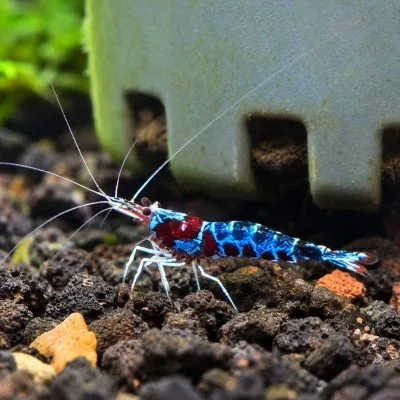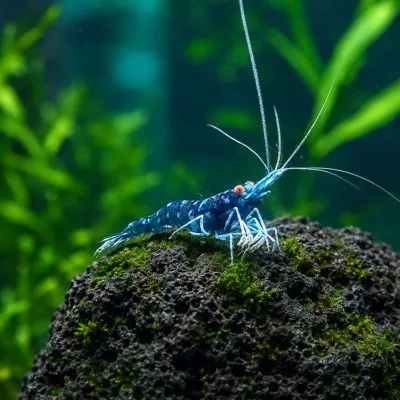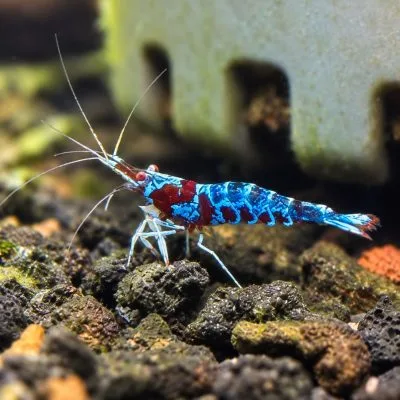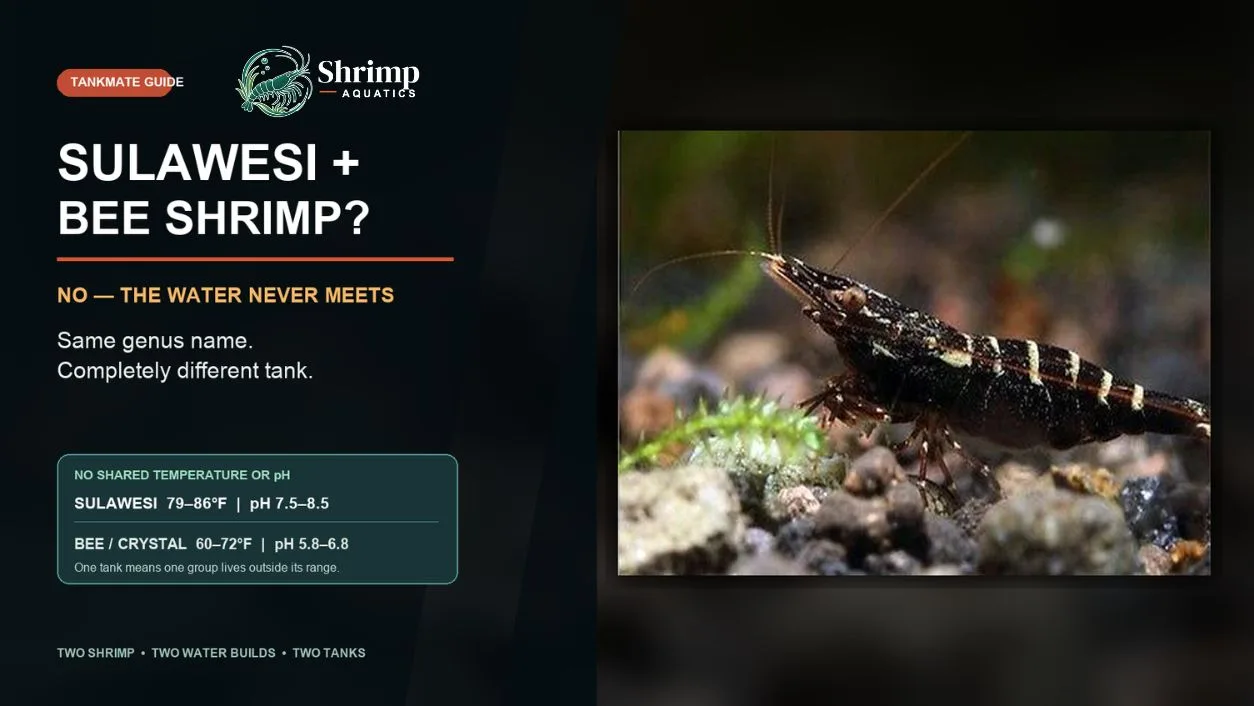
You’ve got a Bee shrimp tank running, and you’d like to add Sulawesi shrimp to it. They can’t share it: Sulawesi shrimp and Bee or Crystal Caridina are kept in two ranges that never meet. One of the two groups would be living outside its own range every day it’s in there. The genus name they share is why the question comes up, and it’s the one thing here that carries no weight.
Where the Sulawesi and Bee shrimp ranges stop overlapping
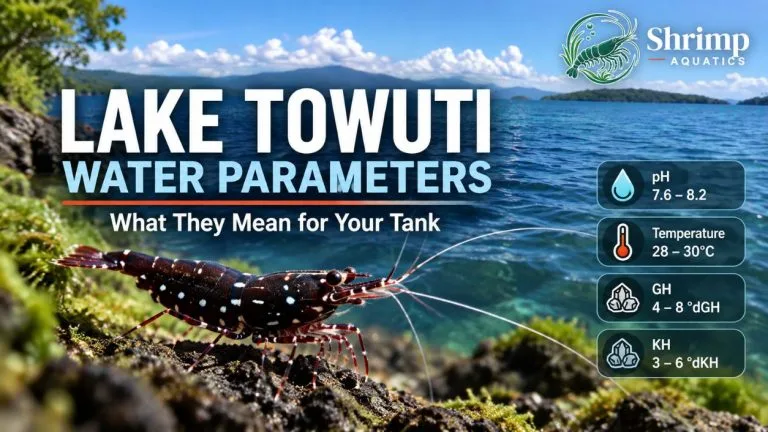
They stop overlapping at temperature, pH and KH, which are the numbers that set the character of a tank. Both groups are sold as advanced Caridina, so their care sheets look like two versions of the same document until you put the numbers side by side. The values below are typical keeping ranges for each group, not survival limits for any one animal. The last column is the one that answers your question.
| Parameter | Sulawesi shrimp | Bee and Crystal shrimp | Shared ground |
|---|---|---|---|
| Temperature | 79-86°F (26-30°C) | 60-72°F (15.5-22°C) | None |
| pH | 7.5-8.5 | 5.8-6.8 | None |
| GH | 4-8 dGH | 4-6 dGH | 4-6 dGH |
| KH | 3-6 dKH | 0-2 dKH | None |
| TDS | 150-250 ppm | 100-150 ppm | 150 ppm only |
| Nitrate | Under 10 ppm | Under 20 ppm | Under 10 ppm |
| Substrate | Inert substrate and hardscape | Commonly an active buffering substrate with remineralized RO or RO/DI water | None |
| Difficulty | Advanced to expert | Intermediate to advanced | Not comparable |
GH is the only row where the two bands really share ground. TDS meets at a single value, not a band, and nitrate isn’t a conflict at all because the tighter target suits both. Everything that sets the character of the tank sits in separate territory: the temperature, the pH and the carbonate hardness that holds that pH steady. A tank has one temperature and one pH. No arrangement of heater, substrate and minerals gives each group its own row.
Why sharing the genus Caridina tells you nothing about shared water
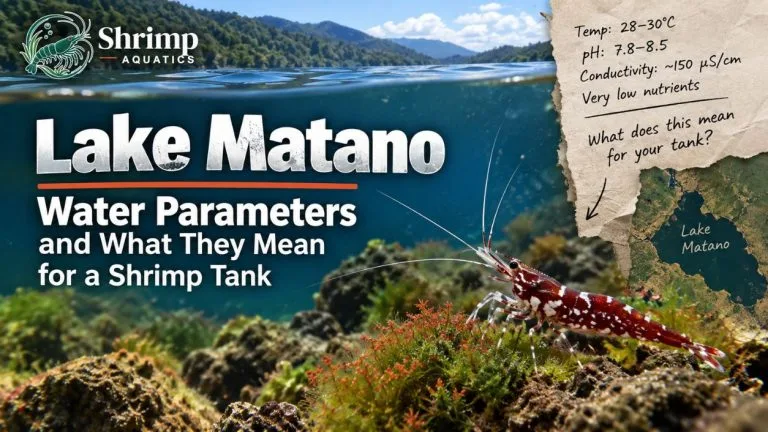
Because the two groups evolved in completely different waters, and the genus name doesn’t reflect that. Sulawesi shrimp are a lake radiation. The 2009 systematic revision of the group recognizes 21 Caridina species from the ancient lakes of Sulawesi, 15 of them from the Malili lakes and six from Lake Poso.1 The cardinal shrimp (Caridina dennerli) is endemic to Lake Matano and widely distributed within that lake.1
The Bee and Crystal lines reached the hobby from somewhere else entirely: the ornamental shrimp of southern China and Hong Kong were revised in 2014 from hill stream material.2 Ancient lake water and hill stream water aren’t two settings of one habitat, and the animals that specialized in each aren’t two settings of one shrimp.
The genus label doesn’t track relatedness the way most keepers assume, either. A 2024 study of caridean shrimp DNA found that Caridina is paraphyletic, with Neocaridina sitting inside it.3 So two shrimp with the same genus name can be further apart than the name suggests. Here that name is telling you about naming history, not about what either animal needs in a tank.
Will Bee and Sulawesi shrimp interbreed if they’re kept together?
No published account describes a cross between a Bee or Crystal line and a Sulawesi species. There’s no test you could run on the offspring to identify one, either. And it’s the wrong reason to keep the two apart. The water settles this pairing long before genetics gets a chance to, so plan the tanks around the parameters and treat hybridization as a question this combination never reaches.
What a compromise tank in the middle costs both colonies
A tank in the middle moves both groups out of their range, not just one. It’s the next thing most keepers try once they’ve seen the table: a set of numbers between the two columns. Read the table again with that in mind. A middle temperature sits below the Sulawesi band and above the Bee band at the same time. A neutral pH is above one group and below the other. A carbonate hardness picked to please both lands at the edge of each. Halfway between two right answers turns out to be two wrong ones.
Don’t average two published ranges
A value halfway between two care ranges belongs to neither group. If the number you’re holding sits outside the range for animals that are already in the tank, the answer is a second tank, not a smaller gap.
What a middle temperature does to the molt cycle
It changes how often the shrimp molt and how much they grow each time. Temperature is the row with no shared ground at all, and it’s also the one keepers treat as easiest to fudge. It isn’t a neutral dial. In many crustaceans, temperature affects both the interval between molts and the growth added at each molt.4 So moving one group toward the other group’s temperature changes how often it molts and how much it gains when it does. Molting is the process that has to go right for a shrimp to grow at all.
Why the mineral and carbonate side can’t be split down the middle
Because carbonate hardness doesn’t overlap, and the substrate that sets it is chosen at setup. The mineral side looks closer than it is, since GH overlaps and GH is the value most keepers watch. Bee and Crystal water is kept at 0-2 dKH, usually over an active buffering substrate. Sulawesi water is kept at 3-6 dKH over inert substrate and hardscape. Those two setups are built for opposite results.
This runs deeper than a test kit reading, because the shell is built from the water. In crustaceans the major source of the calcium used to harden a new exoskeleton is the water the animal lives in, with food a minor contribution.5 Whatever a mixed tank is mineralized for becomes the mineral supply for both groups, and only one of them is drawing on the supply it’s normally kept on.
There’s one more imbalance worth knowing before you try anything in the middle: the warm alkaline end of this comparison is the less forgiving end to run. Cold water can hold more dissolved oxygen than warm water.6 In fresh water the un-ionized share of total ammonia rises roughly tenfold for each rise of a single pH unit and about twofold for each rise of ten degrees Celsius.7 Those are general water chemistry relationships, not a tolerance figure for shrimp. Together, though, they mean the same amount of waste sits in a harsher form in a warm alkaline tank than in a cool acidic one. And that water is carrying less oxygen too. That isn’t the tank to run a stocking experiment in.
Choosing the group your room temperature and source water can actually hold
Pick the group your room’s temperature can hold. Water preparation costs you the same effort either way. Two things decide this, and neither is which shrimp you like more: what your room does to a tank across a day, and what you’re willing to make your water from. Both builds mean hitting a mineral target on purpose, and local tap water varies and has to be tested before you use it for either group. So water isn’t the tiebreaker. Temperature is. A tank for Bee and Crystal shrimp has to hold 60-72°F (15.5-22°C), which in a warm room means a chiller, not a heater. A Sulawesi tank has to hold 79-86°F (26-30°C), which in a cool room means a heater you trust in a room that doesn’t drop at night.
Build for Sulawesi shrimp when
- your room already runs warm, or you can heat steadily without chasing the thermostat;
- you want an inert hardscape tank that grows and holds its own grazing surfaces;
- you’re ready for an advanced to expert group and a slow, patient start.
Build for Bee and Crystal shrimp when
- your room stays cool through the year, or a chiller is realistic for you;
- you’re comfortable building on an active buffering substrate instead of inert material;
- you want the less demanding of the two, at intermediate to advanced.
Either way, the tank is finished before the animals arrive, not after. A cycled system reading zero ammonia and zero nitrite on an established biological filter is the baseline for both builds. Time on the calendar doesn’t prove a tank has reached it. If the warm alkaline build is the one your room supports, Shrimp Aquatics tank-bred Sulawesi shrimp arrive expecting water you’ve already held steady for weeks. The mature grazing surfaces matter to them as much as the numbers do.
What to do when Bee and Sulawesi shrimp are already sharing a tank
Move one group to its own tank and leave the water in the shared tank exactly where it is. Whatever that tank is holding right now, it belongs to one of the two groups. Walking the parameters toward the middle to be fair to the other group makes the tank worse for everything in it.
- Work out which group the tank is actually running for, using the table above, not what you planned when you set it up.
- Set up a second tank on the other group’s requirements, including its substrate. The two builds call for opposite substrates, and substrate is chosen at setup.
- Cycle and mature the tank properly before it gets any shrimp. Zero ammonia and zero nitrite on an established filter, plus visible grazing surfaces, is the check, not the number of weeks that have passed.
- Move only the group that doesn’t match the original tank, slowly, and use acclimation to bring the animals to the water they’re going into instead of adjusting the water they’re leaving.
- Hold the original tank’s parameters exactly where they are throughout, so the group that stays never feels the move at all.
Don’t step the shared tank’s temperature, pH or carbonate hardness in either direction while both groups are still in it. Any parameter moving toward one group is moving away from the other, and a shrimp partway through a molt has no way to opt out of the change. Two tanks is the honest answer here. It’s a smaller project than it sounds, because each tank is far simpler to run for one group than a single tank trying to serve both.
What the research says about keeping Sulawesi shrimp with Bee shrimp
Two kinds of research sit behind this guide: taxonomy that shows where the two groups come from, and studies on other crustaceans that show why water you can’t match matters. On origins, the 2014 revision of the ornamental shrimp of Guangdong Province in southern China and Hong Kong worked from hill stream material collected between 2004 and 2013.2 It described three species as new, among them Caridina logemanni.2 On relatedness, the 2024 mitogenomic study that found Caridina paraphyletic concluded that the classification of the Atyidae needs substantial revision at every level.3
On temperature, the evidence comes from a crab, not a dwarf shrimp. In a rearing study on the lesser blue crab, animals held at elevated temperature showed a shorter intermolt period and less growth per molt.4 So they were smaller at each stage. Read that as the direction the mechanism runs, not as a figure for either shrimp group.
References
7 Sources
- Radiation of endemic species flocks in ancient lakes: systematic revision of the freshwater shrimp Caridina from the ancient lakes of Sulawesi, Indonesia, with the description of eight new species, Raffles Bulletin of Zoology 57(2): 343-452, 2009.
- To “bee” or not to be, on some ornamental shrimp from Guangdong Province, Southern China and Hong Kong SAR, with descriptions of three new species, Zootaxa 3889(2): 151-184, abstract page, 2014.
- Integrative Taxonomy Reveals New Insights into the Species Validity of the Neocaridina davidi-N. denticulata-N. heteropoda Complex and Mitogenomic Phylogeny of Caridean Shrimps, Current Issues in Molecular Biology 46(11): 12279-12298, PubMed Central copy, 2024.
- Elevated temperature induces a decrease in intermolt period and growth per molt in the lesser blue crab Callinectes similis Williams, 1966, Journal of Crustacean Biology 39(1): 22-27, abstract, 2019.
- Biomineralizations: insights and prospects from crustaceans, ZooKeys 176: 103-121, PubMed Central copy, 2012.
- Dissolved Oxygen, U.S. Geological Survey Water Science School.
- Aquatic Life Ambient Water Quality Criteria for Ammonia, Freshwater, U.S. Environmental Protection Agency Office of Water, April 2013.
Ready to get started?
Shop our Sulawesi Shrimp collection
27 products available · Live Arrival Guarantee