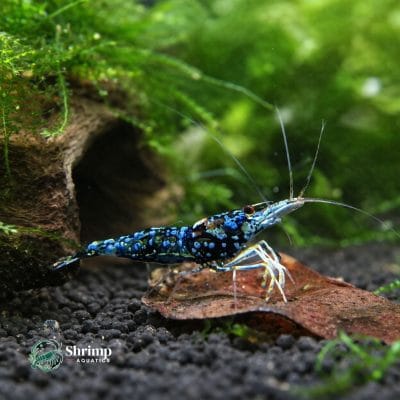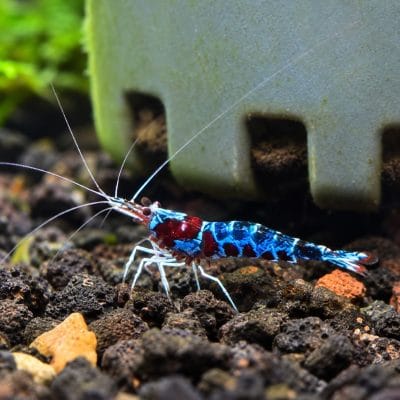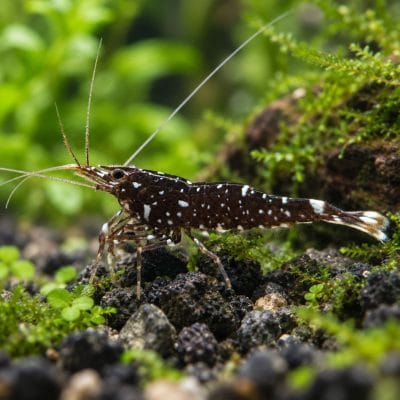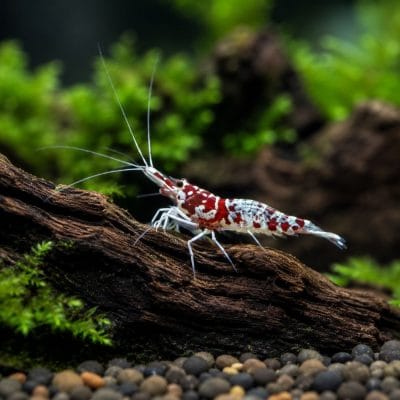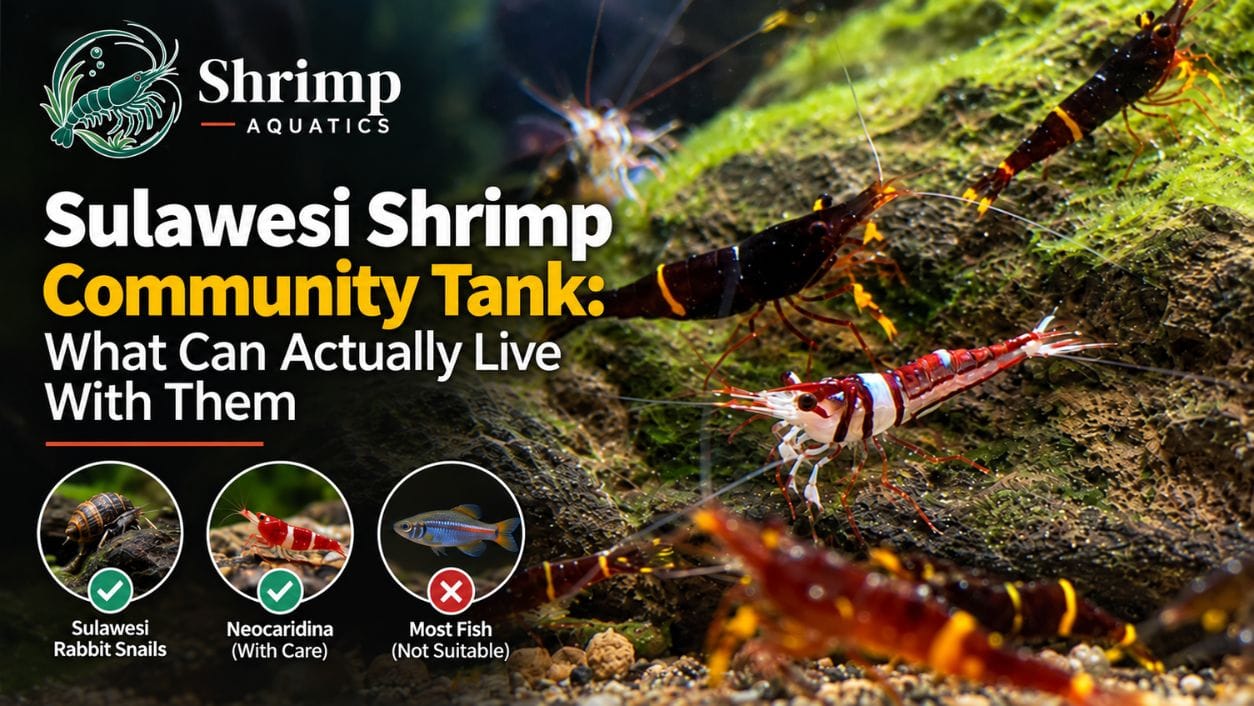
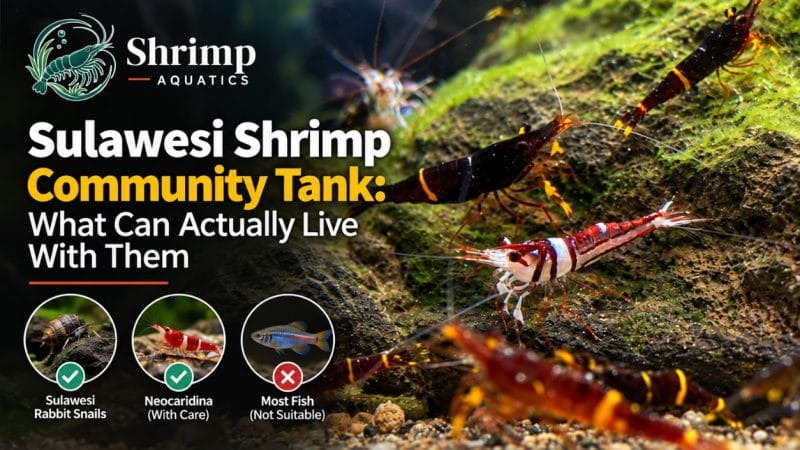
Yes, you can build a community tank around Sulawesi shrimp. The guest list is short, though, and the water decides it, not temperament. Anything you add has to live permanently at 79-86°F (26-30°C) and pH 7.5-8.5, it has to leave shrimplets alone, and it can’t strip the grazing film the colony feeds on. That rules out nearly every fish sold as peaceful. What’s left is Sulawesi rabbit snails, other Sulawesi shrimp lines, and a small managed group of Neocaridina.
What a tankmate has to survive in a Sulawesi shrimp tank
Most compatibility advice starts with behavior. Here it starts with chemistry. The water these shrimp need is the part almost nothing else tolerates, and you hold it there permanently. So ask three questions of any animal before you ask whether it’s peaceful.
First, can it live in these numbers for its whole life?
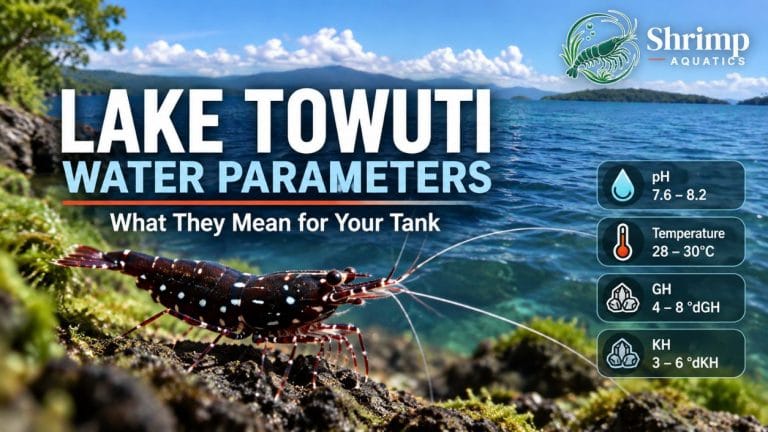
| Temperature | 79-86°F (26-30°C) |
|---|---|
| pH | 7.5-8.5 |
| GH | 4-8 dGH |
| KH | 3-6 dKH |
| TDS | 150-250 ppm |
| Nitrate | Keep it under 10 ppm |
Second, will it eat shrimplets? Newly released Sulawesi shrimp are tiny, and they graze across the same open rock the adults do. That’s exactly where a small hunting mouth finds them. Treat every fish as a shrimplet eater until you’ve got evidence for that species. A fish sold as shrimp safe can still take babies, and sometimes adults.
Third, does it eat the same food? These shrimp live off the biofilm, diatoms and algae growing on rock and glass. An animal that grazes those surfaces isn’t a neutral addition, even if it never touches a shrimp. It’s competition for the one food you can’t simply top up.
Fail any of the three and the answer’s no. Pass all three and you’ve still got the bioload question below.
Why warm alkaline water leaves less room for extra animals
This is the part the tankmate lists skip. It’s also the reason the honest list of the best tank mates for Sulawesi shrimp is so short. The same waste reading isn’t equally dangerous in every tank.
Total ammonia sits in two forms in water, the ammonium ion and un-ionized ammonia. It’s the un-ionized form that drives toxicity in aquatic animals. The split moves with the water. The ratio of un-ionized ammonia to ammonium rises roughly tenfold for each whole pH unit, and roughly twofold for each 10 degree Celsius rise between 0 and 30 degrees Celsius.1 A Sulawesi tank is warm and alkaline by design. So it sits at the end of that relationship where more of any ammonia present is in the harmful form.
Warm water also holds less dissolved oxygen than cool water.2 So the tank that punishes waste hardest is the same tank with the smallest dissolved oxygen buffer to process it. Add a fish, a second shrimp colony and a few large snails, and you’ve raised both the waste load and the oxygen demand. You did it in a system that had less headroom for either one to start with.
Before you add anything
Decide what happens if the addition dies unnoticed. A large animal breaking down under rockwork puts waste straight into water that’s already the least forgiving of it. The bigger the tankmate, the less likely you are to find it in time.
The three tankmates worth considering, and what each one costs
Here’s where the five candidates people usually ask about land once you apply those three tests. Every one that passes still carries a cost. That cost is the part worth deciding on before you order.
| Candidate | Water fit | Safe with shrimplets | Competes for biofilm | Verdict |
|---|---|---|---|---|
| Sulawesi rabbit snails | Same lakes, close fit | Yes | Some, plus a real waste load | Workable, plan for size and breeding |
| Other Sulawesi shrimp lines | Same water | Yes | Yes, directly | Workable if you accept mixed offspring |
| Neocaridina | Above their usual range | Yes | Yes, and the group grows | Only in small, managed numbers |
| Sulawesi ricefish | Broadly suitable | No | No | Out |
| Nano fish and Otocinclus | Wrong water, too cool or too soft | No | Otocinclus, heavily | Out |
Sulawesi rabbit snails, the only genuinely native option
Rabbit snails are the one animal here that actually lives alongside these shrimp in the wild. The genus Tylomelania is restricted to the same two ancient lake systems the shrimp come from, Lake Poso and the Malili lakes of Matano, Mahalona and Towuti.3 The water suits them, then, and nothing about them hunts a shrimp.
The cost is size and reproduction. These snails brood their young inside the body. They produce embryos continuously rather than in seasonal batches, and the juveniles arrive already shelled. In some species they’re close to 2 cm long at release.4 That’s a large animal turning up in your tank at intervals you don’t control, and each one eats and produces waste from day one. Rabbit snails are usually kept a touch cooler at the top end than Sulawesi shrimp, too. If you run the tank at the warm end of the band, that’s the setting to watch. Before you put Sulawesi shrimp and rabbit snails together, work out how many your tank can actually carry.
Other Sulawesi shrimp lines in the same tank
Mixing two or three Sulawesi lines is the easiest addition chemically. They want the same water, and none of them will hunt the others. The whole cost sits in the offspring. If you ever plan to sell or trade a line, or just keep it recognizable, a shared tank puts that at risk. Whether Sulawesi shrimp lines really do crossbreed is a question with a thinner evidence base than the confident charts online suggest. Our advice is simple. If the line matters to you, give it its own tank. If you just want a colorful tank for yourself, mix freely and enjoy what comes out.
There’s a second cost that’s easy to miss. Two colonies graze the same rock. A mixed tank needs more grazing surface than a single species tank of the same volume, not the same amount split two ways.
A small group of Neocaridina, kept small on purpose
Neocaridina are the one addition with a real behavioral argument behind them. They’re also the one most likely to go wrong. A Neocaridina colony is usually kept up to 78°F (26°C), a little below where a Sulawesi tank starts, so putting cherry shrimp in here means running them warm for life. They’ll do it, and they’ll breed while they do it.
At Shrimp Aquatics, in some of our Sulawesi systems we keep about five Neocaridina, and we have observed the Sulawesi shrimp remain more visible, or retreat less, when people approach the tank.
Note the number. About five, not a colony. A group that establishes itself will graze the same film your Sulawesi shrimplets depend on, so the number is the whole point. Go this route and you’re committing to pulling cherry shrimp out regularly for the life of the tank. Decide now where they’ll go. If you’d rather see the full temperature and competition picture first, read up on keeping Sulawesi shrimp with Neocaridina before you order either one.
Why fish stay out, including the Sulawesi ricefish
Boraras, chili rasboras, celestial pearl danios and the small tetras turn up on every list. Put each one through the first test yourself before you believe the list, because a mixed tank only works when every species overlaps on temperature, water chemistry, behavior, space and feeding. Then run the second test, which is where most of them stop anyway. Plenty of peaceful nano fish eat shrimplets, which puts them among the fish to avoid with Sulawesi shrimp. Otocinclus are a different case. They rarely bother adult shrimp, but they’re sensitive animals that do best in a mature tank with plenty of grazing, and grazing surface is precisely the resource you’re trying to reserve.
The interesting case is the Sulawesi ricefish. It’s the one fish that genuinely shares the region and broadly suits the water. It still fails on diet. When the gut contents of an endemic Sulawesi Oryzias were examined, the fish turned out to be an omnivore carnivore whose main food was small crustacean plankton, with Cyclops larvae the dominant item.5 A fish built to hunt small crustaceans, in a tank whose floor is covered in small crustaceans, isn’t a compatibility question you want to test.
What makes predation decisive here, rather than merely annoying, is how slowly the colony replaces what it loses. Published counts of wild Sulawesi Caridina put the broods at the small end for dwarf shrimp. Cardinal shrimp females carried 8-14 eggs each in the material examined.6 The young aren’t quick either. In the one controlled rearing trial published for the species, shrimp starting at an average total length of 1.445 cm gained only about 0.119 cm over 30 days in the best of four feed and shelter treatments.7 A cherry shrimp tank absorbs a fish eating babies. A Sulawesi tank doesn’t.
Weighing up a specific species rather than the category? The case by case assessment of fish tankmates for Sulawesi shrimp works through water, adult size and feeding position one fish at a time.
How to stock a Sulawesi community tank without losing the colony
If you’ve got a candidate that passes all three tests, the order you do things in matters more than the stocking list itself. Shrimp first, always, and by a wide margin.
- Get the shrimp colony established and breeding on its own before you add anything. A tank that’s still finding its feet has no spare capacity to absorb a new animal.
- Grow more grazing surface than you think you need. More rock, more established film, and do it before the extra mouths arrive.
- Add one kind of animal at a time, in small numbers, and leave weeks between additions. If something goes wrong, you’ll want to know what caused it.
- Take a nitrate reading before the addition and again a week or two later. That comparison is the only honest measure of what you’ve just put into the system.
- Keep a headcount you can actually complete. If you can’t find every snail, you can’t tell when one has died.
Stocking is also the moment to be honest about what you’re buying into. A tank built around tank-bred Sulawesi shrimp asks for steady conditions long before it asks for variety. Get the colony right first. Then decide whether variety is worth the margin it costs you.
When a single species tank is the better call
We know a tank with one kind of animal in it sounds like a compromise. In this group it usually isn’t. A Sulawesi tank that holds steady numbers, keeps waste low and grows a thick grazing film is already doing something difficult. Every animal you add makes each of those three jobs harder.
Go single species if the tank is new, or if you’ve lost shrimp before and haven’t yet found out why. Do it if the tank is small enough that one dead animal shifts the readings, or if you want the colony to actually grow. Add a tankmate once the colony has been stable and breeding for months, you’ve got surface to spare, and you’ve got a specific reason for that specific animal. A general wish for company isn’t a reason. And if the reason is that the tank looks empty, the answer is more rock, not more animals.
References
7 Sources
- Aquatic Life Ambient Water Quality Criteria for Ammonia, Freshwater, U.S. Environmental Protection Agency, Office of Water, April 2013.
- Dissolved Oxygen and Water, U.S. Geological Survey, Water Science School.
- The species flocks of lacustrine gastropods: Tylomelania on Sulawesi as models in speciation and adaptive radiation, Hydrobiologia 615, Springer, 2008, abstract.
- Anatomy of an adaptive radiation: a unique reproductive strategy in the endemic freshwater gastropod Tylomelania (Cerithioidea: Pachychilidae) on Sulawesi, Indonesia, and its biogeographical implications, Biological Journal of the Linnean Society 85(4), 2005, abstract.
- Habitat and food habits of the endemic fish Oryzias eversi in Tana Toraja, South Sulawesi, Indonesia, Biodiversitas 24(9): 5137-5145, 2023.
- Radiation of endemic species flocks in ancient lakes: systematic revision of the freshwater shrimp Caridina from the ancient lakes of Sulawesi, Indonesia, with the description of eight new species, Raffles Bulletin of Zoology 57(2): 343-452, 2009.
- Effect of Using Different Shelter and Feed Types on Growth and Survival Rate of Sulawesi Endemic Ornamental Shrimps (Caridina dennerli), Jurnal Ilmiah PLATAX 13(1): 191-204, 2025, journal PDF.
Ready to get started?
Shop our Sulawesi Shrimp collection
27 products available · Live Arrival Guarantee